Elektra (2005) Rob Bowman , with Jennifer Garner, extends the film Daredevil by offering the assassin born in Daredevil #168 (1981) by Frank Miller his own story. The film takes up the resurrected warrior, her knowledge, the Hand and his mentor Stick, but invents an autonomous plot centered on the protection of a child. Faithful to ninja mythology, he reinvents its context. Here is the detailed comparison, film versus comics.
A spin-off dedicated to the most striking character of the Daredevil film, Elektra explores the mystical and martial world of the assassin. He draws on the creations of Frank Miller. Source-by-source decryption.
As in each article in this series, only verified information (creators, distribution, dates, comic numbers) is stated; the comparative analysis is ours, without reproducing dialogue or protected images.
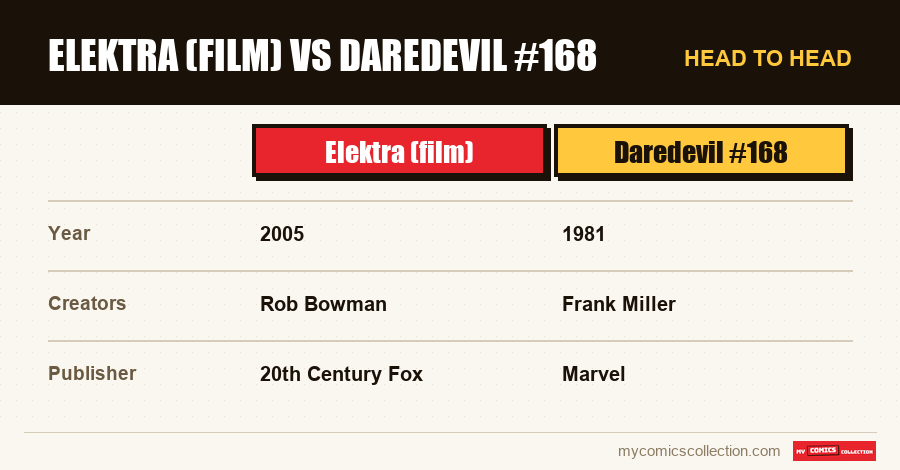
Title : Elektra (2005)
Director: Rob Bowman
Actors: Jennifer Garner (Elektra Natchios), Goran Višnjić, Kirsten Prout, Terence Stamp (Stick)
Exit : January 2005
Studio: 20th Century Fox
Daredevil #168 (1981): Elektra's first appearance (Frank Miller)
The Hand: the mystical ninja organization
Stick and the Chaste: Elektra's mentors
“Elektra: Assassin”(1986): Miller & Sienkiewicz
- Elektra, a murderer, resurrected from the dead.
- La Hand, organization of mystical ninjas.
- Stick, his blind mentor, and the Chaste.
- His mastery of martial arts and its moral ambivalence.
- The theme of the redemption and the refusal to kill an innocent person.
- L'plot is entirely original (protect a child).
- Le connection to Daredevil is absent from the story.
- THE ninjas of the Hand gain fantastic powers.
- new ones antagonists are invented for the film.
- Le your is that of the fantasy action film.
Daredevil #168 (1981): Elektra, creation by Frank Miller
Elektra Natchios appears in Daredevil #168 (1981), created by Frank Miller. Matt Murdock's childhood sweetheart at university, she descends into violence after the murder of her father, becoming a formidable assassin, a mercenary wielding her knowledge with deadly precision. A tragic and fascinating character, torn between her past, her feelings for Matt and her nature as a killer, Elektra is one of Miller's greatest creations. Her death, caused by Bullseye, then her resurrection by the Hand, the organization of mystical ninjas, made her a cult figure, somewhere between film noir and martial mysticism. She even had her own stories, including “Elektra: Assassin” (1986), the peak of the collaboration between Miller and Bill Sienkiewicz.
The film captures the essence of the character: the murderer, his mastery of martial arts, his moral ambivalence, and his resurrection by the Hand. Jennifer Garner, who already played Elektra in the film Daredevil, continues the role in this spin-off. The film draws on the ninja and mystical mythology associated with the character (the Hand, Stick, the Chaste) to compose its universe. The main freedom lies in the plot, entirely original and detached from Daredevil: Elektra, who has become a lone killer, is entrusted with a contract which she refuses to execute upon discovering that her target is a child. This story, invented for the film, nevertheless draws on the character's themes.
The Hand, Stick and the mystical universe
The film develops the mystical and martial universe associated with Elektra in the comics. There Hand, an ancestral organization of ninjas dedicated to evil, is at the heart of the story: it is she who, in the comics, resurrected Elektra, and she who hunts her down in the film. In front of her, the Chaste, order of warriors dedicated to good, led by Stick, the blind mentor of Elektra and Daredevil. This opposition between two mystical martial orders, from Miller's comics, structures the universe of the film and gives it its fantastic dimension. Terence Stamp plays a Stick faithful to the spirit of the character, a severe and enigmatic guide.
The film, however, amplifies the supernatural dimension of this universe. In the comics, the Hand and the Chaste relate to a martial mysticism anchored in a relatively sober reality; the film endows its ninjas with marked fantastical powers: shapeshifting, superhuman abilities, creatures. This amplification, which favors spectacle, moves away from the relative sobriety of comics while relying on their mythology. For the reader, the Hand and the Chaste are invitations to discover Miller's stories, where these organizations and their secret war provide a rich framework for the universe of Daredevil and Elektra. The film gives a more spectacular version, in the service of its action plot.
An original plot and the theme of redemption
Unlike the Daredevil film, which adapted arcs from the comics, Elektra offers an entirely original plot. Having become a lonely and disillusioned hitwoman, Elektra is entrusted with a mysterious contract, before discovering that her targets are a man and his young daughter. Refusing to kill a child, she turns against her sponsors and becomes the protector of the little girl, hunted by the Hand. This story, invented for the film, places at the center the theme of redemption: the murderer who, faced with innocence, rediscovers his humanity and chooses to protect rather than kill.
This theme, if original in its plot, is faithful to the spirit of the character. Elektra, in the comics, is constantly torn between her nature as a killer and her quest for meaning, between the evil she has committed and her possible redemption. The film exploits this ambivalence by confronting it with a decisive moral choice. This dimension, at the heart of the character, saves the film from a simple succession of fights and gives it emotional significance. For the reader, it reminds us that Elektra is not a simple warrior, but a tortured soul in search of redemption. The film, despite its invented plot, captures this tragic essence which is the richness of Miller's character.
Collecting this series?
Track what you own, what you are missing and what your collection is worth. 7 day trial.
Start my trial →The characters, from paper to screen
- Elektra Natchios: Resurrected assassin, faithful to Daredevil #168, in an original plot.
- Stick: Blind mentor of Elektra, leader of the Chaste, faithful to the spirit of the character.
- The Hand: Organization of mystical ninjas, with powers amplified in the film.
- Abby: The young girl that Elektra protects, a character invented for the film.
- Warriors of the Hand: Antagonists with fantastic powers, partly invented.
A spin-off with a fantastic tone
Elektra adopts the tone of a fantasy action film, mixing martial arts, mysticism and the supernatural. By freeing itself from the urban and dark setting of Daredevil, the film explores the most mystical side of the character's universe: ninjas, magic, ancestral martial orders. This orientation, if it offers spectacle, distances the film from the realistic darkness which was the strength of Daredevil and Miller's stories. Elektra appears more as a fantasy action heroine than the tragic and complex figure of the comics, which contributed to the film's mixed reception.
This choice illustrates the difficulty of bringing to the screen a character as rich as Elektra. Its strength, in the comics, lies in its moral ambivalence, its tragic dimension, its anchoring in the dark universe of Daredevil. By detaching her from this context and amplifying the fantastical, the film loses part of what makes her fascinating. For the reader, Elektra is an invitation to discover “Elektra: Assassin” and Miller’s stories, where the character achieves unparalleled psychological depth and visual power. The film, despite its limitations, had the merit of giving this cult assassin her place at the forefront, opening the way to other explorations of her universe.
A special female action heroine
Elektra occupies a unique place in the history of Marvel adaptations: that of one of the first to give the leading role to a female heroine from the comics. At a time when the genre was largely dominated by male heroes, offering an entire film to a complex and ambivalent female assassin was a notable gamble. Jennifer Garner, with her experience in action roles, carried the film on her shoulders, playing a physical and tormented warrior. Even if the result was not convincing, this initiative demonstrated a desire to diversify the figures brought to the screen, well before the heroines gained their rightful place.
This pioneering dimension should not be underestimated. Elektra, a strong, morally complex and fearsomely competent female character, offered a counter-model to heroines confined to secondary roles. The film, despite its weaknesses, contributed to bringing this type of character to existence in cinema. For the reader, Elektra reminds us that comics are full of rich and nuanced female figures, often ahead of their adaptation. Born from the pen of Frank Miller, the assassin embodies a complexity that the film only touched on, but whose very existence on screen, as a headliner, marked a stage in the representation of comic book heroines.
Where to start reading
To extend the film, Daredevil #168 (1981) features the first appearance of Elektra. Frank Miller's run on Daredevil develops the character, his death and his resurrection. “Elektra: Assassin” (1986), by Miller and Sienkiewicz, is a visual and narrative summit. This journey covers the sources for a film faithful to the mystical mythology of Elektra.
Chronology of comics to know
- 1981: Daredevil #168: Elektra's first appearance.
- 1980s: Miller's run: Elektra's death and resurrection by the Hand.
- 1986: “Elektra: Assassin” (Miller & Sienkiewicz): a peak of the character.
Collection side: what numbers to aim for after the film
Elektra points to Bronze Age keys. Daredevil #168 (1981, first appearance of Elektra) is a sought-after key, driven by the popularity of the character. Miller's run numbers marking his death and resurrection are prime targets. “Elektra: Assassin” (1986) is available in collections. These targets cover varied budgets within the Bronze Age and Modern. As always, condition and gradation determine value; relying on real recent sales is strongly recommended.
Its place in the saga and for the collector
Elektra gave Frank Miller's cult assassin her own film, exploring her mystical and martial world. For the collector, it has revived interest in Daredevil #168, key to the Bronze Age. It illustrates the effect of adaptations on the market. Beyond speculation, the film invites us to discover Elektra in the comics, a tragic and fascinating character born from Miller's pen. By detaching her from Daredevil for a fantastic story, he recalls the difficulty of adapting such a rich figure, whose depth is fully deployed in the stories of Miller and Sienkiewicz.
The verdict: a murderer in an invented story
- Loyalty: Elektra, her sais, her resurrection by the Hand, Stick and the theme of redemption come from the comics.
- Freedoms: the entirely original plot, the absence of Daredevil, the ninjas with fantastic powers, the fantastic tone.
- Collectible numbers: Daredevil #168 (Elektra), Miller's run, "Elektra: Assassin" (1986).
Elektra offers Frank Miller's assassin a self-contained narrative, exploring her mystical universe (the Hand, Stick, redemption) in an invented plot detached from Daredevil. Faithful to the essence of the character but amplifying the fantastic, the film was divisive. For both the reader and the collector, it is an invitation to discover Daredevil #168 and “Elektra: Assassin”.
Frequently asked questions
From Daredevil #168 (1981), created by Frank Miller. Matt Murdock's childhood sweetheart, she becomes a knowledgeable assassin after the murder of her father. Killed by Bullseye then resurrected by the Hand, she is a cult figure in comics.
No: the story, where Elektra protects a child she was supposed to kill, is entirely invented for the film. It nevertheless draws on the character's themes (redemption, moral ambivalence) dear to Miller's comics.
An ancestral organization of mystical ninjas dedicated to evil, from Miller's comics. She was the one who resurrected Elektra. The film takes it again by amplifying its fantastic powers, and pits it against the Chaste, the order of Stick.
The blind mentor of Elektra and Daredevil, leader of the Chaste, an order of warriors dedicated to good. A character from Miller's comics, he is played by Terence Stamp, faithful to his role as a severe and enigmatic guide.
Daredevil #168 (1981, Elektra premiere) is the most sought after key. Miller's run issues and "Elektra: Assassin" (1986) are other targets for fans of the character.
Does the film make you want to collect? Estimate the value for free of your numbers (Daredevil #168…) with our tool based on current eBay listings.