Daredevil (Netflix series, 2015-2018), with Charlie Cox and Vincent D'Onofrio, adapts the blind vigilante born in Daredevil #1 (1964) by Stan Lee and Bill Everett. Long considered one of the best superhero adaptations, it digs deep into the runs of Frank Miller, notably “Born Again”. She stages the Caid (Amazing Spider-Man #50, 1967), Elektra (Daredevil #168, 1981), Bulleye and the Punisher. Here is the detailed comparison, series versus comics.
A cornerstone of the Marvel universe on Netflix, Daredevil redefined expectations for superhero adaptations with its realism and darkness. The series is a love letter to Frank Miller's comics. Source-by-source decryption.
As in each article in this series, only verified information (creators, distribution, dates, comic numbers) is stated; the comparative analysis is ours, without reproducing dialogue or protected images.
Title : Daredevil (2015-2018, Netflix)
Creator: Drew Goddard
Actors: Charlie Cox (Matt Murdock), Vincent D'Onofrio (Wilson Fisk / Kingpin), Deborah Ann Woll (Karen), Elden Henson (Foggy), Jon Bernthal (Punisher)
Broadcast: 2015-2018, Netflix (3 seasons)
Studio: Marvel Television
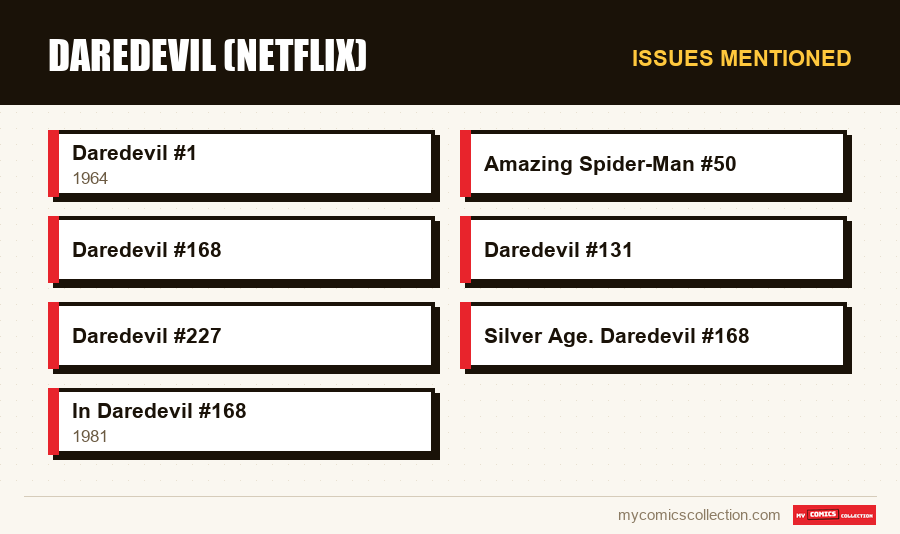
Daredevil #1 (1964): 1st appearance (Lee & Everett)
Runs by Frank Miller (1979-1986): “Born Again”
Daredevil #168 (1981): Elektra's first appearance
Amazing Spider-Man #50 (1967): the Kingpin
- Matt Murdock, blind lawyer with superhuman senses, vigilante of Hell's Kitchen.
- Le Caid, crime boss, sworn enemy and mirror of Matt.
- Elektra and Bulleye, taken from Miller's runs.
- Le Punisher, expeditious vigilante, moral counterpoint to Daredevil.
- Le Catholicism, guilt and violence choreographed.
- Order and context plots are rearranged over three seasons.
- The Caid receives an origin and love story developed for the series.
- The Hand (ninjas) is adapted and reinterpreted.
- The suit evolves from black to classic red over the seasons.
- Of the characters are merged or expanded (Karen, Foggy…).
Daredevil #1 (1964) and Frank Miller's runs
Daredevil is born in Daredevil #1 (1964), created by Stan Lee and Bill Everett: Matt Murdock, blinded as a child, whose other senses are heightened, leads a double life as a lawyer and vigilante. But it was Frank Miller who, from 1979, transformed the character into a tragic and dark figure, anchored in the urban crime of Hell's Kitchen, mixing Catholicism, guilt and violence. The Netflix series draws heavily on this vision: the realistic and dark tone, the anchoring in a neighborhood plagued by the underworld, the solitary struggle of a man torn between his faith and his violence. Charlie Cox plays a Matt Murdock of rare depth, faithful to the moral complexity that Miller had instilled in the character. The series is, in many ways, the best screen adaptation of the universe created by Miller.
This realistic, adult bias redefined expectations when it came to superhero adaptations. Far from the colorful spectacle of blockbusters, the series assumes a darkness and choreographed violence which pay homage to the material of the comics, making Daredevil a milestone of Marvel adaptations.
The Caïd: the sworn enemy, humanized
The main antagonist of the series is the Kingpin, Wilson Fisk. The character is born in Amazing Spider-Man #50 (1967), but it is as Daredevil's nemesis, particularly under the pen of Miller, that he reaches his full dimension: a massive and implacable godfather, whose intelligence and brutality make him the dark mirror of Matt. The series faithfully takes up this stature while considerably developing the character: it gives him an origin, a psychology and a love story (with Vanessa) which make him human without ever excusing him. Vincent D'Onofrio makes him one of the great villains of the entire saga. The duel between Murdock and Fisk (two men convinced of acting for the good of their city, by opposing means) is the beating heart of the series, faithful to the spirit of the comics.
Elektra, Bullseye and the Punisher
The series draws from Daredevil's rich gallery of characters. Elektra, Matt's tragic and murderous love interest, appears in Daredevil #168 (1981), created by Frank Miller; the series adapts his character and his complex relationship with Murdock. Bulleye, the infallible assassin (Daredevil #131, 1976), embodies the absolute threat during the third season. Finally, the Punisher, Frank Castle, a vigilante who kills without remorse, offers a striking moral counterpoint to Daredevil: where Matt refuses to kill, Castle makes it his method. Their confrontation, one of the climaxes of the series, stages an ethical debate faithful to the comics, where the two vigilantes embody two opposing responses to violence. These characters, all from the comics, enrich the universe of the series.
The characters, from paper to screen
- Matt Murdock / Daredevil: True to Miller's runs: blind vigilante, tormented by his faith.
- Wilson Fisk / the Kingpin: Humanized nemesis, with a developed origin and psychology.
- Elektra: Tragic and murderous love, from Daredevil #168.
- The Punisher: Expeditious moral counterpoint, ethical debate faithful to the comics.
- Karen Page and Foggy Nelson: Matt's loved ones, fleshed out for the series.
Collecting this series?
Track what you own, what you are missing and what your collection is worth. 7 day trial.
Start my trial →An adaptation that redefined the genre
Daredevil marked a turning point in superhero adaptation. By focusing on realism, violence and moral complexity rather than spectacle, the series proved that a comic book character could carry an adult and demanding drama. This approach, directly inherited from Miller's comics, contrasted radically with the tone of the blockbusters of the time. The series also launched a whole section of the Marvel universe on Netflix:Jessica Jones, Luke Cage, Iron Fist, The Defenders, The Punisher: sharing this same street-level anchor and this same realism. She became a reference, to the point that her legacy ended up being integrated into the main continuity of the saga with Born Again. Few television adaptations have had such an impact.
This lasting influence testifies to the accuracy of its approach: by respecting the darkness and depth of Miller's comics, the series offered fans the version of Daredevil they were waiting for. For many, it remains the gold standard of superhero adaptation, the one which showed that a neighborhood vigilante could carry a story of rare dramatic intensity, light years away from the clichés of the genre.
The Defenders: a corner of a shared universe
Daredevil didn't just adapt a character: it founded an entire part of the Marvel universe on Netflix, anchored in urban realism. In its wake were born the series Jessica Jones, Luke Cage and Iron Fist, brought together in the mini-series The Defenders: a nod to the comics team, even if its composition differs. Added to this was The Punisher, derived from the appearance of Frank Castle in the second season of Daredevil. This “corner” of the universe, sharing the same street-level anchoring, the same darkness and the same New York, constitutes a coherent adaptation of Marvel's urban heroes, those who operate far from cosmic issues. Daredevil was the cornerstone, setting the tone for the whole thing.
This construction of a shared universe on a human scale is faithful to the spirit of the comics, where these characters (Daredevil, Jessica Jones, Luke Cage, Iron Fist, the Punisher) regularly cross paths in the streets of New York, forming a community of everyday vigilantes. Comics have often brought together these figures, notably in the Defenders or Heroes for Hire teams. By adapting them with a common, realistic and adult tone, the Netflix series have offered the best transposition of this street-level Marvel, that of fallible heroes anchored in reality. This legacy, long distinct from the main cinematographic saga, ended up being integrated into it, notably via the return of Daredevil and the Kingpin. For the reader, this set of series is an invitation to explore the urban side of Marvel, its darkest and most human comics, where heroism is measured on the scale of a neighborhood rather than a galaxy.
Where to start reading
Priority reading is Frank Miller's run on Daredevil (from 1979), which introduced Elektra and redefined the character, then "Born Again" (Daredevil #227-233, 1986), its peak. We can also discover the run by Brian Michael Bendis (2001), very close to the tone of the series. For the origins, Daredevil #1 (1964) remains the matrix. From 1964 to today, this journey covers the sources of a series deeply faithful to the spirit of comics, from the Silver Age to the noir rereadings of the 1980s which shaped the character as we know him.
Chronology of comics to know
- 1964: Daredevil #1: First appearance of Daredevil.
- 1976: Daredevil #131: First appearance of Bullseye.
- 1981: Daredevil #168: first appearance of Elektra (Frank Miller).
- 1986: “Born Again”: Miller’s peak on the character.
Collection side: what numbers to aim for after the series
Daredevil points to major keys. Daredevil #1 (1964, first appearance) is a sought-after key to the Silver Age. Daredevil #168 (first appearance of Elektra) is a very popular number, one of the great keys to the Bronze Age, driven by the popularity of the character. Daredevil #131 (Bullseye) is another target. Miller's run collections are essential reading. These numbers cover various budgets. As always, condition and gradation determine value; relying on real recent sales is strongly recommended. Daredevil #168 is a prime target, the first appearance of Elektra being one of the most sought-after of the period, worn by a character who has become iconic and regularly adapted on the screen as well as in the comics.
Its place in the saga and for the collector
Daredevil launched the Marvel Universe on Netflix and redefined the superhero adaptation, a legacy now integrated into the main continuity. For the collector, the series has sustained interest in Daredevil #1, #168 and #131, as well as Miller's runs. It illustrates the effect of series on the market, in the long term. Beyond speculation, it invites you to discover Frank Miller's Daredevil comics, considered the absolute pinnacles of comics, where the blind vigilante reaches an unequaled tragic depth. By adapting this material so faithfully, the series proved that the best adaptations are born from a deep respect for their source material: a lesson from which the entire saga has benefited.
The Verdict: The Gold Standard of Adaptation
- Loyalty: the tone of Miller, the Kingpin, Elektra, Bullseye and the Punisher come directly from the comics.
- Freedoms: the Kingpin humanized, the intrigues reorganized over three seasons, the Hand reinterpreted.
- Collectible numbers: Daredevil #1 (1964), #168 (Elektra), #131 (Bullseye).
Daredevil remains one of the best superhero adaptations ever made, deeply faithful to Frank Miller's comics. By focusing on realism, darkness and moral complexity, the series redefined the genre and launched a whole section of the Marvel universe. For the reader as for the collector, it is an invitation to discover Miller's runs, the absolute peaks of comics. By proving that a neighborhood vigilante could carry a drama of rare intensity, the series permanently raised the standards of adaptation, and its influence can still be measured today in all Marvel productions, until its official return to the main continuity.
Frequently asked questions
Massively Frank Miller runs (from 1979), notably "Born Again" (1986), which set the character's dark, realistic tone. Daredevil first appears in Daredevil #1 (1964).
Yes for his stature and his function as a nemesis, but the series considerably develops the character by giving him an origin, a psychology and a love story, which makes him one of the great villains of the saga.
In Daredevil #168 (1981), created by Frank Miller. The series adapts this character and his tragic relationship with Matt. It is one of the most sought after keys of the Bronze Age.
Because it redefined the superhero adaptation by focusing on realism, darkness and moral complexity, faithfully to Miller's comics, contrary to the spectacle of blockbusters. His legacy has been incorporated into the main continuity.
Daredevil #1 (1964, first appearance) and especially Daredevil #168 (first appearance of Elektra), one of the great keys to the Bronze Age. Miller's run collections are essential reading.
Does the series make you want to collect? Estimate the value for free of your numbers (Daredevil #1, #168…) with our tool based on current eBay listings.