The Defenders (Netflix miniseries, 2017) brings together Daredevil, Jessica Jones, Luke Cage and Iron Fist facing the ninja organization Hand. The name comes from the comics team born in Marvel Feature #1 (1971), but its original lineup (Doctor Strange, Hulk, Namor, Silver Surfer) is radically different. The series therefore adapts the concept of a team rather than a precise story, by bringing together the street-level heroes of Netflix. Here is the detailed comparison, series versus comics.
Point of convergence of four Netflix series, The Defenders brings together the vigilantes of New York into an improvised team. The mini-series adapts the name of a team from the comics while reinventing its composition. Source-by-source decryption.
As in each article in this series, only verified information (creators, distribution, dates, comic numbers) is stated; the comparative analysis is ours, without reproducing dialogue or protected images.
Title : The Defenders (2017, Netflix)
Creators: Douglas Petrie and Marco Ramirez
Actors: Charlie Cox (Daredevil), Krysten Ritter (Jessica Jones), Mike Colter (Luke Cage), Finn Jones (Iron Fist), Sigourney Weaver (Alexandra)
Broadcast: August 2017, Netflix (8 episodes)
Studio: Marvel Television
Marvel Feature #1 (1971): 1st appearance of the Defenders
The Hand: ninja organization (Daredevil, 1981)
Elektra and the “Black Sky”: the mythology of the Hand
Street-level heroes: DD, Jessica Jones, Luke Cage, Iron Fist
- The concept of a improvised team of heroes who are opposed by everything.
- The name of Defenders, taken from the comics team.
- La Hand, a ninja organization from the Daredevil comics.
- Elektra resurrected as a weapon of the Hand.
- L'anchorage in New York and street-level tone.
- The composition totally different: DD, Jessica, Luke, Iron Fist instead of Strange, Hulk, Namor…
- The Defenders of the comics are a mystical and cosmic team, not street-level.
- Alexandra, leader of the Hand, is a creation of the series.
- The plot is autonomous, designed to bring together the four series.
- The story favors relationships between heroes rather than action.
Marvel Feature #1 (1971): the Defenders of the comics
The name of the series comes from a comic book team: the Defenders appear in Marvel Feature #1 (1971), created by Roy Thomas and Ross Andru. But their original composition has nothing to do with the series: it is a “non-team” bringing together solitary and powerful figures: Doctor Strange, Hulk, Namor the Prince of the Seas, then the Silver Surfer. Unlike the Avengers, structured and institutional, the Defenders of the comics are a temporary and informal alliance of heroes who are completely opposed, brought together by circumstances in the face of often mystical or cosmic threats. The series only takes up this concept, an improvised team of heroes with incompatible temperaments, but transposes it to a completely different register: that of the urban vigilantes of New York.
This difference in composition is major: where the Defenders of the comics face threats on a universe scale, those of the series operate at ground level, in the streets of New York. The series therefore retains the spirit of the team (the improbable alliance, the friction between personalities) while radically changing scale and heroes.
The Hand and Elektra: the central threat
The antagonist of the series is the Hand, an ancient organization of ninjas from the Daredevil comics, where it appears under the pen of Frank Miller (notably Daredevil #174, 1981). Adept in black magic and immortality, its members are recurring adversaries of Daredevil and other heroes. The series makes him the threat that brings together the four vigilantes, led by Alexandra, a figure created for the occasion. She also takes Elektra, the tragic love of Matt Murdock, resurrected by the Hand as a deadly weapon: the “Black Sky”. This mythology, taken from the Daredevil comics, offers the series a common issue for the four heroes, in particular Daredevil and Iron Fist, both linked to the Hand. Elektra, in particular, embodies the emotional heart of the story.
A team of incompatible personalities
The strength of the series lies in the meeting of four heroes with radically opposed temperaments: Daredevil the Catholic and tormented vigilante, Jessica Jones the cynical and alcoholic detective, Luke Cage the honest protector of Harlem, and Iron Fist the mystical billionaire. This diversity of personalities, faithful to the spirit of the “non-team” of the comics, is the driving force of the story: the frictions, the disagreements and the forced alliances between these individuals who are separated by everything are all the spice of the mini-series. Everyone brings their own tone, their own universe and their challenges, and their coming together creates a unique dynamic. The series also favors these relationships and these character confrontations rather than pure action, in the spirit of great team stories.
This approach is faithful to what distinguished the Defenders from the comics: not a united team, but a temporary gathering of loners. The series captures this dynamic by confronting heroes who, left to their own devices, would never have chosen to work together. Pleasure arises precisely from these incompatibilities, from the humor and tension they generate. In this, The Defenders honors the spirit of the concept, even if its composition and scale differ entirely from the source material.
The characters, from paper to screen
- Daredevil: The blind vigilante, linked to the Hand and Elektra.
- Jessica Jones: The cynical detective, bringing her investigation and black humor.
- Luke Cage: The protector of Harlem, with impenetrable skin.
- Iron Fist: The master of martial arts, sworn enemy of the Hand.
- Elektra: Resurrected by the Hand as “Black Sky”, the emotional heart of the story.
Collecting this series?
Track what you own, what you are missing and what your collection is worth. 7 day trial.
Start my trial →A crossover on a human scale
The Defenders represents a unique narrative experience: bringing together in a single story four series with very different tones, ranging from the Catholic thriller of Daredevil to the black comedy of Jessica Jones, including the political thriller of Luke Cage and the mystical story of Iron Fist. This challenge, comparable to that of large superhero gatherings in the cinema, is taken up here on a human scale, in the streets of New York rather than on a cosmic scale. The mini-series relies on the friction between these heroes and their incompatible styles to create its dynamic, in the spirit of the great comic book crossovers. Each character maintains their identity while having to deal with the others, which generates the humor and tension specific to team stories.
This crossover format, bringing together several series into a common event, is directly inherited from the tradition of comics, where heroes regularly cross paths in shared stories. By adapting this logic to television, Netflix's Marvel Universe offered a street-level version of the principle of large gatherings, proving that a crossover could work even without global issues. The strength of The Defenders lies in this intimate scale: the four heroes do not save the universe, but their city, which anchors the story in a realism faithful to the spirit of their respective series. This approach, going against the gigantism of blockbusters, illustrates the diversity of tones that the Marvel universe can accommodate. For the reader, it is an invitation to discover how comics have, throughout time, brought their heroes into dialogue on all scales, from the neighborhood to the galaxy, by bringing together completely opposite personalities for the pleasure of their interactions.
Where to start reading
To discover the Defenders from the comics, Marvel Feature #1 (1971) and the series “The Defenders” which followed present the original “non-team” (Doctor Strange, Hulk, Namor). But to recapture the spirit of the series, it's better to read the individual stories of its heroes: Frank Miller's runs on Daredevil (which introduces the Hand and Elektra), "Alias" for Jessica Jones, "Hero for Hire" for Luke Cage and "Immortal Iron Fist" for Danny Rand. From 1971 to today, this journey covers both the original team and the heroes of the series.
Chronology of comics to know
- 1971: Marvel Feature #1: first appearance of the Defenders (Doctor Strange, Hulk, Namor).
- 1981: Daredevil #174: The Hand in Frank Miller's comics.
- 1980s: Elektra, the “Black Sky” and the mythology of the Hand.
Collection side: what numbers to aim for after the series
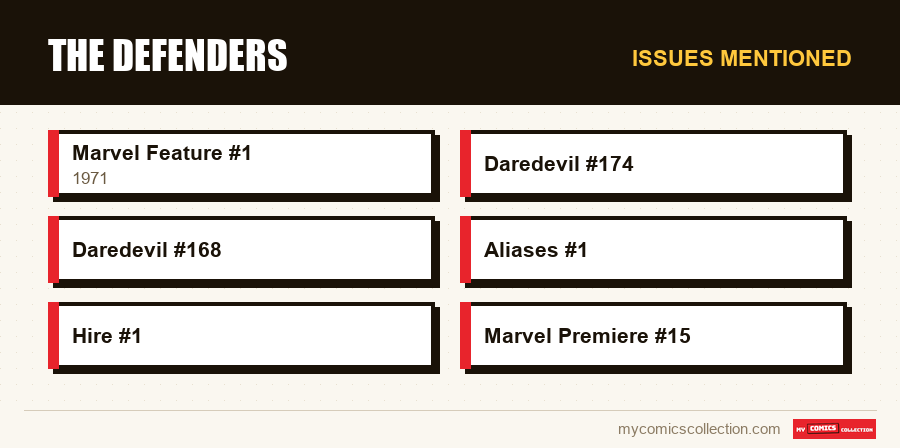
The Defenders points to various keys. Marvel Feature #1 (1971, first appearance of the Defenders) is an interesting Bronze Age issue, even if the team differs from the series. To find the heroes of the mini-series, the individual keys are more relevant: Daredevil #168 (Elektra), Aliases #1 (Jessica Jones), Hero for Hire #1 (Luke Cage) and Marvel Premiere #15 (Iron Fist). These targets cover various budgets. As always, condition and gradation determine value; relying on real recent sales is strongly recommended. The first appearances of the four individual heroes are the most consistent targets for a collector in the series.
Its place in the saga and for the collector
The Defenders is the culmination of the Marvel universe on Netflix, bringing together four series into a crossover on a human scale. For the collector, the miniseries sustained interest in the first appearances of its four heroes, as well as Marvel Feature #1. It illustrates the effect of series on the market, by bringing together several characters. Beyond speculation, it invites you to discover the individual stories of each hero, as well as the Defenders of the comics, this mystical “non-team” whose concept inspired the name. By bringing together New York's vigilantes, the series offered a street-level version of the Defenders principle, proving that the concept of an improvised team could work at all scales of the Marvel Universe. Where the Defenders of the comics faced cosmic and mystical threats, their television counterparts fought for a neighborhood, in familiar alleys and buildings, without ever losing the dramatic scale of the story. It is this ability to reinvent a cult concept by bringing it down to human level that makes The Defenders a separate adaptation, respectful of its original material while fully embracing its singularity.
The verdict: the New York vigilantes reunited
- Loyalty: the concept of an improvised team, the Hand and Elektra come from the comics.
- Freedoms: the composition (street-level hero instead of Strange/Hulk/Namor), Alexandra created for the series.
- Collectible numbers: Marvel Feature #1 (the Defenders) and the first appearances of the four heroes.
The Defenders brings together New York's vigilantes into an improvised team, adapting the concept of the Defenders from the comics while radically changing their composition. Faithful to the spirit of the “non-team” and the mythology of the Hand, the mini-series brings together four series into a street-level crossover. For both the reader and the collector, it is an invitation to discover Marvel's urban heroes and the team that inspired their name. By bringing together four vigilantes with incompatible tones without ever erasing their differences, the mini-series proved that a crossover could be based on the alchemy of the characters rather than on the spectacle alone. It thus closes, in style, a street-level chapter of the Marvel universe whose influence has ended up joining the main continuity, proof of the vitality of these urban heroes born in the comics.
Frequently asked questions
Only for the impromptu team concept. The composition is completely different: the Defenders of the comics (Marvel Feature #1, 1971) bring together Doctor Strange, Hulk and Namor, a mystical and cosmic team, while the series brings together the street-level heroes of New York.
A millennial organization of ninjas adept at black magic, from the Daredevil comics (notably under Frank Miller). She is the antagonist of the series, who unites the four heroes against her.
Resurrected by the Hand as a deadly weapon (“Black Sky”), Elektra, the tragic love of Matt Murdock, is the emotional heart of the story. This mythology comes from the Daredevil comics.
Daredevil, Jessica Jones, Luke Cage and Iron Fist: the four heroes of the Netflix series. Their radically opposing personalities create the dynamic of the mini-series, true to the spirit of the “non-team” of the comics.
Marvel Feature #1 (1971, The Defenders) for the original team, and the first appearances of the four heroes: Daredevil #168 (Elektra), Alias #1 (Jessica Jones), Hero for Hire #1 (Luke Cage), Marvel Premiere #15 (Iron Fist).
Does the series make you want to collect? Estimate the value for free of your issues (Marvel Feature #1…) with our tool based on current eBay listings.