The Punisher (Netflix series, 2017-2019), with Jon Bernthal, adapts Frank Castle, the expeditious vigilante born in Amazing Spider-Man #129 (1974) by Gerry Conway and Ross Andru. A former soldier whose family was massacred, he wages a merciless war against crime, killing without remorse. The series draws on the run “Punisher MAX” by Garth Ennis (2004) and retains the darkness and violence of the character. Here is the detailed comparison, series versus comics.
The darkest and most violent tale in the Marvel Universe on Netflix, The Punisher explores war trauma and revenge. The series adapts one of Marvel's most notable antiheroes. Source-by-source decryption.
As in each article in this series, only verified information (creators, distribution, dates, comic numbers) is stated; the comparative analysis is ours, without reproducing dialogue or protected images.
Title : The Punisher (2017-2019, Netflix)
Creator: Steve Lightfoot
Actors: Jon Bernthal (Frank Castle / The Punisher), Ebon Moss-Bachrach (Micro), Ben Barnes (Billy Russo / Jigsaw), Amber Rose Revah
Broadcast: 2017-2019, Netflix (2 seasons)
Studio: Marvel Television
Amazing Spider-Man #129 (1974): 1st appearance of the Punisher (Conway & Andru)
“Punisher MAX”(2004): Garth Ennis, the definitive run
The massacre of his family: the origin of his crusade
Billy Russo / Jigsaw: his disfigured enemy
- Frank Castle, a former soldier who became an expeditious vigilante.
- The origin: the massacre of his family, the driving force behind his crusade.
- His method: kill criminals without remorse, without moral limits.
- Le white skull iconic on his chest.
- Billy Russo, his disfigured friend-turned-enemy (Jigsaw).
- A military plot linked to his past structures the first season.
- War trauma and post-traumatic stress are explored in depth.
- Microphone, hacker ally, receives advanced treatment.
- Jigsaw sees its origin rearranged for the series.
- The context is anchored in veterans issues contemporaries.
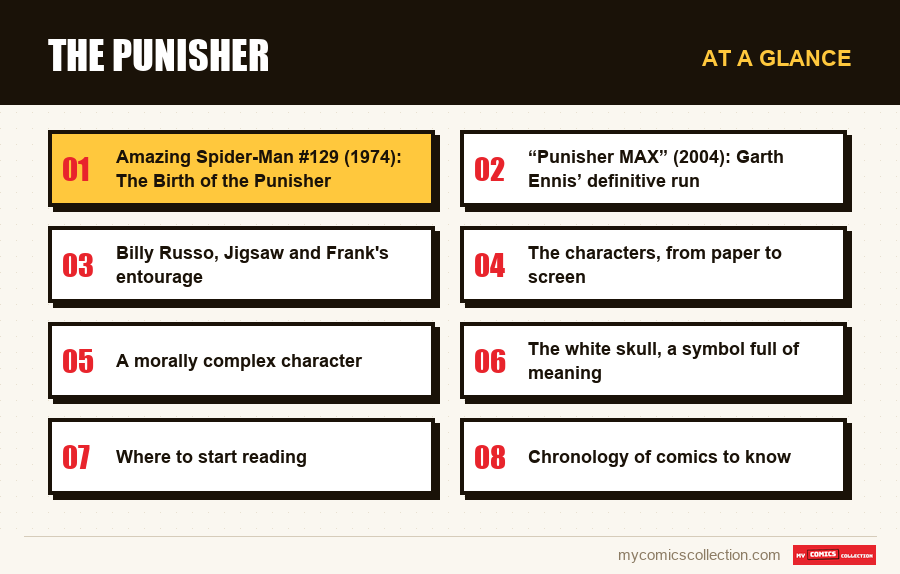
Amazing Spider-Man #129 (1974): The Birth of the Punisher
The Punisher appears in Amazing Spider-Man #129 (1974), created by Gerry Conway, Ross Andru and John Romita Sr. initially as an adversary of Spider-Man, a killer manipulated to hunt him down. The character enjoys a success which transforms him into a major antihero: Frank Castle, a former soldier whose wife and children were murdered by the underworld during a settling of scores of which they were unwitting witnesses, therefore leads a personal and merciless war against crime, executing criminals without hesitation or remorse. The series faithfully takes up this origin and this method: Frank Castle is a vigilante broken by the loss of his family, whose expeditious violence contrasts radically with the ethics of the other heroes. Jon Bernthal plays a Punisher with praised intensity, faithful to the darkness of the character.
What distinguishes the Punisher from other vigilantes is precisely his lack of limits: where Daredevil refuses to kill, Frank makes it his method. This moral difference, at the heart of the character since 1974, is the very subject of the series, which explores what it means to take justice into your own hands, without law or pity.
“Punisher MAX” (2004): Garth Ennis’ definitive run
The series draws heavily on Garth Ennis' “Punisher MAX” run (2004), considered the definitive version of the character. Published on the adult label MAX, this run stripped the Punisher of any fantasy aspect to make him a haunted veteran, evolving in a realistic and brutal world, marked by war trauma and raw violence. The series is directly in line with this: it anchors Frank in the context of contemporary veterans, explores his post-traumatic stress, and assumes graphic violence faithful to the spirit of Ennis. The trauma of war, the central theme of the MAX run, becomes a major subject of the series, which questions the after-effects of combat and the difficulty of returning to civilian life. This gravity, inherited from Ennis, gives the character a depth that goes beyond the simple action story.
Billy Russo, Jigsaw and Frank's entourage
The series adapts several figures from the comics. Billy Russo, Frank's former comrade-in-arms who became his enemy, corresponds to the character of Jigsaw, famous for his disfigured face. The series reorganizes its origin, its disfigurement occurs throughout the story, while retaining the essential: the betrayal of a friend who became an adversary. Microphone (David Lieberman), hacker ally of the Punisher in the comics, receives an expanded role, becoming Frank's technological accomplice. These characters, taken from the comics, enrich the universe of the series and anchor Frank in a network of relationships, despite his isolation. Their presence humanizes the character, showing that even a lonely and broken vigilante maintains connections.
The characters, from paper to screen
- Frank Castle / The Punisher: True to Amazing Spider-Man #129 and Ennis' run: broken veteran, vigilante without limits.
- Billy Russo / Jigsaw: Friend become disfigured enemy, origin rearranged.
- Microphone: Hacker ally, with a role developed for the series.
- Veterans: Frank's entourage, anchored in contemporary issues.
- Karen Page: Link with the Daredevil universe, where Frank was introduced.
Collecting this series?
Track what you own, what you are missing and what your collection is worth. 7 day trial.
Start my trial →A morally complex character
The Punisher is one of Marvel's most debated characters, precisely because he embodies a radical and problematic response to violence: expeditious justice. The series assumes this moral complexity, without making Frank a triumphant hero or a simple avenger. She questions the legitimacy of his crusade, the endless cycle of violence, and the trauma that pushes him to kill. This ambiguity, faithful to the best stories of the character, distinguishes the series from Manichean action stories. Frank is neither glorified nor condemned: he is shown as he is, a broken man whose pain has turned into methodical violence. The white skull he wears, an ambiguous symbol, crystallizes this complexity.
This depth, inherited from Ennis's run, makes The Punisher much more than a simple revenge story. The series explores the after-effects of war, loneliness and the impossibility of mourning, serious themes rarely approached with such seriousness in the genre. By refusing to simplify her character, she remains faithful to what has made the Punisher so rich over the decades: an antihero who forces the reader to question justice, the law and the limits of violence. For the reader, Ennis' “Punisher MAX” run remains the reference for understanding all the darkness of the character.
The white skull, a symbol full of meaning
The white skull that Frank Castle sports on his chest is one of Marvel's most recognizable symbols, and one of the most debated. In the comics, he embodies the death that the Punisher brings to criminals, a visual threat intended to terrify them. Over the decades, this logo has become iconic, even going beyond comics. The series faithfully takes up this symbol and its meaning, while being aware of its ambiguity: the Punisher, a vigilante who kills in the name of personal morality, is a deliberately problematic character, whose most intelligent stories question the fascination he exercises. The skull crystallizes this tension between justice and revenge, between the hero and the murderer.
This symbolic dimension makes the Punisher a more complex character than he seems. The best authors, from Garth Ennis to others, have always refused to make him a simple action hero, preferring to explore the darkness and the unease that he arouses. The series follows this line by showing a haunted Frank Castle, whose violence is never presented as a glorious solution. The white skull, far from being just a cool logo, becomes the sign of a broken man who has made death his only language. By treating this symbol seriously, the series remains faithful to the moral complexity of the character, the one that has always distinguished the great Punisher stories from Manichean action stories. For the reader, this ambiguity is precisely what has made the character so fascinating and disturbing, since his creation in 1974.
Where to start reading
Priority reading is Garth Ennis' "Punisher MAX" (2004), the definitive and closest version of the series, a brutal and realistic run. We can go back to Amazing Spider-Man #129 (1974) for the origins, then discover “Welcome Back, Frank”, also by Ennis, which revived the character. The Punisher's grand narratives illuminate his evolution from Spider-Man adversary to major antihero. From 1974 to 2004, this route covers the sources of a series of rare darkness.
Chronology of comics to know
- 1974: Amazing Spider-Man #129: First appearance of the Punisher.
- 1980s-1990s: the Punisher becomes a successful antihero, with his own series.
- 2004: “Punisher MAX” by Garth Ennis: the definitive run.
Collection side: what numbers to aim for after the series
The Punisher highlights a major Bronze Age key. Amazing Spider-Man #129 (1974, first appearance of the Punisher) is one of the most sought-after and highly rated keys of the period, driven by the character's enduring popularity. Its value has benefited from numerous adaptations. The “Punisher MAX” collections by Garth Ennis offer the best entry point into reading. As always, condition and gradation determine value; relying on real recent sales is strongly recommended. Amazing Spider-Man #129 is a prestigious target, both for its historical value and for its status as the first appearance of an iconic antihero.
Its place in the saga and for the collector
The Punisher brought its darkest, most adult tale to the Marvel Universe on Netflix, exploring war trauma and revenge. Introduced in the second season of Daredevil, Frank Castle won his own series thanks to Jon Bernthal's performance. For the collector, the series has sustained interest in Amazing Spider-Man #129, one of the great keys to the Bronze Age. It illustrates the effect of series on the market, in the long term. Beyond speculation, the series invites you to discover Garth Ennis' “Punisher MAX” run, the peak of the character's darkness. By exploring Frank's moral complexity without glorifying him, the series remains faithful to an antihero who, since 1974, has questioned the limits of justice and violence.
The verdict: revenge without limits
- Loyalty: Frank's origin, his expeditious method, the white skull and Jigsaw come from the comics.
- Freedoms: the military plot, the war trauma deepened, Micro and Jigsaw re-arranged.
- Collectible numbers: Amazing Spider-Man #129 (first appearance of the Punisher).
The Punisher adapts one of Marvel's darkest antiheroes, faithful to his tragic origin and the darkness of Garth Ennis' run. In exploring the war trauma and moral complexity of Frank Castle, the series assumes a rare gravitas. For both the reader and the collector, it is an invitation to discover “Punisher MAX” and one of the great keys to the Bronze Age. By refusing to glorify its antihero, the series remains faithful to what makes the Punisher so disturbing and so fascinating: a mirror held up to our ambiguous relationship to justice and violence.
Frequently asked questions
In Amazing Spider-Man #129 (1974), created by Gerry Conway and Ross Andru, first as Spider-Man's adversary. Frank Castle then becomes a major antihero after his family is massacred.
Largely from the run “Punisher MAX” by Garth Ennis (2004), the definitive and realistic version of the character, which explores war trauma and raw violence, on the adult label MAX.
Billy Russo, Frank's former comrade-in-arms who became his enemy, famous for his disfigured face. The series rearranges its origin while retaining the betrayal of a friend turned adversary.
A complex antihero: unlike other vigilantes, he kills criminals without remorse. The series assumes this moral ambiguity, questioning the legitimacy of its crusade and the cycle of violence, without glorifying or condemning it.
Amazing Spider-Man #129 (1974, first appearance of the Punisher) is one of the most sought-after keys to the Bronze Age. Ennis' Punisher MAX collections are essential reading.
Does the series make you want to collect? Estimate the value for free of your issues (Amazing Spider-Man #129…) with our tool based on current eBay listings.