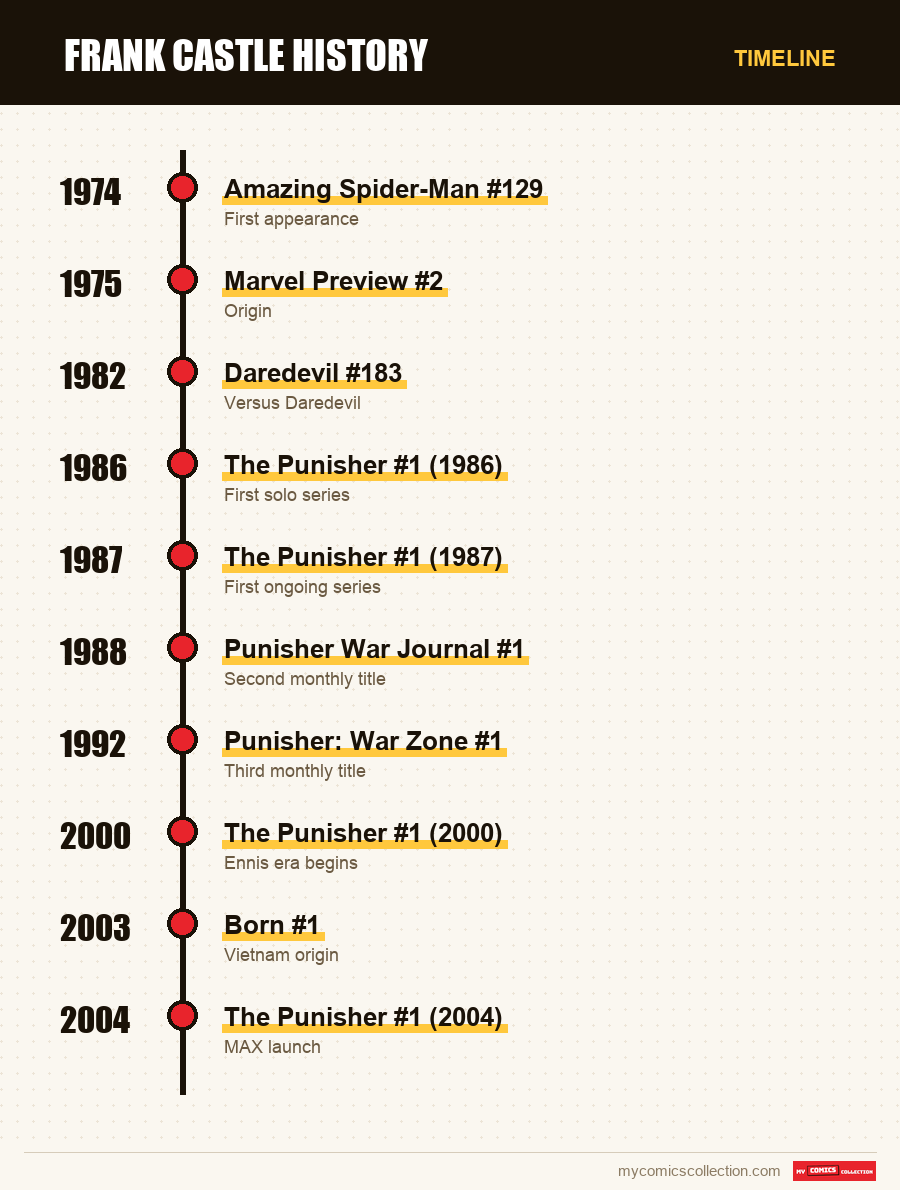
Frank Castle, aka the Punisher, first appears in The Amazing Spider-Man #129 (February 1974), created by screenwriter Gerry Conway with design by John Romita Sr. and art by Ross Andru. Originally designed as a one-off adversary of Spider-Man, the character became cult thanks to the mini-series Circle of Blood (1986), then to its first monthly series in 1987 with Mike Baron and Klaus Janson. The Garth Ennis era (2000-2001, then the MAX line) established him as a reference antihero, before the Netflix adaptations with Jon Bernthal (2016-2019) permanently revived demand for his original comics.
There are few Marvel characters whose editorial trajectory is as atypical as that of Frank Castle. Unlike the majority of figures born in the pages of Amazing Spider-Man, the Punisher was never intended as a protagonist. He was to remain a secondary antagonist, a mercenary manipulated by the Jackal for the duration of one story, before disappearing. Fifty years later, his stylized skull is among the most recognizable symbols of all American pop culture, for better (one of the densest sagas in the Marvel catalog) and for worse (a political exploitation that its own creator has publicly denounced).
Understanding the story of Frank Castle in comics therefore means following two parallel threads: that of a literary character who has crossed almost all possible registers: pulp thriller of the 80s, commercial exploitation of the early 90s, ultra-violent noir by Garth Ennis, then prestige reinterpretation carried by Jon Bernthal, and that of a collector's item whose price faithfully follows the major cycles of its media exposure. The two constantly respond to each other: each peak of interest in the character on screen translates, in the months that follow, into an increase in demand for the founding episodes in circulation.
This article retraces the verifiable editorial milestones of Frank Castle's career (creation, first series, Ennis turning point, symbol controversy) and explains how these events have concretely weighed on the rating of the comics which feature him, from the founding issue of 1974 to the more recent prints linked to the television series.
Frank Castle before the Punisher: a creation conceived as an adversary of Spider-Man (1974)
The Punisher is born in The Amazing Spider-Man #129, dated February 1974 and subtitled "The Punisher Strikes Twice!" ". The screenplay was written by Gerry Conway, then one of Marvel's most prolific in-house screenwriters, while John Romita Sr., artistic director at the time, drew the founding design of the character: the black fatigues, the bulletproof vest and especially the stylized skull on the torso, originally thought of as a simple visual target facilitating identification of the character on a full page. The interior design of the episode goes to Ross Andru, with a cover by Gil Kane and Romita. This same issue also marks the very first appearance of the Jackal, making it a double entry point for collectors of Bronze Age comics.
In this origin story, Frank Castle is not yet the vengeful veteran readers will later come to know: he is hired and manipulated by the Jackal, who convinces him that Spider-Man killed an innocent young man. The Punisher then tracks down the hero with cold determination, without knowing that he serves the interests of a much more devious enemy. Most of the founding myth of Frank Castle (the former Marine, his family shot dead in a shootout in Central Park, his personal and endless war against organized crime) will be gradually developed in the following episodes, notably in Marvel Preview #2 (1975), which tells his origin for the first time: his family gunned down by the mob.
In terms of the collection, Amazing Spider-Man #129 remains to this day the most sought-after episode in the entire editorial history of the character, all series combined. CGC census data shows a considerable volume of submissions for a Bronze Age comic-several thousand copies certified over the decades, with only a handful ranked at the top of the 9.8 NM/M scale. This very high grade rarity can be explained by the very nature of the issue: a massive print run intended for newsstands of the time, handled, folded and stacked like any other monthly issue, long before anyone suspected the future importance of the character it revealed. A CGC 9.8 copy sold for $57,000 at auction in March 2022, a record which illustrates the abysmal gap between optimally preserved copies and the more accessible intermediate grade market.
From one-off antagonist to recurring character: pivotal appearances from the 70s and 80s
After his first attempt at Spider-Man, the Punisher became a regular on widescreen Marvel in the 70s, reappearing regularly in Amazing Spider-Man then in the pages of Daredevil, ground which would prove decisive for its future popularity. It was in 1982, under the pen and pencil of Frank Miller, then in the process of revolutionizing Daredevil with a darker, more adult tone: that the character takes a major narrative step. The arc published in Daredevil #182 to #184, including the "Child's Play" episode (#183, co-written with Roger McKenzie),, features a head-on confrontation between Matt Murdock and Frank Castle on the question of methods: how far can we go in the name of justice? This confrontation, where Daredevil goes so far as to disarm the Punisher with his own weapon, is today considered one of the founding texts of the moral mythology of the character: the one which definitively opposes his lethal absolutism to the ethics of classic superheroes.
These Miller-era episodes are of particular value to Punisher collectors because they mark the point at which the character ceased to be a mere foil and became a recurring thematic counterpoint in the Marvel Universe. Contrary to Amazing Spider-Man #129, this is not a first appearance issue, which makes them much more accessible on the second-hand market, but their narrative importance makes them pieces sought after by readers which reconstruct the complete evolution of the character rather than just the list of his "firsts".
1986: Circle of Blood, the first solo foray
It was not until twelve years after its creation that Marvel finally gave Frank Castle his own mini-series. The Punisher, limited to five issues, began in January 1986 under the pen of Steven Grant, with drawings by Mike Zeck (on the first four episodes, the fifth being penciled by Mike Vosburg) and inkings by John Beatty. Subsequently republished under the title Circle of Blood, this miniseries lays the visual and tonal foundations that will define the character for the following decade: a double-format first issue which sees Castle, then imprisoned on Ryker's Island, being taken from his cell by an underground citizen organization called "the Trust", which seeks to replicate his method on a larger scale.
The commercial success of this mini-series surprises Marvel itself. At a time when ultra-violent secondary characters struggled to sustain a series over time, Circle of Blood demonstrates that a significant readership exists for an antihero without powers, whose only weapon is limitless determination. This success directly paves the way for what will follow: the character's first ongoing monthly series.
1987-1995: the Baron/Janson era and the commercial explosion of the Punisher
In July 1987, Marvel launched The Punisher volume 2, the very first regular monthly series dedicated to the character. Screenwriter Mike Baron, already recognized for his work on Nexus, installed Frank Castle there for more than five years, with Klaus Janson drawing, inking and even coloring for a good part of the run. The series would run until issue #104, published in July 1995, making it to date the longest Punisher series ever published under a single numbering.
This success was such that it pushed Marvel to an unprecedented decision at the time: duplicating the character on several simultaneous monthly titles. Punisher War Journal was launched in 1988, followed in March 1992 by Punisher War Zone, scripted by Chuck Dixon with drawings by John Romita Jr. For several years at the turn of the 90s, Frank Castle was the hero of three separate monthly series in parallel: a status then reserved for very rare Marvel characters, generally Spider-Man or the X-Men. This period of editorial oversaturation, which culminates with the crossover "Countdown" crossing the three titles, also corresponds to the commercial peak of the character on the comics market of the 90s, before the speculative bubble of that decade finally burst for the entire industry. Warzone ended in July 1995, around the same time as the parent series, marking the end of this first major Punisher era.
Garth Ennis and the MAX line: Frank Castle reinvented for an adult readership
After several attempts at relaunch in the second half of the 90s, it was British screenwriter Garth Ennis who gave the character a strong and lasting editorial direction. In April 2000, under the Marvel Knights label then led by Joe Quesada, Ennis launched The Punisher: Welcome Back, Frank, a twelve-issue miniseries drawn by Steve Dillon (with Jimmy Palmiotti), which runs until March 2001. The story, centered on the methodical elimination of Ma Gnucci's criminal family, reintroduces Frank Castle in a darker, more ironic and significantly more graphic register than the runs of the 80s and 90s, while fully assuming the dark absurdity of his method.
The critical and commercial success of "Welcome Back, Frank" led directly to a new ongoing series signed Ennis from 2001, then to its transfer to Marvel's MAX editorial line: a label intended for adult readers, without the seal of the Comics Code, which allowed Ennis to push the violence, nihilism and political satire of the character well beyond what the shared continuity allowed until then. This period, often referred to by readers as the "Ennis era", is today widely considered to be the character's literary peak: it directly influences the tone adopted later by audiovisual adaptations, notably the Netflix series.
The Punisher's skull: from fictional emblem to controversial symbol
No serious retrospective on Frank Castle can ignore what has become, since the late 2010s, one of the most heated debates in all of Marvel editorial history: the appropriation of the skull logo by certain members of American law enforcement and by far-right groups. Gerry Conway, co-creator of the character, spoke publicly in 2017 to denounce this use, comparing the adoption of the symbol by police officers to the display of the Confederate flag: a sign whose meaning has, according to him, been hijacked by those who choose to display it. Its central argument: a police officer who wears the Punisher's skull fundamentally misunderstands the nature of the character, a figure who exists precisely in opposition to institutional authority, not in its name.
The controversy intensified in 2019 and 2020, with several incidents relayed in the American press involving police services using the symbol, until the protests following the death of George Floyd in 2020. Marvel responded editorially in July 2019, in an issue of the series Punisher then written by Matthew Rosenberg, where Frank Castle directly confronts police officers wearing his skull: “We're not the same. You took an oath to uphold the law. You help people. I gave all that up a long time ago. You don't do what I do. Nobody does. » In June 2020, Gerry Conway personally launched the “Skulls for Justice” initiative, inviting artists to reinterpret the Punisher's skull around themes linked to the Black Lives Matter movement, in an explicit attempt to regain control of a symbol that he considers distorted.
For collectors, this episode has a paradoxical effect: it keeps the character at the center of cultural news well beyond the circle of comic book readers alone, which mechanically maintains interest, and therefore demand, for his original publications, without this modifying the intrinsic nature of the character as he has always been written in the Marvel pages.
The impact of adaptations on the rating
As with most high-profile Marvel characters, the popularity of Frank Castle's seminal comics responds directly to his on-screen exposure. The first move to cinema dates back to 1989, with a film directed by Dolph Lundgren, released directly on video in the United States but released theatrically in several international markets, for a budget of around 9 million dollars and worldwide revenues of around 30 million. Followed by the 2004 film with Thomas Jane in the title role, then Punisher: War Zone in 2008, worn by Ray Stevenson and directed by Lexi Alexander: a version often cited by readers as the most visually faithful to the character from the comics of the 2000s.
The most decisive turning point for collector demand, however, remains the arrival of Jon Bernthal in the Marvel television universe. His casting was confirmed in June 2015, and the character made his first appearance on screen on March 18, 2016, in the entirety of season 2 of Daredevil on Netflix. This performance, praised by critics for its fidelity to the nihilistic tone of the Ennis era, led to a spin-off series, The Punisher, broadcast over two seasons between 2017 and 2019. Each of these stages (casting, release of season 2 of Daredevil, then launch of the solo series) generated measurable search and sales peaks on used comics marketplaces, in particular on issues linked to the origin of the character and the Ennis era from which the series is directly inspired tonally.
Bernthal has since returned to the role at Marvel Studios, with an appearance in Daredevil: Born Again from 2025, and a confirmed presence in the film Spider-Man: Brand New Day. This continuity of presence on screen, almost uninterrupted since 2016, distinguishes Frank Castle from many other Marvel characters whose ratings follow more erratic cycles: the demand for his original comics remains structurally sustained rather than punctual.
Collecting this series?
Track what you own, what you are missing and what your collection is worth. 7 day trial.
Start my trial →Buying Guide: How to Collect Frank Castle / Punisher
The Punisher catalog is large and heterogeneous (more than thirty years of series, mini-series, one-shots and crossovers) which makes the selection all the more important for a collector who wants to invest intelligently rather than accumulate without strategy. Here are the main points to watch out for:
- Favor real editorial milestones. Amazing Spider-Man #129 (first appearance, 1974) remains the absolute reference piece; come next Daredevil #182-184 (Miller arc, 1982), The Punisher #1 of the 1986 mini-series (Circle of Blood) and The Punisher #1 of the ongoing 1987 series: four distinct entry points that should not be confused when making a purchase.
- Systematically check the volume number and year of publication before any purchase: Marvel has published at least six distinct series simply titled "The Punisher" since 1986 (1987, 1995, 1998, 2000, 2001, 2004, 2011, 2016, 2018, 2022...), which creates frequent confusion on marketplaces between a high-value "#1" and a recent relaunch "#1" at a much more modest value.
- Do not confuse first appearance and first solo series. A copy of Amazing Spider-Man #129 in average condition can be worth significantly more than a high grade copy of a later issue: it is the nature of the publication, not just its condition, which weighs most heavily in the valuation.
- Beware of mass print runs from the War Journal/War Zone era (1988-1995). Produced in very large volumes at the height of the speculative bubble in comics, most of these issues remain abundant on the market today, including high grades, and should not be purchased out of a logic of rarity.
- Prioritize episodes from the Ennis era (2000-2001 and the MAX line) for those seeking to cover the period most referenced by recent adaptations, notably the Netflix series: this is the body of work whose direct influence on the contemporary image of the character is the most documented.
- Compare actual sales before purchasing. The second-hand comic market is evolving quickly, particularly around announcements related to upcoming Frank Castle adaptations; an estimation tool based on actual eBay sales, rather than a fixed list price, gives a much more reliable picture of the rating at the time of purchase.
- Monitor the collection status over time. Once several Punisher numbers have been collected, an application dedicated to collection tracking makes it possible to centralize the states, grades and estimated values rather than relying on scattered notes.
To go further in this logic of reasoned purchasing, the estimator available on/free-estimate/allows you to check in a few seconds the real price range observed on a given number, taking into account the declared status. Collectors who manage a significant Punisher fund also have an interest in centralizing their inventory via the collection tracking app, which allows you to track the evolution of the value of each item over time rather than relying on a fixed estimate at the time of purchase.
Key issues to know
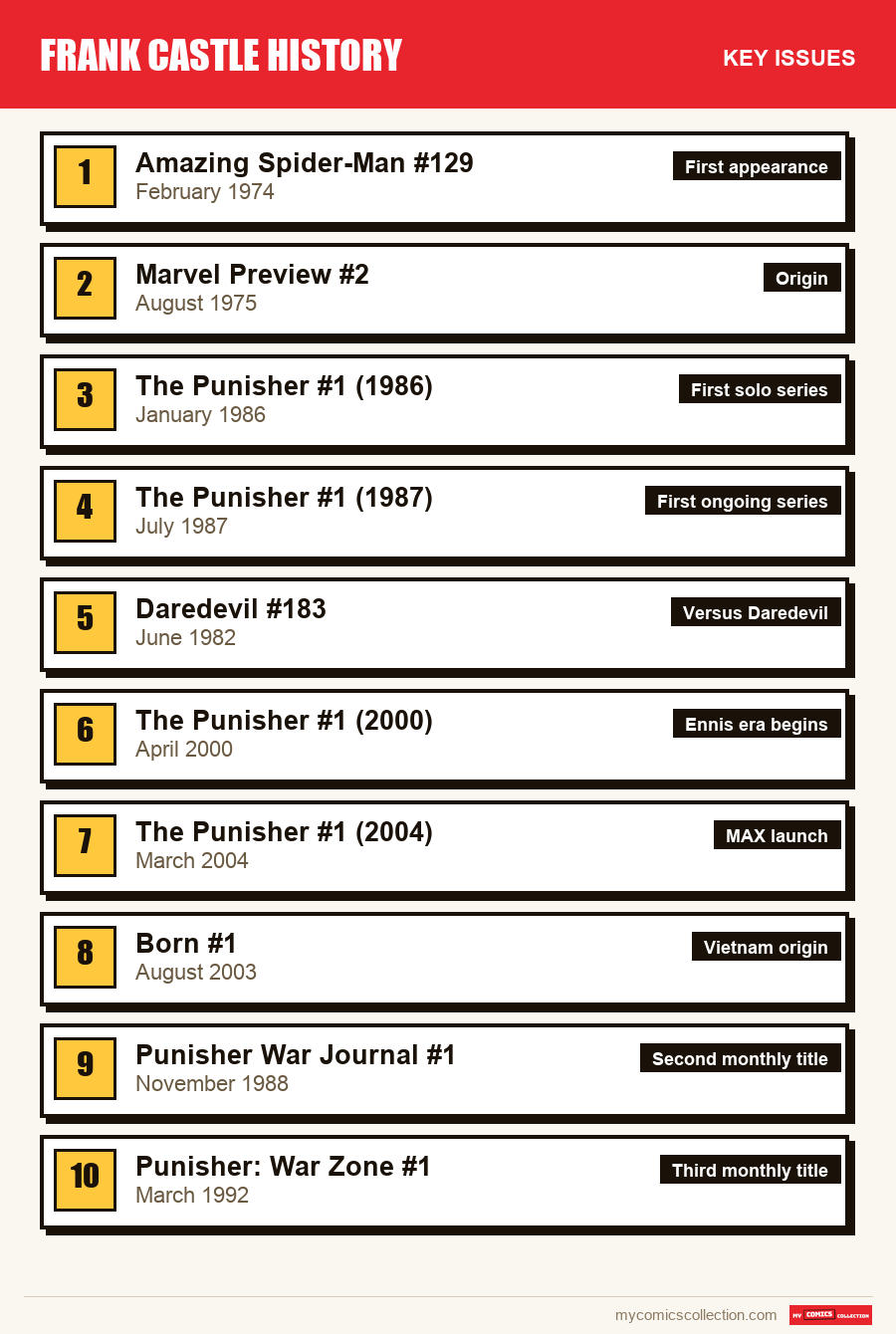
Amazing Spider-Man #129
Gerry Conway writing, Ross Andru on art, a costume designed by Conway with John Romita Sr.: the Punisher debuts as a vigilante who only kills those who deserve it, manipulated by the Jackal into hunting Spider-Man. The issue also marks the Jackal's first appearance under that name. It is the character's ultimate key.
Marvel Preview #2
Gerry Conway and Tony DeZuniga tell the Punisher's origin for the first time: a decorated Marine home on leave, Frank Castle sees his family gunned down by the mob after they witness an execution. His wife Maria and their children Lisa and Frank Jr. make their first appearance here, in flashback.
The Punisher #1 (1986)
Steven Grant, Mike Zeck and John Beatty launch "Circle of Blood", the five-issue first series under his name. Locked up on Ryker's Island, Castle is offered by the warden a deal to work for the Trust, a secret organization bent on fighting crime outside the law. The miniseries' success paves the way for the ongoing title.
The Punisher #1 (1987)
Writer Mike Baron and artist Klaus Janson launch the character's first continuing monthly series with "Marching Powder". The title runs until #104, cover dated July 1995, and establishes Frank Castle as one of Marvel's headliners.
Daredevil #183
Written by Roger McKenzie and Frank Miller, with Miller on art, "Child's Play" pits Daredevil against the Punisher as both hunt a dealer after a drugged schoolgirl dies. Unwilling to kill the hero, Castle takes him down with a tranquilizer shot. Originally planned for #167, the story had been rejected by the Comics Code before being reworked.
The Punisher #1 (2000)
Under the Marvel Knights label, Garth Ennis, Steve Dillon and Jimmy Palmiotti launch "Welcome Back, Frank", a twelve-issue maxiseries that wraps up in March 2001. The issue introduces the Gnucci crime family, the target of this dark, ironic crusade that revives the character for good.
The Punisher #1 (2004)
Garth Ennis moves to the adult Marvel MAX line with Lewis LaRosa on art and opens the "In the Beginning" arc. Freed from superhero continuity, Castle moves into grim, raw, realistic crime territory. Ennis stays on the series through #60.
Born #1
Garth Ennis and Darick Robertson revisit the character's genesis in this miniseries often called Punisher: Born. At Firebase Valley Forge in Vietnam, the story follows Captain Frank Castle through the eyes of Private Stevie Goodwin, and suggests the Punisher already existed before his family's tragedy.
Punisher War Journal #1
Carl Potts writes and pencils this first issue, with Jim Lee on inks. Every year, Frank Castle returns to the park where his family was slaughtered to fly a kite, just as they did on the day of the tragedy. Launching this second monthly title shows how popular the character had become by the late 1980s.
Punisher: War Zone #1
Chuck Dixon writing, John Romita Jr. on pencils and Klaus Janson on inks: Castle infiltrates the Carbone family by posing as Mickey Fondozzi's simple-minded cousin. With this third simultaneous monthly title, the Punisher reaches the peak of his exposure in the early 1990s.