Punisher: War Zone (2008) Lexi Alexander , with Ray Stevenson, offers an ultra-violent reboot of Frank Castle (Amazing Spider-Man #129, 1974), faithful to the tone of Punisher MAX by Garth Ennis. The film pits him against Jigsaw (Billy Russo), disfigured, appeared in Amazing Spider-Man #162 (1976). Most faithful to the brutality of comics, he fully embraces his violence. Here is the detailed comparison, film versus comics.
A reboot taking on the extreme violence of the character, Punisher: War Zone is often cited as the most faithful version of the vigilante. He draws on Garth Ennis' run and Frank Castle's gallery of enemies. Source-by-source decryption.
As in each article in this series, only verified information (creators, distribution, dates, comic numbers) is stated; the comparative analysis is ours, without reproducing dialogue or protected images.
Title : Punisher: War Zone (2008)
Director: Lexi Alexander
Actors: Ray Stevenson (Frank Castle), Dominic West (Jigsaw), Doug Hutchison
Exit : December 2008
Studio: Lionsgate
Amazing Spider-Man #129 (1974): Punisher's first appearance
Amazing Spider-Man #162 (1976): Jigsaw's first appearance
“Punisher MAX”(Garth Ennis): ultra-violent tone
The white skull: the symbol of the vigilante
- Frank Castle and his merciless crusade.
- La extreme violence faithful to “Punisher MAX”.
- Jigsaw (Billy Russo), face disfigured.
- Le white skull and the arsenal of the vigilante.
- Her New York anchorage and criminal.
- L'origin of Jigsaw (disfigured by Frank) is rearranged.
- The plot is largely original.
- The tone, outrageous, flirts with excess.
- The movie restarts the franchise (new actor).
- The link to Spider-Man remains absent.
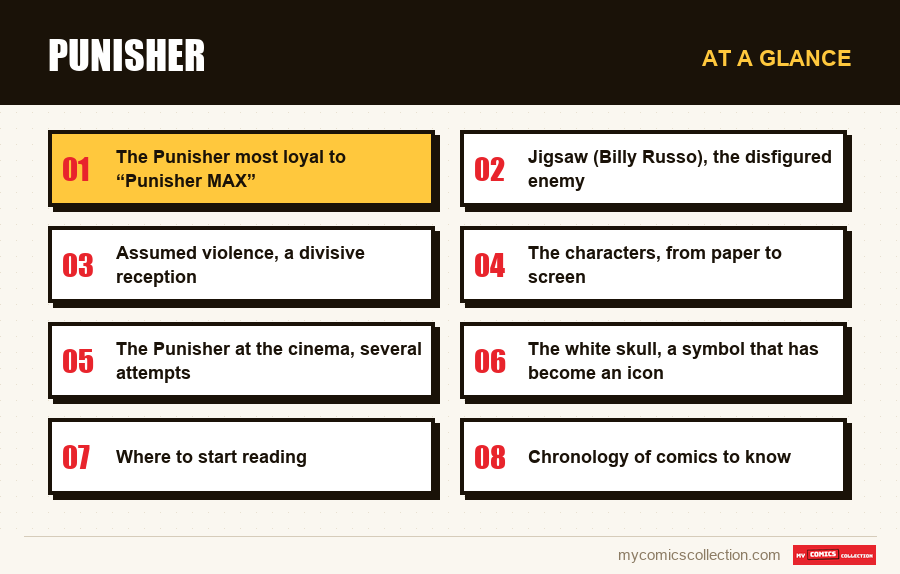
The Punisher most loyal to “Punisher MAX”
Punisher: War Zone is a reboot that fully embraces the extreme violence of the character. Frank Castle, born in Amazing Spider-Man #129 (1974), is brought to the screen in his most brutal version, directly inspired by Garth Ennis' “Punisher MAX”. This label for adult readers pushed the character towards an unprecedented realism and darkness, making the Punisher a relentless figure of vengeance, in a world of merciless criminals. The film takes up this tone: graphic violence, a methodical and ruthless Frank Castle, a sordid criminal universe. Ray Stevenson plays a massive and taciturn Punisher, faithful to Ennis' version.
This fidelity to the brutality of the comics makes War Zone, in the eyes of many fans, the best adaptation of the character, the one which finally dares to show the Punisher as he is in “Punisher MAX”: a vigilante of extreme violence, without concession or watering down. The film assumes its adult classification, with scenes of rare brutality for a superhero film. This bias, while it divided the general public, appealed to fans of the character. The main freedom lies in the largely original and originally re-arranged plot of Jigsaw. On the essentials (the crusade, the violence, the white skull) the film is very faithful to the spirit of the Punisher of Ennis.
Jigsaw (Billy Russo), the disfigured enemy
The film's antagonist is Jigsaw, one of the Punisher's most iconic enemies, appearing in Amazing Spider-Man #162 (1976), created by Len Wein and Ross Andru. Billy Russo was a handsome and vain mafia henchman until a confrontation with the Punisher left his face horribly mutilated: hence his nickname "Jigsaw", in reference to the scars that streak his face. Disfigured and thirsty for revenge, he becomes one of Frank Castle's recurring adversaries. The film faithfully reproduces this character and his scarred appearance, played by Dominic West, while rearranging his origin: it is Frank himself who, in the film, causes his disfigurement.
This rereading of Jigsaw's origin serves the film's narrative, by directly linking the villain to Frank's crusade. In the comics, Billy Russo's mutilation also results from a confrontation with the Punisher, but the circumstances differ. The film retains the essential: a disfigured henchman who has an obsessive hatred of the vigilante, making their rivalry a personal duel. Jigsaw, with his nightmarish appearance and his madness, offers the film an antagonist to match the violence of the Punisher. For the reader, it is an invitation to discover Frank Castle's gallery of enemies, where Jigsaw occupies a special place, the grotesque incarnation of the crime that the Punisher fights.
Assumed violence, a divisive reception
Punisher: War Zone stands out for its uninhibited violence, arguably the most extreme of all Marvel adaptations. Under the direction of Lexi Alexander, the film assumes a graphic and stylized brutality, faithful to “Punisher MAX” but pushed to excess, sometimes flirting with excess. This radical bias was deeply divided: rejected by part of the public and critics for its violence considered gratuitous, it was on the other hand hailed by many fans of the character as the only adaptation to dare to show the real Punisher. This divisive reception illustrates the difficulty of adapting such an extreme character for a wide audience.
This divide raises a fundamental question about the Punisher: can we faithfully adapt a character whose very essence, limitless violence, clashes with the codes of mainstream entertainment? War Zone answers in the affirmative, fully assuming the brutality of its source, at the risk of being repulsive. This radicality makes it, paradoxically, the most faithful adaptation of the character, the one which does not betray his nature. For the reader, the film is an invitation to discover “Punisher MAX” by Garth Ennis, where this extreme violence serves a purpose on revenge, evil and justice, with a depth that the film only touches on. War Zone remains the closest transposition of this cult Punisher.
Collecting this series?
Track what you own, what you are missing and what your collection is worth. 7 day trial.
Start my trial →The characters, from paper to screen
- Frank Castle / The Punisher: Ultra-violent vigilante, faithful to Garth Ennis’ “Punisher MAX”.
- Jigsaw (Billy Russo): Disfigured henchman, faithful to Amazing Spider-Man #162, originally retooled.
- Loony Bin Jim: The disturbed brother of Jigsaw, character in the film.
- Microphone: Frank's technical ally from the comics.
- The white skull: Iconic symbol, faithfully reproduced.
The Punisher at the cinema, several attempts
Punisher: War Zone is the third film adaptation of the character, following a 1989 version and the 2004 film. This multiplicity of attempts illustrates both the appeal of the Punisher and the difficulty of bringing him to the screen. Each film offered a different approach: more classic in 1989, more dramatic in 2004, more radically violent in 2008. None fully met the general public, but War Zone is the one that most convinced fans of the character, for its fidelity to his fundamental brutality. These successive adaptations bear witness to the lasting fascination with this powerless vigilante.
This contrasting cinematic story underlines the singularity of the Punisher in the Marvel universe. Violent antihero, morally ambiguous, devoid of superpowers, he resists the codes of the mainstream superhero film. It was perhaps on television, in a longer and more adult format, that the character finally found his best incarnation. For the reader, these multiple adaptations are an invitation to discover the Punisher in the comics, in particular Garth Ennis' run, where Frank Castle reaches his full dimension. War Zone, despite its divisive reception, will remain as the most audacious and faithful attempt to bring to the screen the extreme violence of this cult character.
The white skull, a symbol that has become an icon
It's impossible to talk about the Punisher without mentioning his symbol: the white skull that adorns his chest, which has become one of the most recognizable icons of popular culture. This logo, of striking simplicity, alone embodies the identity of the character: death, fear, implacable justice. In the comics as in the film, it is much more than an emblem: it is a warning, a signature left by the vigilante in his path. War Zone, faithful to this imagery, depicts this symbol forcefully, in a universe where the Punisher reigns terror among criminals.
The influence of this symbol goes far beyond the framework of comics and films. The Punisher's skull has become a cultural motif in its own right, displayed and misused in numerous contexts, to the point that its creator and Marvel have sometimes had to recall the true meaning of the character. This reach illustrates the iconographic power of a creation born in the pages of Amazing Spider-Man. For the reader, the white skull is an invitation to discover the Punisher in the comics, where this symbol accompanies Frank Castle's tragic crusade. War Zone, by bringing it to the screen with fidelity, pays homage to one of the most striking emblems of the Marvel universe, inseparable from its darkest vigilante.
Where to start reading
To extend the film, Amazing Spider-Man #129 (1974) introduces the Punisher, and #162 (1976) Jigsaw. Garth Ennis’ “Punisher MAX” is the direct reference to the tone of the film, a must-read. “Welcome Back, Frank” (2000) revives the character. This journey covers the sources of a film with great fidelity to the brutality of the vigilante.
Chronology of comics to know
- 1974: Amazing Spider-Man #129: The Punisher's first appearance.
- 1976: Amazing Spider-Man #162: Jigsaw's first appearance.
- 2000s: “Punisher MAX” (Garth Ennis): the ultra-violent version that inspires the film.
Collection side: what numbers to aim for after the film
Punisher: War Zone points to keys to the Bronze Age. Amazing Spider-Man #129 (1974, first appearance of the Punisher) is a highly sought after issue. Amazing Spider-Man #162 (1976, premiere of Jigsaw) is another target for fans of the character. The “Punisher MAX” collections by Garth Ennis are essential reading. These numbers cover various budgets. As always, condition and gradation determine value; relying on real recent sales is strongly recommended.
Its place in the saga and for the collector
Punisher: War Zone brought to the screen the most faithful version of the vigilante, that of Garth Ennis' “Punisher MAX”. For the collector, it reignited interest in Amazing Spider-Man #129 and #162. It illustrates the effect of adaptations on the market. Beyond speculation, the film invites us to discover the Punisher in the comics, in particular the Ennis run, where Frank Castle and Jigsaw reach their full dimensions. By assuming the character's extreme violence, he reminds us that the Punisher is one of Marvel's most radical antiheroes, on the border between hero and murderer.
The verdict: the most faithful version of the vigilante
- Loyalty: Frank Castle, his extreme violence (“Punisher MAX”), Jigsaw, the white skull and the criminal anchor come from the comics.
- Freedoms: the origin of Jigsaw rearranged, the original plot, the outrageous tone, the reboot of the franchise.
- Collectible numbers: Amazing Spider-Man #129 (Punisher), Amazing Spider-Man #162 (Jigsaw), “Punisher MAX”.
Punisher: War Zone fully embraces the extreme violence of the character, faithful to Garth Ennis' “Punisher MAX”, and pits him against Jigsaw. The most brutal and faithful of the Punisher films, it divided the general public while winning over fans. For the reader as well as the collector, it is an invitation to discover Amazing Spider-Man #129, #162 and “Punisher MAX”.
Frequently asked questions
Yes, it is often cited as the most faithful version of the character: he assumes the extreme violence of Garth Ennis' “Punisher MAX”, without watering down. Frank Castle is brought to the screen in his most brutal and merciless version.
Billy Russo, mafia henchman disfigured during a confrontation with the Punisher, hence his nickname ("puzzle") linked to his scars. Appearing in Amazing Spider-Man #162 (1976), he is one of Frank Castle's recurring enemies.
For its uninhibited violence, the most extreme of all Marvel adaptations. Rejected by part of the public for its brutality, it was hailed by fans as the only adaptation to dare to show the real Punisher, faithful to “Punisher MAX”.
War Zone is the third, following a 1989 version and the 2004 film. Each offered a different approach; War Zone is the most faithful to the character's violence. The Punisher also had an acclaimed television series.
Amazing Spider-Man #129 (1974, Punisher premiere) is the most sought after key. Other targets include Amazing Spider-Man #162 (1976, Jigsaw premiere) and the "Punisher MAX" collections.
Does the film make you want to collect? Estimate the value for free of your issues (Amazing Spider-Man #129, #162…) with our tool based on current eBay listings.