
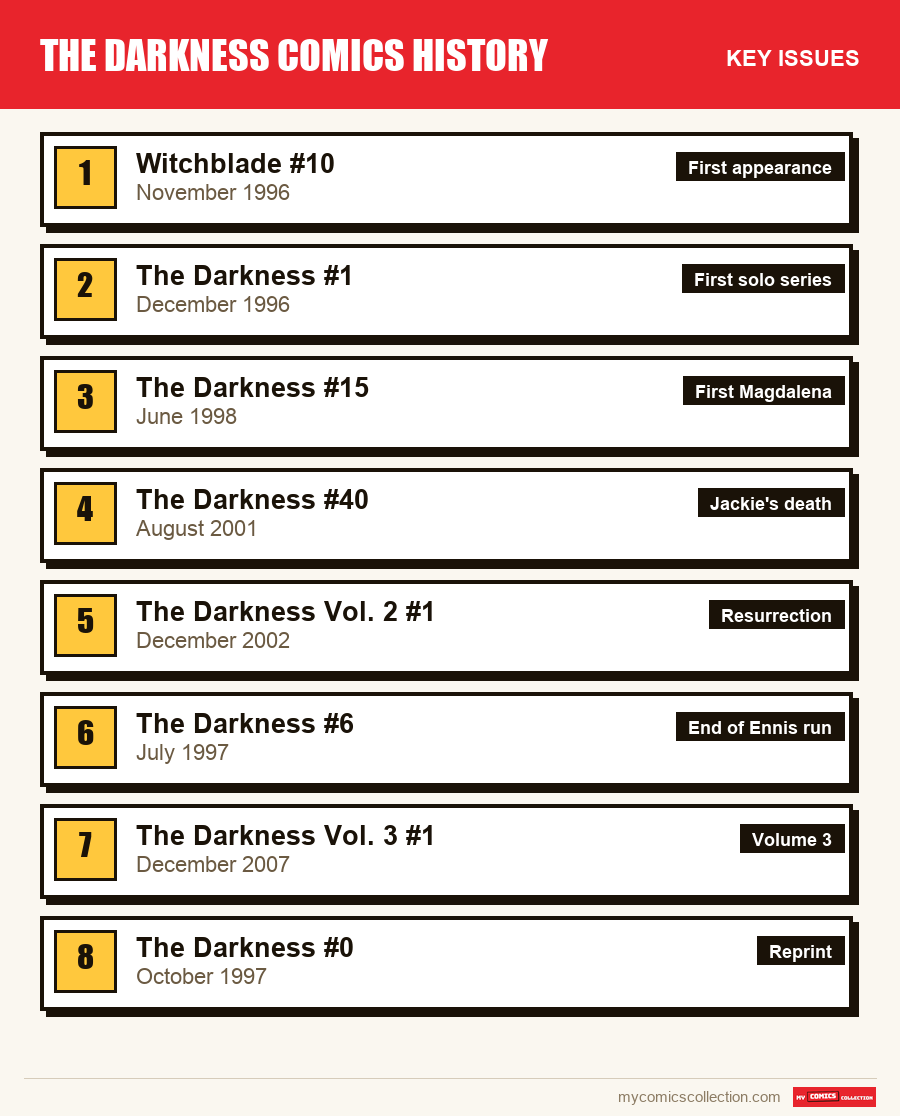
The Darkness was born in November 1996 in the pages of Witchblade #10, before receiving his own series signed Marc Silvestri, Garth Ennis and David Wohl at Top Cow (Image Comics) in December 1996. The character of Jackie Estacado, a New York mafioso possessed by an ancestral demonic force at the age of 21, spanned three volumes (1996-2001, 2002-2005, 2007-2013), inspired two video games (2007 and 2012) and today remains one of the most sought-after licenses in the Top Cow universe, with a Darkness #1 of which examples graded CGC 9.8 remain rare: 59 copies listed at the top of the census, with no higher grade.
Few characters born in the creative chaos of '90s indie comics have survived as long as The Darkness. Launched at a time when the Image Comics explosion was multiplying muscular antiheroes and chrome covers, Jackie Estacado could have been just another footnote in Top Cow's bloated catalog. On the contrary, it has become, alongside Witchblade, the pillar of one of the most coherent shared universes of American independent comics, carried by an ambitious mythology mixing mafia thriller, cosmic horror and counter theology.
This article retraces the complete editorial history of The Darkness: its genesis at Top Cow, the determining role of Garth Ennis and Marc Silvestri, the three volumes of the parent series, the crossovers which have woven the Top Cow universe around the character, as well as the concrete elements (variants, print runs, CGC census) which today make it possible to assess the real rarity of the most sought-after copies. We will also see how the video game adaptations, and the never-completed film adaptation, have shaped the perception of the character on the collector's market.
At the origins of The Darkness: the genesis of an antihero at Top Cow
According to Marc Silvestri's own confidences, the basic idea of The Darkness existed in his notebooks several years before its editorial realization: a hero whose powers would only work in darkness, a sort of inverted vampiric figure, without the fangs but with all the moral darkness expected of such a concept. This prototype sat on a shelf while Top Cow found the right vehicle to launch it. This opportunity presented itself in the mid-90s, when Witchblade had just established itself as a commercial success for the young studio founded by Silvestri within Image Comics. Building on this momentum, Top Cow chose to reveal its new character directly in the pages of the series which already wore its colors.
This is how Jackie Estacado, a hitman for the New York mafia, makes his first appearance in Witchblade #10, published in November 1996. On his twenty-first birthday, the character inherits an ancestral and malevolent force called Darkness, which gives him control over a shadow dimension populated by demonic creatures called Darklings. The creation of the character is credited to Marc Silvestri, Garth Ennis and David Wohl, an association which combines Silvestri's sense of visual worldbuilding with the sharp and willingly cynical pen of Ennis, then in full rise after his notable debut on Hellblazer and just before his definitive work on Preacher at Vertigo.
From Witchblade to the Solo Series: The December 1996 Launch
The success of this introduction into Witchblade #10 immediately validated the bet: in December 1996, Top Cow launched Darkness #1 as a standalone monthly series, written by Garth Ennis with Marc Silvestri serving as art and creative director. The first arc, entitled "Coming of Age", lays the foundations of the character's mythology: Jackie Estacado, already consumed by the guilt of a job as a killer that he practices for the Franchetti family, sees his life turned upside down when the Darkness fully manifests itself within him. The tone of Ennis' initial run contrasts with the classic superheroic production of the time: crude violence, black humor, social criticism and a real tenderness for a protagonist who nothing makes sympathetic on paper, except his fractured humanity.
Issue 1 was published in a variety of cover variations which, in hindsight, say a lot about the commercial practices of comics in the 90s: a version with a blue cover bearing the title of the first story, a version with a black cover which became the most common in collecting, a Platinum edition with a silver jacket, a convention exclusive with a sketch cover produced in limited edition, as well as an edition reserved for members of the Top Cow Fan Club. Signed copies also circulated, including a Dynamic Forces edition limited to 750 copies and an edition autographed by Marc Silvestri and inker Batt limited to 1,500 copies. This profusion of variants, characteristic of the comic boom era, partly explains why certain variations of number 1 remain difficult to locate in high conservation today, while the standard black version remains relatively abundant on the second-hand market.
Garth Ennis, a founding interlude before Preacher
Garth Ennis's appearance in the first six issues of the series deserves to be considered in his career. At the same period, the Northern Irish author laid the foundations of Preacher for Vertigo, the series which would lastingly mark his reputation as a transgressive author. His work on Darkness share with Preacher a pronounced taste for damaged characters, a very British way of treating American violence with a mixture of fascination and ironic distance, and a displayed skepticism towards any form of authority, whether religious, familial or criminal. Issues 1 to 6, published between December 1996 and July 1997, cover the stories "Coming of Age", "Underworld", "Almost An Angel", "Brought To Light", "Apocalypse Shortly" and "End of an Era": a founding arc which permanently establishes the character before Ennis hands over the pen to other in-house writers, notably David Wohl and Christina Z, who take over from issue 7 to direct the series towards a broader exploration of Top Cow mythology, particularly around the Estacado lineage and the ancestral war between Darkness and Angelus.
This shift in storyline, at number 7, also corresponds to the arrival of Michael Turner on alternate covers, symptomatic of a time when Top Cow multiplied the covers signed by its star artists to stimulate sales on newsstands and in specialized comic shops. Issue 11, with no less than a dozen different covers signed by artists as varied as Whilce Portacio, Brandon Peterson, Billy Tan, Joe Benitez, the Hildebrandt brothers, Dale Keown, Michael Turner, David Finch, Nathan Cabrera and Marc Silvestri himself, illustrates the extent to which the variant cover had become a central commercial argument for Top Cow at the turn of 1998.
Three volumes, a mythology that spans nearly twenty years
The editorial history of The Darkness is structured into three distinct volumes, each corresponding to a different phase in the evolution of the character and the independent comics market.
Volume 1 (December 1996: August 2001)
This first volume lays the foundations: origin of Jackie Estacado, war against the Angelus, exploration of the Darklings dimension, and gradual integration of the character into the shared universe of Top Cow alongside Witchblade. Issue 15, published in 1998, marks the first appearance of Magdalena, another central figure in the Top Cow mythology who will also give birth to her own series. Issue 16, in July 1998, was the last issue of the series sold for $2.50, a detail revealing the inflation of cover prices that marked the end of the 90s in the American comics industry.
Volume 2 (December 2002: November 2005)
After a break of more than a year, the series resumes with a numbering starting from 1. This second volume sees Jackie take control of the Franchetti family and face the Angelus once again. His daughter Hope, conceived with Sara Pezzini, the bearer of the Witchblade, is only born in 2007 in the First Born crossover: an event which permanently redefines the balance between the two mystical artifacts of the Top Cow Universe, the Darkness and the Witchblade being presented as the symbolic parents of the child.
Volume 3 (December 2007: December 2013)
The third volume, the longest in the character's history, sees Jackie Estacado take control of the fictional microstate of Sierra Muñoz to build an open-air criminal empire, before facing a new central antagonist called the Sovereign as well as a former Bringer of Darkness named Aram. This period coincides with the release of two video games which considerably broadened the character's notoriety beyond the traditional comic book readership.
A shared universe: Angelus, Witchblade and the big crossovers
One of the specificities of the Top Cow Universe is its internal coherence: Darkness, Angelus and Witchblade form a mythological triptych where each artifact or entity responds to a precise cosmological principle, Darkness embodying the original void from which everything comes, in constant but complementary opposition with the light of the Angelus. This architecture allowed Top Cow to multiply structuring crossovers without ever giving the impression of a simple marketing stunt. The Witchblade/Darkness crossover, with the crossover issues Witchblade #36, Witchblade/Darkness #1 and Darkness/Witchblade #1, as well as issue 28 of the solo series, illustrates this mechanic well: Sara Pezzini and Jackie Estacado, unable to prevent their respective powers from clashing in each encounter, are nevertheless brought back to each other by events, until revealing the deep link between their two artifacts.
Later, the “Broken Trinity” saga brought together Darkness, Angelus and Witchblade in a common arc intended to reposition the three pillars of the Top Cow universe for the 2010 decade. The Darkness also multiplied the incursions outside its original ecosystem, with occasional crossovers at Marvel (against Hulk, Ghost Rider or Doctor Strange) and at DC Comics (against Batman, Superman or the Justice League), as well as a notable clash against Eva, daughter of Dracula, in The Darkness vs. Eva: Daughter of Dracula. These inter-publisher meetings, more frequent in the 90s and 2000s than today, contribute to the legend of the character and remain sought after by collectors who follow a logic of “versus” rather than pure continuity.
Rarity, cover variants and CGC census data
For a collector looking to position themselves on The Darkness #1, the first thing to understand is that this issue does not exist in just one form. Between the blue “Coming of Age” cover, the standard black cover, the Platinum edition with silver dust jacket, the convention exclusive with sketch cover, the edition reserved for the Top Cow Fan Club and the limited number signed prints (750 copies for the Dynamic Forces edition, 1,500 for the edition autographed by Silvestri and Batt), there are at least seven distinct variants identified by specialist cataloguers. This multiplicity is a classic trap for the unwary buyer: two copies of “number 1” can have very different rarity and therefore desirability depending on the precise variant in the hands of the seller.
In terms of objective conservation data, the CGC (Certified Guaranty Company) census lists, on the variant concerned by the publicly available data, 59 examples graded at the maximum grade NM/MT 9.8, without any example having been graded above to date. This figure should be read with caution: it does not measure the absolute rarity of the issue: several tens of thousands of copies circulated at the time of its release, in accordance with Image Comics' printing standards in the mid-90s, but rather the rarity of conservation in almost perfect condition. A copy in 9.8 is structurally more difficult to find than a copy in VF or NM, which explains the premium that this grade systematically imposes on the graded sales market, without a fixed amount being able to be advanced here as prices evolve according to the precise variant, the sales period and the platform.
To situate number 1 in the rest of the series, we must also keep in mind that certain later issues concentrate specific collector's interest regardless of their numbering: number 15 for the first appearance of Magdalena, number 16 as the last issue at the historic cover price of $2.50, or even the Witchblade/Darkness crossovers for readers who follow the crossover continuity of the Top Cow universe. These issues, less publicized than number 1, can represent more affordable entry points for building a coherent collection around the character.
Collecting this series?
Track what you own, what you are missing and what your collection is worth. 7 day trial.
Start my trial →The impact of adaptations on the rating
Unlike licenses that have benefited from massive cinematic exposure, The Darkness followed an atypical adaptation trajectory, made of a real video game success and a film project that remained stuck in development for almost two decades. In 2007, Starbreeze Studios developed Darkness, a first-person shooter published by 2K Games on PlayStation 3 and Xbox 360, with Jackie Estacado played by actor Kirk Acevedo and the voice of Darkness entrusted to Mike Patton, singer of Faith No More. The game, praised by critics for its atmosphere and the originality of its gameplay mixing firearms and demonic powers, exposed the character to a much wider audience than that of traditional comics. A sequel, The Darkness II, developed by Digital Extremes, was released in 2012 on PC, PlayStation 3 and Xbox 360, extending this mainstream notoriety at the same time as volume 3 of the paper series explored the arc of Sierra Muñoz.
On the cinematographic level, however, the story is that of a project perpetually relaunched without ever coming to fruition. Dimension Films acquired the adaptation rights in December 2004 with the ambition of a release around 2008, before these rights were sold to the Hong Kong directors known as the Pang brothers in December 2005. The project then remained silent until Comic-Con 2009, where Matt Hawkins, president of Top Cow, announced that a live action film was again in development, this time with Scott Stuber Productions as producer. In 2012, it was director Len Wiseman (known for the franchise Underworld) which is briefly attached to the project. Since then, no theatrical release has materialized. This absence of a film to date distinguishes The Darkness from obvious comparisons like Spawn or Hellboy, and partly explains why the character's rating remains driven almost exclusively by the nostalgia of the readership for comics from the 90s and by the memory of the two video games, rather than by a peak in demand linked to a recent cinema release: a factor that collectors must take into account when comparing the dynamics of this license to that of other Top Cow or Image Comics characters who have benefited from successful adaptations.
Another significant milestone for the character's rating is the 25th anniversary of the series, celebrated in 2020 with a commemorative edition of number 1, followed in 2023 by an authentic editorial return: Marc Silvestri himself takes up the pen to relaunch the series, supported in particular by the artist Christopher Mitten, with an exclusive Kickstarter edition of number 1/2 which has revived collectors' interest in the first original publications of 1996, in a well-known dynamic where the return of an original creator to his own license tends to renew the attention paid to his origins.
Buying guide
Before investing in a copy of The Darkness, whether it is the founding number 1 or a key later issue, a few concrete reflexes allow you to avoid the most common pitfalls linked to this series rich in variants.
- Identify the variant precisely before bidding. Number 1 exists in at least seven variations (blue, black, Platinum silver, convention sketch, Fan Club, Dynamic Forces signed in 750 copies, Silvestri/Batt signed in 1,500 copies): an ad that simply mentions “Darkness #1” without specifying the cover must always be clarified with the seller before purchase.
- Check if the copy is Witchblade #10 or Darkness #1. These are two separate comics, published a month apart: the first contains the very first appearance of the character, the second is the launch of his solo series. Both are sought after but for different reasons, and their relative rarity is not the same.
- Favor graded examples for high grades. With only 59 copies listed at maximum grade 9.8 on the variant concerned, a CGC certificate or equivalent remains the only reliable means of guaranteeing the condition declared on an issue published almost thirty years ago.
- Do not neglect key numbers other than number 1. Number 15 (first appearance of the Magdalena) or the Witchblade/Darkness crossovers offer interesting entry points for a thematic collection around the Top Cow universe, often at a more measured acquisition cost than number 1.
- Compare several recent sales before setting a budget. The rating of this type of independent comics from the 90s fluctuates more than that of major historical Marvel or DC titles; relying on several real transactions rather than a single announcement avoids unpleasant surprises.
- Be wary of reissues and facsimiles. The 25th anniversary commemorative edition (2020) and the “Top Cow Classics in Black and White” type reissues are clearly identified as such by the publishers but can be confused with the original by an inattentive buyer; the original cover price ($2.50 for early issues) and the Top Cow logo of the era are useful benchmarks.
- Check the condition of the interior pages, not just the cover. The paper used by Top Cow in the mid-90s is prone to yellowing; a copy with an impeccable cover but amber pages will significantly lose potential grade.
For collectors who follow several Top Cow series in parallel (Witchblade, Magdalena, Angelus or The Darkness) organizing your collection with a dedicated tool allows you to keep an overview of the issues already acquired, the missing variants and the evolution of the estimated value of each copy over time. This is precisely the role of our collection management application, designed for this type of multi-series monitoring.
Key issues to know
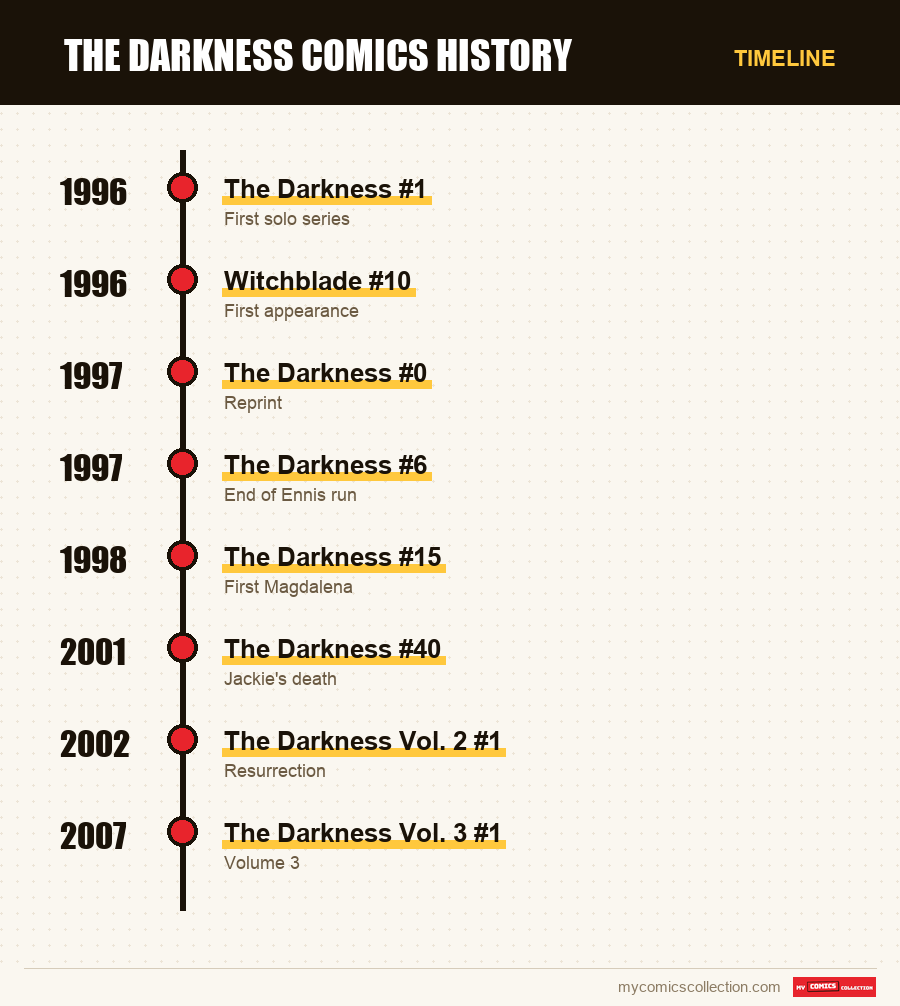
Witchblade #10
Jackie Estacado, a New York Mafia hitman, debuts in Top Cow's flagship series, written by David Wohl and Christina Z and drawn by Marc Silvestri. It is the very first appearance of the Darkness bearer, one month before his own series launched.
The Darkness #1
Garth Ennis on script and Marc Silvestri on art open the series with "Coming of Age": at 21, Jackie feels the Darkness awaken within him. The issue also marks the first appearance of Jenny Romano, his childhood love. It exists with several covers, something to check before any purchase.
The Darkness #15
Written by Malachy Coney and drawn by Joe Benitez, this issue introduces the Magdalena, the Church's warrior who wields the Spear of Destiny. The character would become a pillar of the Top Cow universe and eventually earn her own series.
The Darkness #40
The final issue of the first volume, by Paul Jenkins and Dale Keown. After Uncle Frankie murders Jenny, Jackie blows up the warehouse holding the Franchetti crew and dies in the flames. A radical ending that sets up the resurrection in volume 2.
The Darkness Vol. 2 #1
Paul Jenkins and Dale Keown relaunch the series with numbering back at 1. Back from Hell, Jackie has his body rebuilt by the Darkness and finds the Franchetti family now run by one of Frankie's cousins. It is the starting point of the second volume, published until 2005.
The Darkness #6
"End of an Era" closes the founding arc by Garth Ennis and Marc Silvestri and Jackie's first great clash with the Angelus. From the next issue, David Wohl and Christina Z take over the writing. The first six issues form the bedrock of the character's mythology.
The Darkness Vol. 3 #1
The third volume, the longest in the series, opens with Jackie seizing power in Sierra Muñoz, a fictional South American republic, to build his own empire. It arrived around the time of the first video game and carried the series through to 2013.
The Darkness #0
Titled "Prelude", this issue zero reprints the Witchblade #10 story in which Jackie Estacado first appears. It lets readers enjoy that origin without the original, but it is not the true first appearance: check the title and cover date carefully before buying.