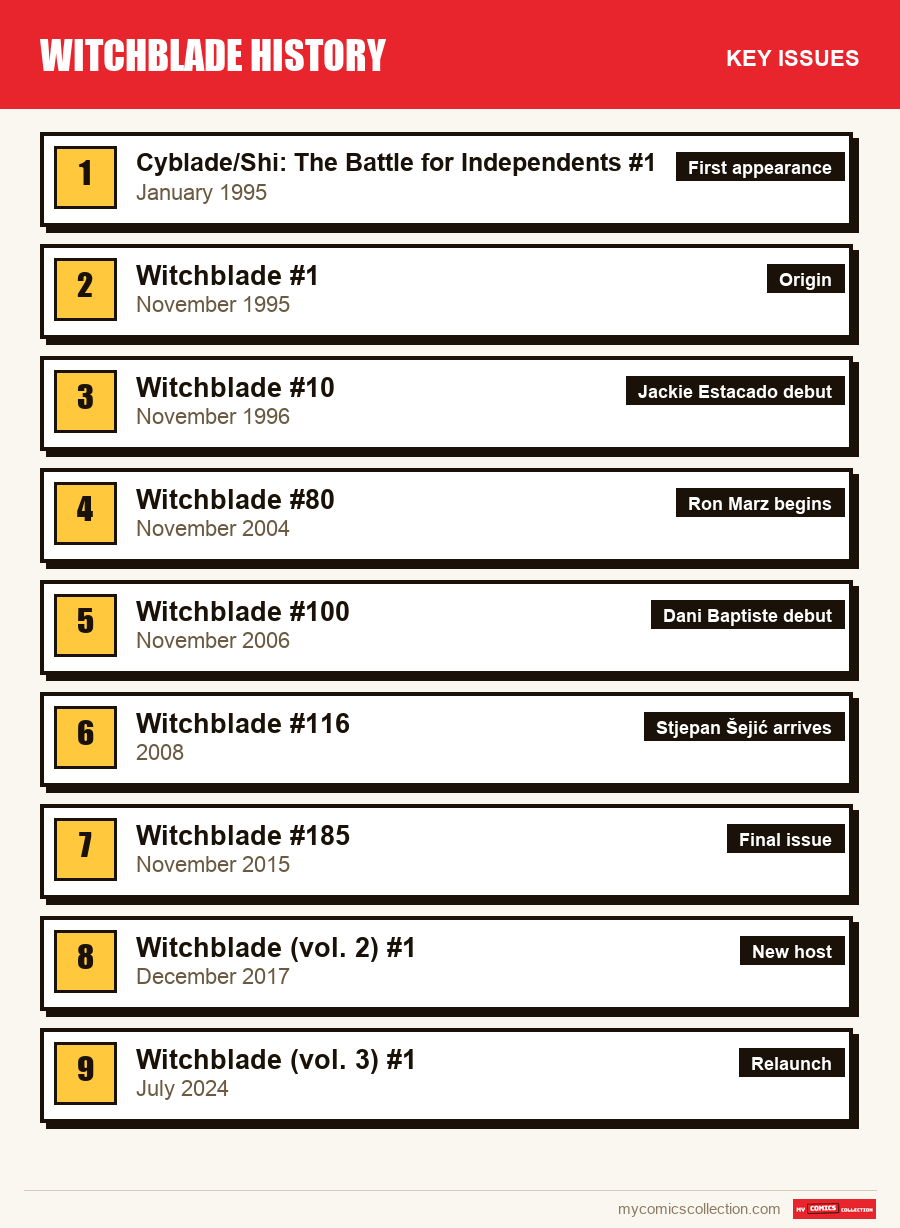
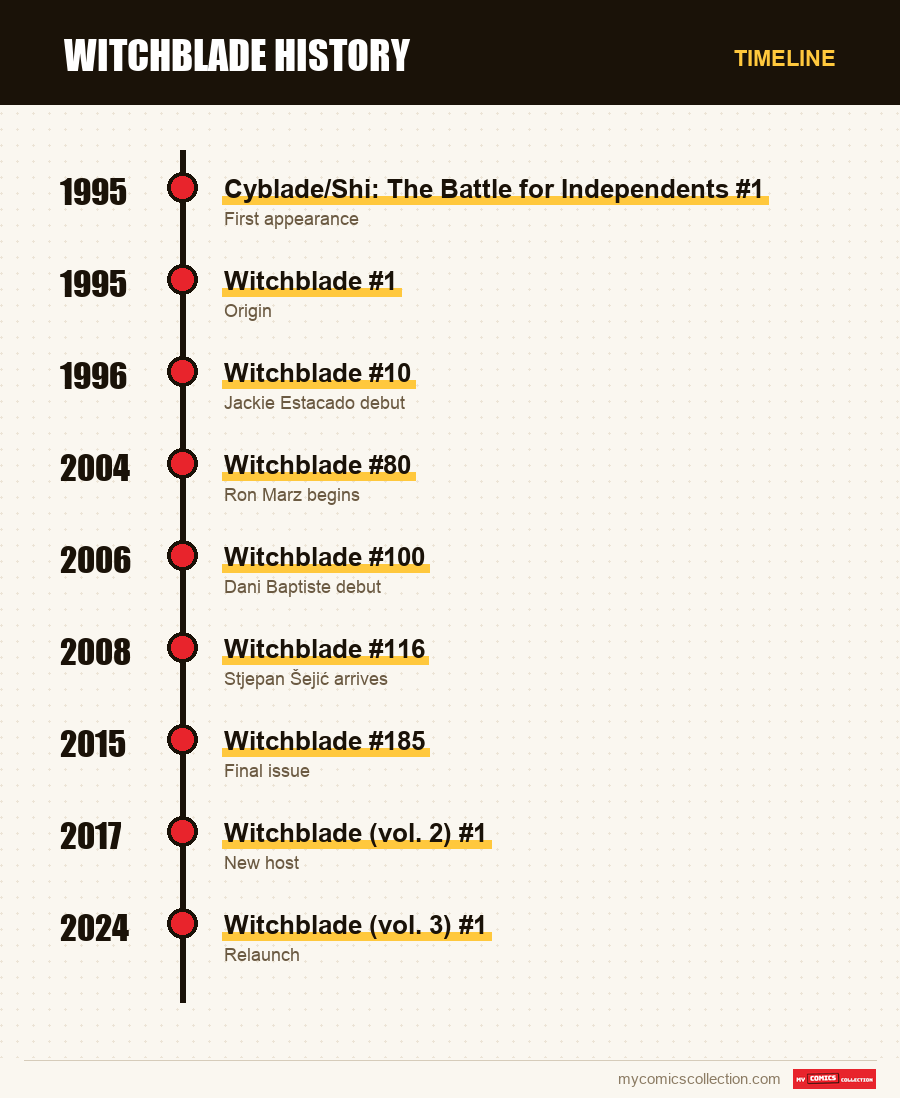
Witchblade was born in 1995 at Top Cow, the studio founded by Marc Silvestri within Image Comics. Sara Pezzini, New York detective carrying the mystical artifact, appears for the first time in the crossover Cyblade/Shi: The Battle for the Independents #1 (January 1995) before landing his own series with Witchblade #1 (November 1995), drawn by Michael Turner. Driven by the “bad girl” aesthetic and the wave of variant covers of the mid-90s, the series became one of the commercial pillars of Top Cow, inspired a television series on TNT (2001-2002) then a Japanese anime (2006), before ending with issue #185 in November 2015. A first relaunch ran from December 2017 to 2020, by Caitlin Kittredge and Roberta Ingranata, centered on a new bearer, journalist Alex Underwood. It was then reborn in July 2024 under the pen of Marguerite Bennett, with an origin story redesigned for a new readership.
Few characters embody the spirit of the '90s Image era as well as Witchblade. Neither quite a superhero, nor quite an anti-heroine, Sara Pezzini carries on her arm a living artifact capable of transforming into organic armor and a cutting weapon, at the cost of a control that she never fully masters. The concept, half-thriller, half-fantastic, allowed Top Cow to build an entire mythology parallel to that of Marvel and DC, with its own artifacts, its own crossovers and its own collection economy.
This article traces the complete editorial history of Witchblade: its birth in the creative and commercial chaos of 1995's Image, the variant cover craze that shaped its first issue, the creative team changes that redefined the character over two decades, its forays into animation and television, its end in 2015 and its recent relaunch. If you are looking for a concrete selection of numbers to own to invest in or complete your collection, the article Witchblade key numbers details the priority episodes with their rarity criteria: here, we focus on the story and context that explain why these numbers matter.
At the origins: Top Cow, Image Comics and the birth of an artifact
To understand Witchblade, you have to go back to 1992. That year, seven star Marvel artists: including Marc Silvestri, then star artist on Uncanny X-Men: left home to found Image Comics, a structure where creators retain the rights to their works. Silvestri set up his own studio there, Top Cow Productions, with the ambition of developing a distinct shared universe, darker and closer to the supernatural thriller than to the classic superhero. Three years later, this studio features a narrative object that will become its signature: the Witchblade, a mystical gauntlet with its own consciousness, which chooses its wearer through the centuries and grants her devastating power in exchange for a share of her free will. The idea is brought forward collectively by Marc Silvestri (co-creator, covers), David Wohl (writer and editor, at the origin of the concept with Silvestri), Brian Haberlin and Christina Z (screenplay), and especially Michael Turner, a young artist whose style (stylized analyses, dynamic cut-outs, pin-up covers) will define the visual identity of the character for an entire generation of readers.
A first appearance prior to the series itself
Contrary to popular belief, the very first appearance of Sara Pezzini and the Witchblade does not take place in Witchblade #1. It occurs in Cyblade/Shi: The Battle for the Independents #1, published in January 1995: a crossover one-shot bringing together the heroines of several studios linked to Image (Top Cow and Billy Tucci's Crusade Comics), originally thought of as a promotional tool to launch several future series. This issue is where Witchblade debuts, ten months before its own monthly series. There is even an earlier level: the Cyblade/Shi Preview, a promotional booklet distributed in advance, which contains plates and pin-ups by Michael Turner presenting the character even before the crossover: the CGC census of this Preview remains very limited, with nineteen copies rated 9.8 recorded to date, no higher copy having been identified. This anteriority has a direct consequence on the collection hierarchy: for a collector who seeks the true “first appearance”, Cyblade/Shi #1 premium on Witchblade #1, which nevertheless remains the founding number of the solo series and the one which really launched the commercial phenomenon.
1995: the launch and the crazy mechanics of variant covers
Witchblade #1 was released in November 1995 by Image/Top Cow, at a price of $2.50 for 36 pages. The issue quickly established itself as a commercial success for an independent publisher: it ranked among the best sellers of the month for all houses combined, a rare result for a title outside Marvel/DC at that time, and established sales records for Top Cow. Michael Turner's cover, depicting Sara Pezzini half-dressed in the Witchblade's organic armor, became an iconic image of the "bad girl" aesthetic that was then running through the independent comics industry. The success of the issue also took place in a very particular context: the 1995 comic book market was still marked by the speculative bubble of the beginning of the decade, where publishers multiplied variant covers to stimulate sales to collectors and stores. Witchblade #1 is no exception to the rule: there are at least ten different versions of the number: gold foil logo for the counters, “Jay Company Color” variant with gold logo, Dynamic Forces edition limited to 800 copies, edition signed by David Wohl limited to 1,250 copies, among other variations. This profusion of variants, typical of the period, today complicates the precise identification of prints for a collector who discovers the series retrospectively: a point on which one must be particularly vigilant before purchasing (see the buying guide section below).
The Golden Age of Top Cow: Darkness, Angelus and the Shared Universe
The success of Witchblade allows Top Cow to quickly build a true shared universe around the concept of “artifacts”: thirteen mystical objects scattered throughout the story, each linked to a cosmic force. In 1996, the studio launched Darkness, sister series centered on Jackie Estacado, a hitman linked to a dark force in symbolic opposition to the Witchblade carried by a figure closer to the Angelus, a protective entity associated with Sara Pezzini. This narrative complementarity between the two series creates a dynamic of crossovers which will become a trademark of the studio for almost twenty years. The scale of the success of this period can be measured in one number: Darkness #11, released in 1997, became the best-selling comic book of the year, all publishers combined: a performance that Top Cow itself would later describe, through its president Matt Hawkins, as the peak of its "second era", with Witchblade and The Darkness as flagship titles. This period permanently established Top Cow as the most powerful studio in the Image movement outside of the historical founders.
Changes of guard: from Michael Turner to Ron Marz and Stjepan Sejic
Like many series originally carried by a star artist, Witchblade goes through several creative generations after the gradual departure of Michael Turner towards other projects (he notably co-founded Aspen Comics in 2003). Several writers and artists from the Top Cow workshop succeeded one another during the late 90s and early 2000s, in a context where the series had to manage both the continuity of its shared universe and the renewal of its readership. The most significant turning point came in 2004, when screenwriter Ron Marz: already known for his work on Green Lantern at DC: takes over the writing of the series from issue #80. His stint, which spans eleven years with an interruption of nineteen issues during which Tim Seeley provides the script while Marz devotes himself to the crossover maxi-series Artifacts, will profoundly redefine the character. Starting with issue #116, Croatian artist Stjepan Sejic joins the title to the art and initiates a gradual redesign of the Witchblade's armor, designed to function visually as a true organic armor rather than as a simple suggestive costume: a stylistic evolution that accompanies a deeper treatment of Sara Pezzini as a single mother and investigator, praised at the time for her more nuanced approach to the female and queer characters of the Top Cow universe. In 2008, the crossover event Broken Trinity brings together Witchblade, Angelus and Darkness in a major story arc intended to reignite interest in the entire shared universe. The same year, Michael Turner died of cancer at the age of 37: a loss that had a profound impact on Top Cow, whose founding image he had designed. In 2010, the maxi-series Artifacts, written by Ron Marz, brings together all the bearers of the studio's thirteen artifacts in a sum story which symbolically closes the great mythological cycle opened fifteen years earlier by Witchblade.
The end of an era: issue #185 and the end of the series in 2015
After twenty years of uninterrupted existence: a rare feat for a creator-owned series outside of the two major publishers:, Witchblade ends with issue #185, a double episode released on November 25, 2015. Ron Marz, still in charge of the main storyline, completes the arcs started around Sara's return to New York and her quest for a legitimate carrier to whom to transmit the artifact; The issue also includes a companion story by Marc Silvestri himself and Matt Hawkins, President and COO of Top Cow. This conclusion is part of a broader reorganization of the studio's editorial policy, which then chose to put an end to several historic monthly series in favor of a format more focused on mini-series and new launches. The series leaves behind a continuity of 185 regular issues, not counting the countless one-shots, annuals, derivative mini-series and crossovers published in parallel since 1995 - a corpus which explains why the identification of "real" key issues (as opposed to derivative products with low circulation) requires particular attention, a subject covered in detail in our Witchblade key numbers guide.
The impact of adaptations on the rating
Witchblade is one of the rare Top Cow creations to have gone beyond the comic book framework to reach television and animation, with a measurable effect on collector interest around the very first issues. In 2001, the American cable channel TNT broadcast a pilot television film followed by a spin-off series with actress Yancy Butler in the role of Sara Pezzini. Driven by good audiences for basic cable, the series got a full season and continued until 2002, for a total of twenty-four episodes over two seasons. Its termination, in September 2002, remained associated with the personal difficulties of its main actress rather than public disavowal: Matt Hawkins went so far as to describe the series as "the highest rated television series ever canceled". This live-action adaptation permanently associated the face of Sara Pezzini with a wider audience than that of comic book readers, and maintained demand for the very first issues of the series during the 2000s. In 2006, it was Japan's turn to take on the character: the animation studio Gonzo produced an anime of twenty-four episodes broadcast from April 6 to September 21, 2006 on the CBC and TBS channels. The program does not, however, take up the story of Sara Pezzini: it invents a new carrier, Masane Amaha, amnesiac and hunted by social services with her daughter, hired by a company executive to track down semi-conscious weapons escaped from a laboratory. Only the concept of the Living Artifact is carried over-a choice that introduced the character to an international audience without directly driving demand for the original American issues, with the anime functioning more as a standalone spin-off product than a faithful adaptation. A first relaunch ran from December 2017 to 2020, by Caitlin Kittredge and Roberta Ingranata, centered on a new bearer, journalist Alex Underwood. More recently, in February 2023, Marc Silvestri unveiled a new armor design for the Witchblade as a Kickstarter exclusive, a harbinger of a return of the character to the forefront of the editorial scene. This return materializes in July 2024 with the launch of a brand new series Witchblade, written by Marguerite Bennett and drawn by Giuseppe Cafaro (with colors by Arif Prianto), under the creative supervision of Marc Silvestri, still CEO of Top Cow. This relaunch offers an origin story reimagined for a contemporary readership: Sara Pezzini, a New York police detective haunted by the murder of her father, tracks down an underground criminal cartel when she comes into contact with the artifact that will transform her life. This type of relaunch has a classic effect on the vintage market: it puts the original series back in the spotlight with a new audience of readers curious to discover the origins of the character, which tends to revive the attention paid to the very first issues from 1995 rather than immediately increasing its value: a movement to watch over the coming months rather than an already confirmed signal.
Collecting this series?
Track what you own, what you are missing and what your collection is worth. 7 day trial.
Start my trial →Buying Guide: What to Check Before Buying a Vintage Witchblade
- Distinguishes the real first appearance from the launch of the series. Cyblade/Shi: The Battle for the Independents #1 (January 1995) precedes Witchblade #1 (November 1995) of ten months: if your goal is the "very first appearance", it's this crossover that you should look for, not just number 1 of the solo series.
- Accurately identifies the variant and print run of Witchblade #1. With around ten different versions (standard cover, gold foil logo, Jay Company variant, Dynamic Forces prints, signed edition limited to 1,250 copies), the price and rarity vary greatly from one variant to another: always check the print mention and compare with an online collaborative database before purchasing.
- Checks the condition of the paper. The Image comics of the mid-90s used paper of varying quality; prioritizes copies with white pages or close to white pages, a criterion that weighs heavily in the CGC/CBCS rating and in the resale value.
- Don't confuse spin-off series with the main continuity. Between Darkness , Angelus , Broken Trinity , Artifacts and the countless one-shots and annuals, the Top Cow universe multiplies the parallel titles: make sure that the issue you buy belongs to the series Witchblade vol. 1 (1995-2015) if it's the main continuity you're looking for.
- Find out about the census before paying a high-end premium. For low diffusion prints such as Cyblade/Shi Preview, the number of examples listed in very high grade remains limited: a copy graded 9.8 does not have the same rarity depending on whether there are a few dozen or several hundred in the census.
- Distinguishes between signed copies and standard copies. Dynamic Forces editions signed by David Wohl, Michael Turner or Marc Silvestri, as well as Signature Series CGC copies authenticated by convention, trade in a different market segment from unsigned copies: always compare comparable sales (same variant, same signature or absence of signature).
- Keep an eye on the effect of the 2024 stimulus. A new active series tends to bring readers back to the origins of the character: this is a good time to monitor the evolution of demand for the very first issues rather than buying in haste on a one-off peak.
To track actual price developments on current eBay listings rather than theoretical estimates, our free estimator calculates a low, middle and high range from current eBay listings. And if you manage a collection that goes beyond a few issues of Witchblade, the collection management application allows each variant, edition and condition to be precisely cataloged, which greatly simplifies the monitoring over time of a series as fragmented as this one.
Why Witchblade remains a textbook case in the history of independent comic books
Beyond its intrigue and its aesthetics, the editorial history of Witchblade illustrates several structuring dynamics of the comic book industry since the mid-90s. It is first of all a textbook case of the mechanics of variant covers and the speculation which marked the independent market in 1995, with its effects still visible today on the difficulty of identifying print runs. It is then a rare example of a creator-owned series having lasted twenty years without interruption outside the two major historical publishers, carried by several generations of screenwriters and artists capable of developing the character: from the very marked "bad girl" aesthetic of Michael Turner to the more nuanced reading that Ron Marz and Stjepan Sejic would offer a decade later. It is finally a title that has managed to cross the media barrier, with an American television adaptation and a Japanese anime with radically different biases, before returning in 2024 in a redesigned form for new readers. For a collector, this editorial wealth is both an opportunity and a trap: opportunity, because the character's history offers numerous collection entry points, from the founding crossover of January 1995 to the 2024 relaunch via the major Top Cow crossovers of the 2000s; trap, because the multiplication of variants, prints and derivative series requires systematic verification before each purchase. It is precisely this practical dimension (which numbers exactly to look for, in what order of priority) that our Witchblade key numbers guide, complementary to this historical retrospective.
Key issues to know
Cyblade/Shi: The Battle for Independents #1
This crossover between Top Cow and Crusade, drawn by Marc Silvestri, brings Cyblade and Shi together. Sara Pezzini and the Witchblade make their debut here, months before the ongoing series. For anyone after the character's very first appearance, this issue comes before Witchblade #1.
Witchblade #1
The series' first issue, drawn by Michael Turner. Undercover at an auction run at the Rialto by Ian Nottingham for Kenneth Irons, detective Sara Pezzini is gravely wounded shielding her partner Michael Yee. The gauntlet then bonds to her arm and heals her. The whole mythology of the series starts here.
Witchblade #10
Michael Turner and Marc Silvestri introduce Jackie Estacado, a hitman raised by the Franchetti crime family, who crosses paths with Sara in an alley. The future host of the Darkness, he goes on to headline the sister series The Darkness. This is the birth of the pair of artifacts at the heart of the Top Cow universe.
Witchblade #80
The first chapter of "Witch Hunt", drawn by Mike Choi, marks Ron Marz's arrival as writer. He writes the series through #150, then again from #170 to the final issue, and gives Sara Pezzini new depth. It is the best entry point into the second half of the series.
Witchblade #100
The hundredth issue introduces Danielle Baptiste, a young dancer from New Orleans. Pregnant, Sara soon hands her the Witchblade, before the artifact ends up split between the two women. Dani later becomes the host of the Angelus.
Witchblade #116
The start of the "Advent" arc and the arrival of Croatian artist Stjepan Šejić alongside Ron Marz. He draws the series through #150, the longest run by a single artist on the title. A milestone for fans of the Marz era.
Witchblade #185
The final issue of the original series, written by Ron Marz. It closes Sara Pezzini's journey as the Witchblade's host and her search for a worthy successor. It brings twenty years of continuous publication at Top Cow to an end.
Witchblade (vol. 2) #1
The series' first relaunch, handled by writer Caitlin Kittredge and artist Roberta Ingranata. The Witchblade chooses a new host, journalist Alex Underwood. This version, published from 2017 to 2020, bridges the original series and the 2024 relaunch.
Witchblade (vol. 3) #1
Marguerite Bennett (script) and Giuseppe Cafaro (art) relaunch the series with Sara Pezzini, under Marc Silvestri's oversight. The origin is rethought for a new readership: the detective encounters the artifact while hunting a criminal network. It is the most recent way into the character's world.