Michael Layne Turner (April 21, 1971: June 27, 2008) is the American cartoonist who co-created Witchblade at Top Cow in 1995, launched his own universe with Fathom in 1998, then founded his publishing house Aspen MLT in 2002. Diagnosed with chondrosarcoma (cancer of the pelvic bones) in 2000, he continued to draw during eight years of treatment before dying at age 37. Its founding comics (Witchblade #1, Fathom #1, Soulfire #1 and its run on Superman/Batman) remain among the most sought-after pieces of the Image/Top Cow era of the 1990s-2000s.
There are a handful of artists whose lineage alone was enough to sell a comic. In the 1990s, when Image Comics was exploding sales scores with a new generation of star cartoonists, Michael Turner belonged to this very restricted category. His style-slender analyses, dynamic drapes, piercing gazes, and poster-like cover compositions-defined the visual identity of Top Cow Productions and then his own label, Aspen MLT, for more than a decade.
Her journey is also a story of resilience. Diagnosed with a rare bone cancer while at the height of his career, Turner continued to produce covers, scripts and character designs until the final months of his life, refusing to let the disease interrupt the studio he had built. This article traces, with available verified facts, the path from background illustrations at Top Cow to the founding of a recognized independent label, and explains why some of its founding comics continue to interest collectors today.
We will also see how to approach the purchase of his key works (variants, editions and gradation pitfalls included) without ever putting forward a figure that is not supported by a verifiable source.
From background illustrations at Top Cow to the consecration with Witchblade
Michael Layne Turner was born on April 21, 1971 in Crossville, Tennessee. After studying at the University of Tennessee and then a stint at the International Performing Arts Academy, he settled in San Diego, California: a city that, with its annual Comic-Con, would become a central anchor in his career. It was there, during a convention, that he was spotted by Marc Silvestri, the founding artist of Top Cow Productions, one of the Image Comics member studios created by dissident Marvel artists in the early 1990s.
Like many young artists joining an established studio, Turner started at the bottom: he produced background illustrations and finishes on existing Top Cow titles, without being credited on the cover. This period of learning, often minimized in general public biographies, was nevertheless decisive: it allowed him to assimilate the visual codes of the studio (exaggerated anatomy, dense ink shading, cinematographic staging) before redefining them in his own way a few years later.
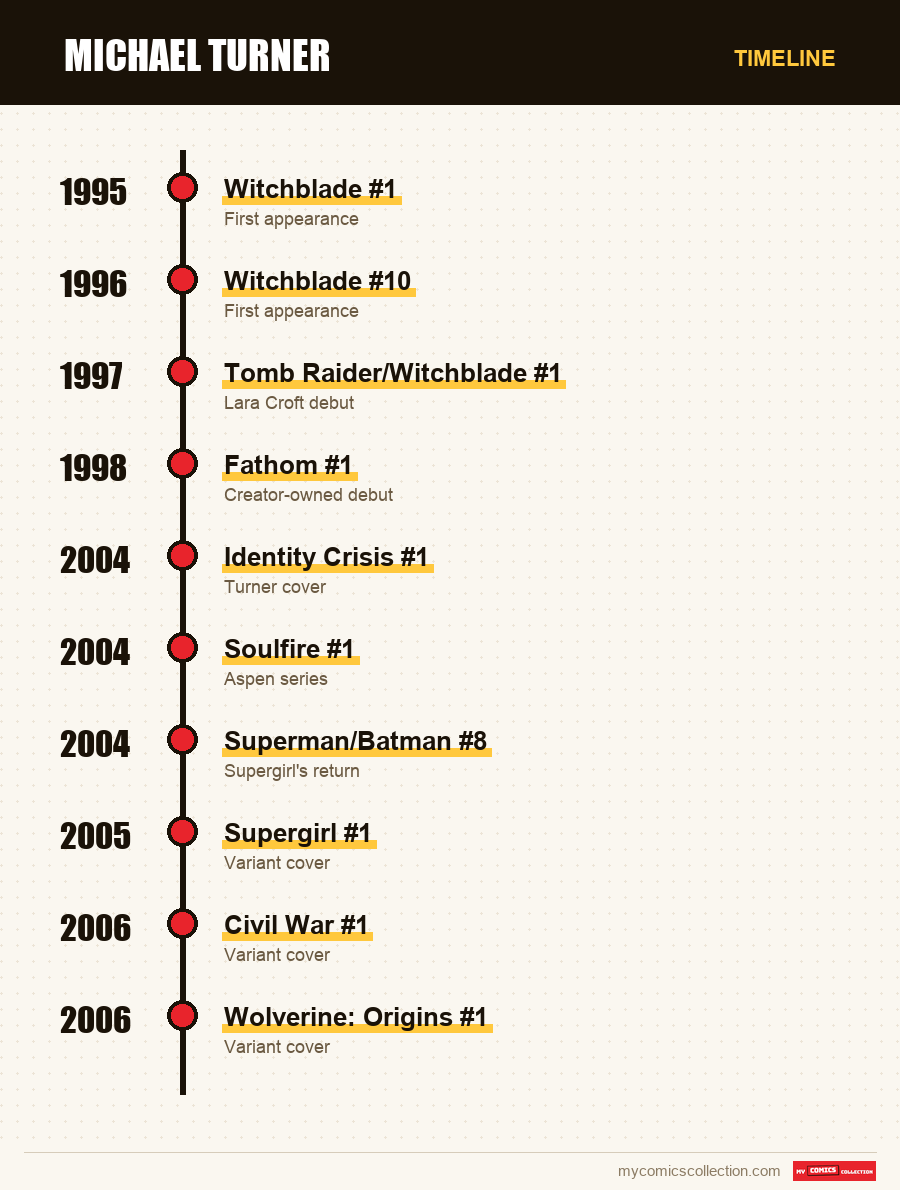
The turning point comes with Witchblade, the series that would become one of Top Cow's commercial pillars. Turner was part of the founding creative team alongside David Wohl and Brian Haberlin on the story side, and drew on issues #1 to 8, then #10 to 23 and #25, between 1995 and 1998. The first issue, published on October 31, 1995 by Image Comics for $2.50, features New York police detective Sara Pezzini and the eponymous mystical artifact which binds it. The cover character drawn by Turner (stylized female silhouette, organic armor, dynamic pose) quickly became a reference image of American comics of the 1990s, reproduced on dozens of promotional materials and reissued multiple times, including in the form of a facsimile edition in 2025 with a cover signed Turner.
The success of Witchblade catapulted Turner to cover art stardom. At a time when the American comic book market was going through a crisis of overproduction and speculation on variant covers, his name became one of the few reliable selling points: a Turner cover, alone, could increase pre-orders for an issue from distributors.
The Birth of Fathom: Turner's First Personal Universe
Building on the recognition acquired on Witchblade, Turner develops his own creative universe. In the summer of 1998, he launched Fathom, published under the Top Cow label within Image Comics, with issues #0 to #14 published between 1998 and 2002. The series follows Aspen Matthews, a marine biologist who discovers that she belongs to a race of aquatic humanoids called the Blue, capable of controlling water: a premise which allows Turner to develop a visual language very different from the urban and gothic aesthetic of Witchblade: flowing curves, blue-green palettes, detailed sea creatures.
Fathom is not just another series in the Top Cow catalog: it is the first creation of which Turner retains full intellectual property, a choice which directly foreshadows the structure that he will put in place with Aspen MLT a few years later. The very name of the main character, Aspen, became that of his company: a sign of Turner's personal attachment to this universe. The first issue had numerous cover variations over the course of reissues and convention exclusives (notably an exclusive Wizard World Chicago edition), a phenomenon characteristic of the period and which today complicates the precise identification of the prints for collectors.
In parallel with Fathom, Turner is also working on the beginnings of Soulfire, a fantasy series that he only managed to fully launch in 2004, under the Aspen label, with issues #0 to #7 published until 2005. Soulfire confirms his taste for fully controlled fantasy universes, where he controls the script, the design of the characters and the artistic direction: a creative autonomy that was increasingly rare for a designer of his notoriety at that time.
The departure of Top Cow and the founding of Aspen MLT
At the end of 2002, Michael Turner left Top Cow Productions to found his own structure, Aspen MLT Inc. the initials MLT referring to Michael Layne Turner. The company is based in Santa Monica, with a production studio in Marina del Rey, California. This departure was not without friction: a dispute over the rights to certain creations between Turner and Top Cow was settled by an agreement in 2003, allowing Turner to start again on a clear basis with his new house.
Aspen MLT is not only the vehicle for Turner's solo career: it is a real studio-publisher, designed to develop several series in parallel (Fathom , Soulfire, then creations of other artists he mentored) and to offer Turner creative and financial control that an artist employed by a major studio could not obtain. It's the same model that many of his contemporaries from Image Comics had adopted: building a personal brand rather than remaining a mere implementer for a third-party publisher.
The fight against cancer, alongside a still active career
It was in March 2000, when he was at the height of his notoriety on Witchblade and just launched Fathom, that Turner was diagnosed with chondrosarcoma, a rare form of bone cancer affecting the pelvis. The treatments were heavy: he lost a hip, around 40% of his pelvis and several bones, and underwent nine months of radiotherapy. Despite this, Turner continued to draw: a fact regularly highlighted by his colleagues and the specialist press of the time as a mark of exceptional determination.
This period of chronic illness, which extended over nearly eight years until his death, partly explains why some of his series (notably Soulfire and various announced projects at Aspen, such as the unfinished collaboration Ekos with screenwriter Geoff Johns) experience publication delays or never see the light of day in their originally intended form. The production pace of a studio heavily dependent on the health of its founder-lead artist necessarily suffered, a point that Aspen officials themselves publicly acknowledged after his death.
Superman/Batman and the covers that marked Marvel and DC
In the mid-2000s, Turner expanded his work beyond his own label, illustrating bows and covers for the two major historical publishers. At DC Comics, he drew issues #8 to #13 of Superman/Batman in 2004, corresponding to the “The Supergirl from Krypton” arc written by Jeph Loeb, which introduces the modern version of Supergirl, Kara Zor-El. This arc, later adapted into an animated feature film, remains one of Turner's most visible collaborations on a "Big Two" title.
During the same period, he also signed covers for Identity Crisis , The Flash and Justice League of America DC side, as well as variant covers for the event Civil War and for Wolverine: Origins on the Marvel side, between 2006 and 2008. These covers are part of the wave of "variant covers" which then structured a good part of the collecting market: alternative editions, often limited in print run or reserved for a specific order ratio among distributors, which relied largely on the immediate recognition of the style of an artist like Turner to justify their appeal to collectors.
The Death of Michael Turner and the Legacy of Aspen Comics
Michael Turner died on June 27, 2008 at Santa Monica Hospital, at the age of 37, from complications related to bone cancer. He leaves behind his mother Grace Crick, his brother Jake Turner and his fiancée Kelly Carmichael. Its disappearance comes at a time when Aspen MLT, since renamed Aspen Comics, was in full expansion of its catalog.
After his death, management of the company was taken over by his partners: Frank Mastromauro became president, Peter Steigerwald remained involved as co-owner, and Vince Hernandez held the position of vice-president and editor-in-chief. Rather than disbanding the structure, the team chose to perpetuate Turner's editorial vision: Aspen Comics continued to publish its flagship series, developed new titles and produced a tribute book in the months following his death. Frank Mastromauro himself described this period as "virtually unbearable", while explaining that the public's demand for a worthy tribute directly motivated the creation of this book.
Since then, Aspen Comics has published more than thirty titles and boasts more than eight million copies sold in total: a commercial and creative legacy that builds directly on the foundation Turner laid with Fathom and Soulfire. The studio also continues to reissue and celebrate its work, notably through luxury reissues and collaborations with other structures specializing in collectible art.
The impact of adaptations and popular culture on the rating of its comics
Unlike cartoonists whose work directly inspired a successful film, Michael Turner does not have a feature film based on his personal creations bearing his name in the credits as director or showrunner. But the ecosystem around Witchblade has undergone several adaptations which maintain interest in the founding issues he drew: a television series Witchblade aired on TNT in the early 2000s, as well as a Japanese animated adaptation. These media extensions, even without a direct production link with Turner, contributed to maintaining the character's notoriety, and therefore collector's interest in the Witchblade #1 from 1995 which he co-designed.
On the side of Fathom, several options for film adaptation have been discussed over the years without any film having finally come to fruition to date. The lack of mainstream adaptation remains one of the reasons why Fathom, although very recognized by collectors of independent comics, remains less identified by the general public than franchises adapted for cinema: a factor to keep in mind for those evaluating the long-term valuation potential of the series.
The most determining factor for the value of Turner's comics remains, in reality, the recognition of his style by the collecting community itself: his covers for Superman/Batman, its Marvel variants of the period Civil War , and of course Witchblade #1 and Fathom #1, are sought after above all because they represent milestones in the history of contemporary American cover design, independently of any audiovisual adaptation.
Collecting this series?
Track what you own, what you are missing and what your collection is worth. 7 day trial.
Start my trial →Buying guide: how to approach the Michael Turner collection
Collecting Michael Turner requires dealing with a central aspect of his career: the profusion of variant covers, convention exclusives and reissues that marked the entire Top Cow then Aspen period. Here are the points to check before any purchase.
- Distinguishing the Witchblade #1 prints: the original issue (cover-dated November 1995) has had eleven variations recorded over time (reissues, exclusives, facsimile editions). Systematically check the exact mention of the edition (first printing, reprint, foil, facsimile 2025) before comparing advertisements with each other.
- Spot convention exclusives on Fathom #1: variants like the exclusive Wizard World Chicago edition have significantly smaller print runs than the standard print run. They are the ones that concentrate most of the demand for very high gradation (CGC 9.8 and above).
- Carefully examine the condition of special effects covers: foil or selective varnish covers from this period are particularly sensitive to micro-scratches and corner creases, often invisible to the naked eye in poor lighting but penalizing when submitted for professional grading (CGC, PSA).
- Favor already graded examples for the most sought-after pieces: on titles like Witchblade #1 or Fathom #1, where the number of variants is high, a CGC slab with the exact wording of the edition eliminates any risk of identification error, unlike a raw copy sold without certainty of its precise edition.
- Do not neglect the Superman/Batman period and the Marvel/DC covers: issues #8 to #13 of Superman/Batman (“The Supergirl from Krypton” arc) and the Civil War / Wolverine: Origins variant covers offer an entry point that is often more accessible than the Top Cow comics of the 1990s, while remaining representative of the artist's late career style.
- Check the provenance of post-2002 Aspen prints: the Fathom series (from #0) and Soulfire published under the Aspen MLT label had tighter print runs than the Top Cow period, a characteristic which may play in favor of the relative rarity of certain recent issues compared to market expectations.
- Beware of erroneous attributions: on Witchblade #1, several artists (Brian Haberlin, Nathan Cabrera, Jonathan D. Smith, Dennis Heisler) contributed to the inside of the issue alongside Turner, who signed the cover and part of the interior art. Don't assume that "Turner cover" automatically means "Turner-designed interior."
To estimate the true value of a specific copy you own or are considering purchasing, rely on actual sales data rather than store prices or rough estimates-the price differences between a standard edition and a convention variant can be considerable on comics from this period.
Key issues to know
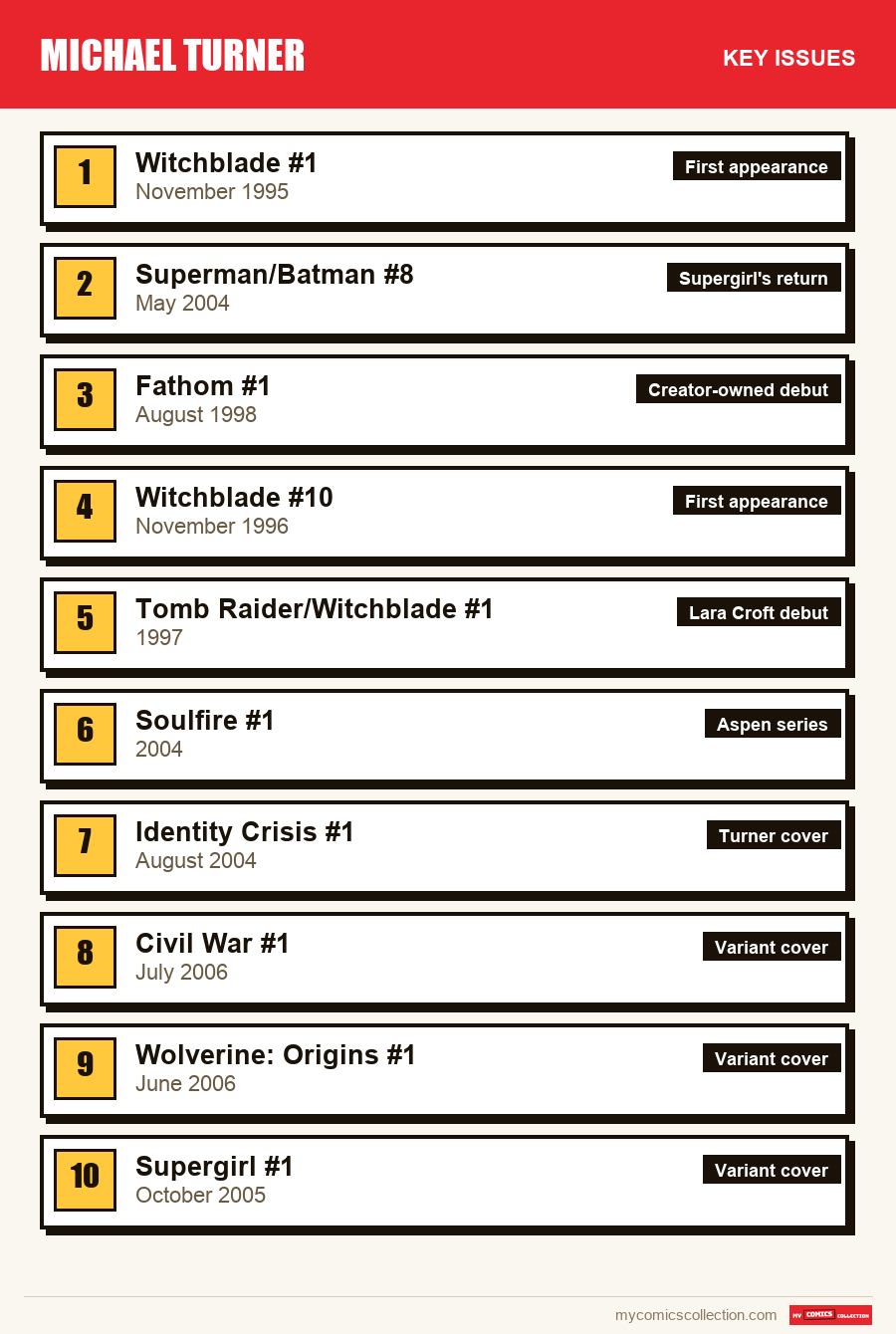
Witchblade #1
The first issue of Witchblade and the first appearance of Sara Pezzini, the New York police detective bound to the mystical artifact that gives the series its name. Michael Turner, the book's co-creator, drew the cover and shared the interior art with other Top Cow studio artists. Cover-dated November 1995, it went on sale on October 31, 1995.
Superman/Batman #8
The first chapter of “The Supergirl from Krypton”, written by Jeph Loeb and fully drawn by Michael Turner. It reintroduces Kara Zor-El, Superman's Kryptonian cousin, into modern DC Comics continuity. The arc runs through issue 13, cover-dated October 2004.
Fathom #1
The launch of Fathom, the first series Michael Turner owned outright, published by Top Cow through Image. It follows Aspen Matthews, a marine biologist who discovers she belongs to the Blue, an aquatic race able to control water. Turner created and drew it; the first volume ended in 2002.
Witchblade #10
The first appearance of Jackie Estacado, the future lead of The Darkness, the other major series of the Top Cow universe. Michael Turner shares the interior art with Marc Silvestri and co-signs the cover. A key issue for anyone collecting the studio's shared universe.
Tomb Raider/Witchblade #1
This crossover marks Lara Croft's very first comic book appearance, alongside Sara Pezzini. Michael Turner both wrote and penciled it. Top Cow went on to launch an ongoing Tomb Raider series in 1999.
Soulfire #1
Soulfire is Turner's major fantasy creation, first developed at Top Cow under the name Dragonfly and then launched at Aspen MLT, his own publishing house. He drew issues 0 to 7, between 2004 and 2005. The story follows Malikai, a boy destined to bring magic back to a future that has lost it.
Identity Crisis #1
The first issue of Brad Meltzer and Rags Morales's event miniseries at DC Comics. Michael Turner drew the covers for all seven issues, colored by Peter Steigerwald. That same year he also drew the Supergirl arc in Superman/Batman.
Civil War #1
The first issue of Marvel's Civil War event. Michael Turner drew a variant cover for it, also released in textless and sketch versions. The work came out of the deal he signed with Marvel in August 2005.
Wolverine: Origins #1
The first issue of the series devoted to Wolverine's past. Michael Turner drew its alternate cover, colored by Peter Steigerwald, also offered in a textless version and a Director's Cut edition. Like his Civil War covers, it came out of his August 2005 deal with Marvel.
Supergirl #1
The first issue of the Supergirl series launched in 2005 and written by Jeph Loeb, following Kara Zor-El's return in Superman/Batman. Michael Turner, who had drawn that return, provided a variant cover, along with a sketch version.