
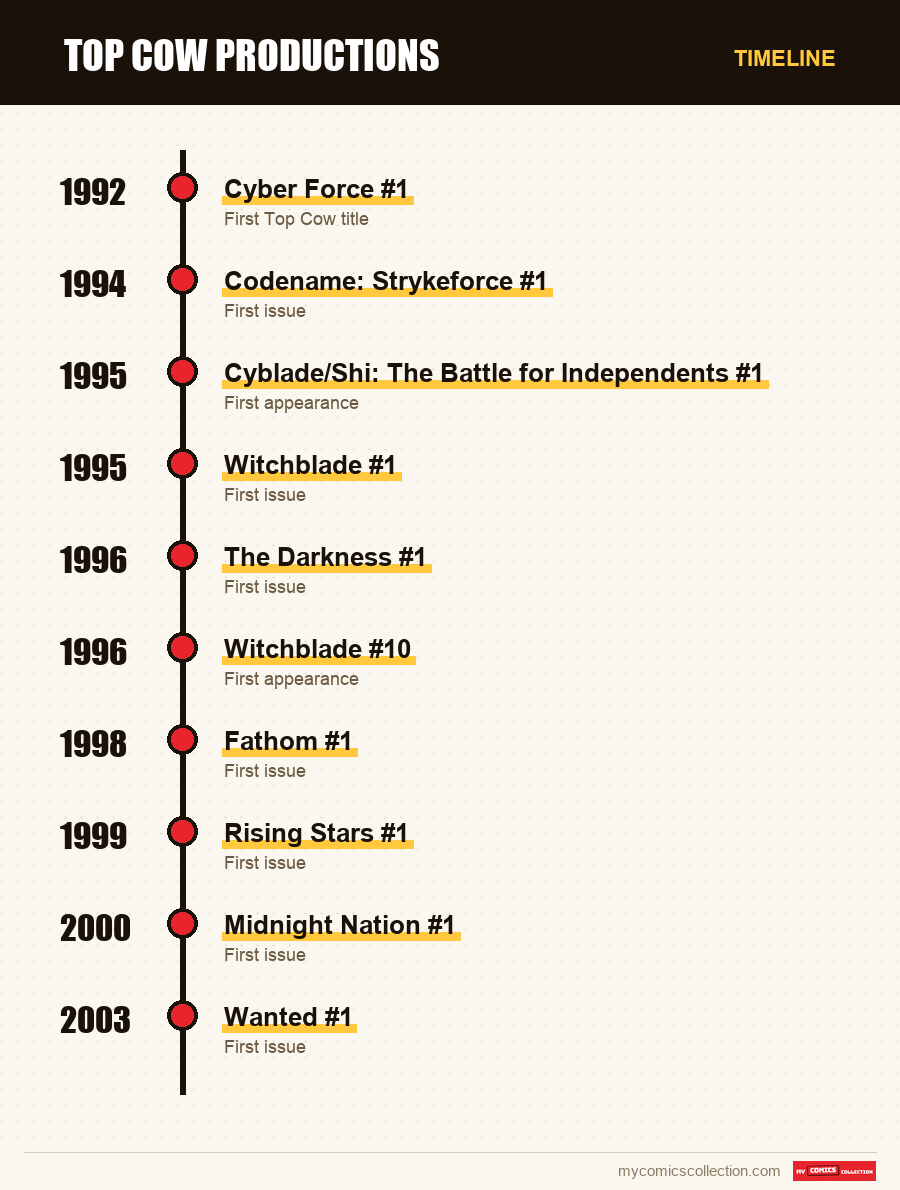
Top Cow Productions was founded in 1992 by Marc Silvestri, one of the seven founding artists of Image Comics. First simple label for Cyberforce, the house really took off in 1995 with Witchblade , then with Darkness in 1996, two series which still define its urban “dark fantasy” identity today. After a slump in the 2000s, a successful film adaptation (Wanted, 2008) and several reboots, Top Cow remains in 2026 an active imprint of Image Comics, supported by relaunches of Witchblade and Cyberforce and an annual Talent Hunt which recruits new creators.
Few labels born out of the creative chaos of Image Comics in the early 1990s have survived as long as Top Cow Productions. Many studios founded the same year have disappeared, changed names or refocused on a single character. Top Cow, for its part, has spanned more than three decades while retaining its original DNA: heroines and heroes hybrids between dark thriller and the supernatural, artists from the Silvestri school with hyper-detailed lines, and a propensity to multiply variant covers which has made its reputation as much as its commercial fortune.
Retracing the history of Top Cow also means telling that of an entire section of the collector's comic book market: the disproportionate print runs of the Image era of the early 1990s, the explosion of Witchblade in the “bad girl” format which marked an entire generation of covers, the attempt to compete with Marvel and DC in the crossover field, then the more calm transformation of a publisher which today produces as much graphic romance as superheroes. This article looks back at the major stages of this history, at the titles and creators who shaped it, and at what this means in concrete terms for those who collect Top Cow comics today.
We will also see how the TV and cinema adaptations have influenced the perception of certain key numbers, and we will end with practical guidelines for making an informed purchase, whether you are aiming for a copy of Witchblade #1 in high grade or a more confidential piece in the catalog.
From the origins at Image Comics to the Silvestri empire
The story of Top Cow begins in 1992, in the founding turmoil of Image Comics. Marc Silvestri, designer already recognized for his appearance on Uncanny X-Men at Marvel, is one of seven creators who slammed the door of the historic publisher to found their own house, alongside Jim Lee, Todd McFarlane, Rob Liefeld, Erik Larsen, Jim Valentino and Whilce Portacio. Everyone retains ownership of their creations, a revolution for the time when scriptwriters and artists traditionally worked on characters belonging to the publisher.
Silvestri first published under the Homage studio banner, which he shared with Jim Lee, Joe Chiodo, Whilce Portacio and Scott Williams. The name “Top Cow” appeared shortly after: according to Silvestri himself, it was a decision taken one evening, after having rejected the “Ballistic Studios” option in favor of a logo that amused him more. From number 2 of one of its series, published in March 1993, the mention Top Cow Productions appears on the cover. The first title carried by this label is Cyberforce, released in October 1992, a team of genetically modified mutants escaped from a clandestine laboratory: a pitch which owes a lot to the X-Men atmosphere that Silvestri knows well, but transposed into a more violent and more adult universe.
These first years of Image were marked by colossal print runs, incommensurate with what the market knows today. For comparison, Spawn #1 by Todd McFarlane reached 1.7 million copies in print by May 1992, and pre-orders of Youngblood #1 by Rob Liefeld exceeds 930,000 copies. In this context, it is not uncommon for several Image titles to cross the barrier of 500,000 copies sold during 1992 and 1993, and Cyberforce takes full advantage of this collective enthusiasm for the emerging label, even if its exact print run has never been publicly documented with the same precision as that of Spawn. This abundance has a direct consequence for current collectors: the original numbers of the first Top Cow series are, in absolute value, rather available on the second-hand market, and it is above all the very high grade state of conservation which makes the difference in price.
Cyberforce and Codename: Strykeforce, the foundation of the years 1992-1994
Before Witchblade does not become the showcase of the label, it is Cyberforce which installs Top Cow on the map. The series follows a group of super-humans, including Cyblade, Stryker and Velocity, created by a fictional pharmaceutical company, Cyberdata, as part of a genetic enhancement program. The tone, darker and more graphic than the average mainstream comic book of the time, corresponds exactly to the aesthetic that would become the house's signature: exaggerated analyses, futuristic armor, stories centered on hybrid characters between victims and weapons of war.
In 1994 released Codename: Strykeforce, spin-off centered on a subgroup of Cyberforce. The title enjoyed notable success for the time, becoming the third best-selling comic of the year, a result which confirmed that Top Cow was no longer just the subsidiary label of one of the founders of Image, but an actor capable of producing several simultaneous commercial successes. It was this period that also established the creative team that would carry the house for the rest of the decade: David Wohl, Brian Haberlin and Christina Z, all credited a few months later on the creation that would transform Top Cow into a franchise in its own right.
Witchblade (1995): the series that rocked Top Cow
The decisive turning point came in November 1995, with the release of Witchblade #1. The character of Sara Pezzini, a New York police detective who inherits a mystical artifact capable of organically bonding to its wearer and transforming into living armor, is created collectively by Marc Silvestri, David Wohl, Brian Haberlin and Christina Z, with drawings by Michael Turner that become immediately identifiable: stylized silhouettes, fabrics that seem to melt on the skin, cover compositions designed to capture the eye on a magazine rack.
Witchblade #1 became a milestone in the genre then nicknamed “bad girl comics”, these series centered on hypersexualized heroines who dominated part of the independent market in the mid-1990s. The issue enjoyed rare editorial longevity: the series lasted until October 2015, i.e. twenty years of almost continuous publication, an achievement for a title born outside the major Marvel and DC shared universes. Over the course of the reissues and special editions, there are at least eleven cover variations for this issue 1 alone, including a Movie Edition in gold foil limited to 3,000 copies linked to the broadcast of the TV film in 2000, and an edition signed by David Wohl limited to 1,250 numbered copies via Dynamic Forces. This profusion of variants, typical of the commercial practices of independent publishers of the 1990s and 2000s, is an essential point of vigilance for anyone looking for a specific copy: “Witchblade #1” in reality covers several very different collectibles in terms of relative rarity.
The Darkness, Fathom and the diversification of the catalog
Building on the success of Witchblade, Top Cow launched in December 1996 Darkness, another pillar of what will become the “Top Cow Universe”. Created by Marc Silvestri, David Wohl and British screenwriter Garth Ennis: already noted for his work on Preacher at Vertigo: the series follows Jackie Estacado, hitman for the New York mafia who discovers, on the evening of his twenty-one birthday, that he is the bearer of an ancestral demonic force, Darkness, capable of summoning creatures and manipulating the shadow itself. The opening story, “Coming Of Age”, immediately establishes the resolutely adult and violent tone which distinguishes the title from the rest of the superheroic production of the time.
The series experienced its own peak of popularity with issue 11, which became the best-selling comic of 1997, proof that Top Cow now had two simultaneous editorial powerhouses. The designer David Finch, who would become one of the house's star artists before joining Marvel then DC, joined the series during its publication and shaped a style that would have a lasting influence on the visual identity of the label.
In 1998, Michael Turner left the position of designer of Witchblade to launch Fathom, a creator-owned series which also became the best-selling comic of its year of release, before Turner took it with him to found his own studio, Aspen MLT. This departure illustrates a recurring dynamic at Top Cow: the label often serves as a springboard for artists who, once their notoriety has been established, go on to develop their own universes, sometimes damaging relations with the parent company in the process.
Rising Stars, Midnight Nation and J. Michael Straczynski’s “creator-owned” parenthesis
Between 1999 and 2000, Top Cow attempted an ambitious editorial diversification by welcoming television screenwriter J. Michael Straczynski, then showrunner of the series. Babylon 5, for two series entirely detached from the Witchblade/Darkness universe: Rising Stars, chronicle over several decades of a group of individuals endowed with superpowers after the passage of a comet, and Midnight Nation, a mystical road movie co-created with designer Gary Frank. This period corresponds to what current president Matt Hawkins retrospectively describes as the "third era" of Top Cow: that of guest-writer projects, as opposed to the in-house characters that had dominated the early years.
This parenthesis did not last, however: from the mid-2000s, Top Cow began what Hawkins describes as the “fourth era”, an assumed refocusing on its historical properties, Witchblade and The Darkness in the lead, deemed more profitable in the long term than a collection of author series scattered between several universes with no narrative link.
Wanted, the adaptation that propelled Top Cow to the cinema
In 2003, the Scottish screenwriter Mark Millar and the designer J. G. Jones launched the mini-series at Top Cow Wanted, a dark tale about a global brotherhood of assassins who recruit an anonymous office worker, Wesley Gibson, by revealing that he is the son of a legendary killer. Millar's cynical and ultra-violent tone, which would become his trademark on Kick-Ass or The Authority, stands out in the Top Cow catalog of the time.
However, it is this title, more confidential than Witchblade upon its release, which offers the house its greatest exposure to the general public: very freely adapted for the cinema in 2008 by Timur Bekmambetov, with James McAvoy, Angelina Jolie and Morgan Freeman as headliners, the film Wanted garnered $342 million in worldwide revenue for a budget of $75 million, under the Universal Pictures banner. The film's storyline departs considerably from the original comic, the brotherhood of destiny weavers replaces the more down-to-earth structure of the comic, but the commercial success was enough to make it Wanted one of the few Top Cow properties recognized beyond comic book readers.
Witchblade on screen: TV movie, TNT series and Japanese anime
Witchblade is, by far, the Top Cow franchise which has generated the most audiovisual adaptations. In August 2000, a TV film produced for TNT was previewed at the Wizard World Chicago convention before its official broadcast on August 27 of the same year. The success of this format led to the launch of a full-fledged television series, which aired on TNT from 2001 to 2002, starring Yancy Butler as Sara Pezzini. The series totaled twenty-four episodes over two seasons before being canceled.
In 2006, the character even crossed the Pacific Ocean with an anime adaptation produced by the Japanese studio Gonzo, which took up the Witchblade universe by introducing new characters while remaining faithful to the continuity established by the comic. Later, in 2017, a reboot project for the NBC channel was announced, led by producers Carol Mendelsohn and Caroline Dries, but it will never see the light of day. Likewise, a feature film project scripted by Everett De Roche and to be directed by Michael Rymer was announced in 2008 without ever entering production.
This accumulation of projects, completed or not, has a measurable effect on the character's notoriety well beyond the usual readership of comics, and partly explains why Witchblade #1 remains, even today, the Top Cow issue most systematically sought after by collectors who discover the house through its adaptations rather than through the comics themselves.
Turbulence, temporary split and partnership with Marvel
The story of Top Cow is not without internal tensions. In 1996, the company temporarily separated from Image Comics following a dispute with Rob Liefeld, one of the most divisive founders of the collective label. The two parties eventually reconciled and Top Cow reintegrated into the Image structure, of which it remains an imprint to this day: an original configuration that allowed Silvestri and his team to retain full intellectual property of their creations while benefiting from Image's distribution strength.
Ten years later, in 2006, Top Cow signed an unprecedented agreement with Marvel Comics to organize crossovers between their respective universes: Darkness/Wolverine and Witchblade/Punisher thus see the light of day, meetings which remain rare in the history of the American comic book as rights issues usually complicate this type of initiative between an independent publisher and one of the two giants of the sector. In 2007, Top Cow continued its commercial innovation strategy with a digital distribution partnership with IGN, offering comics at $1.99 each, an early move for the time, as well as a mobile distribution agreement with the Zannel platform.
The turning point Rebirth, Sunstone and the new creative generation
2012 marks a new milestone with the “Rebirth” event, which redefines the continuity of the Top Cow universe and simplifies entry into the flagship series for new readers. The same year begins the first Talent Hunt, an annual competition which invites previously unpublished creators to submit projects to join the Top Cow stable: an initiative which will become recurring and which will continue to exist in 2026.
Between 2014 and 2018, the house significantly expanded its editorial offering beyond the dark superhero that made its reputation. Sunstone, a romantic and sensual webcomic created by Croatian author Stjepan Šejić, joined the Top Cow catalog in 2014 and enjoyed notable critical and commercial success, followed by other titles in the same register such as Swing or Sugar. This diversification towards graphic romance reflects an assumed desire to reach a readership different from that, historically more masculine, which led to the beginnings of the label.
In 2017, Witchblade is experiencing a significant relaunch: for the first time in its history, the series is entrusted to an entirely female creative team, screenwriter Caitlin Kittredge and artist Roberta Ingranata, a strong symbolic choice for a title long associated with the very typical imagery of “bad girl comics” of the 1990s.
Collecting this series?
Track what you own, what you are missing and what your collection is worth. 7 day trial.
Start my trial →Top Cow in 2026: relaunches, Kickstarter and Talent Hunt
The label continues to maintain its heritage while opening up to new creators. In 2022, to mark the thirty years of the founding series, Top Cow is publishing a bound collection Cyberforce financed via a Kickstarter campaign, confirming the persistent attachment of part of the readership to this very first title from the label. In 2024, a new series Witchblade is launched under the leadership of screenwriter Marguerite Bennett and designer Giuseppe Cafaro, before an evolution of the creative team with the artist Ariela Kristantina, the colorist Bryan Valenza and the letterer Troy Peteri takes over from 2025, the year in which the series officially gains regular collection status (“ongoing”), with a plot which features the confrontation between Sara Pezzini and the billionaire Kenneth Irons, crossing the trajectory of Jackie Estacado, bringer of Darkness.
Still in 2025, Cyberforce also returns to bookstores, supervised directly by Marc Silvestri and written by Matt Hawkins and Bryan Hill, with drawings by Atilio Rojo: a sign that the house is banking on the simultaneous return of its two founding series to mark its entry into a new decade. At the start of 2026, Top Cow announces the most recent edition of its Talent Hunt, a call for applications open to as yet unknown artists to come and work on the worlds of Witchblade and Darkness, proof that the label continues to see itself as a springboard for new talents, exactly as it was for Michael Turner or David Finch thirty years earlier.
The impact of adaptations on the rating
Unlike houses like Marvel or DC, whose each new blockbuster release immediately increases demand for original comics, Top Cow has a more mixed relationship with its adaptations. The massive success of the film Wanted in 2008 has, for example, never transformed the original mini-series by Mark Millar and J. G. Jones into a cult series on the collector's market in the same way as Witchblade #1, largely because the film strays too far from the original material to create a direct purchase reflex among the general public discovering the story at the cinema. The copies of Wanted #1 in good condition nevertheless remains sought after by collectors who follow Millar's career, whose author's rating has risen considerably since then with Kick-Ass and his time at Marvel then Netflix.
The dynamics are different for Witchblade. The combination of the 2000 TV film, the TNT series with Yancy Butler broadcast over two seasons, then the 2006 Japanese anime, has built cumulative notoriety over several years and several formats, maintaining a regular flow of new collectors who came to discover the comic after having known the character on screen. This is also what explains the proliferation of special editions around issue 1 (including the gold foil Movie Edition of 2000, calibrated to capture precisely this audience) a marketing phenomenon which, in hindsight, created several layers of relative rarity within the same original issue.
For today's buyers, the lesson to learn is simple: the existence of an adaptation never automatically guarantees an increase in the value of the source comic, especially when it was commercially disappointing or too far from the original work, as was for a long time the case for the highly anticipated feature film. Witchblade never filmed despite an official announcement in 2008. The value of a Top Cow issue lies above all in its real place in the editorial history of the house (first appearance, first issue of a cult series, work by an artist who has become a reference) more than a simple announcement effect around a project on screen.
Buying guide
The Top Cow catalog presents a particularity which both complicates and enriches the collection: the profusion of variant covers, reissues and promotional editions produced over more than thirty years. Here are the points to be aware of before purchasing.
- Identify the correct edition of Witchblade #1. The original number 1 from November 1995 is just one of eleven cover variations recorded over time; systematically check the publisher, the printing date and the print edition on the title page before considering a copy as the original version.
- Be wary of reissues linked to screen adaptations. The 2000 Gold Foil Movie Edition and similar editions that appeared around the TV movie or TNT series are collectibles in their own right, but they do not have the same rarity or historical significance as the original 1995 printing.
- Favor the very first issues of the founding series. Cyberforce #1 (1992), Witchblade #1 (1995) and The Darkness #1 (1996) remain the three most iconic pieces in the historical catalog, each marking the launch of a narrative universe still active in 2026.
- Looking beyond the two flagship franchises. Wanted #1 (2003) benefits from growing authorial interest around Mark Millar, while Rising Stars and Midnight Nation by J. Michael Straczynski constitute more confidential but critically recognized creator-owned series.
- Do not neglect the state of conservation. Given the relatively large print runs of the Image era of the early 1990s, it is above all the very high grade rarity (close to 9.8) which distinguishes premium copies from current copies, more than the rarity of the issue itself.
- Follow recent collector reissues. The 30th anniversary Cyberforce hardcover (2022) and the complete Witchblade reissues offer an accessible alternative to discover the founding arcs without investing in period booklets.
- Compare real prices before buying. Use an estimator based on sales actually concluded rather than on displayed prices, which are particularly volatile in a catalog as rich in variations as that of Top Cow.
To go further in the management of its collection over the course of acquisitions, the collection tracking app allows you to centralize the numbers owned, the variant editions and their status, a particularly useful tool given the complexity of Top Cow prints mentioned above.
The key issues to know
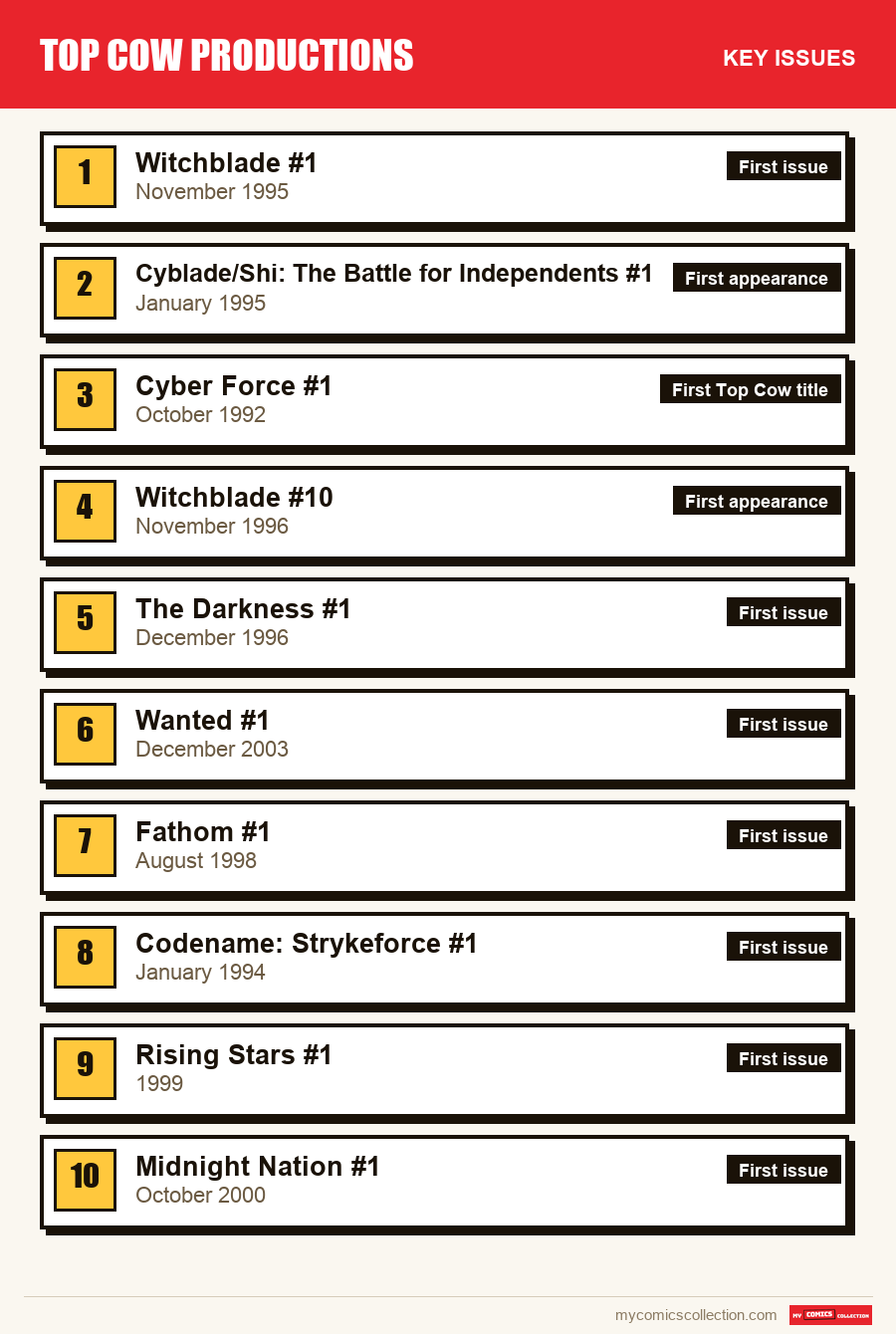
Witchblade #1
The series that turned Top Cow around: Sara Pezzini, a New York City police detective, becomes the bearer of a mystical gauntlet that bonds with her. Created by Marc Silvestri, David Wohl, Brian Haberlin, Christina Z and Michael Turner, the series ran until October 2015. Watch out for the many covers and reprints of this first issue.
Cyblade/Shi: The Battle for Independents #1
Sara Pezzini makes her very first appearance here, several months before Witchblade launched. This crossover brings together Cyblade, a member of Cyberforce, and the heroine Shi. It is the true entry point of the Witchblade's bearer, often overshadowed by the first issue of her own series.
Cyber Force #1
The label's cornerstone: first published as a miniseries, it is drawn by Marc Silvestri and written by his brother Eric. Velocity tries to escape the mega-corporation Cyberdata and crosses paths with a group of enhanced mutants on the run. The whole Top Cow universe starts here.
Witchblade #10
Jackie Estacado, a New York mob hitman who inherits the curse of the Darkness at 21, first appears in the pages of Witchblade. The character was created by Marc Silvestri, Garth Ennis and David Wohl. He gets his own series the very next month.
The Darkness #1
Launch of Jackie Estacado's solo series, the second pillar of the Top Cow universe alongside Witchblade. This first volume ran from December 1996 to August 2001, followed by two more series. The first six issues form the "Coming of Age" story.
Wanted #1
Mark Millar and J. G. Jones launch this miniseries about Wesley Gibson, a nobody who discovers he is heir to a career as a supervillain. The series ran until February 2005. It very loosely inspired the 2008 film Wanted.
Fathom #1
Michael Turner launches his first creator-owned series at Top Cow, centered on Aspen Matthews. The first volume ran until May 2002. Turner then took the series to his own studio, Aspen MLT, which still publishes it.
Codename: Strykeforce #1
The first Cyberforce spin-off, centered on the mercenary team Strykeforce, introduced in Cyber Force #4 in July 1993. The first nine issues were written by David Wohl and Marc Silvestri and drawn by Brandon Peterson. The series ran fourteen issues, until August 1995.
Rising Stars #1
J. Michael Straczynski opens this 24-issue series about 113 "Specials", born with powers after a mysterious light appeared in the sky over Pederson, Illinois. The series later moved to the Joe's Comics imprint. The final issue did not come out until March 2005.
Midnight Nation #1
J. Michael Straczynski's second series at Top Cow, published under the Joe's Comics imprint with Gary Frank on pencils. This twelve-issue, religious-themed story follows a man who is killed, in a sense, and must take a long journey to save his soul. The series ended in July 2002.