The real first appearance of Witchblade and Sara Pezzini is not in Witchblade #1, but in Cyblade/Shi: The Battle for Independents #1 (late 1994, designed by Marc Silvestri): an often overlooked crossover that remains the holy grail of the series, with CGC 9.8 copies priced around $250. The most iconic number remains Witchblade #1 (October 1995), the first major demonstration by Michael Turner, whose CGC 9.8 copies sell for around $100, with high premiums on foil variants and copies signed by Turner, who died in 2008.
Few series embody the 1990s as well as Witchblade. Launched by Top Cow, Marc Silvestri's studio within Image Comics, it made Sara Pezzini, a police inspector wearing a mystical gauntlet, one of the icons of the decade. Behind this success, one name keeps coming up: Michael Turner, a young designer whose fine and dynamic line defined the aesthetic of an entire era. Understanding the key issues of Witchblade is therefore as much a matter of collecting as it is of editorial history.
The problem, for the collector, is that Witchblade is a textbook case of speculation from the 1990s. Multiplication of variants, foil editions, exclusive prints for distributors, a mess of crossovers: you have to know how to disentangle the real key numbers from marketing overproduction. Some booklets are actually worth something; many others, printed in profusion, hardly exceed their original cover price, even in good condition.
In this guide, we review the issues that really matter: the true first appearance, issue #1 of the regular series, sought-after variants, and historical crossovers like Medieval Spawn/Witchblade. For each, we give the editorial context and, when they exist, actual price indications observed on the market. When no reliable odds are available, we prefer to talk about rarity and mintage rather than putting forward an invented figure.
Context: the birth of a 1990s phenomenon
To understand Witchblade, we have to go back to 1992, the year Image Comics was founded by a group of star artists leaving Marvel. Marc Silvestri, defector from the series Uncanny X-Men, created his own studio, Top Cow Productions, based in Century City, California. After Cyberforce, Top Cow is looking for new franchises. It is in this context that a young designer recruited in 1994, Michael Turner, is entrusted with the editor David Wohl, the screenwriters Christina Z and Brian Haberlin, the creation of a new character: Witchblade.
The concept is simple and extremely effective for the time: Sara Pezzini, a New York police inspector, finds herself linked to an ancestral artifact, the Witchblade, a living gauntlet which unfolds into armor and weapons when it senses danger. A mix of urban thriller, fantasy and glamorous aesthetics very marked by its time, the series immediately finds its audience. Michael Turner, for whom this is his first major work, imposes a style that will become a school and influence an entire generation of designers.
An editorial detail deserves the collector's attention: the very first appearance of Sara Pezzini and the Witchblade is not in issue 1 of the regular series, but in a crossover one-shot published a few months earlier. This subtlety, typical of Image's marketing strategy at the time, made all the difference in the key numbers market. This is the first trap to know, and the first real treasure to track down.
Key Witchblade numbers to know
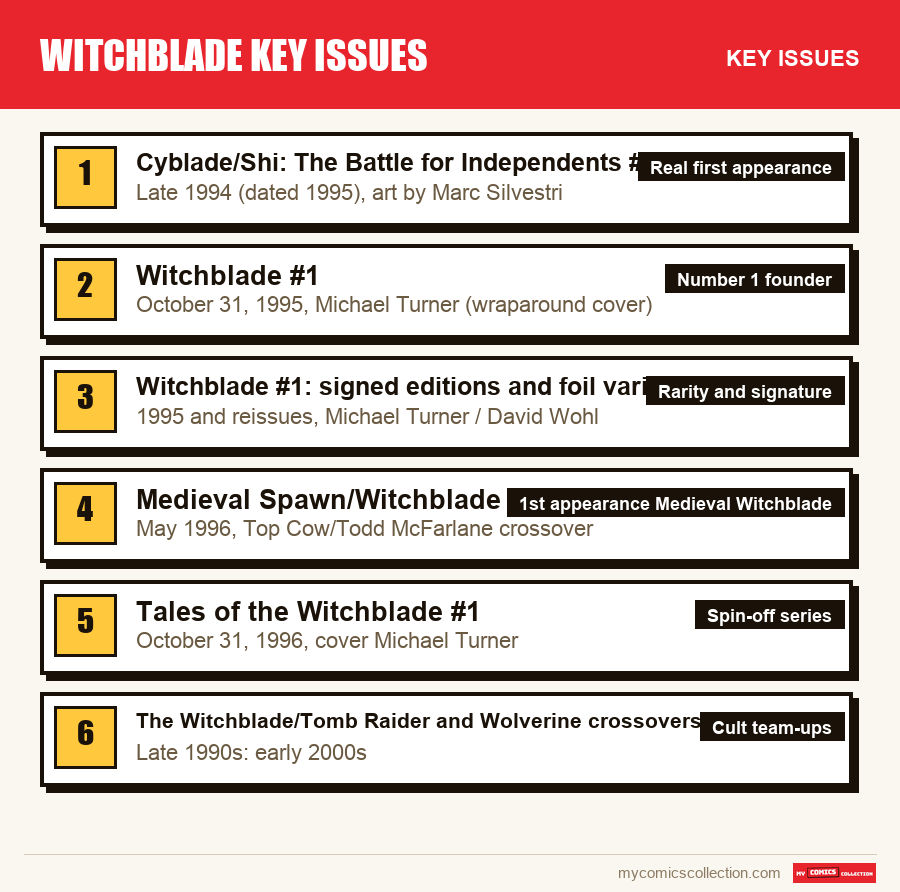
Here, classified by importance for the collector, are the booklets which really structure the value of the series. We carefully distinguish between the first appearance, the regular number 1, the variants and the founding crossovers.
Cyblade/Shi: The Battle for Independents #1
Here is the true holy grail, and yet the least known to the general public. This crossover one-shot, the result of a collaboration between Top Cow and Crusade Comics (the publisher of Shi, a character created by Billy Tucci), contains the very first appearance of Sara Pezzini and the Witchblade, several months before the regular series. Designed by Marc Silvestri himself, it went under the radar for a long time, which today makes it the most strategic piece in the collection. Many buyers mistakenly think that the regular number 1 is the first appearance: it is this confusion that makes this one-shot so valuable to those who know the nuance.
Witchblade #1
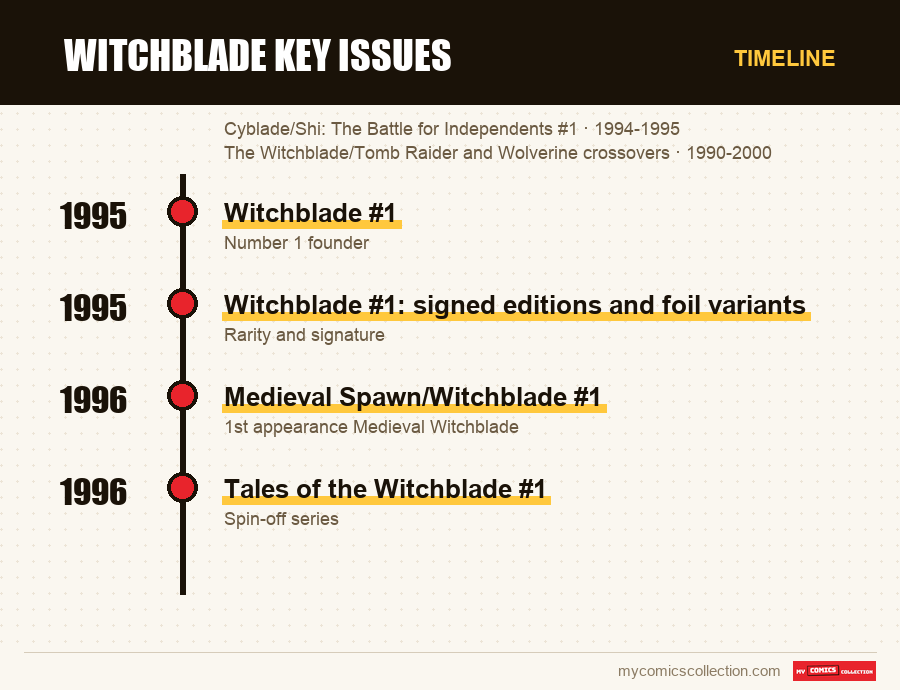
It's THE iconic number, the one that everyone is looking for and which launches the regular series. Original cover price: $2.50, for 36 pages. Screenplay by David Wohl and Christina Z, co-plot by Brian Haberlin and Michael Turner, and above all a wraparound cover by Turner which became a cult image of the 1990s. Despite its iconic status, you have to keep a cool head: the circulation was massive, commensurate with the craze of the time, which explains a reasonable rating for such a famous issue. High grades nevertheless remain sought after, because a truly impeccable example is rarer than it seems in a production from the nineties.
Witchblade #1: signed editions and foil variants
Around number 1 gravitates an entire ecosystem of limited editions, typical of Image speculation. In particular, we find a Dynamic Forces edition signed by David Wohl limited to 1,250 copies, another signed by Michael Turner, David Wohl and D-Tron limited to 1,500 copies, as well as various foil editions, including a later DFE Gold Foil (Movie Edition) with a print run of around 3,000 copies. The death of Michael Turner in 2008, who died of bone cancer at just 37 years old, increased interest in anything bearing his authenticated signature.
Medieval Spawn/Witchblade #1
This crossover brings together two Image heavyweights: Witchblade and Spawn, Todd McFarlane's character. Cover price $2.95, 36 pages. In terms of key issues, it matters because it contains the first appearances of several characters, including Katarina Godliffe, the Medieval Witchblade (a gauntlet wielder in medieval times), as well as Medieval Spawn. There is an American Entertainment Exclusive edition limited to 5,000 copies and an ETM Gold Foil variant, more sought after than the standard edition. Spawn's enduring popularity lifts this title over other Witchblade crossovers.
Tales of the Witchblade #1
One year after issue #1, Top Cow launches this anthology series exploring the history of the Witchblade through the ages. The first issue, cover price $2.95, features a cover by Michael Turner and is available in several versions: regular edition (Turner cover), Gold edition, Platinum edition and an exclusive distributor cover. These metal variants, produced in much lower quantities than the standard edition, are those to be preferred for a collector seeking rarity. The title remains more confidential than the parent series, which makes it more of a supporting piece than a central investment.
The Witchblade/Tomb Raider and Wolverine crossovers
True to Top Cow's crossover strategy, Witchblade has crossed many franchises. The encounters with Tomb Raider (Lara Croft), another flagship Top Cow property at the time, and with Marvel's Wolverine, gave rise to very popular one-shots, often available in Gold Foil editions. These booklets capitalize on the dual fan bases of the two characters. Their value strongly depends on the precise edition (regular or foil) and the condition, and the market is more segmented than for the main key issues. They are ideal complementary pieces to expand a thematic collection.
Collecting this series?
Track what you own, what you are missing and what your collection is worth. 7 day trial.
Start my trial →The impact of adaptations on the rating
As with many franchises, Witchblade's collectible value has been punctuated by its on-screen adaptations. The character has undergone two notable transitions from paper, with measured but real effects on demand.
The first was the television series broadcast on TNT, preceded by a pilot TV film in August 2000, then turned into a series from June 2001 to August 2002. Yancy Butler played Sara Pezzini for two seasons and 23 episodes. This exposure on American television gave general public visibility to the character and generated, at the time, derivative editions such as the Witchblade Movie Edition, itself available in a Gold Foil variant by Dynamic Forces. These marketing products remain curiosities for collectors more than investment pieces.
The second was the anime produced in 2006 by the Japanese studio Gonzo in partnership with Top Cow. Broadcast from April 2006 over 24 episodes, this adaptation offered a partly new story and characters, while remaining part of the continuity of the license. It fueled the interest of an international audience, particularly fans of Japanese animation, without causing a lasting surge in the original paper issues.
More recently, the facsimile reissue of Witchblade #1 published in 2025, featuring the historic cover by Michael Turner (including a foil variant), demonstrates a persistent heritage interest in the title. These facsimiles obviously do not replace the 1995 originals in the eyes of collectors, but they maintain the notoriety of the key issue and recall Turner's place in the history of the medium. To follow the evolution of these ratings over time, it may be useful to record your acquisitions in a collection management application rather than relying on his memory.
Buying guide
Buying Witchblade intelligently means above all knowing how to distinguish the authentic key number from the speculative variant with no future. Here are the concrete tips to keep in mind:
- Don’t confuse the two “first times.” The first appearance of Sara Pezzini and the Witchblade is in Cyblade/Shi: The Battle for Independents #1, not in Witchblade #1. If you're looking for the real founding piece, this is the one-shot you should aim for.
- Beware of 1990s overproduction. Many Witchblade booklets have been printed in very large numbers. A current example in average condition is often worth little more than its original cover price: pay accordingly.
- Favor high ranks over key numbers. On recent and abundant comics, the value is concentrated on near-perfect condition. A Witchblade #1 in CGC 9.8 is clearly distinguishable from a 9.2 copy, even though copies exist in quantity.
- Always check the exact edition. Foil, Gold, Platinum, DFE, American Entertainment, signed editions: the wording changes everything. A variant limited to a few thousand copies has nothing to do with the standard edition, and sellers are not always precise.
- For signatures, require certification. Copies signed by Michael Turner increase in value, but a signature only has weight on the market if it is authenticated (CGC Signature Series, CBCS or COA recognized). An uncertified dedication remains unverifiable.
- Compare recent ratings before buying. Prices for comics from the 1990s fluctuate with trends and adaptation announcements. Base yourself on recent actual sales, not isolated displayed prices. OUR free estimator relies on current eBay listings to give a realistic range.
- Inspect the foil for typical defects. Metallic covers mark easily (scratches, folds, chips). On these variants, the condition of the foil surface is decisive for the value.
By applying these rules, we avoid the two classic errors: overpaying for a marketing variant without real rarity, or missing out on the founding one-shot due to lack of knowledge of its existence. Rigorous monitoring of its collection, thanks to a Collection tracking, helps you keep a clear vision of what you really have and how it is evolving.