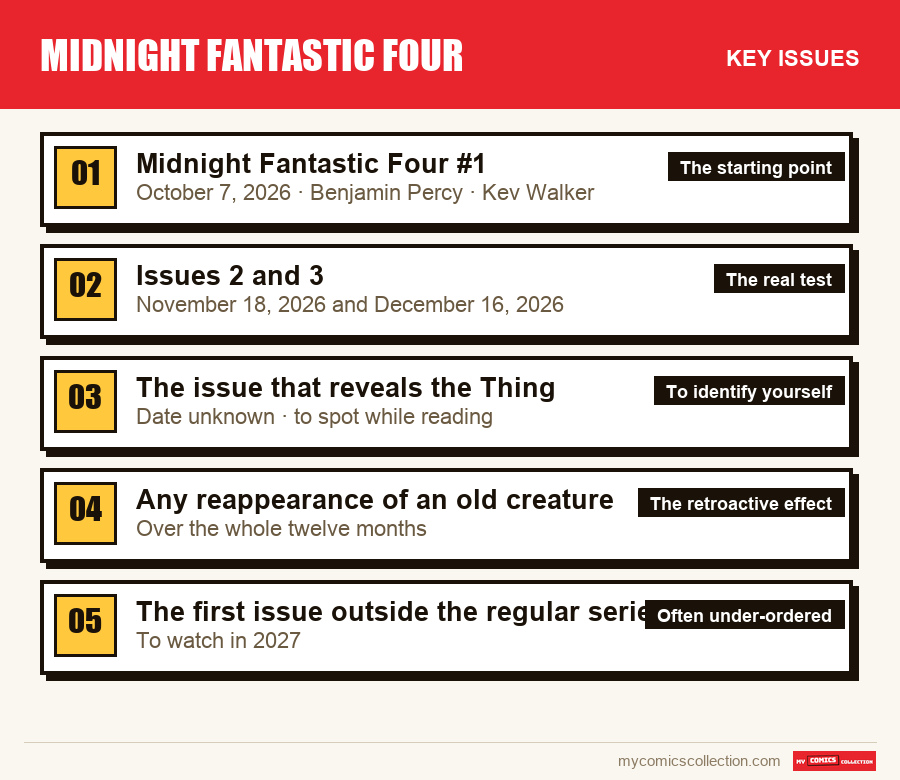
Midnight Fantastic Four #1 comes out on October 7, 2026, written by Benjamin Percy and drawn by Kev Walker. Of the line's three titles, it is the one whose shift to horror takes the least effort: the quartet is born in November 1961 from a radiation accident that deforms four bodies, one of them permanently, and Stan Lee and Jack Kirby's first issue looked far more like a monster comic than a superhero comic. For the collector, the issues to watch over twelve months are not the first three but those that will introduce new creatures and versions: issue 2 on November 18, 2026 and issue 3 on December 16, 2026 will already give an idea of the pace of invention. No price exists before release, and anyone announcing one is inventing it.
There is a question we never ask enough in front of a horror reimagining: does the source material lend itself to it, or is a disguise being imposed on it? In the case of the Fantastic Four, the answer is unusually clear. No other group in the Marvel catalog was conceived, from its first page, around an irreversible bodily mutilation suffered by one of its members. No other inherited so directly from a decade of giant-creature comics. And no other produced, in its own canon, a story whose very title poses the question of the monster.
This article does not present the Midnight line as a whole: the schedule, the three creative teams and the launch mechanics are covered in our complete guide to the line. Here, we stay on a single title and a single question: why the Fantastic Four are Marvel's most naturally horrific franchise, and which issues a collector has an interest in spotting in the first twelve months. It is October 1st, 2026, the series has not come out, and everything that follows is either documented publishing fact, or method.
An origin that is an accident, not an election
Most great superhero teams are founded on a choice. You are recruited, you gather, you accept a mission. The four characters of Fantastic Four #1, dated November 1961 and signed Stan Lee and Jack Kirby, choose nothing at all. They board a craft, the craft crosses a radiation zone, and they come back down with bodies that no longer obey them as before. A man becomes elastic, a woman disappears from view, a teenager catches fire, and the fourth wakes up covered in a mineral shell he can never remove.
The right word for this is not "power." It is "contamination." The narrative pattern is exactly that of the transformation horror story: a threshold is crossed, something enters the body, the body changes with no possible return. That the series' continuation chose adventure and family over dread is an editorial decision, not a consequence of the premise. The premise itself has been intact for sixty-five years, and it was waiting to be taken seriously.
Two details of the first issue deserve recalling, because they are often erased by collective memory. First, the four characters wear no costume there: visually, they are not heroes, they are four transformed civilians. Next, the adversary they face is a man secluded underground who commands subterranean creatures. None of this belongs to the conventional heroic register. We are in anxious fantasy, that of things rising from below.
The cover's tone goes the same way. Kirby's composition shows a gigantic creature bursting from the ground in the middle of a street, the four silhouettes reacting in urgency. A reader in 1961 who saw this cover at the newsstand did not immediately distinguish this issue from the publisher's other titles, and for a very simple reason: those other titles were precisely monster comics.
Before 1961, Marvel published monsters
It is the most often forgotten point, and the one that best illuminates the relevance of Midnight Fantastic Four. The house that published Fantastic Four #1 was not coming off ten years of superheroes. It was coming off ten years of fantasy anthologies, published under the Atlas banner, whose titles are still familiar to collectors: Strange Tales, launched in 1951, Journey into Mystery, launched in 1952, then Tales to Astonish and Tales of Suspense, which appeared in 1959.
From 1959, these four series massively specialize in a very identifiable format: the giant creature, often extraterrestrial, often given an absurd-sounding name, who terrorizes a city over about twenty pages before being driven back by an ordinary man. This current answers directly to the era's taste for monster movies, and it occupies most of the publisher's production just before the superhero turn. The creations of this period survived well beyond what you would have thought: Groot appears in Tales to Astonish #13, dated November 1960, and Fin Fang Foom in Strange Tales #89, dated October 1961, the same month as the on-sale date of the first issue of the Fantastic Four.
In other words, the Fantastic Four do not succeed the monster comics: they come out of them, and they coexist with them for months. The same artist produced both. The same visual grammar, that of the enormous silhouette and the crushing perspective, serves in both cases. For anyone interested in this layer of the catalog, the article on 1950s horror comics describes the earlier period, that of pure horror genre, which stopped dead in 1954 and of which the Atlas anthologies are in part the domesticated legacy.
The practical consequence is interesting. If Benjamin Percy wants to draw on a stock of creatures already belonging to the publisher, he has no need to invent: he has a bestiary of several dozen forgotten monsters, all historically tied to the cradle of the series entrusted to him. For a collector, this means a revisited reappearance in the Midnight series could suddenly bring attention back to an Atlas issue of 1959 to 1962 that nobody was looking at. This mechanism is known and documented, it is the one that pulled Groot out of oblivion.
The Thing: the monster who lives with the others
The second argument comes down to one character. Ben Grimm is, in the whole catalog, the purest case of a tragic monster set at the heart of a group of heroes. He is not partially or temporarily disfigured: his body has become mineral, his face is no longer legible as a human face, and the series spent decades refusing to cure him durably. This irreversibility is the very definition of monstrosity in the horror genre's sense, where what frightens is not the creature but the impossibility of return.
The series also looked at this question head-on very early. Fantastic Four #51, dated June 1966, is titled "This Man... This Monster!" The story confronts Ben Grimm with a scientist who takes his place and appearance, and directly questions what makes one a monster and the other a man. It is one of the most regularly cited stories of the Lee and Kirby period, and its existence proves the register is not a 2026 addition: it has been inscribed in the canon since the first decade.
A second aspect matters for the coming series: the Thing is the character through whom the reader measures fear. The other three members have powers that remain spectacular. He bears the bill. In a horror version, he is therefore the character whose treatment will be the most revealing, and probably the most illustrated on covers. For the Fantastic Four, this also determines which covers will have the best memory on the secondhand market: those where the transformation is legible at a glance.
What Benjamin Percy's track record foretells
The choice of writer is not decorative. Benjamin Percy is a novelist and short-story writer before being a comics writer, and his literary output explicitly belongs to fantasy and horror, with texts selected in the genre's annual anthologies and a regular presence in the specialist horror press. He is not a superhero writer being asked to scare, he is a horror writer being entrusted with superheroes. The gap is considerable in the reading.
His Marvel record goes the same way. He launched X-Force in November 2019, in the wave of relaunching the mutant franchise, then Wolverine in 2020, with Adam Kubert on art for the first issues. These two series occupied him for several years, until the middle of the decade, and they are the two most violent titles on the mutant side of the catalog. He also wrote Ghost Rider, which settles him definitively on the dark side of the house. It is a long-haul writer's profile, not a flash-in-the-pan, which matters for a line announced as a universe meant to settle in.
On the art side, Kev Walker brings a thick, loaded line, particularly at ease on deformed anatomies and oppressive settings. The pairing of a horror writer and an organic artist is coherent, and it reduces a frequent risk on this kind of reimagining: the gap between a dark text and an overly clean drawing.
What can be deduced without inventing? Two things, and only two. First, that the register will be owned rather than suggested, given the two creators' track records. Next, that a writer coming from the horror novel generally works by gradual build rather than immediate shock, which shifts the interest of issue #1 toward issues 4 to 8, where the mechanism reveals itself. It is a reading hypothesis, not a market prediction.
The issues to watch over the first twelve months
Here is what a collector can usefully spot, knowing that none of these issues exists yet and none can be valued today.
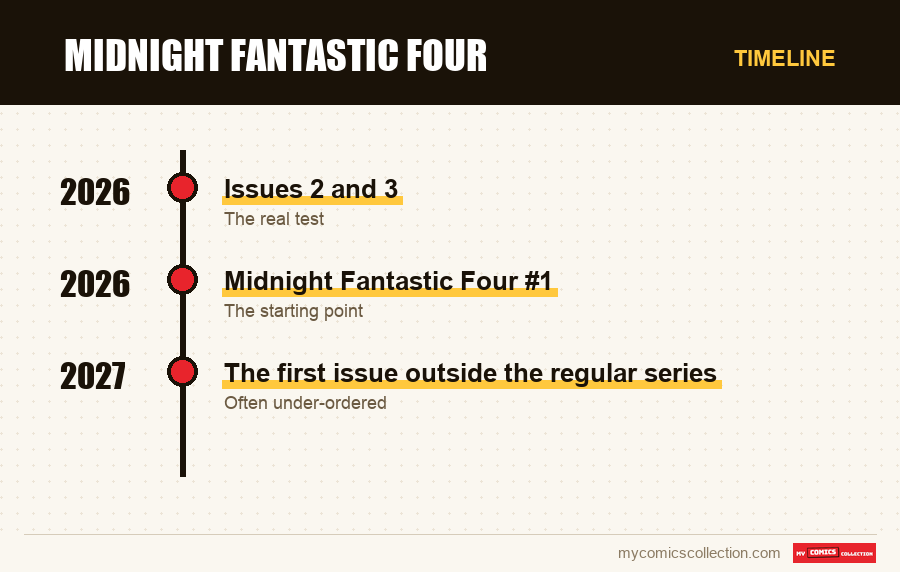
Midnight Fantastic Four #1
It is the issue that will carry the first-appearance mention of the horror version of the four characters, and that is its only objective quality. It will be printed in quantity, ordered widely, and available for a long time. Its interest for a collection is to open the series properly: main cover, first printing, purchase condition preserved.
Issues 2 and 3
In a horror series, the first issue sets the scene and the next two reveal the bestiary. This is where secondary creatures, recurring antagonists and altered versions of known characters usually appear. These issues will be ordered less widely than the first, which makes them structurally the scarcest of the three.
The issue that reveals the Thing
In a horror reimagining, the treatment of Ben Grimm is the pivot. The issue where his transformation is fully shown, named or explained will be the series' thematic issue, regardless of its place in the numbering. Nobody can say today which one it will be: you spot it while reading, not by consulting a list.
Any reappearance of an old creature
If the series reuses a creature from the 1959 to 1962 anthologies, the interesting effect concerns not the Midnight issue but the original comic, sixty-five years older and printed under incomparable conditions. It is the mechanism that has historically produced the clearest movements on old stock.
The first issue outside the regular series
Annual, special issue, short story inserted in a line anthology: these formats leave the main numbering, escape subscriptions and automatic orders, and are therefore ordered cautiously by retailers. When a first appearance falls in one, the gap between importance and availability becomes large.
Recognizing a first appearance, concretely
It is the skill that separates a collector from a buyer. On a new series, no database will help you in the first weeks: the mentions come afterward. Here is the path to follow, applicable from October 7.
Distinguish appearance from mention
A character evoked in dialogue, shown in shadow or designated without being seen does not constitute a first appearance in the usual sense. The convention the market follows requires an identifiable presence on the image. If in doubt, note both issues: the mention's issue and that of the full appearance. One of the two will gain importance, and you will know which one you hold.
Check that it is indeed a new character
On a reimagining line, most creatures will be altered versions of existing characters. An alternate version is not a first appearance: it is a first appearance of that version, a very different wording and valued very differently. The case that matters is that of the character with no equivalent elsewhere in the catalog.
Read the credits page
Credits pages sometimes flag a creation, and the line's letters or editorial pages comment on novelties. It is the most reliable and earliest source you have, and it is in the object you hold.
Note the purchase date and printing
For a recent issue, the only information that cannot be reconstructed later is provenance: when you bought it, in which printing, under which cover. Sales observed on the secondhand market clearly value copies with a documented history.
Wait before any grading
On a comic printed in 2026 and bought new, a high grade is the expected condition, not a performance. Encapsulating immediately amounts to paying a fixed cost for an object whose interest is not demonstrated. Keep it properly, decide in a year.
Holding this series in an already well-stocked collection
The difficulty specific to Midnight Fantastic Four, for anyone who already owns material on the group, is that two objects carrying the same franchise name do not belong to the same set. An issue of the main series and an issue of the Midnight series have neither the same numbering, nor the same continuity, nor the same scarcity logic. Mixing them in a single list produces an unreadable record after two years.
In the app, the useful reflex is therefore to create the Midnight series as a distinct series from the first issue, and not as an extension of what exists. Then, two fields deserve to be filled in systematically on this precise title: the cover held, because a horror series produces many, and the possible appearance mention, because it is the information nobody will find later. Finally, the irregular gap between releases makes tracking releases more useful here than on an established monthly.
For the old issues the series might put back in the light, the logic is reversed: it is about knowing what you already own before a reappearance creates tension on supply. A collector who holds 1960s material on the group, including discreet issues, benefits from checking their record now rather than when attention shifts. Our articles on the group's still-discreet issues and on cover variants cover this inventory work.
The heart of the matter
Midnight Fantastic Four is the line's title with the strongest internal coherence, and it is a reading argument well before being a collecting argument. An origin that is a contamination, a permanently transformed member, a direct inheritance from ten years of creature comics, a writer from the horror novel and an artist with an organic line: there is no piece sticking out in this assembly.
That says nothing about what issue #1 will be worth. Nothing, absolutely. What it does say, on the other hand, is where to look: not at the launch, but at what the series will introduce in its first six to twelve months, and at what it will reactivate in a sixty-five-year-old stock. Both are spotted by reading and keeping a clean record. Neither is spotted by consulting a list of hot issues published the week of release.