The original Fantastic Four #1 (November 1961) is out of reach for most budgets: in CGC 9.6, it realized $2,040,000 at Heritage Auctions in September 2024. Below that pinnacle, reprints have multiplied (the Golden Record edition (1966), Milestone reprints (1993), and Marvel facsimile editions (2018-2025)) and each format requires specific markers to avoid paying original prices for a modern reproduction.
Since 1961, Stan Lee and Jack Kirby's Fantastic Four run has generated more reprints than almost any other Silver Age Marvel title. The reasons are straightforward: Fantastic Four #1 launched the Marvel Age of Comics; issue #5 (July 1962) introduced Doctor Doom; and the "Galactus Trilogy" (#48, #49, and #50 (1966)) gave the world the Silver Surfer and a fully realized Galactus. All three arcs command documented records in high grade, and their popularity has fueled a parallel market of reproductions that, when misidentified, can mislead even seasoned collectors.
This guide sticks to the verifiable: eBay data from our estimator (eBay.fr + eBay.com, June 2026), records documented by Heritage Auctions and GoCollect, and identification markers confirmed by the CGC community and a worldwide comics database.
The three main Fantastic Four reprint families
| Format | Date | Issues covered | CGC status |
|---|---|---|---|
| Golden Record Reprint | 1966 | FF #1 | Graded separately (label reads "Golden Record Reprint") |
| Marvel Facsimile Edition (2018-2025) | 2018, 2022, 2025 | #1, #5, #48, #49, #50, #52, and others | Graded as "Facsimile Edition" on the label |
| Newsstand vs Direct Edition (1977-1994) | 1977-1994 | Entire Bronze/Copper Age run | Since 2017, CGC notes "Newsstand" on the label |
The Golden Record Reprint (1966): the best-known Silver Age reprint
In 1966, Marvel partnered with Golden Records to produce four comic-and-record sets sold for $2.49 (a 33 rpm vinyl record plus a reprint comic). The Fantastic Four set reproduces issue #1 with notable differences from the November 1961 original:
- No cover price. The original carries "10¢" in the upper-left banner; the Golden Record reprint shows no cover price whatsoever.
- Different interior covers and back cover. Instead of the original 1961 advertisements, the interior covers and back cover of the reprint promote the Golden Records LP line.
- Reduced page count. Certain advertisement pages from the original are absent, slightly reducing the overall page count.
- Crisper color for 1966 printing standards. Colors appear brighter than the original, which was printed on cheap rotary presses in 1961.
This reprint is itself a collectible: Heritage Auctions has sold a CGC NM+ 9.6 copy (white pages), and CGC assigns it a dedicated label, "Golden Record Reprint", giving it its own market tier, substantially below the original but above modern facsimile editions. The total absence of a cover price remains the most reliable visual marker: if the cover banner is blank where the price should appear, and interior covers display Golden Records promotional material, you have the 1966 reprint.
Modern Marvel facsimile editions (2018-2025): the hardest to spot
Since October 2018, Marvel has regularly reprinted key issues as "Facsimile Editions": page-for-page reproductions including period advertisements, letter pages, and original logos. In 2025, Marvel reissued the first twelve Lee-Kirby issues as facsimiles, timed to the release of the MCU film The Fantastic Four: First Steps (July 2025, directed by Matt Shakman, starring Pedro Pascal as Reed Richards), which opened to $218 million worldwide.
The identification markers are subtle but real:
- Modern cover price. A facsimile shows a current price ($3.99 or similar) where the original carries 10¢ (FF #1) or 12¢ (FF #2 onward, from January 1962). This is the fastest check.
- Modern UPC barcode at lower left. Silver Age originals have no UPC barcode. Any UPC code in the lower-left corner signals a modern or facsimile printing.
- Altered cover date on FF #1 (2018 edition). The first 2018 facsimile of FF #1 shows "AUG" instead of the correct "NOV": a documented production error that helps date that specific print run precisely.
- Paper quality. Original 1961-1966 issues were printed on cheap, now-aged newsprint. A facsimile on glossy or noticeably thicker paper immediately reveals its modern origin.
- CGC label reads "Facsimile Edition". CGC explicitly states "Facsimile Edition" in its label description. A slab without this designation is not a facsimile.
Newsstand vs direct editions (Bronze and Copper Age)
From roughly 1977 to 1994, Marvel printed two distinct versions of every issue: newsstand editions, sold at supermarkets and general retailers with a standard UPC barcode on the cover, and direct editions, sold exclusively at comic shops with a drawn logo in place of the barcode (a Spider-Man head silhouette from 1977 through the late 1980s, followed by other publisher markers).
For Bronze Age Fantastic Four issues from the 1970s, both versions coexisted and newsstand was the dominant sales channel, so scarcity dynamics did not strongly favor one over the other. By the late 1980s and into the 1990s, comic shops became the primary channel: newsstand print runs shrank, making high-grade Copper Age newsstand copies significantly scarcer. CGC began noting "Newsstand Edition" on its label in 2017, formalizing the value distinction. The visual check is straightforward: a UPC barcode on the cover equals a newsstand copy; a publisher logo where the barcode would be equals a direct edition.
eBay market data (June 2026): all editions blended
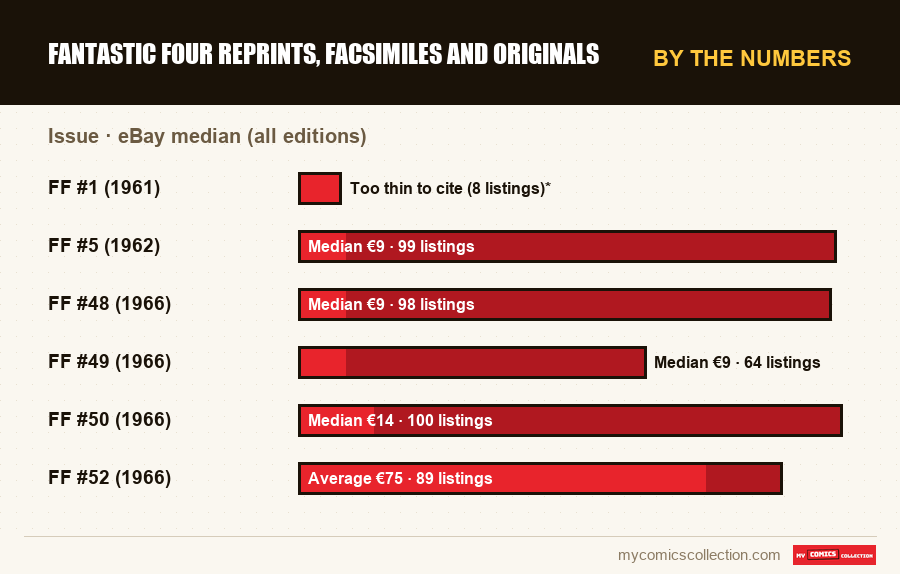
Our eBay data mixes all editions (facsimiles, reprints, and originals) in a single pool. This is why Silver Age medians appear deceptively low: they reflect the mass of modern facsimile editions priced under €10. The table below puts that in context:
| Issue | eBay median (all editions) | Active listings | Documented original record |
|---|---|---|---|
| FF #1 (1961) | Too thin to cite (8 listings)* | 8 | $2,040,000 (CGC 9.6, Heritage Sept. 2024) |
| FF #5 (1962) | Median €9 · 99 listings | 99 | $180,000 (CGC 9.2, 2021) |
| FF #48 (1966) | Median €9 · 98 listings | 98 | $192,000 (CGC 9.8, 2022) |
| FF #49 (1966) | Median €9 · 64 listings | 64 | |
| FF #50 (1966) | Median €14 · 100 listings | 100 | |
| FF #52 (1966) | Average €75 · 89 listings | 89 | $90,000 (CGC 9.8, ComicLink) |
* FF #1: only 8 active listings: too thin for a reliable median. Prices above come exclusively from Heritage Auctions, GoCollect, and ComicLink sale records.
Record sources: Heritage Auctions, GoCollect, CGC News, ComicLink.
Practical checklist before you buy
- Check the cover price first. FF #1 with no price = Golden Record reprint (1966). FF #1 with a modern price ($3.99) = facsimile (2018 or 2025). Only the 1961 original carries "10¢".
- Demand a full cover photo. Modern facsimile editions are legal and well-labeled, but some sellers list them without disclosing "Facsimile Edition." Always request a photo of the lower cover (barcode area) and back cover before buying.
- A CGC-certified slab is the definitive reference. CGC systematically notes "Golden Record Reprint," "Facsimile Edition," or "Newsstand Edition" on its label. Without a slab, identification is your responsibility.
- The all-editions eBay median is not the price of an original. The €9 median on FF #48 or FF #5 reflects the volume of facsimile editions flooding listings. A verified low-grade original trades in the hundreds of euros; in high-grade CGC, in the tens to hundreds of thousands of dollars.
Have a Fantastic Four issue and unsure whether it's an original or a reprint? Get a free valuation with our tool based on real eBay sales to find its low, median, and high value.
Frequently asked questions
The 1966 reprint shows no cover price, whereas the 1961 original carries "10¢". Its inside covers and back advertise the Golden Records line, and the page count is slightly reduced. CGC gives it a dedicated "Golden Record Reprint" label.
First look for a modern cover price where the original carries 10¢ or 12¢, then for a barcode at lower left, which Silver Age originals lack. Glossy or thick coated paper also gives away its modern origin. The first facsimile edition of #1 (2018) reads "AUG" instead of "NOV", a documented production error.
Between roughly 1977 and 1994, Marvel printed two versions: the newsstand edition, with a UPC barcode, and the direct edition, sold in comic shops with a logo in place of the barcode. From the late 1980s, newsstand print runs dropped, making 1990s newsstand copies scarcer. CGC has flagged "Newsstand Edition" on its labels since 2017.
Because market data mixes all editions: facsimiles, reprints and originals. The mass of modern facsimiles drags the median down. An authenticated original sits in a completely different category, especially in high grade.
Check the cover price first, and require a photo of the full cover, the barcode area and the bottom of the back. A CGC slab remains the reference: its label states "Golden Record Reprint", "Facsimile Edition" or "Newsstand Edition" as appropriate. Outside a slab, identification rests on your vigilance.