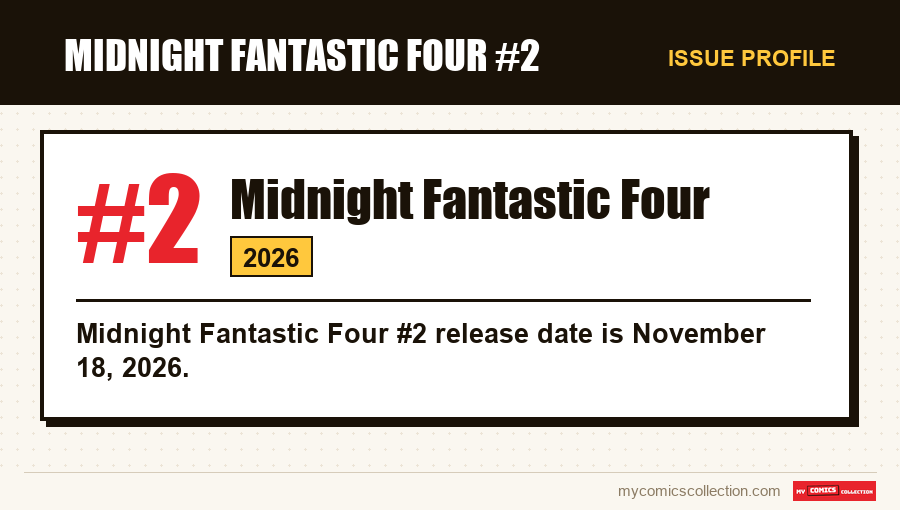
Midnight Fantastic Four #2 has a release date of November 18, 2026: a 32-page issue rated Parental Advisory, written by Benjamin Percy and drawn by Kev Walker. The solicitation describes the story as Reed Richards, haunted by a past he barely remembers, starting to work with Sue, Johnny and Ben at Storm Systems to test a theory that revives the dangers of the atomic age. Six covers are listed, A through F, two of them ratio variants.
A second issue has a thankless mission: proving that issue #1 was not a fluke. This one has a particular feature: its solicitation does not talk about monsters, it talks about offices, coworkers and a theory. That is an announcement choice that says a lot about the direction the series wants to take.
As always in this guide, we only state verified information (creators, issue numbers, dates); the analysis is our own, with no reproduction of interior pages or protected dialogue.
The announced issue's spec sheet
The catalog information is set by the publisher. Schedule: on sale November 18, 2026, alongside the other two Midnight titles. Length: 32 pages, where the launch offered 40. Audience: the Parental Advisory rating remains. Creators: Benjamin Percy on script, Kev Walker on art.
This issue has no announced episode title, unlike the next one. You will therefore find it in a catalog under the series title, with its issue number and the year 2026, and the cover is what will tell it apart from the other versions.
What the solicitation presents: a lab, not a battlefield
Marvel announces that Reed Richards is haunted by a past he barely remembers. He starts working with Sue, Johnny and Ben at Storm Systems, and the group wants to test a theory that revives the dangers of the atomic age. That is all the announcement text gives, and we will stick to it: no page-by-page account, no guess about what happens to these four people at the end of the test.
Three elements of that sentence carry meaning for a reader of the series. First, the word "haunted": Reed is not presented as a self-assured leader, but as a man carrying a blurry past. Second, the verb "work": the text places the four in a company, with the hierarchy, contracts and funding that implies. Finally, the phrase "atomic age," which puts the story in a very dated register of anxiety, one we will come back to.
The contrast with issue #1 is sharp. The launch reviews describe cosmic horror, with a scientist exposing himself to transformations. The announced issue #2 foregrounds the research setup, the group and its theory. The announced setup emphasizes research rather than confrontation.
Reed Richards in the classic series: the man who knows and decides
To gauge what the Midnight version has at stake, we need to recall what Reed is in the series' tradition. The November 1961 issue, by Stan Lee and Jack Kirby, presents Reed Richards both as the rocket's designer and as the leader of the small band. He is the one who decides on the flight, even against the reservations of Ben Grimm, the expedition's pilot. Once he becomes Mister Fantastic, he keeps this role of scientific chief and strategist, housed in the Baxter Building, the team's headquarters.
This position has a constant narrative consequence: Reed is the character whose decisions cause the group's troubles as much as he solves them. The series has regularly staged experiments gone wrong, calculations that overlook a variable, certainties shaken. Making him a man who no longer remembers his own past amounts to taking from the character what defines him most: the memory of causes. A reader who knows the series sees the inversion right away. The scientist who knows has become the scientist who is trying to know.
The leadership dimension changes in nature too. In the classic series, the group falls in behind Reed because he has a plan. In the announced version, he works with his three colleagues to test a theory: the verb suggests collaboration, even dependence, rather than command. We do not know how that plays out on the page, and we will not pretend to. We only note that the tension between a leader who doubts and loved ones who follow him is obvious dramatic material.
Storm Systems: a name that is not neutral
The company's name deserves a pause. In the classic series, Storm is the family name of Sue and Johnny, the two team members who are brother and sister. That the company where the four work bears this name is an observation that strikes any reader of the series. We draw no conclusion about either one's role in the company, since the announcement does not say: we note that the choice of name points to family, in a version where family ties are no longer a given.
The reader of issue #1 will remember that the reviews describe Sue as a tech billionaire. The connection with the company's name is tempting, but the announcement does not establish it, and we do not make it a fact.
There is another reading, a more general one. Placing the four characters in a workplace structure brings them back to a situation the adult reader knows well: you have coworkers you did not choose, a project you do not control, and an employer whose interests are not yours. Office horror is a register in its own right, and the choice to set the Four there is consistent with a line that promises to reread familiar figures through another genre.
Do you collect this series?
Track what you own, what you are missing and what your collection is worth. 7-day trial.
Start my trial →
The atomic age: an anxiety that has already produced monsters
The phrase "atomic age" used by the solicitation designates a well-defined period of the twentieth century. It begins with the August 1945 bombings of Hiroshima and Nagasaki, and extends into the Cold War, where the threat of nuclear conflict fed an entire culture of worry. The Fantastic Four were born in 1961, in the heart of that period: their origin stages a space flight and radiation that transforms bodies, which spoke directly to readers of the time.
The cinema of the previous decade had already established the association between nuclear energy and monsters. Godzilla, released in Japan in 1954, makes the monster the direct consequence of atomic tests, and the American film Them!, released the same year, features giant ants born of a test. Both titles are classic references of the genre. They show that the link between atom and horror is not a 2026 invention: it is constitutive of the modern monster story.
Why does this matter for issue #2? Because the announcement text uses vocabulary that recalls this current. A reader who knows the atomic monsters of the 1950s will be better placed to spot what Percy and Walker take up, twist or refuse. To place this monster tradition in the publisher's history, the guide to pre-Marvel Atlas Comics gives reading benchmarks, and it makes a useful complement.
We refrain from going further. Announcing that the test will stage this or that consequence would be speculation, and this guide does not deal in it. Just remember that the theme is announced, and that it is an old one.
Six covers, two of them ratio variants
At the top of the list, A carries Kev Walker's name as the announced artist. Marvel describes it as veiled, which means the full illustration is only revealed when you open the issue. We repeat this credit as announced.
B is by Lucas Werneck, in the Midnight Bloodbath family, the bloody covers. Ben Harvey illustrates C, part of the Midnight Special line, reimaginings of heroes in the spirit of the line. Phil Noto creates D, placed among the Midnight Horror Homage covers. E goes to Taurin Clarke: a Midnight Gallery with an announced ratio of 1:25. That leaves F, a Special Virgin version drawn by Ben Harvey, without logo or text, at an announced ratio of 1:50.
A ratio like 1:25 is a purchase condition imposed on the retailer, not a print quantity: it describes how many copies of cover A a store must order to be entitled to receive one of that variant. The details of the mechanism are on the line's variants page; here we stick to its application. No market value exists for an issue that has not been released, and we offer none.
A filing remark: the six announced versions are easier to read than the launch's ten, and it is simpler to keep their list up to date in an inventory.
How to prepare for issue #2's arrival in a collection
Three simple steps come before November 18. Reserve the issue with your local shop and specify the cover letter you want: without a specification, you get cover A, and the ratio variants depend on the store's orders. Note the release date in your tracking, so the issue does not slip past you among the month's releases. Finally, plan storage that keeps the issues in series order: a #2 whose #1 cannot be found is a copy that is hard to place.
If you already own issue #1, compare the two issues when this one arrives. The change from 40 to 32 pages is a physical difference you can confirm in hand, and the veiled cover of #2 contrasts with the fully visible cover of #1's second printing. These differences are identification benchmarks, not signs of value.
For anyone discovering the series through this issue, a note on reading order: the announcement text assumes the reader knows the starting point. It is therefore more comfortable to start with issue #1, which sets up the roles, before tackling this one.
Frequently asked questions
The date set by the publisher is November 18, 2026, shared with the other two series. The issue is limited to 32 pages and remains rated Parental Advisory. The next one is set for mid-December.
Reed Richards, haunted by a past he barely remembers, starts working with Sue, Johnny and Ben at Storm Systems. The group wants to test a theory that revives the dangers of the atomic age. The solicitation says no more than that, and we do not extend the story.
Benjamin Percy writes and Kev Walker draws, as for the launch issue. For cover A, the announced artist is Kev Walker, under a veil that only lifts inside the issue.
They run from A to F: Kev Walker for A, Lucas Werneck for B (Bloodbath), Ben Harvey for C (Special), Phil Noto for D (Horror Homage), Taurin Clarke for E (Gallery, 1:25) and Ben Harvey again for F (Special Virgin, 1:50).
It is an ordering condition for the retailer: the store must buy a set number of copies of the main cover to be able to order a variant. The ratio does not say how many copies exist, since that number depends on all stores' orders combined.
Does your collection already include issue #1 or other Fantastic Four comics? Value what you own before adding the next issue.
Value my comic