The foundational issue of the Marvel Silver Age, Fantastic Four #1 (November 1961), reached a documented record of $2,040,000 for a CGC 9.6 (Heritage Auctions, September 2024). The other keys in the run (FF #5 (1st Doctor Doom), FF #48-50 (Galactus Trilogy / 1st Silver Surfer), FF #52 (1st Black Panther)) are well indexed on eBay and offer far more accessible entry points depending on the grade you target.
In November 1961, Stan Lee and Jack Kirby launched Fantastic Four #1 for Marvel Comics: Reed Richards (Mr. Fantastic), Sue Storm (Invisible Woman), Johnny Storm (Human Torch), and Ben Grimm (The Thing) all made their simultaneous debut in a single issue. That launch kicked off what historians call the Marvel Silver Age: a narrative revolution built on flawed, conflicted, deeply human heroes, a radical departure from the clean-cut archetypes of the preceding decade.
This guide sticks to the verifiable: eBay medians and averages from our estimator (eBay.fr + eBay.com, June 2026), and sale records documented by Heritage Auctions, CGC, and specialist sources. FF #1 has only 8 active eBay listings, too thin for a reliable median, so all prices cited for that issue come exclusively from documented public auction results.
Key issues of the original FF run (real values, June 2026)
eBay values = all grades combined (reprints, low grades, and high-grade slabs blended together). The "Documented record" column is the most meaningful signal for Silver Age grails.
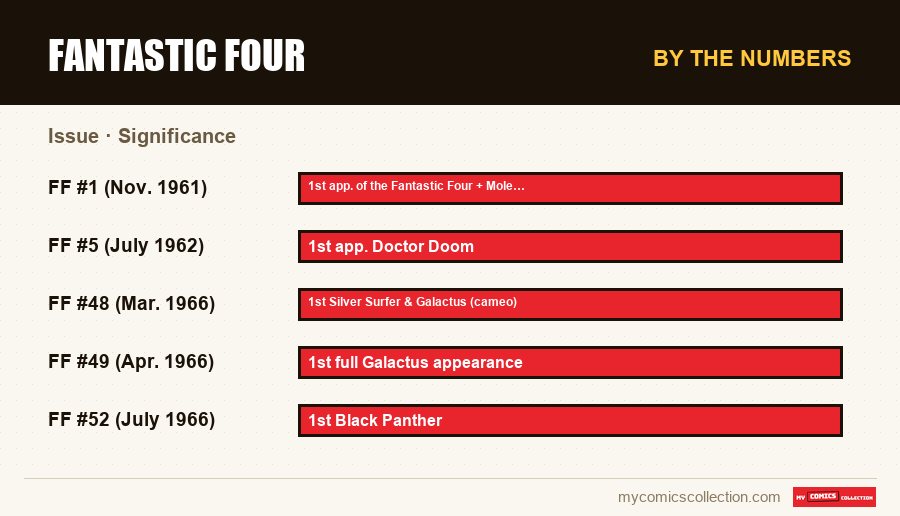
| Issue | Significance | eBay data (all grades) | Documented record |
|---|---|---|---|
| FF #1 (Nov. 1961) | 1st app. of the Fantastic Four + Mole Man | Too thin (8 listings): not usable | $2,040,000 (CGC 9.6, Heritage Sept. 2024) |
| FF #5 (July 1962) | 1st app. Doctor Doom | Med. €9 · avg €10 · 99 listings | $180,000 (CGC 9.2) · CGC 7.0 = $14,400 (Heritage July 2025) |
| FF #48 (Mar. 1966) | 1st Silver Surfer & Galactus (cameo) | Med. €9 · avg €25 · 98 listings | ~$192,000 (CGC 9.8) · CGC 9.4 = $12,600 (Heritage July 2025) |
| FF #49 (Apr. 1966) | 1st full Galactus appearance | Med. €9 · 64 listings | Not isolated publicly |
| FF #50 (May 1966) | Galactus Trilogy conclusion | Med. €14 · high €45 · 100 listings | Not isolated publicly |
| FF #52 (July 1966) | 1st Black Panther | Avg €75 · 89 listings | $90,000 (CGC 9.8, ComicLink 2016) |
Record sources: Heritage Auctions, CGC News, ComicLink, Bleeding Cool, QualityComix.
Fantastic Four #1: the absolute Silver Age grail
Fantastic Four #1 is the ground zero of the modern Marvel universe. Stan Lee and Jack Kirby introduce all four heroes and their first villain, the Mole Man, in a single issue. What sets it apart from every contemporary title is its tone: characters argue, doubt themselves, suffer. That was a total break from the superhero comics of the era.
On the market, FF #1 is exceptionally scarce in high grade: copies circulate rarely, and eBay carries only 8 active listings, insufficient for a representative median price. Documented auction records tell the story: $1,500,000 for a CGC 9.2 (Heritage Auctions, 2022), then $2,040,000 for the sole known CGC 9.6 example: carrying the "Curator Pedigree" designation (Heritage Auctions, September 2024). These figures place FF #1 among the most valuable comics ever sold in any era. The upcoming MCU film The Fantastic Four: First Steps (directed by Matt Shakman, released July 2025, starring Pedro Pascal as Reed Richards) has added renewed collector attention to the entire run.
Fantastic Four #5: the first appearance of Doctor Doom
Published in July 1962, Fantastic Four #5 introduces Victor Von Doom: the series' most enduring antagonist and one of Marvel's great villains. Our eBay estimator returns a median of €9 across 99 active listings: a liquid, highly accessible market for low-grade copies. But the grade-dependent spread is stark: Heritage Auctions realized $14,400 for a CGC 7.0 at its July 2025 sale, and specialist sources document sales around $180,000 for a CGC 9.6. Doctor Doom's MCU debut in 2025 has kept demand strong across all grades.
The Galactus Trilogy: FF #48, #49, #50
The "Galactus Trilogy" (March-May 1966) is universally cited as the creative peak of the original run. Stan Lee and Jack Kirby introduce two cosmic characters of unprecedented scale:
- FF #48 (March 1966): first appearance of the Silver Surfer and first cameo of Galactus. Our eBay estimator shows a median of €9 across 98 listings (weighted down by very low grades), but Heritage Auctions realized $12,600 for a CGC 9.4 in July 2025. The documented CGC 9.8 record exceeds $192,000.
- FF #49 (April 1966): first full appearance of Galactus. eBay median is €9 across 64 listings. No sale record has been isolated publicly in the sources consulted.
- FF #50 (May 1966): trilogy conclusion: the Silver Surfer turns against Galactus to save Earth. eBay median reaches €14 (high €45) across 100 listings.
Collectors frequently target all three as a run set; among them, FF #48 carries the greatest individual value in high grade for its dual first appearance (Silver Surfer + Galactus cameo).
Fantastic Four #52: the Silver Age Black Panther key
Fantastic Four #52 (July 1966) contains the first appearance of T'Challa, king of Wakanda: the first Black superhero in mainstream American comics history. It is the most valuable secondary-appearance issue in the main FF run: the eBay average exceeds €75 (89 listings), and the CGC 9.8 record is documented at $90,000 (ComicLink, 2016). For a deeper dive into this specific issue, see our dedicated Black Panther key issues guide.
Collector strategy (grounded in real data)
- FF #1 = a museum piece. Accessible only through Heritage-level auctions, priced well above most collectors' budgets. Owning it in authenticated low grade remains an option for serious budgets; in high grade, recent records exceed one million dollars.
- FF #5 = the most accessible key on the list. At a €9 eBay median across 99 listings, it is the most liquid entry point. Low grades trade freely; CGC high-grade slabs quickly move into the thousands of dollars.
- Galactus Trilogy = collect all three together. Each issue has individual value, but the complete #48-50 run is routinely sought as a set. FF #48 carries the bulk of the value.
- Grade determines everything on Silver Age keys. All-grades eBay medians do not reflect the real upside of high-grade copies; always consult the estimator issue by issue before buying or selling.
Own a Fantastic Four comic? Get a free valuation with our tool based on real eBay sales to find its low, median and high value.
Frequently asked questions
Fantastic Four #1 (November 1961), published by Stan Lee and Jack Kirby, where the four heroes and their first enemy, the Mole Man, appear together. Its tone, with characters who argue and doubt, breaks completely with the superhero comics of the time.
In Fantastic Four #5 (July 1962), which introduces Victor Von Doom, the series' most enduring antagonist. It is the most accessible key on the list, with a liquid market for low grades, but the value gap by grade is dizzying.
Fantastic Four #48 to #50 (March to May 1966). #48 features the first appearance of the Silver Surfer and the first cameo of Galactus, #49 the first full appearance of Galactus, and #50 concludes the arc when the Silver Surfer turns against Galactus to save Earth.
Fantastic Four #52 (July 1966), which introduces T'Challa, king of Wakanda, the first Black superhero in mainstream American comics. It is the most valued of the secondary issues of the main series.
Because all-grade valuations blend reprints, low grades and high grades, and do not reflect the potential of high-grade copies. So always look issue by issue and grade by grade before buying or selling.