
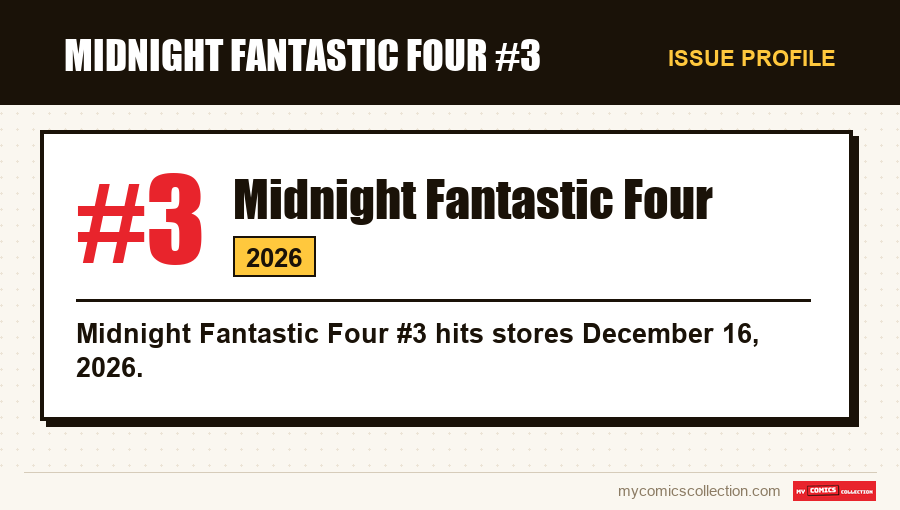
Midnight Fantastic Four #3 has a release date of December 16, 2026, under the title "Finding the Hidden World!": 32 pages, Parental Advisory rating, script by Benjamin Percy, art by Kev Walker. According to the solicitation, the plot sends the Four to the Jornada del Muerto, a New Mexico desert near Los Alamos and the site of the 1945 atomic test, where a crack in the firmament has left traces of another world.
Some issues are announced by a character, others by a threat. This one is announced by a place, and not just any place: a corner of desert that appears in history textbooks. That is enough to make it the series' most real-world-grounded issue.
As always in this guide, we only state verified information (creators, issue numbers, dates); the analysis is our own, with no reproduction of interior pages or protected dialogue.
The announced issue's spec sheet
The catalog information is set. Midnight Fantastic Four #3 carries the title "Finding the Hidden World!" Its on-sale date falls on December 16, 2026, alongside the other two series. On the menu: 32 pages and an unchanged Parental Advisory rating, for a creative team that remains the one from the previous issues. No notable debut is highlighted.
That last point is useful to anyone building a collection: you do not shelve this issue because it introduces a character, but because it belongs to a run. Its place is justified by the series' continuity, not by a first appearance.
What the solicitation announces: a journey to a place
In the publisher's text, the Four head for the Jornada del Muerto, in New Mexico. It is the ground of the atomic test near Los Alamos; there they find the imprints of another world, which a crack in the firmament would have left behind. The title, centered on a hidden world, reinforces the idea of an exploration rather than a fight.
Two reading notes. First, the previous issue announced a theory to be tested in a company, and the next one puts the characters in the field: the series therefore moves from the lab to the location. Second, the solicitation points to traces, that is, remains left after the fact: the announced story is an investigation into the aftermath of an event, not an account of the event itself. We stop there, and we say nothing about what the characters find.
The real place: the Jornada del Muerto and the Trinity site
The interest of this issue lies in the fact that the setting exists. The Jornada del Muerto is a New Mexico desert, whose Spanish name evokes a dead man's journey. It was there, about 35 miles southeast of the town of Socorro, on what was then the Alamogordo bombing and gunnery range, that the test called Trinity took place on July 16, 1945, at 5:29 in the morning.
The weapons were developed at the Los Alamos laboratory, under the direction of J. Robert Oppenheimer, and the test itself was planned and directed by Kenneth Bainbridge. Originally, the closest structure was the McDonald ranch, about two miles away, which the scientists used as a laboratory: the device's nuclear capsule was assembled there. The origin of the name Trinity is unknown; Oppenheimer chose it, and it is often linked to the poetry of John Donne.
The explosion fused the desert sand into a pale green, slightly radioactive glass called trinitite. The site was designated a National Historic Landmark district of the United States on December 21, 1965. So this is a place that literally keeps a material trace of the event: a glass born of the ground melting.
This detail sheds light on the solicitation. When the text talks about the traces of another world, it uses a word that has a concrete equivalent on site. We do not claim that the series refers to trinitite; we say that the chosen location already carries, in real history, the idea of a ground transformed by an event that changed the world. The horror story finds a fully prepared terrain there.
A crack in the firmament: the tradition of hidden worlds
The Fantastic Four series has always had a particular relationship with worlds out of sight. From the issue dated November 1961, by Stan Lee and Jack Kirby, the adversary is the Mole Man: Harvey Rupert Elder, a nuclear engineer and explorer mocked for his theories about a hollow Earth, who becomes master of an underground kingdom populated by creatures. The series' inaugural hidden world is therefore beneath our feet, and its ruler is a rejected scientist.
The second major step is the Negative Zone, which bursts onto the scene in Fantastic Four #51 (June 1966), again by Stan Lee and Jack Kirby. It is a universe parallel to Earth's, whose matter is negatively charged and which has also been interpreted as antimatter. Largely uninhabited, it attracts conquerors who seek to open a passage to Earth, and its notable inhabitants include Blastaar and Annihilus. To follow the second character and the logic of his key issues, the page devoted to him is the right starting point.
These two examples sketch a grammar: in the series, a hidden world is a place reached through a flaw in the visible world, whether a cave, a breach or a door. The crack in the firmament that the solicitation announces is one more variation on this motif, moved to the sky. It is not new in principle; it is new in its setting, since the breach opens this time above a site marked by history.
For the collector, this reminder has a practical use. It lets you tell apart, in the years to come, what will be a reuse of a classic motif and what will be truly new. Jack Kirby, whose creator biography is worth reading, laid the foundations of this visual vocabulary: the series' hidden worlds are his worlds, and the Midnight version rereads them in its own way.
The link between the hidden world and the atom is, besides, not a 2026 novelty. In that same November 1961 issue, the Mole Man goes after nuclear plants and threatens to invade major cities through tunnels; the story closes on an atomic explosion in which he seems to perish. From the very beginning, then, the series associates buried worlds with nuclear energy. The solicitation for this issue #3 picks that association back up, moving it from underground to the sky and tying it to a specific site.
This link gives collectors of the classic period a key to reading: the 1961 issue is not only the series' opening, it already contains the ingredients that the Midnight line puts forward again. To place that issue among the decade's other issues, the analysis of the 1961 series offers a reading framework, and it keeps you from confusing the value of an old issue with the interest of a recent story.
Do you collect this series?
Track what you own, what you are missing and what your collection is worth. 7-day trial.
Start my trial →
Why anchor horror in a real place
A horror story works better when its setting is identifiable. A haunted house only truly frightens if it resembles a house you could live in. The Jornada del Muerto desert fills this function differently: there is nothing fantastic about it, it is in the history books, and that is precisely what makes the crack more unsettling.
The series already has a habit of this device. The atomic anxiety surrounding the Four's birth in 1961 is a real anxiety, shared by readers of the time. In 2026, the Midnight line takes it up by attaching it to a dated, verifiable place, which amounts to saying that the fear is not invented but inherited. That is our analysis, not a statement from the publisher.
There is also a structural effect. Issue #2, as announced, talks about a theory reviving the dangers of the atomic age; issue #3 sends the characters to the very site of the 1945 test. The progression is legible: after the idea, the terrain. A reader who has followed both issues will recognize the sequence, and it is one of the few things you can state about an unreleased issue without inventing anything.
Five announced covers
This issue has five versions. Kev Walker is the announced artist of A, veiled like all the A covers in the rest of the line. Juan Ferreyra drew B (Bloodbath) and Ben Harvey C (Special). Giuseppe Camuncoli takes D, filed with the Horror Homage covers. Phil Noto closes the set with E, of the Midnight Gallery type, offered at 1:25.
A collector's detail: Phil Noto signs cover E here, while he is announced for cover D of the previous issue. An artist who does variants on two consecutive issues lets you build a coherent set, and some readers like to follow a cover artist through a series. That says nothing about value, only about how you can order your shelving.
As for the 1:25 ratio, it describes an ordering condition placed on the retailer, not a number of existing copies. To understand the mechanics, see the line's variants page. No market value can exist before release, and we put none forward.
Preparing issue #3 in your collection
December 16 falls in the middle of the holiday season, which is a practical reason to reserve your copy in advance: shops have different hours, and an issue ordered with its cover letter specified is more likely to be there. Specify the letter when you reserve, because without an indication cover A is what you get.
For your inventory, note the title "Finding the Hidden World!" in the issue's entry. Issues that carry a title are easier to find in a catalog. Also note the date and the rating, which confirm it is the right issue.
As for reading, it is preferable to approach this issue after the two previous ones: the solicitation assumes the reader knows the characters and the company where they work. A reader starting here would lose the sequential effect we mentioned above.
Frequently asked questions
The schedule sets the release for December 16, 2026, at the same time as the other two series. The title is "Finding the Hidden World!"; the issue runs 32 pages, with the Parental Advisory rating.
The text sends the team into the New Mexico desert, to the site of the atomic test near Los Alamos, to find the marks of another world caused by a crack in the firmament. The announcement stops there.
It is a New Mexico desert, southeast of Socorro. It is where the Trinity atomic test took place on July 16, 1945, prepared at the Los Alamos laboratory under the direction of J. Robert Oppenheimer. The site has been a National Historic Landmark district since 1965.
Five versions: Kev Walker for the veiled A, whose full image is revealed inside, then Juan Ferreyra (B, Bloodbath), Ben Harvey (C, Special), Giuseppe Camuncoli (D, Horror Homage) and Phil Noto (E, Gallery, 1:25).
That of hidden worlds: the Mole Man's underground kingdom in the November 1961 issue, then the Negative Zone in Fantastic Four #51 from June 1966. The crack in the firmament is a variation on this motif, set this time above a site of atomic history.
Have you followed the series since issue #1? Value the Fantastic Four in your collection, old or recent.
Value my comic