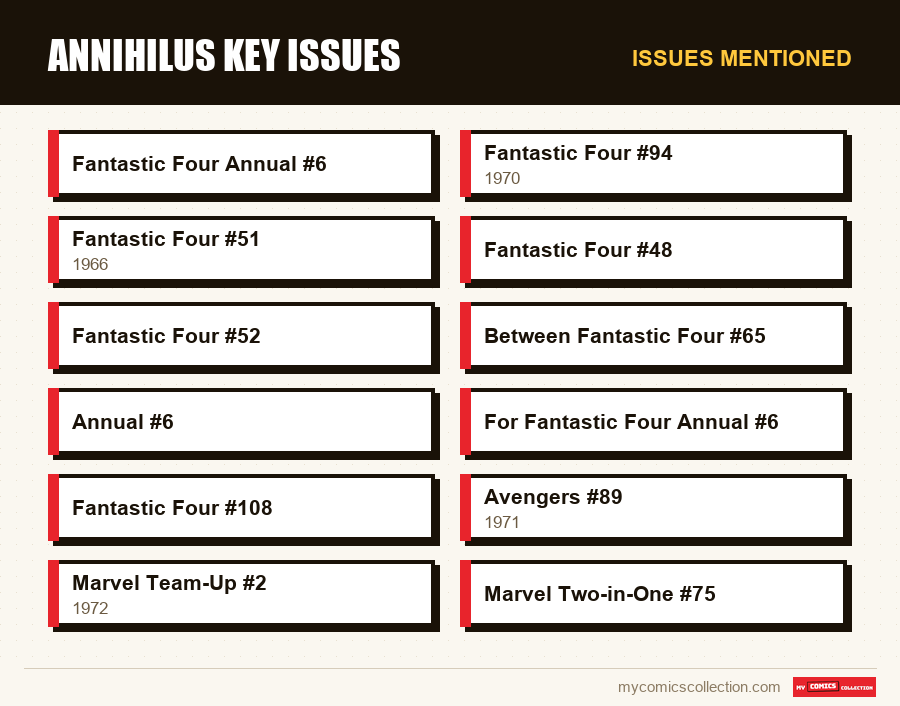
Annihilus first appears in Fantastic Four Annual #6, in a story titled "Let There Be Life!", written by Stan Lee, drawn by Jack Kirby and inked by Joe Sinnott. The same issue contains the birth of Reed and Sue Richards' son, the future Franklin Richards, who will not receive his name until Fantastic Four #94 (January 1970). Key point: this first appearance is not in a monthly issue but in an annual, a format with separate numbering, a different page count and price, often missing from tracking lists. The Negative Zone, for its part, is a distinct key: it appears in Fantastic Four #51 (June 1966), two and a half years before its future master. Annihilus became a headliner again with the Annihilation event in 2006.
There is a category of key issues that escapes almost every methodical collector: the ones filed elsewhere. You follow a series, you tick off the issues, your want list empties out neatly, and one day you discover that the first appearance of a major character is nowhere in your table, because it never carried a series number. It carries an annual number. Annihilus is the textbook case of this situation.
The character is no supporting role. He is the ruler of the Negative Zone, the adversary who led the armada that ravaged part of the Marvel universe in 2006, and one of the few villains of the Lee and Kirby era to have been promoted to a galactic-scale threat forty years after his creation. His first appearance is nonetheless housed in a separate editorial object, and that changes everything: how to identify it, how to track it, how to evaluate it, and how to buy it.
This article therefore looks at two things at once, because they are inseparable: who Annihilus is in terms of verifiable issues, and how a collector approaches a key issue that lives in an annual rather than in a series.
Annihilus: the verified record, and a date that deserves a note
Let us start with what is documented, and what is less so.
Fantastic Four Annual #6
The story is called "Let There Be Life!", and Stan Lee gave it a subtitle that sums up the issue's principle: "The Glory of Birth, 'neath the Shadow of Death." The plot fits in one sentence: Mister Fantastic, the Thing and the Human Torch enter the Negative Zone to find a source of cosmic energy capable of treating the complications of Sue Storm's pregnancy. That source turns out to be the Cosmic Control Rod, the control rod Annihilus carries. The heroes steal it from him, draw what they need from it, then give it back.
On the date, we must be precise, and accept saying that sources disagree. The most widespread indication for Fantastic Four Annual #6 is a cover date of November 1968. Several reference works devoted to villains and to the editorial history of the period, on the other hand, mention a cover date of August 1968. Both claims circulate side by side in serious literature on the subject. This is not a scholar's quibble: a discrepancy in a date is exactly the kind of thing that complicates identifying a copy when you compare two listings. The only fact beyond dispute is the year, 1968, and the issue's content. When you examine a copy, it is the indicia printed on the inside page that settles it, not a record copied from somewhere else.
Another identification detail that readers of the time noticed before collectors did: Annihilus does not have the same palette on the cover and inside. On the cover, he is green, with red eyes. In the interior pages, his costume mixes purple, pink and green, and the Cosmic Control Rod is yellow. A coloring inconsistency that is commonplace for the period, but that helps spot a cropped image or a late reproduction.
As for the character's fictional identity, the stable elements are few and always the same: he comes from the planet Arthros, in the Negative Zone; his power rests on the cosmic control rod, which slows his aging and lets him manipulate matter and energy; he is called the lord of the Negative Zone and "the living death that walks"; his recurring ally is Blastaar, who began as a rival for control of the Zone before becoming a partner.
The Negative Zone is a distinct key, and it comes earlier
This is the most frequent error on this subject, and it is costly: confusing the first appearance of Annihilus with that of the Negative Zone. They are two different issues, separated by two and a half years.
The Negative Zone, also a creation of Stan Lee and Jack Kirby, appears in Fantastic Four #51, dated June 1966. This issue is also famous for another reason: it contains the story "This Man... This Monster!", considered for decades one of the peaks of the period, and it also introduces Wyatt Wingfoot. The dimension Reed Richards explores there is rendered through abstract pages that remain famous in the graphic history of the medium.
An important nuance: the dimension crossed in this issue will become the Negative Zone in the following stories. In other words, the thing appears before its name. It is a classic configuration in comics of this period, and it has an immediate practical consequence. A collector looking for "the first appearance of the Negative Zone" should know that the issue in question does not necessarily carry the phrase on its cover or in its text, and that it is valued on the market first for its story, second for this first-appearance status.
The rest of the description is stable from one source to another: the Negative Zone is a universe parallel to ours, in which all matter is negatively charged, equated by some commentators with antimatter. It is largely uninhabited, which explains why its few notable occupants, Annihilus and Blastaar, are both conquerors seeking to cross the passage to Earth. It was reused much later as a detention site for superheroes in the continuity of Civil War.
For anyone who wants to place all this in the series, the immediate neighborhood is dense: Fantastic Four #48 opens the Galactus trilogy, Fantastic Four #52 introduces the Black Panther, and number 51 slips in between the two. Our guides to Fantastic Four Silver Age key issues and Galactus key issues cover this sequence in detail.
The heart of the matter: what changes when a first appearance is housed in an annual
An annual is not a series issue with more pages. It is a different editorial object, and each of these differences has a consequence for collecting. Here they are, separating what comes from editorial structure and what comes from market behavior.
Parallel numbering, hence invisible in a run
This is the founding difference. The annuals of the Fantastic Four have their own sequence of numbers, running in parallel to that of the monthly series. Between Fantastic Four #65 and #66, there is no room for Annual #6: the annual occupies no rank in the main sequence. Direct consequence: a collection of the series can be rigorously complete, without a gap, with no missing issue flagged, and not contain the first appearance of Annihilus. No tracking tool will alert you, because there is nothing to report from the series' point of view.
It is precisely for this kind of case that the list of missing comics must be built by character and by key, and not only by numbering continuity. A run is checked by subtraction. An annual is checked by intention.
An annual cadence, and gaps in the annuals series itself
A monthly comes out twelve times a year and creates a habit. An annual comes out once, sometimes not at all. The Fantastic Four annuals series gives a clear demonstration: Stan Lee and Jack Kirby sign annuals 1 to 6, that is, the entire first wave, which stops in 1968. In the series' creator index, the next original annual story only appears at number 11, in 1976. In between, the numbering keeps advancing without an original story lodging in it.
For a collector, this means you cannot reason about an annuals series as you would about a run: there is no regularity to exploit, and the next issue is not necessarily comparable to the previous one. Each annual must be evaluated for what it contains, not for its position.
A different physical format, hence different flaws
The annuals of this period are giants: far more pages than a monthly issue, a cover price noticeably higher, and a markedly thicker spine. Always check the page count and cover price on the copy itself rather than on a record, since these characteristics varied from one title and year to another.
What matters is the consequence: a thick object does not wear like a thin one. On a standard issue, the classic flaws are cover creases, corner wear and staple rust. On a giant, spine stresses are added: splits, detachments, sagging under the weight of the pages, and a tendency to gape when the copy was stored flat under a pile. An annual that looks superb from the front can lose several points on the spine examination alone. Our grading guide applied to the Fantastic Four details how to read these flaws.
Separate distribution and preservation
An annual was not handled in the same way as a monthly. It did not automatically feature in what a regular reader received or reserved, because it was not expected at the same pace and cost more to buy. A reader of the time who bought every month could easily miss the summer giant, for the sole reason that he was not there that day or lacked the money.
Thirty or sixty years later, this asymmetry shows in what circulates. High-grade copies of the period's annuals are proportionally fewer than those of contemporary monthlies, not because the print run was necessarily smaller, but because the preserved population is. A collector who set aside a series in a box filed his issues there; the giant with twenty-five more pages often had another destination, and another life.
A thinner market, hence more fragile reference points
On a highly sought monthly issue, copies of all grades come up for sale regularly. You can build a credible range in a few minutes, because comparables are abundant and recent. On an annual, the frequency of sales is lower, especially in the intermediate grades. Reference points exist, but they are spaced out in time, which creates two symmetrical traps: accepting a price pegged to a single, exceptionally high sale, or turning down a fair opportunity by comparing it with an old sale made in a different market context.
For Fantastic Four Annual #6 specifically, public sales have been documented across several CGC grades, and our article on the key Fantastic Four annuals and specials gives the amounts with their dates. The trend observed on this issue has been upward for several years, against the current of part of the Silver Age that stagnates, which is easily explained: two first appearances in a single issue, one of which concerns a character who became central in cosmic continuity.
The method: six steps to approach a key housed in an annual
First decide whether you are aiming at the key or the series
These are not the same purchases. If the goal is the first appearance of Annihilus, a single issue is concerned and the whole budget can be concentrated on it. If the goal is the annuals series, you are entering a collection without regularity, where several issues have no comparable narrative interest. Decide before searching, not during.
Check the format on the copy, not on a record
Page count, cover price, indicia, printed date. These four elements are on the object. They are the only way to resolve a date discrepancy between two sources, and the only way to tell an original edition from a reprint or a later anthology reusing the same story.
Create a dedicated tracking entry, outside the sequence
The annual must not be filed as a series issue, otherwise it vanishes. Give it its own line, identified by the full title of the format and its annual number, and mark it as a key. That is the only way to see it show up in a want list. Our issue-by-issue tracker accepts this kind of separate entry.
Examine the spine before the cover
Counterintuitive, but it is the useful order on a giant. A split, detached or sagging spine caps the grade whatever the condition of the front. Systematically ask for a photo of the spine over its full height, and a photo of the spine fold with the issue open, before discussing price.
Calibrate a realistic target grade, then hold to it
On an old annual, aiming for very high grade amounts to waiting for a rare opportunity and paying for scarcity twice. Upper mid-grade often offers the best ratio between cost and enjoyment, especially since the format reads better than it displays. Set a grade range before searching, and refuse what falls outside the range even if the copy is tempting.
Cross-check several dated sales, and beware of isolated sales
In a thin market, a single transaction does not make a price. Look for at least three sales of the same grade, note their date, and never compare a sale from four years ago with an offer today without accounting for it. An estimate based on real sales is worth more than a value displayed without a source.
Annihilation, 2006: when an annual villain becomes a headliner
Between 1968 and the mid-2000s, Annihilus carries on a career as a recurring adversary without ever carrying an event. Then Marvel entrusts him with a universe-wide invasion, and his value as a character changes category. Here is the publication structure, which is the only useful thing to remember here.
The whole runs from 2006 to 2007. It opens with a single issue, Annihilation: Prologue, forty-eight pages, out on March 15, 2006. Four four-issue miniseries follow, launched one week apart: Silver Surfer, Super-Skrull, Nova and Ronan. The central series, Annihilation, has six issues published from August to December 2006, in a story driven by Keith Giffen.
Annihilus' role is that of the main antagonist. He commands the Annihilation Wave, an armada of warships out of the Negative Zone, which conquers the Kyln and then neighboring systems and destroys the Nova Corps' home world, Xandar. His real intention, revealed mid-story, goes beyond conquest: to build a bomb of cosmic power capable of destroying both the universe and the Negative Zone, so as to remain its sole survivor. The outcome is well known: Galactus, freed, destroys most of the armada, then Nova weakens and kills Annihilus in the sixth issue. The character is immediately reborn as a child, retaining his memory.
Two cross-references so as not to stray from the subject. The event itself, its reading order and its collected editions are the subject of a dedicated reading guide on this blog, devoted to Annihilation in 2006. The journey of Nova, Richard Rider, from his first appearance to his role in the event, is covered in an article specific to the character. For the general cosmic context, our pages Galactus, Thanos and Silver Surfer gather the rest.
Notable later appearances, and what they are worth as reference points
After 1968, Annihilus returns in waves. The following list retains the documented appearances that have collecting or reading interest, with their issue numbers and dates.
- Fantastic Four #108 and #109 (March and April 1971): the episode of Janus the Nega-Man, who develops a module able to harness antimatter energy and serves as a vehicle for Annihilus to try to reach Earth.
- The Avengers #89 (June 1971): Annihilus is about to cross a portal built by Mister Fantastic and is driven back by the Avengers. He also plays a secondary role in the Kree-Skrull War issues, #89, #96 and #97.
- Marvel Team-Up #2 (May 1972): a new attempt to exit the Negative Zone, countered by Spider-Man and the Human Torch.
- Marvel Two-in-One #75, The Avengers #233, Thor #404 and #405, then Thor #434 and #435: the scattered appearances of the 1980s and 1990s, which keep the character in circulation without giving him an arc of his own.
- Ultimate Fantastic Four #15 to #18 (January to May 2005): Nihil, an Ultimate universe character inspired by Annihilus, ruler of a station made of wrecked ships. It is not the same character, and that is worth knowing before buying in the belief of acquiring a key.
- War of Kings: Ascension #2 (July 2009): Annihilus appears there in his child form, placed in the care of Catastrophus, who uses the Cosmic Control Rod to prevent his growth.
- Fantastic Four #587 (January 2011), #588 (February 2011) and #600 (January 2012): the most discussed sequence of the modern period. The Human Torch dies stopping a horde from the Negative Zone, then Annihilus brings him back through regenerative surgery and forces him to fight as a gladiator.
- Thanos vs. Hulk #3 (April 2015): still stuck in a child form and using a mechanized dummy for his public appearances, Annihilus has Bruce Banner kidnapped, then turns into a giant and monstrous form.
- Thanos: The Infinity Relativity (August 2015) and Thanos: The Infinity Finale (June 2016): a successful invasion, then its cancellation by a time journey of Thanos and Adam Warlock.
- All-New, All-Different Avengers #10 to #12 (August and September 2016): the episode of the Nega-Bands and the energy cannon, countered by the team.
- Annihilation: Scourge Omega (February 2020): Annihilus and Blastaar make common cause against the forces of the Cancerverse, and Annihilus resurrects Nova at the end of the episode.
A note of method on this list. None of these issues is a first appearance, and none therefore carries the scarcity premium attached to the 1968 annual. Their interest is in reading, and incidentally in theme: if you are building a collection devoted to the Negative Zone rather than to a title, they form its backbone, at a cost that remains that of ordinary issues in the vast majority of cases. There is another neighboring case worth knowing: that of Ahmyor, the amnesiac, humanoid version of Annihilus in Age of Apocalypse continuity, who circulates under a different name and may go unnoticed in a search by character.
What to remember if you are aiming at this annual
Annihilus condenses a principle that is useful well beyond his case. The value of a key issue does not depend only on what it contains: it also depends on where it was published. A first appearance in a closely followed monthly is easy to find, compare and negotiate, because hundreds of copies circulate and the market is thick. The same first appearance in an annual has to be hunted, verified and decided on, because there are fewer comparables and more uncertainty.
That makes it neither a better nor a worse purchase. It makes it a purchase that calls for different preparation: identify the format on the object, track the key outside the series sequence, examine the spine with as much attention as the cover, and cross-check several dated sales before talking about a price. For everything else, our guide to cosmic first appearances and our Fantastic Four reading guide extend the subject in the two possible directions, that of the market and that of reading.