
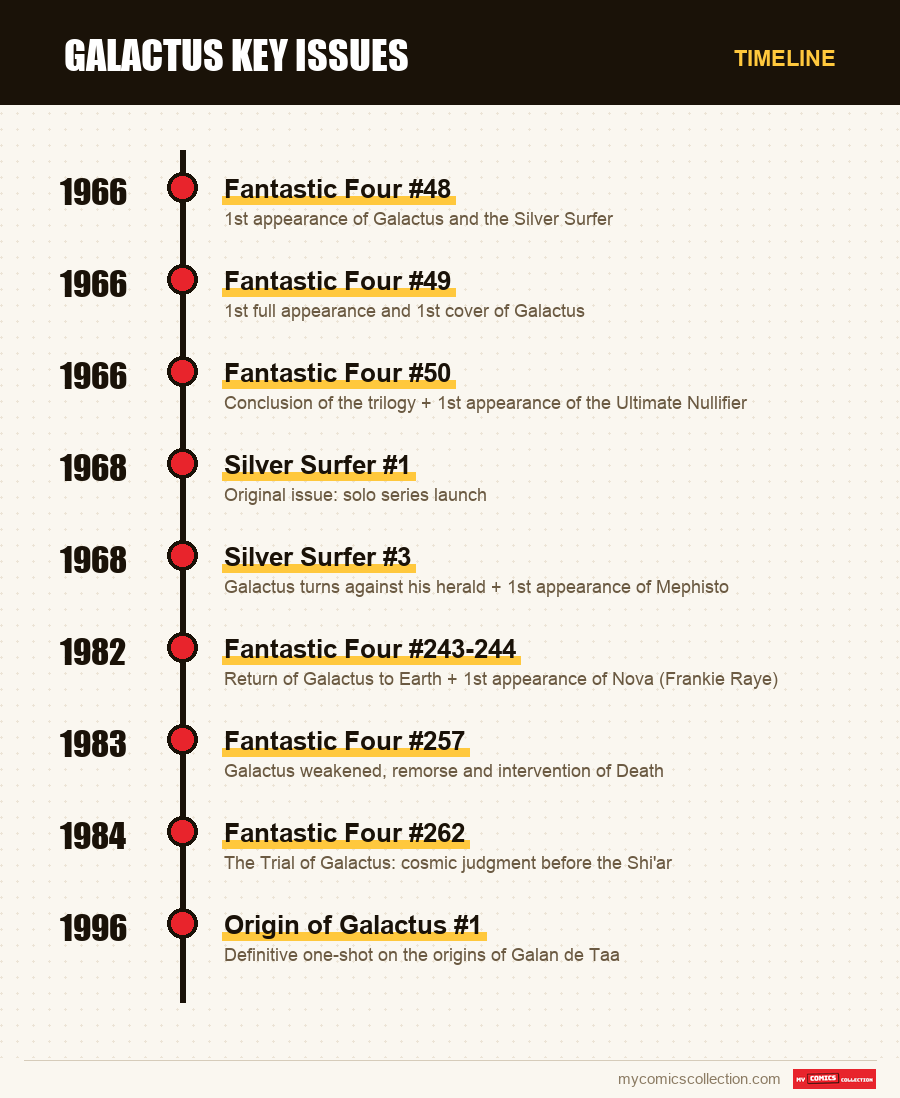
Galactus' absolute key number is Fantastic Four #48 (March 1966, Lee/Kirby/Sinnott), which introduced both the Devourer of Worlds and the Silver Surfer. The trilogy is completed with the #49 (first full appearance, on cover) and #50 (first appearance of the Ultimate Nullifier). A CGC 9.4 of #48 crossed $95,000 in 2025, compared to $71,000 at the end of 2024. Serious collectors also add Silver Surfer #1 and #3, as well as the great cosmic stories by John Byrne (Fantastic Four #243, #244, #257, #262).
Few supervillains in the Marvel Universe have as concentrated a track record of key issues as Galactus. Unlike characters whose mythology spans dozens of disparate titles, most of the collectible value of The Devourer of Worlds lies in a handful of specific stories, produced over less than twenty years, between 1966 and 1984, before a 1996 one-shot came to close the story of its origins. This is good news for anyone who wants to build a coherent Galactus collection without breaking the bank on dozens of secondary appearances.
This is also what makes this character particularly readable for a collector just starting out: where tracking down all the key appearances of Spider-Man or Wolverine involves following dozens of parallel series over several decades, the mythology of Galactus is based on a limited number of titles: essentially Fantastic Four and Silver Surfer: published by a handful of identifiable creative teams. This editorial concentration also explains why the differences in value between the founding issues and the rest of the character's bibliography are so marked: demand crystallizes almost entirely on three or four titles.
This article is specifically aimed at buyers and sellers: which numbers to buy first, why they matter, and what they are really worth on the current market, with supporting figures. If you are instead looking for the complete story of the creation of the character, his editorial evolution and his place in Marvel cosmology, our article the story of Galactus in the comics covers this narrative angle in detail: the two texts complement each other without repeating each other.
We cross-referenced documented sales data (Heritage Auctions, GoCollect, price guide publishers) with verifiable editorial facts: publication dates, creative teams, print runs and historical context. No figure is put forward without a source; When the value data is not publicly available, we indicate the rarity or status of the issue rather than inventing a price.
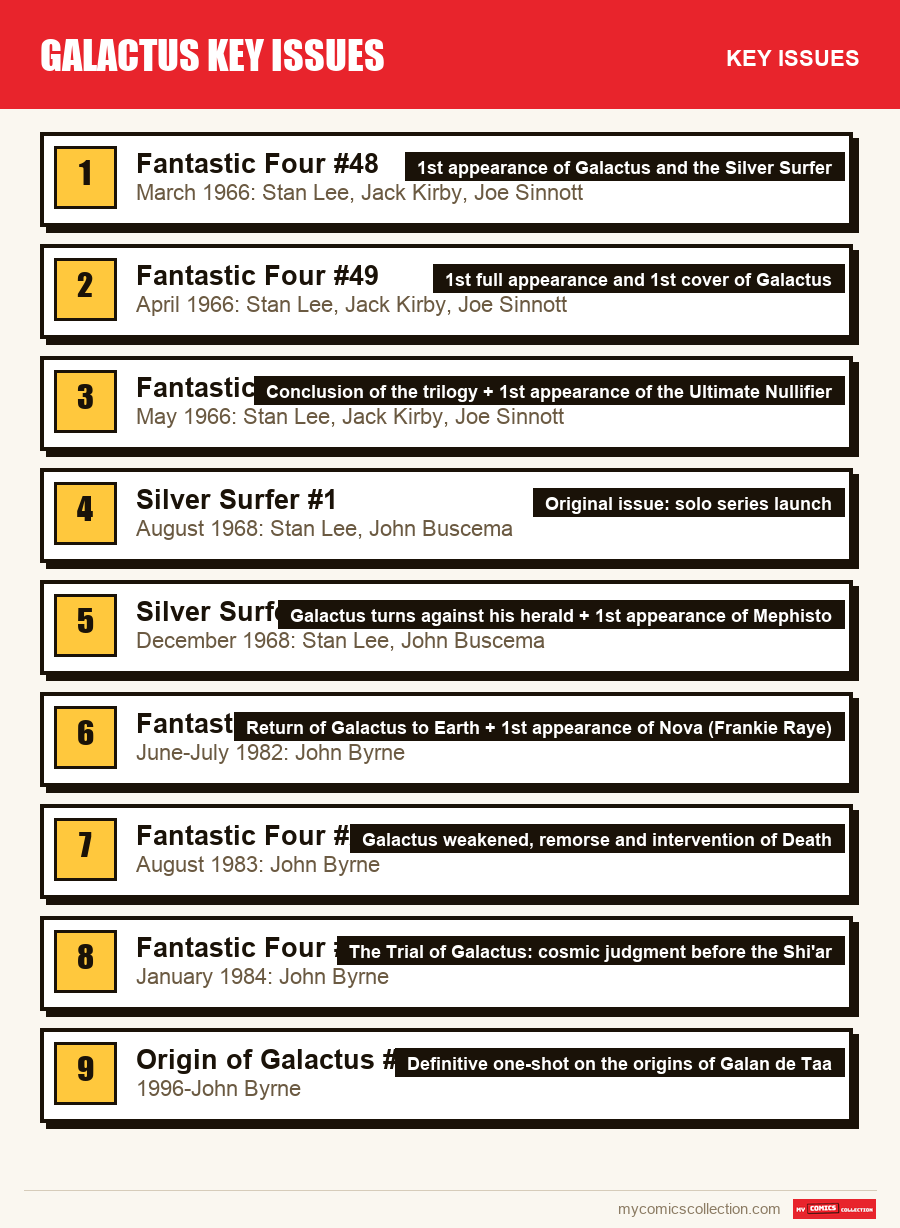
Why the 1966 Trilogy Changed Superhero Comics
In March 1966, Stan Lee and Jack Kirby had been working on Fantastic Four for nearly five years and were looking for an antagonist who broke from the classic costumed supervillain mold. The result is a being on a cosmic scale who does not fight the team out of malice but out of biological necessity: he must feed on planets to survive. This story, published over three consecutive issues (Fantastic Four #48 to #50, March to May 1966) and retrospectively nicknamed “the Galactus trilogy”, was described by The Atlantic in 2018 as the indisputable peak of the Silver Age of comics. A Comic Book Resources reader survey ranked it the 19th best saga in the history of the medium in 2012.
What sets this story apart from other Silver Age arcs is that it introduces two major characters at once: Galactus himself, and his herald the Silver Surfer, whose relationship of moral debt (the Surfer sacrificed his freedom to save his home planet Zenn-La) will give birth to one of the most tragic figures in the Marvel catalog. Kirby draws and co-writes, Sinnott inks, Lee dialogues: the creative team at the top of their game during this pivotal period for the publisher.
On an editorial level, this trilogy also opened the way to the entire “cosmic” dimension of the Marvel universe: without Galactus, no solo Silver Surfer, no Thanos (conceived by Jim Starlin in the direct lineage of these stories), no recurring Watcher, no Fantastic Four space-opera version of the Byrne years. It is an editorial tipping point as much as a commercial one, which explains why the three founding issues so clearly dominate the market today.
We must also remember the context of the print run: in 1966, Fantastic Four was already one of the best-selling titles in the Marvel catalog, with national distribution via newsstands far greater than that of today's comics. The gross circulation of #48-50 was therefore high for the time, but the survival rate in high grade is extremely low sixty years later: acidic newsprint, intensive reading by a young audience, absence of protective bags before the 1970s. It is this de facto rarity, and not the rarity of circulation, which explains the dizzying price gap between a medium grade copy and a copy certified CGC 9.6 or 9.8.
Fantastic Four #48
The absolute Holy Grail of the Galactus collection. Kirby introduces the character in a dramatic reveal at the end of the episode, an imposing figure emerging from his ship, accompanied by the Silver Surfer, who makes his very first appearance here. It is also one of the most sought-after Fantastic Four in all categories, alongside FF #1 and FF #5. The demand was relaunched in 2023 with the announcement of the character's integration into the MCU.
Fantastic Four #49
#48 showed him in the shadows: #49 is the issue where Galactus appears for the first time in full light, and especially on the cover, alongside the Surfer. This is the pivotal episode of the trilogy, the one where the threat fully materializes and the battle for Earth begins. It remains significantly less expensive than the #48 in equivalent grade, which often makes it the preferred entry point for collectors who want a pillar of the trilogy without aiming for the most expensive number.
Fantastic Four #50
The outcome of the confrontation: Johnny Storm brings back from Galactus' ship the Guardian's weapon, the Ultimate Nullifier, the only one capable of truly threatening the Devourer of Worlds. Reed Richards uses it as leverage to force Galactus to spare Earth. This item would become a recurring element of Marvel cosmic mythology (it would resurface in major arcs decades later). The issue also contains the second full appearance of Galactus and the third appearance of the Silver Surfer.
Silver Surfer #1
First issue of the Silver Surfer solo series, this comic doubles the usual format and unfolds for the first time in detail the origin of Norrin Radd and his pact with Galactus to save Zenn-La. This is the issue that permanently establishes the Galactus/Surfer relationship as the cornerstone of the entire Marvel cosmic universe, and it is considered one of the pillars of any collection dedicated to the character: almost every issue of this first series is sought after by collectors today.
Silver Surfer #3
After his rebellion against his master to protect the Earth, the Surfer is banished by Galactus, who erects an invisible energy barrier around the planet, calibrated only to prevent him from leaving it: the starting point for all of the character's terrestrial exile in the following decades. This issue also marks the very first appearance of Mephisto, one of the major recurring antagonists of the Marvel universe, making it a highly sought-after key double issue in high grade.
Fantastic Four #243-244
Byrne reignites cosmic mythology by bringing Galactus back to Earth to face the Fantastic Four, the Avengers, Spider-Man, Daredevil and Doctor Strange, with New York City as the battlefield. #244 (July 1982) marks a turning point: Frankie Raye volunteers to become Galactus' new herald under the name Nova, the character's first appearance in this role. This is the beginning of the Byrne era on the Galactus mythos, more introspective and less purely destructive than the Kirby era.
Fantastic Four #257
After devouring the Skrull throne world on Nova's orders, Galactus, satiated, falls into a deep sleep and is visited by the incarnation of Death, who reminds him of his necessary cosmic function. Terrax, another former rebel herald, then attempts to recruit the Fantastic Four to finish him off during his vulnerability, but the team chooses to save him. This is one of the issues where Byrne most humanizes the character, moving him away from simply being a destructive force.
Fantastic Four #262
Reed Richards is brought before a galactic tribunal by Lilandra of the Shi'ar for saving Galactus' life in the previous episode. The Guardian defends himself, Odin testifies, and Galactus himself comes to plead on Reed's behalf before Eternity reveals, through his own eyes, that he is acting without free will-a force of nature that the universe needs. This issue permanently establishes the philosophical status of Galactus in Marvel continuity: neither hero nor villain, but cosmic necessity.
Origin of Galactus #1
Twenty-eight years after drawing the great cosmic hours of the character, Byrne returns to tell in a single issue the complete origin of Galactus: the scientist Galan, on the planet Taa, trying to save his people from the end of the previous universe, embarks towards the final collapse and, instead of dying, gestates for billions of years in a cocoon before being reborn in the form of Galactus. This is the canonical reference for any subsequent origins of the character.
Collecting this series?
Track what you own, what you are missing and what your collection is worth. 7 day trial.
Start my trial →The impact of the film Fantastic Four: First Steps on the rating
The Fantastic Four: First Steps, released in theaters on July 25, 2025, stars Ralph Ineson in the role of Galactus, portrayed as a cosmic threat on a literally planetary scale. The film grossed approximately $118 million in North America in its first weekend and crossed $500 million in worldwide revenue, bringing the total to approximately $506 million: the best opening performance for a Marvel film of the year 2025.
This media exposure translated into a measurable effect on the comic book market. Fantastic Four #48, already the subject of a surge in interest upon the announcement of the film's distribution in 2023, saw a CGC 9.4 copy cross $95,000 in 2025, compared to $71,000 in December 2024, an increase of 33.8% over the film's promotion window. Fantastic Four #1 (1961) followed a comparable trajectory, with a CGC 7.0 copy rising from $38,000 to $51,500 between January and June 2025 (+35.5%).
As is often the case after a peak of anticipation linked to a cinema release, the market then stabilized and then experienced a correction of around 4 to 7% on the main key numbers in the weeks following the theatrical release: a classic post-blockbuster return pattern. Over the twelve months preceding April 2026, Fantastic Four #48 even shows a drop of around 16% across all CGC gradations combined, which clearly illustrates the volatility specific to issues whose value is partly driven by cinematic news rather than solely by intrinsic rarity. For buyers looking for the long term, these post-release correction phases often represent better buying windows than hype peaks.
This market movement also illustrates why it is essential to clearly distinguish the grades before buying or selling: the difference in value between a CGC 9.0 and a CGC 9.8 can represent a factor of ten, or even more, on an issue like Fantastic Four #48. Our guide to the difference between a CGC grade 9 and 9.8 precisely details the visual criteria and the rating differences between these levels, particularly relevant for the Silver Ages like the Galactus trilogy.
Buying guide for a Galactus collection
- Prioritize the founding trilogy: if the budget is limited, it is better to own a Fantastic Four #48 in medium grade (VG-FN) than a #49 or #50 in very high grade: this is the number which carries most of the historical and financial value of the character.
- Check the restoration on Silver Age examples: Fantastic Four #48-50 are from 1966; Copies not certified as apparent high grade deserve an inspection or CGC/CBCS certification before purchase, invisible restoration being common on these highly sought-after titles.
- Don't ignore Silver Surfer #1 and #3: less expensive than the Fantastic Four trilogy in equivalent grade, they tell the “herald” side of the Galactus myth and #3 brings as a bonus the first appearance of Mephisto.
- The Byrne issues (1982-1984) are a great entry point: higher print runs, availability in very high grade at prices significantly lower than the Silver Age, while covering essential narrative moments (Nova, the trial of Galactus).
- Origin of Galactus #1 is an economical essential: inexpensive because published in the midst of overproduction in the 1990s, it intelligently completes a collection without blowing the budget.
- Monitor cycles related to adaptations: announcements of films or series drive up key numbers before release, followed by regular corrections after the media peak: buying during these ebb phases is often more advantageous.
- Always compare several recent sales before buying or selling, rather than a single price displayed, because the difference between adjacent grades can be considerable on these securities.
- Track your collection over time: OUR collection tracking app allows you to catalog your Galactus numbers and follow the evolution of their rating over the character's news.
For the complete character profile (powers, notable appearances, place in Marvel continuity) head to the page Galactus of the site, which centralizes all of our content dedicated to the Devourer of Worlds.