When a series starts, you do not keep an issue because it is the first, you keep it because you know why. The method comes down to four decisions: settle the copy's use (to read, to display, to resell one day) before buying it, because these three uses do not call for the same object; physically check the printing in the indicia rather than assuming it; accept that issue #1 is the most abundant of the series and that the print-run trough comes later, often between the fifth and the fifteenth issue; record on the same day what memory will have lost in six months. Preservation and grading are not goals, they are consequences of these decisions. The rest is launch noise.
A launch puts the collector in an unfavorable position: they must decide fast, with no data, under attention pressure organized by the publisher. The numbers that would let you judge, how many copies are out there and how many will survive, will not exist for several years. The buying decision, however, is made on a Wednesday morning.
The usual response to this imbalance is to take everything as a precaution. It is the worst one: it turns an uncertainty into a certain expense, and after three years it produces boxes whose owner can no longer say what they have, in which printing, bought when. The useful response is a method: a small number of gestures that depend on no prediction and remain valid whether the series becomes a classic or stops at the eighth issue. It works for a big-franchise launch as for an independent series printed at a few thousand copies. The horror line Marvel opens on October 7, 2026 serves as an example of application at the end of the path, not as a subject: its presentation is in the guide devoted to it.
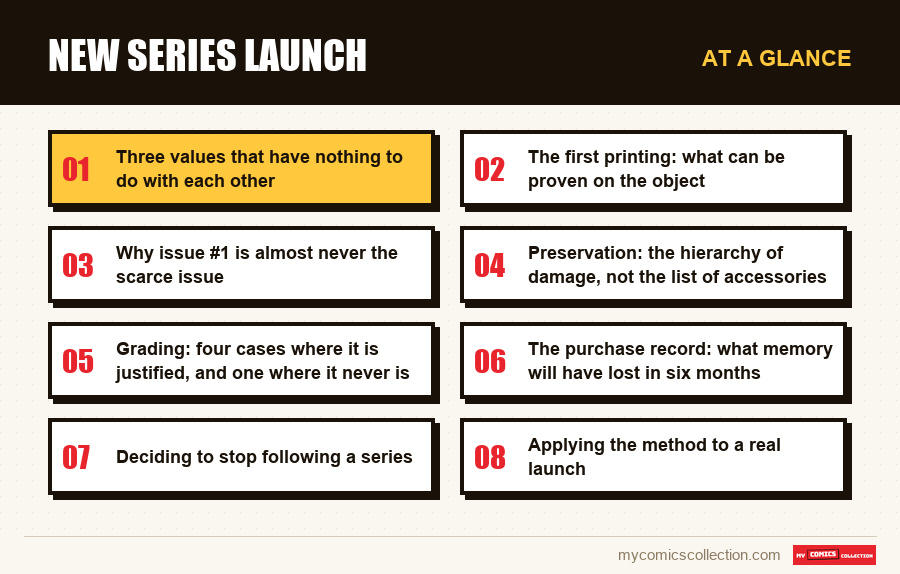
Three values that have nothing to do with each other
The first mistake is not buying the wrong issue, it is pursuing three incompatible goals with a single copy. A comic carries three distinct values, which are measured differently and do not peak at the same moment.
The reading value is realized immediately and in full. It depends on no market and is indifferent to condition: a copy with blunted corners tells the same story as a perfect copy. It is the only one of the three whose return is guaranteed on the day of purchase. The use value is what the object gives back without being read or sold: displayed, framed, leafed through, shown. It is continuous over time and the most underestimated, because it has a hidden cost: display is the most destructive mode of preservation there is. The resale value, finally, is the only one that is hypothetical. It only exists if someone wants this precise object, in this precise condition, at the moment you want to let it go. As long as the object is at your place, what you hold is not a value, it is an option on a value.
Confusing the three costs dearly in three ways. You overpay for a condition on a copy meant for reading, whereas condition brings nothing to that use. You destroy a copy's resale value by having it perform a display service, without being aware of having made a trade-off. And you forbid yourself from reading what you bought: the resale option may never be realized, the reading not done is a dead loss.
The practical consequence is simple. On a launch that truly interests you, the right answer is often two copies of the same issue: one to read, one to keep intact. It is cheaper than a graded copy and removes an impossible trade-off. On a launch that only half interests you, the right answer is one copy, and it is for reading.
The first printing: what can be proven on the object
"First printing" is not a quality, it is a manufacturing fact, and it can be verified. Most comics saw only a single pass through the press: the question only makes sense for issues whose demand exceeded the initial stock. But on a heavily ordered launch, the probability that a reprint exists is not negligible, and it is on this type of issue that the price gap ends up appearing.
The check is done in the indicia, that block of legal text printed in very small type at the bottom of the first story page or the last page. It carries the publisher's corporate name, the copyright and, where applicable, the edition notice. It is the only zone of the comic whose content binds the publisher.
Read the indicia in full, not skimming
A second pass through the press is normally declared there in plain text. Its absence constitutes a presumption of first printing, and that is the right word: a comic whose indicia says nothing is probably a first printing, but it can also be a reprint whose indicia was not corrected, which happens.
Compare the displayed date with the actual release date
A reprint decided after a sell-out necessarily arrives later. When the indicia carries a publication month later than that of the announced launch, the object you hold did not come out on release day. It is the simplest clue and the most often overlooked.
Look at the barcode block
It does not indicate the printing, but it carries a suffix specific to the edition and the cover. Two copies presented as identical whose suffixes differ are not the same commercial object. It is not proof, it is a divergence signal to clear up.
For a collected edition, look for the number line
Bound editions often follow the classic book convention: a descending sequence of numbers where the lowest one still present gives the printing number. This convention does not apply to periodical single issues, where you have to stick to the indicia.
When in doubt, do not decide
Write "printing not established" rather than "first printing". A recorded uncertainty remains usable years later; a recorded false claim will contaminate your later decisions and put you in an awkward spot the day you describe the object to a buyer.
One precaution completes this check: a reprint is not junk. It is often produced in smaller quantity than the first printing, because it answers residual demand and not an anticipation. It is not the reference piece, but the automatic contempt it faces sometimes creates absurd situations. The market mechanics that separate printings belong to another subject, covered in the guide on first printing and reprint. Here, only the gesture of checking counts.
Why issue #1 is almost never the scarce issue
This is the point where intuition is wrong most systematically, and the reason is purely arithmetic. Issue #1 is the one everyone orders: retailers take it wide because they do not yet know whether the title will work, the curious try it, collectors take it by reflex. It comes out at the highest print run of the whole series, in a context where everyone knows it should be kept. The result is an abundant and well-preserved object, that is, the opposite of what creates scarcity.
What follows is documented by analyses of the American direct market, and the curve is always the same. The drop between the first and the second issue is massive: observations published on recent series put this first step at around forty percent of orders, sometimes more. The third loses another ten to fifteen percent, the fourth about ten, then attrition calms down to a few percent per issue without ever canceling out. Orders do not rebound, they decelerate.
The trough therefore forms at the moment two curves cross: orders, which have finished deflating and hit their floor, and attention, which has vanished. Nobody comments on the series anymore, nobody sets it aside, and copies are bought to be read. It is there, in practice between the fifth and the fifteenth issue depending on the title's lifespan, that the issues hardest to find ten years later are located. The same reasoning holds for the end of a cycle: the last issues before a halt or a renumbering come out at the absolute floor of attrition, and many collections stop two issues before the end, out of distraction.
Issue #1
Ordered wide as a precaution, bought by people who know it should be kept, often in several copies. It concentrates attention and spending, but it is by construction the least scarce issue of the series: its future value can only come from exceptional demand, therefore from an external event occurring much later.
The trough, between the fifth and the fifteenth
Orders have hit bottom, attention has fallen back, and these issues are only bought by the core of regular readers. Nobody sets them aside. If the series becomes important later, they are the ones that will be missing, and will have to be hunted one by one, often in mediocre condition.
Preservation: the hierarchy of damage, not the list of accessories
What you need at launch time is not a list of equipment but a hierarchy, to know where to put your effort and above all where not to. Three kinds of damage weigh more than all the rest combined on a recent comic.
Light, the only truly irreversible one. A faded cover never becomes colorful again. No later treatment changes anything about it, and the damage accumulates silently, with no day visibly responsible. There is no second chance, and that is why it dominates. The upside is pleasant because it is free: a comic stored flat in an opaque container is fully protected from the one damage that cannot be repaired.
Mechanical stress on the spine, the most common. The reading crease and the marks along the edge do not come from an accident but from the normal gesture of opening. On a stapled comic, the spine takes it all. This damage is largely avoidable, but not avoidable and compatible with reading: that is precisely why separating the reading copy from the preservation copy solves the problem instead of managing it.
The ambient environment, the slowest. Humidity and temperature variations work on paper over years, with nothing spectacular in the short term, and that is what makes them dangerous: mediocre storage produces no signal before it has produced damage. The remedy is not equipment, it is a choice of room, and a lived-in room almost always does.
Conversely, two concerns are overrated on a recent comic. The exact material of the bag has no measurable consequence on an object bought new and stored properly, because the material's degradation horizon is longer than the collector's decision horizon; the case is entirely different for an old, already weakened comic, the subject of the preservation guide. And the factory micro-defect does not count: a staple shift or a cutting imperfection are manufacturing characteristics, present on a large share of the print run.
Grading: four cases where it is justified, and one where it never is
Getting a comic released a week ago graded is the most poorly calibrated operation of the beginner collector, for a structural reason: the cost is fixed and known, the object's value is unknown, and the high grade is nothing exceptional. On a comic bought new from a bin and handled properly, the very high grade is not a performance, it is the expected condition. Paying to certify the normal condition of a new object adds no information. Four situations nonetheless make an exception.
One: the object will be sold remotely. The slab solves two real problems, describing the condition to a buyer who cannot see the object and protecting it during transport. It is a logistical argument, not a valuation argument. Two: the copy carries a signature obtained in front of a witness. The only situation where certification brings information that no later examination will reconstitute: not the condition, but the circumstances, and that information is lost over time.
Three: the object is meant to be shown over the long term. The slab protects mechanically, a real answer to a real use need, but it does not protect from light: a graded copy exposed in full light degrades like any other. Four: the object goes into an insured set or one meant to be passed on. A description certified by a third party radically simplifies conversations with an insurer or an heir, and those conversations always come at the wrong time.
The case where it is never justified is the mirror of these four: getting a launch issue graded in the weeks following its release, in the hope that the grade creates the value. The grade describes a condition, it does not create demand. If the series settles in, your well-preserved copy will still be gradable in five years, at the same rate and with more information to decide. The opposite is not true: waiting is free, haste is final. The full trade-off is in the grading guide.
The purchase record: what memory will have lost in six months
Memory does not fail over a question of volume. It fails because the information useful to a collecting decision is exactly what it does not encode: arbitrary data, with no associated story, indistinguishable from one another. You remember having bought a comic on a launch day; you do not remember the month printed in the indicia, nor the cover variant you held, nor the exact price. These elements are not forgotten through negligence, they were never memorized. Worse, memory does not stay empty: it reconstructs. At six months, a sincere collector will claim in good faith to hold a first printing because it is the coherent version of their memory, and they will be wrong once in several times without ever knowing which.
- The purchase date, not the release date. It places your entry into the series, and it is the only one nobody else can attest to.
- The observed printing, phrased as an observation: what the indicia says, and if it says nothing, write it that way. Never a deduction presented as a fact.
- The exact cover, designated by what is printed on the object and not by a visual description. A series with multiple covers becomes undecipherable within months without this precision.
- The price actually paid. Without it, any later discussion of what the series cost you will be a self-serving estimate.
- The intended use, in a word: reading, preservation, display. Noting it prevents the decision from being revisited for comfort six months later.
- The condition at purchase, in one line, visible defects included. This mostly protects against the opposite error: later attributing to your storage a defect that was already there in the shop.
A seventh piece of information deserves a place of its own, because it is the one that pays off most and the one nobody notes: the reason for the purchase, in one sentence. For the creator, for the character, out of curiosity, because it was the last one in the bin. When it comes time to decide, three years later, between what you keep and what you let go, that sentence is worth more than any price guide: it is the only data that speaks about you and not about the market.
Deciding to stop following a series
No launch method is complete without its exit rule, and that is the part everybody skips. Collections do not degrade through bad purchases, which are rare and cheap. They degrade through the series you keep buying without reading, out of habit, for two years.
The most reliable signal is purely material and requires no literary judgment: the number of unread issues waiting. From three on, the series is no longer a pleasure, it is an obligation whose reading has been postponed. It is not a flaw of the series, it is the information that your time has gone elsewhere, and no additional purchase will fix that. Three secondary signals complete the picture: no longer being able to summarize the last two issues, the departure of the creative team that brought you in, and the fact that your only reason to continue is the integrity of the set, which is a different hobby from reading.
Stopping cleanly takes three gestures, and the most important is the last. Fix the last issue bought as an explicit boundary. Note the reason for stopping, because it is what will tell you in two years whether to resume. And above all, decide the fate of what you hold at that precise moment: keeping a coherent fragment of a series is defensible, leaving it in a box with no decision is the beginning of collections about which nothing is known anymore.
Applying the method to a real launch
Let us take the textbook case of the moment: the horror line Marvel opens on October 7, 2026 with three first issues the same day, the seconds announced for November 18 and the thirds for December 16. This launch is nothing special from the method's point of view, and that is what makes it a good exercise. The separation of values first settles the number of titles: three series being read represent three budgets, and nothing obliges you to take them all. The print-run check will be done in the indicia, and it only has value if recorded the same day. The trough arithmetic indicates where the real early decision lies: not on the first three issues, which everyone will have, but on those of the first half of 2027, when orders will have finished settling. Grading waits, none of the four cases that justify it being met on launch day. And the irregular calendar, six weeks then four, is exactly the configuration where the exit rule becomes useful: a series whose second issue you missed through forgetfulness is not a series you chose to abandon.
What remains out of reach deserves to be named too: the method does not say which of the three titles will be the right one, nor whether the line will last, and it produces no price guide. It only guarantees that at the twelfth issue you will know exactly what you hold, in which printing, bought when and why.
Keeping the method in a collection app
All the above fits on a sheet of paper for a single title. The problem appears at the third series followed simultaneously, because the method demands two things a static medium cannot do: remind you of an irregular deadline, and find a precise piece of information six months after writing it.
Issue-by-issue tracking answers the first difficulty. Creating the series as soon as the first issue is owned, even with a single copy recorded, sets off the mechanism: from then on the following issues are expected, and a gap in the numbering becomes visible instead of forgotten. It is the direct answer to the irregular calendar, the most banal cause of incomplete series.
The per-copy record answers the second. In the app, the six pieces of information of the purchase record are entered at the time of adding, during the one minute when they are still verifiable on the object. What changes everything is not the entry, it is that they can be queried afterward: knowing in one query which issues are established first printings, which are unestablished printings and on which you noted a doubt is information you never reconstruct from a pile of boxes.
Two habits make the whole durable. Distinguish in your tracking your reading copies from your preservation copies, because it is this distinction that prevents the trade-off from unraveling out of convenience on an evening when you have nothing to read. And reread your list of ongoing series twice a year, with a single question: how many unread issues for each. Most collections that become unmanageable never had those ten minutes.