VisionQuest is an 8-episode Disney+ series whose broadcast begins on October 14, 2026. Its title is borrowed from a specific print story: "Vision Quest", published in West Coast Avengers #42 to #45 (March to June 1989), written and drawn by John Byrne. That is where government agencies kidnap and dismantle the synthezoid, then have him rebuilt without his original personality: the white Vision is born in issue 45. Around this matrix, the series draws on characters whose first appearances are identifiable to the issue: Jocasta in Avengers #162 (August 1977), Thomas Maximoff in The Vision and the Scarlet Witch #12 (September 1986) then Thomas Shepherd in Young Avengers #10 (2006), Paladin in Daredevil #150 (January 1978). The artificial intelligences that go by an acronym come from the screen and have no founding issue.
An adaptation is not collected as an adaptation. It is collected by what it points to. When a series takes the exact title of a thirty-seven-year-old story arc, it does more than quote: it points to four comics, a creator, an editorial era, and it suddenly makes legible a slice of the catalog nobody was going to look for. That is the whole interest of the VisionQuest case.
This article does not tell the character's story. Others do that here, and better, because it is their subject. This one does a single thing: take each announced element of the series, one by one, and say which print story feeds it and in which issues that story is found. For some elements the answer is clear and dated. For others, and it must be said just as frankly, there is no print source at all.
We are writing on October 1st, 2026. No episode has aired. Everything that follows therefore rests on the cast and the pitch made public by the broadcaster, and on the publication history, which will not move. Nowhere below will you find a quantified estimate of what a given issue will be worth in December: nobody knows, and claiming otherwise would be lying.
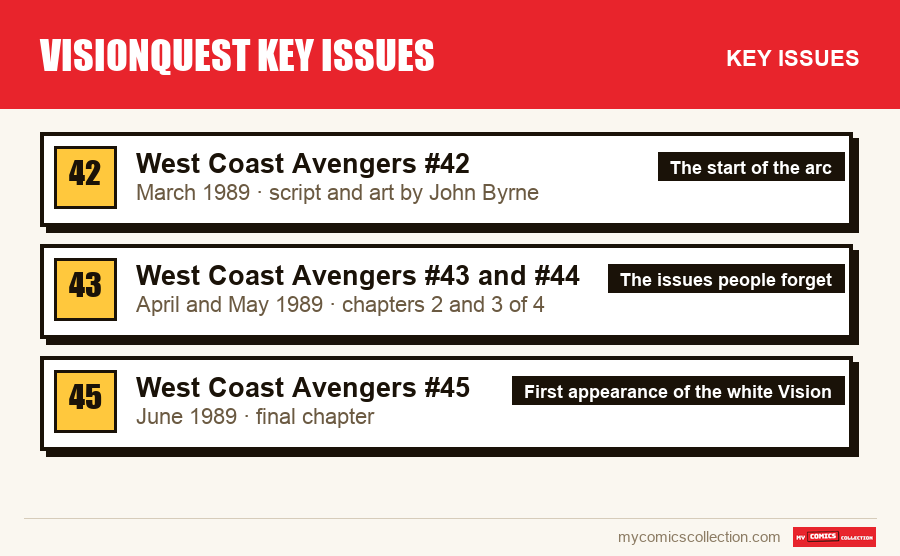
The correspondence table, element by element
Let us start with the overview. Here is what the broadcaster announced, and the matching print source when there is one.
- The series title refers to West Coast Avengers #42 to #45 (1989), by John Byrne. Direct, explicit, claimed correspondence.
- The white Vision first appears in West Coast Avengers #45. It is the outcome of the arc, not its starting point.
- Jocasta, played by T'Nia Miller, is born in Avengers #162 (August 1977), from the pen of Jim Shooter and the pencil of George Pérez.
- Ultron, played by James Spader, is a 1968 character whose resurrection mechanic is the real print subject.
- Thomas Shepherd, or Tommy Maximoff, played by Ruaridh Mollica, has two distinct first appearances, nine years apart, and that is a collecting point in itself.
- Paladin, played by Todd Stashwick, debuts in Daredevil #150 (January 1978). A mercenary, therefore someone you pay: consistent with the bounty announced in the pitch.
- Raza, played by Faran Tahir, goes the other way: born on screen in 2008, adapted afterward into comics.
- E.D.I.T.H. and F.R.I.D.A.Y., played by Emily Hampshire and Orla Brady, have no print first appearance. They were born on screen and exist only there.
This list already contains the essence of the method. Three regimes coexist: characters whose print source is a precise issue, a character who made the reverse trip, and purely audiovisual entities. Confusing the three means going looking for issues that do not exist.
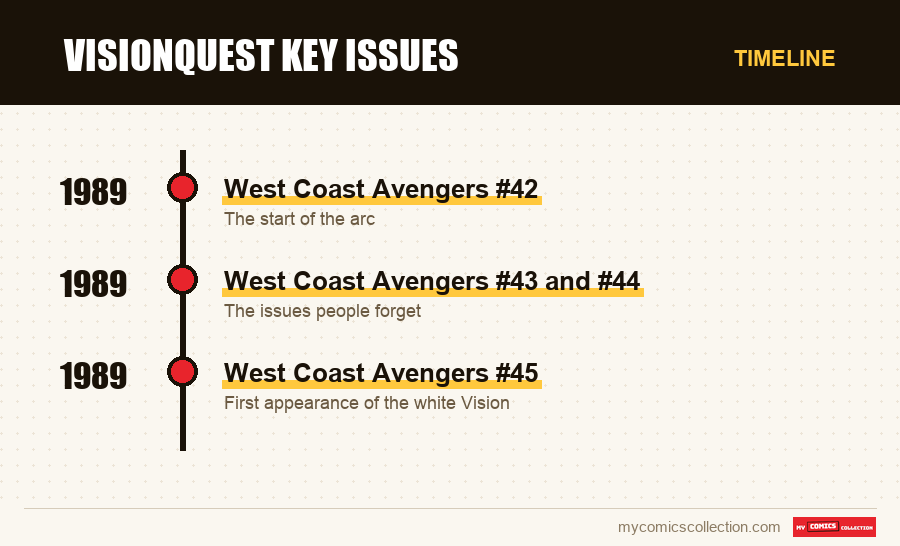
"Vision Quest": the four issues that give the series its title
The arc occupies four consecutive comics of West Coast Avengers volume 2, from March to June 1989. John Byrne writes and draws it, which is a collecting fact and not an anecdote: a complete creator over four issues in a row produces a homogeneous block that the market treats as a unit.
West Coast Avengers #42
The story opens on an absence: on waking, the Scarlet Witch finds her husband missing from the California headquarters. The team searches, follows the trail, and discovers an organized kidnapping. This issue is the first chapter of four announced as such in the pages of the comic itself. It is also the start of the Byrne period on the title, which makes it a doubly logical entry point.
West Coast Avengers #43 and #44
These are the two middle comics, and they are the ones most often missing from collections. The reason is mechanical: #42 opens, #45 contains the transformation, so the two ends are bought alone and the two central chapters stay on the shelf. Yet it is there that the dismantling proper and the team's reaction play out, that is, the heart of the story that the 2026 series takes as its emotional starting point.
West Coast Avengers #45
The synthezoid is rebuilt, but not restored. His synthetic skin, damaged by the dismantling, comes out a chalky white, and while the data is reinjected, the emotional attachment that went with it does not return. It is exactly the situation in which the 2026 series places its main character: a being who has his memories without feeling them. This issue is therefore both the last chapter of an arc and the first appearance of a version of the character.
A word on numbering, because it regularly trips people up. The series is called West Coast Avengers until issue 47, then Avengers West Coast from 48. The four issues we care about are therefore before the title change, but graded copies and catalogs sometimes use one name or the other interchangeably. If you search for #42 under only one of the two titles, you will miss half the supply.
Before the arc: why governments dismantle an Avenger
"Vision Quest" is not a standalone story. It answers something, and that something is found four years earlier in the parent series. Under Roger Stern's pen, the synthezoid becomes chairman of the Avengers, plugs into a planetary computer of extraterrestrial origin, and temporarily takes control of computer systems, weapons systems and government databases on a planetary scale. He gives it up himself, tears out the control crystal housed in his skull, and leaves the team with his wife. The episode unfolds in Avengers #251 to #254, published in 1985.
This sequence is the key to reading the 1989 arc. The agencies that kidnap the character do not do it out of mere secret-service malice: they act in retaliation for an event readers saw happen. In other words, the dismantling is a consequence, and Byrne's story is a story of sanction. For a collector, that shifts the perimeter: the real entry point of the story is not issue 42 of 1989, it is the 1985 block.
And that is also why the 2026 series' device, a character who converses with artificial intelligence personalities housed in his own programming, has a sturdier print anchor than it seems. The precedent exists: this character has already had, in continuity, a consciousness partially colonized by another machine.
Jocasta: a first appearance dated to the line
T'Nia Miller plays Jocasta. For whoever seeks the source, it is short and unambiguous: Avengers #162, dated August 1977, written by Jim Shooter and drawn by George Pérez. The issue's title announces the program plainly, since it is about Ultron's bride.
The character's principle deserves stating because it sheds light on her presence in the series. Ultron builds a companion by transferring the Wasp's mental patterns into her. The intention is to give himself a counterpart; the result is an entity that, as soon as it truly gains consciousness, chooses to betray the one who made her. It is the same structure as that of the synthezoid himself, created to destroy a team and gone over to its side from his introductory issue. Two Ultron creatures, two disobediences. Putting both in the same series is therefore not a casting accident, it is a symmetry.
The detail of her key issues and her editorial path is the subject of a separate article on this site, which we point to rather than summarize badly here. Keep the useful fact: a single first appearance, a single issue to aim for, 1977.
Tommy: two first appearances, and it is not a detail
Ruaridh Mollica embodies Thomas Shepherd, also designated as Tommy Maximoff. This double designation is not a communication blur: it corresponds to two distinct narrative statuses, and therefore to two different issues.
Thomas Maximoff, the child
The Vision and the Scarlet Witch volume 2 #12, dated September 1986. It is the birth of the twins within the couple, in the series devoted to them. The character is an infant there, and the issue is a first appearance in the strict sense.
The erasure
Avengers West Coast #51 and #52, published in 1989, still by Byrne, in direct continuity with "Vision Quest". Agatha Harkness establishes that the twins only exist when their mother thinks of them, then erases them from her memory. The children do not die: they are reabsorbed. That is what makes a return possible.
Thomas Shepherd, the teenager
Young Avengers #10, published in 2006. A white-haired teenager, endowed with speed and a power to destabilize matter, is found in a juvenile detention center. It is in this issue that it is suggested he is one of the couple's lost sons. It is this version, and not the 1986 infant, that the series' pitch evokes when it talks about a teenager who could be a reincarnated son.
For a collector, the consequence is practical. If the series puts this character forward, demand will not go to the 1986 issue, which shows a baby in a couple's series, but to the 2006 one, which shows the silhouette viewers will recognize. Both are legitimate first appearances; only one resembles what will be on screen. This distinction between priority and resemblance alone explains a good part of the market movements that follow an adaptation.
The artificial intelligences: sorting what has an issue and what does not
The announced central device is an inner conversation between the character and several artificial personalities. The cast names Ultron, Jocasta, E.D.I.T.H. and F.R.I.D.A.Y. This list mixes two populations that must absolutely be separated before opening a catalog.
Those that come from paper. Ultron is a 1968 character whose editorial peculiarity is not having a fixed body: he returns by changing shells, which multiplies the issues likely to be presented as first appearances of a version. It is a ground where caution is needed, and we devote an entire article to it. Jocasta, as we saw, comes down to a single 1977 issue.
Those that come from the screen. E.D.I.T.H. and F.R.I.D.A.Y. have no first appearance in comics. They were created for the films and exist nowhere else. There is therefore no issue to buy, and any listing that offered you one would be selling either a later and secondary appearance, or a mistake. Same observation for the film series' historic voice assistant: its character logic belongs to the screen.
If the artificial intelligence angle interests you for its own sake, the print catalog does, on the other hand, offer a real vein, independent of the series. Machine Man, created by Jack Kirby, debuts in 2001: A Space Odyssey #8 in July 1977, under the name Mister Machine, later renamed for trademark reasons. And in 2013, Marvel published Avengers A.I., a series by Sam Humphries and Andre Lima Araujo that takes as its explicit subject a humanity judged by the machines it built. These are two serious entry points on the theme, and neither is today sought after for that reason.
Last case, the most instructive: Raza. The character was invented for the 2008 film, then adapted into comics. The path is therefore the reverse of all the others. For anyone building a collection around adaptations, it is a useful reminder: the arrow between paper and screen sometimes goes the other way, and a character can have a comics first appearance later than their creation.
The reading list, from essential to complementary
Four levels, in descending order of necessity. You can stop at any of them without feeling you left a gap.
Level 1, essential: West Coast Avengers #42 to #45. All four, not two. It is the story the series takes its name from, it fits in four comics, and it reads in an hour. Nothing else has this ratio between effort and return.
Level 2, strongly advised: Avengers #251 to #254. The motive for the dismantling. Without this 1985 block, the 1989 arc looks like gratuitous persecution; with it, it is a story of retaliation. Four issues as well.
Level 3, for the announced supporting characters. Three isolated issues, to take or leave depending on what the series actually does with them: Avengers #162 for Jocasta, Young Avengers #10 for Tommy, Daredevil #150 for Paladin. None of the three requires reading the series around it.
Level 4, complementary. Avengers West Coast #51 and #52 to understand how the twins disappear, which makes their return intelligible. And, if the question of the synthezoid trying to build an ordinary life interests you, Tom King's limited series published from November 2015, in which the character builds a wife and two teenagers, Viv and Vin. It is not a source of the 2026 series, and should not be presented as such, but it is the most accomplished modern treatment of the theme the series announces.
What this list does not contain is deliberate. No complete path of the character since Avengers #57, because that is not the subject and our reading guide already does it. No general survey of key issues, covered in the dedicated article. No comparison between the previous series and the comics, which has its own article. And no overview of the California team, which deserves its own.
Market: what can be said, and what cannot
What cannot be said: how much anything will be worth. As of October 1st, 2026, the series is not broadcast, and no market observation after broadcast exists by definition. Any range put forward today would be a projection disguised as data.
What can be said belongs to structure, and it is enough to decide.
The four 1989 issues are not scarce. Late 1980s, that is, high print runs and wide newsstand distribution. Copies circulate, in quantity, and an arc of this period is completed with no particular difficulty. Scarcity, if any, lies in the very high grades, for a material reason: the comics of this era were read, folded and stored carelessly by readers who had no reason to protect them.
The tension, when it exists, is brief and targeted. The movements observed at adaptation announcements concentrate on one or two emblematic issues, not on a whole arc. Here, the obvious candidate is issue 45, because of the first appearance. The central chapters stay in the shadows, which is precisely what makes them the best reasoned purchase: you complete the story while attention is elsewhere.
The calendar works against the last-minute purchase. A broadcast that starts on October 14 over eight episodes means the series will occupy attention for about two months. The tension periods correspond to announcements and landmark episodes, not to the season's average. Buying before or well after is buying in a quiet market.
Grading is not decided in a hurry. On a 1989 comic you already own and whose condition is good, the operation can make sense. On a copy bought in haste during a broadcast, it adds a fixed cost to an already strained entry price. Our guide on CGC grading details the reasoning.
Tracking a four-issue arc in your collection
A short arc poses a recording problem that long series do not: it matches neither an entire series nor an isolated issue. Classic result, you own #42 and #45, you feel you have done the work, and two years later you rediscover that the middle is missing.
In the app, the useful reflex is to record the four issues as an explicit goal and not as four independent purchases, then let the missing list do its work. The series' double title, West Coast Avengers then Avengers West Coast, is exactly the kind of detail that turns a complete collection into an apparently gappy one: recording the title properly as it appears on the cover avoids this false problem.
For the level 3 issues, which are single purchases in series you do not collect, note the reason for the purchase at the time you make it. In five years, "Jocasta's first issue" will be useful information; "Avengers #162" alone will say nothing anymore.
What to take away
A series that borrows its title from a 1989 arc does the reader an involuntary service: it points to a small, dated and cheap target. Four issues for the source story, four more to understand its motive, three single purchases for the announced characters. Eight to eleven comics, all predating 2010, none unfindable.
The rest of the noise around a broadcast concerns objects the series does not point to, or characters who never had an issue. Knowing how to sort is, concretely, the only skill that separates a considered purchase from a mood purchase.