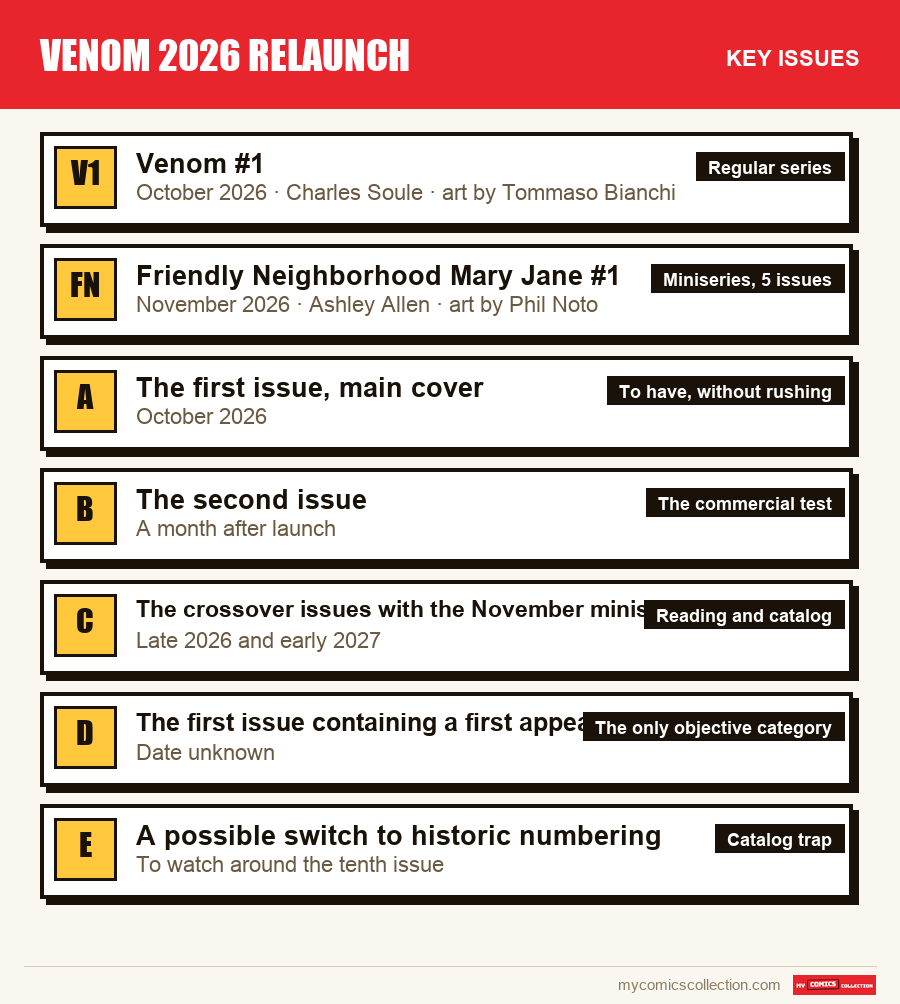
Venom #1, a new regular series written by Charles Soule and drawn by Tommaso Bianchi, arrives in October 2026. It follows the Queen in Black crossover (five issues, July to September 2026, Al Ewing and Iban Coello) and closes the period when another character carried the symbiote. Announced starting point: Eddie Brock and the symbiote are reunited after a long separation, and Eddie wants to become the Lethal Protector again. In November 2026 comes Friendly Neighborhood Mary Jane, a five-issue miniseries by Ashley Allen and Phil Noto. For a collector, the immediate stake is not the price, which does not yet exist, but the numbering: it is the sixth or seventh issue #1 of a title that has just passed its #250 in historic numbering.
A regular series launch is badly judged on release day and very well twelve months later. In between, there is a series of decisions the collector makes without always realizing: buying or not the alternate covers, continuing or not after the third issue, and above all, filing the object somewhere. This last point seems trivial. It is in fact the one that costs the most time when five or six different series carry exactly the same title.
It is October 1st, 2026. The first issue is not on the shelf yet, no copy circulates, and nobody can say what it will be worth. What exists are announced creators' names, an editorial calendar, a narrative situation, and thirty-three years of publication history of the character solo. That is largely enough to build a serious watch method, never going through price prediction. This article sticks to that angle: what to look at, in what order, and why.
What is confirmed, and nothing more
Two titles are announced, with their teams. Here is the state of the information published by the publisher at the time of writing.
Venom #1
The writer is no stranger to the character: Charles Soule is among the writers credited on Queen in Black, the summer 2026 crossover from which this series comes directly. The publisher therefore does not entrust the relaunch to someone discovering the file, but to someone who took part in writing the previous page. It is useful information: a relaunch written by a writer foreign to the arc that precedes it more often starts from a blank slate, where a participant tends to extend elements already laid down. On art, Tommaso Bianchi is an Italian artist who arrived on the American market in the mid-2020s, noticed on dark and violent titles, which is coherent with the character.
Friendly Neighborhood Mary Jane #1
Closed format, five issues, published a month after the regular title's launch. It is not a scheduling detail: the two series answer each other, and the publisher announced that the miniseries includes an element received from the symbiote. A crossing between a regular title and a short miniseries is exactly the case that produces collection gaps, because the two calendars are not aligned and shelves file them separately.
Everything else is hypothesis. The planned number of issues, the existence of a later crossover, the series' duration: nothing is public. A regular series launch comes with no guarantee of longevity, and several earlier volumes of the same title stopped before their twentieth issue.
Yet another reset to 1: what Venom's numbering tells
It is the most concrete point of this whole launch, and the one least talked about. The Venom title does not have one publication history, it has several, stacked, with two numbering systems that overlap.
Reconstructed from publication summaries, the history of the character's regular series looks like this:
- June 2003 to November 2004: first regular volume, eighteen issues, written by Daniel Way.
- April 2011 to October 2013: second volume, forty-two issues, written by Rick Remender then Cullen Bunn.
- Late 2016 to 2018: third volume, written by Mike Costa, drawn by Gerardo Sandoval. It publishes six issues under its own numbering, then switches to the historic numbering and resumes at #150.
- 2018 to 2021: fourth volume, written by Donny Cates, drawn mainly by Ryan Stegman. Thirty-five issues, the last of which appears under the double designation #200.
- October 2021 to November 2024: fifth volume, thirty-nine issues, written by Al Ewing, Ram V and Torunn Grønbekk, drawn mainly by Bryan Hitch.
- December 2024: new volume launched under a title augmented by an adjective, written by Al Ewing and drawn by Carlos Gómez. It in turn switches to the historic numbering in October 2025 with issue #250, and the title returns to its short form.
- October 2026: new #1.
Read the last line keeping the previous one in mind. The title had just passed its two-hundred-fiftieth issue twelve months ago, and it starts again from 1. It is not an anomaly, it is the normal operation of American superhero publishing for some twenty years: issue #1 is a sales argument, the historic number is a prestige argument, and the publisher alternates the two depending on what it wants to put forward.
The historic numbering adds up the character's earlier solo issues, 1993 to 1998 miniseries included. That is why a volume launched in 2016 can find itself at #150 after six issues: the previous one hundred forty-four exist, spread over about fifteen different titles.
The practical consequence is twofold. First, a Venom issue #1 is not a rarity: there are at least six, and the October 2026 one will be neither the first nor the last. The argument "it's an issue #1" has no discriminating value on this title. Next, you must watch for a possible new switch: if the series settles in, nothing prevents it from moving to historic numbering around its tenth or twelfth issue, like the previous two volumes. Doubly numbered issues are those that pose the most identification problems, and those sellers describe the worst.
The return of the historic holder: a scheme the publisher has already played
The announced starting point is the reunion of Eddie Brock and the symbiote after a lasting separation, during which another character carried the costume. This movement is nothing new, and that is precisely what makes it legible. The scheme almost always unfolds the same way: a secondary or unexpected character takes up an established identity, which allows telling something else and attracting a new readership, then the historic holder returns, often on the occasion of an event, and the series restarts under a new issue #1 with a promise of back to basics.
From the collecting point of view, this cycle produces three very different categories of objects, which must absolutely be distinguished:
The issue that installs the replacement
It is the one carrying a first appearance, that is, an objective, datable fact. In the character's history, these issues are the only ones whose status is not debated: a symbiote bearer appears for the first time on a precise page of a precise issue. These are permanent landmarks, independent of the story's quality.
The issue that organizes the return
It is the category of October 2026's Venom #1. It contains no first appearance: the returning character has existed since 1988, the symbiote too. Its possible value will therefore come not from a fact but from a use, that is, from the status the series will end up taking. It is a bet on posterity, not a documentary piece.
The issue that closes the intermediate period
The issues at the end of the previous volume, those just before the relaunch. They are printed at the volume's lowest order level, since a series at the end of its run interests fewer people, and they sometimes become the hardest to find of the lot. It is the most regular paradox of the secondhand market: the end of a series is scarcer than the beginning.
The third category is the one to remember. The collective reflex goes to the new issue #1, printed in large quantity and available for a long time. The discreet issues of the previous volume are never reprinted.
"Lethal Protector": why these two words are not harmless
The phrase used in the announcement refers to a precise title. Venom: Lethal Protector is a six-issue miniseries published by the publisher from February to July 1993, written by David Michelinie and drawn by Mark Bagley on the first three issues, Ron Lim taking over with Sam DeLaRosa. It was the first solo series devoted to the character.
The publication detail of this miniseries and the question of its value are covered in our dedicated articles. What matters for understanding the 2026 announcement is the term's function.
"Lethal Protector" is a positioning formula. It describes neither a power nor membership in a team, but a moral contract: the character defends innocents and kills those who threaten them. It is the definition of the antihero as the American market set it up in the early 1990s, when violent characters dominated sales. Taking up this vocabulary in 2026 is therefore a double promise: a return to the original register, and an explicit reference to the period when the character sold best.
Hence a caution. A relaunch resting on a historic slogan offers the reader an emotion of recognition, and this emotion is neither an indicator of quality nor of scarcity. Many series invoked a golden age without recovering it. The only judge will be the content of the issues, legible from the third or fourth.
Which issues to watch in the first twelve months
Here is a watch grid, built on categories and not predictions. None of the issues listed below exists yet, and none will be given a value here.
The first issue, main cover
It is the entry piece, and it will be abundant. A major-title launch at this publisher is printed in large numbers and is still easily found years later. There is therefore no urgency, unless you want a copy bought new, unhandled, which is a perfectly valid reason.
The second issue
The strongest order drop of a new series happens between its first and second issue. It is also, mechanically, the first issue printed on the basis of real demand rather than anticipation. It is therefore less abundant than #1 and almost always cheaper, which makes it the launch's most rational purchase.
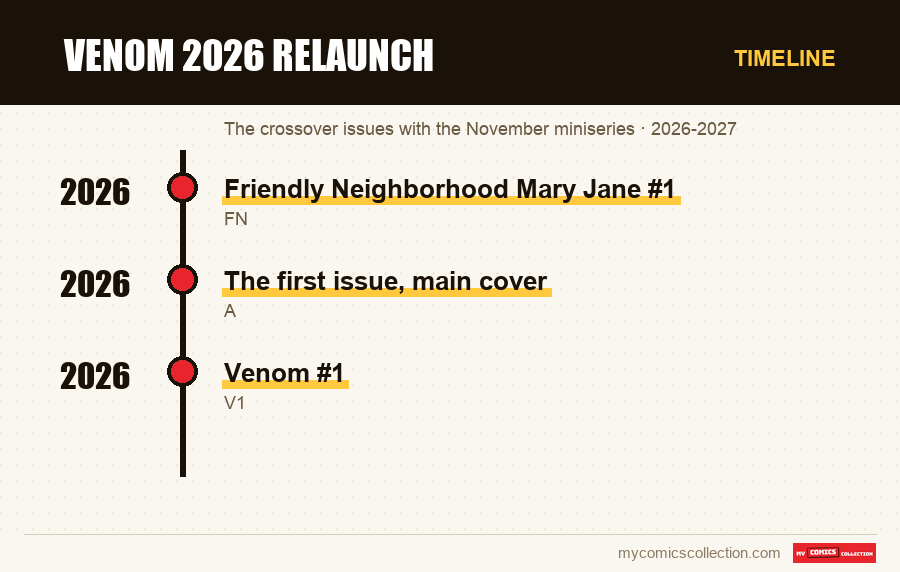
The crossover issues with the November miniseries
Two linked titles appearing in parallel almost always end up crossing. For reading, that means an issue of the regular series will take on its meaning in the miniseries, or the reverse. For the catalog, it means two series to follow simultaneously with two distinct numberings.
The first issue containing a first appearance
A new adversary, a new symbiote, a new bearer: that is historically what produced the character's most sought-after issues, far more than relaunches. Nobody can say today in which issue it will land, but you can decide now to spot it by reading rather than learning it six months too late.
A possible switch to historic numbering
The two previous volumes both abandoned their own numbering along the way to resume the historic count. If this happens again, an issue will carry two numbers on its cover, and it is that one that will be badly described everywhere: by sellers, by release lists, and by your own catalog if you did not anticipate it.
Six series, one title: how to cope in a catalog
It is the most concrete problem posed by this launch, and it is nothing theoretical. If you type "Venom 1" into any management tool, you get at least six possible answers, not counting miniseries, annuals and foreign editions. The same ambiguity exists for "Venom 2," "Venom 3" and so on up to the eighteenth issue, which is the length of the shortest volume.
The solution is not to memorize the history. It is to record, for each copy, the four pieces of information that remove all ambiguity.
The series launch year, not the issue's year
It is the volume identifier used everywhere in the trade. The October 2026 issue belongs to the 2026 series; an issue released in 2027 still belongs to the 2026 series. Confusing the two is the most frequent error and the hardest to correct afterward, because it scatters a single series across several entries.
The cover date
Printed on the object, it is generally two months ahead of the real on-sale date. It serves as arbiter when two entries look alike, and it is the most reliable datum because it depends on no outside catalog.
The writer's name
On this title precisely, the writer is an almost perfect identifier: each volume is associated with a different writer. Noting "Charles Soule" suffices to tell the 2026 series from all the previous ones, even if you lose the date.
The cover edition
Main cover or alternate cover, and which one. They are distinct objects, sometimes printed in very different proportions, and confusing them makes a collection impossible to evaluate. A short note suffices: the cover artist's name.
With these four fields, a lot of homonymous comics becomes legible again in ten years and by someone other than you. It is the work of a correctly filled-in issue-by-issue tracking, and the only moment when the effort is low is at purchase, when the information is still before your eyes. Reconstructing these fields two years later, on a stack of forty issues, takes a whole evening.
Last method tip: create the series entry in your collection management before buying the first issue, not after. A series created in advance receives its issues month by month without effort, and the missing list flags the forgotten third issue while it is still on the shelf. A series created after the fact starts with an inventory.
The three mistakes that cost the most on a launch
Buying several copies of the same issue. The reasoning ignores that the printed quantity of a major title's issue #1 is very high, and that scarcity cannot be decreed after the fact. The second copy doubles the spending while bringing nothing. If you want redundancy, it makes more sense on a middle issue, truly less available.
Having it graded in the first weeks. A current-month comic in very fine condition is nothing exceptional: it is the object's normal state. The cost of grading is fixed, the piece's value unknown, and the operation is therefore decided in a vacuum. Keeping it cleanly leaves the decision open; the reverse is not true.
Confusing the 2026 volume with another in your own catalog. The least spectacular and costliest error, because it skews everything else: the valuation, the missing list, the ability to hand on a coherent set. It is prevented in thirty seconds at purchase.
To place this launch in the whole of the season's releases, our guide to the Marvel Midnight line approaches the same type of question on three other October 2026 issue #1s. And to place the earlier volumes relative to one another, the file on the character's main runs details what each brought. The hub devoted to the character gathers all the guides, and the 1993 miniseries sheet documents the object the 2026 announcement refers to.