Queen in Black is Marvel's summer 2026 crossover: a 5-issue miniseries by Al Ewing and Iban Coello, published from July 1st to September 30, 2026, surrounded by a handful of tie-in titles. To read it properly, three steps are enough: the Knull miniseries (January to May 2026) as a preamble, then the five issues of Queen in Black in order, then Venom #260 to #262, which carry the intimate part of the story. Everything else is optional. The event pits Hela, who has imprisoned Knull and taken his title, against Knull returned with a new power, and it ends with the end of Mary Jane Watson's time under the symbiote. The sequel is read in Venom volume 7, launched on October 14, 2026.
A Marvel crossover always poses the same practical problem: the official list of tie-in titles does not say in what order to read them, and even less which ones you can skip without losing the thread. Queen in Black is no exception. Between the central miniseries, three satellite limited series, two one-shots, three issues of the ongoing Venom series and one issue of Black Cat, a reader who wants to take everything ends up with about fifteen comics and no indication of a path.
The event is now closed: the fifth and final issue came out on September 30, 2026, and the series that follow from it are dated. It is the right time to talk about it, because you can read it in one go, without waiting, and because we now know what it leaves behind. This article does not tell the story in detail and reveals only what is needed to decide what to read. It answers four questions: in what order, what is essential, what is accessory, and what to chain into.
What Queen in Black is, and where it really begins
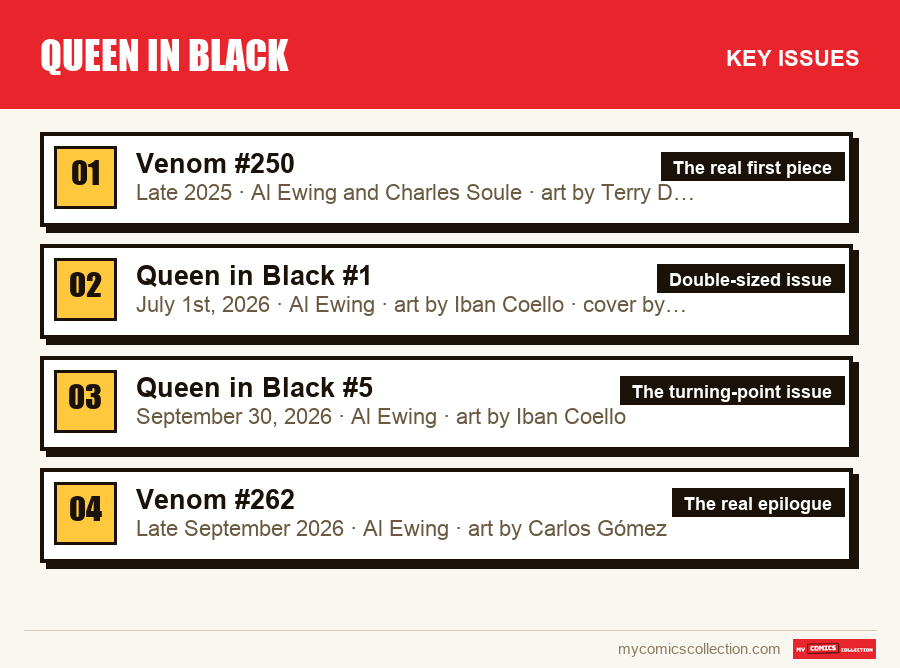
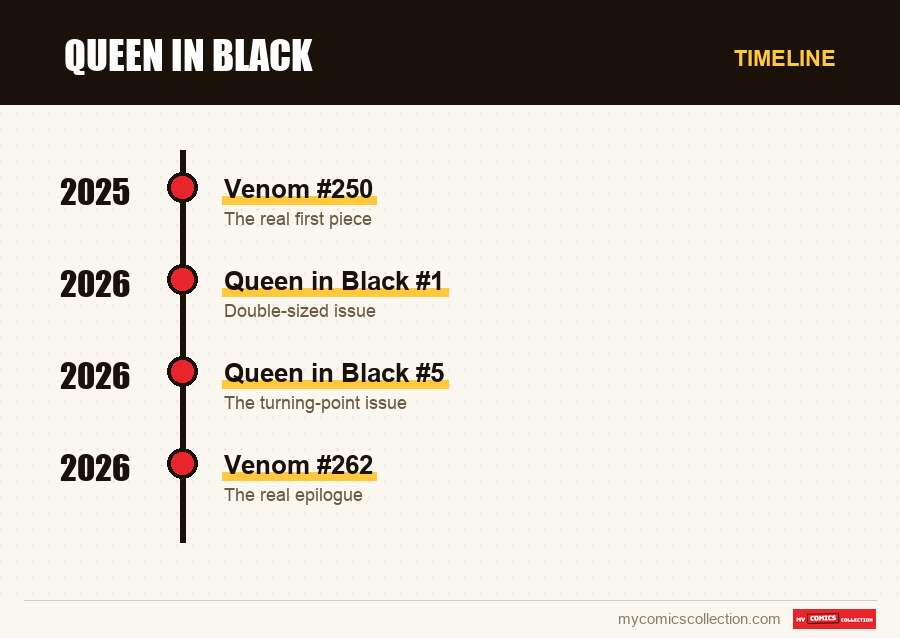
The starting point is not in the miniseries that carries the title. It is in Venom #250, published in late 2025, written by Al Ewing and Charles Soule with art by Terry Dodson, Carlos Gómez and Todd Nauck. The cover announced Knull's return; the inside told the opposite. Hela, the Asgardian goddess of death, imprisons the god of symbiotes there by means of ancient magic while he is still weakened, dons armor of black ichor and proclaims herself Queen in Black. The title changes hands before the event begins: it is the writing find from which everything else follows.
Marvel then announced the event at New York Comic Con 2025, then confirmed the date of the first issue in February 2026 at the ComicsPRO trade show. Ewing publicly explained the project's origin as the meeting of two independent plotlines: the Thor series launched in 2025 had set up a world where Thor is dead and mortals no longer remember the Norse gods, which removed any serious divine opposition to Hela on the Earth side. Her power grab over the symbiote fed, for its part, into the Venom series. The two threads tied together.
The central miniseries has five issues, all written by Al Ewing and drawn by Iban Coello, with a main cover by Ryan Stegman on each of the five. This detail is not anecdotal: Stegman is the co-creator of Knull, a character he conceived with writer Donny Cates and whose first appearance dates back to the third issue of the Venom series launched in 2018. Giving him the covers of an event that dislodges Knull from his throne is editorial coherence.
The release schedule, useful for anyone buying secondhand single issues or trying to rebuild the series:
- July 1st, 2026: Queen in Black #1, a double-sized issue of 56 pages.
- July 29, 2026: Queen in Black #2.
- August 12, 2026: Queen in Black #3.
- September 16, 2026: Queen in Black #4.
- September 30, 2026: Queen in Black #5, conclusion.
One month between #1 and #2, two weeks between #2 and #3, then five weeks, then two. The pace is irregular, which explains part of the collection gaps seen on this event: three of the five issues landed in the middle of the summer period.
The reading order, step by step
Here is the path we recommend. It is built so that no step spoils the next and so that you can stop at the end of any of them without frustration.
The preamble: the Knull miniseries, 5 issues, January to May 2026
Written by Al Ewing with Tom Waltz, drawn by Juanan Ramírez, the first issue out on January 14, 2026 and the fifth on May 13. It is the one that tells Knull's escape, the theft of symbiotes from his guardians to rebuild an armor, the passage into the Lightforce dimension and the meeting with an alternate Eddie Brock. Without these five issues, the event's Knull arrives in white and blue armor with no explanation why. It is the most profitable prior reading of the batch.
Optional but short: Queen in Black, Hela, a one-shot from July 8
Al Ewing on script, Carlos Magno on art. A flashback story narrated by Karnilla of the Norns, it shows how Hela got to Knull and under what conditions she put him in a cage. A single, self-contained comic that fills precisely the hole left by Venom #250. To read before miniseries #1 if you do not want to miss anything, or at any moment afterward.
The core: Queen in Black #1 to #5, in order, with nothing interleaved
The miniseries stands on its own and contains the entire main arc, from Hela's arrival in the solar system to the resolution. Resist the temptation to slip the satellites between two issues on a first read: the tie-in titles unfold in parallel and not in sequence, and interleaving them breaks the rhythm without adding anything necessary.
The essential complement: Venom #260 to #262
Three issues of the regular series, written by Ewing and drawn by Carlos Gómez, out on July 8, August 26 and late September. They carry the whole intimate line of the story: the fate of Dylan Brock, the old dispute between the symbiote and Mister Fantastic, and the scenes of Mary Jane Watson at the center of the resolution. The miniseries will tell you what happens; these three issues will tell you why it matters.
For the Eddie Brock side: Venom Unchained, 3 issues
Charles Soule on script, Juanan Ramírez on art, from July 15 to late September. Eddie Brock is at the Raft, without a symbiote, after a failed rebonding. He has to get out while the invasion begins. It is an almost independent prison-escape story, and it is also where Eddie's return in Venom is prepared. To read after the miniseries if that return interests you, to skip otherwise.
For the cosmic side: Defenders of Light and Dark, 3 issues, and the Thor one-shot
Tom Waltz and Zé Carlos on the three issues from July 8, Ewing and Sergio Davila on Queen in Black: Thor on August 5. Two shock teams are assembled to face the two invasions at once, one turned toward Hela, the other toward Knull. It is the best of the periphery, and it is also where the consequences for Cloak and Dagger play out. To read after #3 of the miniseries, not before.
The detour: Black Cat volume 3, #14, in September
A single issue, an object-retrieval mission on a moon orbiting a distant planet, and a resolution that unlocks a bolt of the main story. It explains a twist of the event that the miniseries covers in two pages. Dispensable, pleasant, to read last.
The sequel: Venom volume 7, from October 14, 2026
New series, new team, new issue #1. It is the entry point of the aftermath, and it is where the thread picked up after the event continues. We come back to it below.
The issues that really matter
Out of about fifteen comics, four entries deserve particular attention, for story reasons before any collecting reason.
Venom #250
This is the issue where the Queen in Black title is taken, and therefore the true starting point of the event. It predates miniseries #1 by more than six months, which makes it the comic most often forgotten by readers who began the event in July. An anniversary issue with three artists, perfectly readable without knowing the complete run.
Queen in Black #1
Fifty-six pages, which is rare for a first event issue and explains the choice to read it in one go. It sets up the two simultaneous threats, spreads the heroes across several fronts and poses the question that will hold for five issues: what becomes of Mary Jane Watson under the symbiote if both camps want her hide. For this issue, Stegman signed two covers as homages to his own 2018 Knull cover, one available in bookstores, the other reserved for a blind-bag scheme.
Queen in Black #5
This is the comic that tips three things at once: Hela's fate, Knull's, and the end of Mary Jane Watson's time as Venom. It also introduces the notion of Venomworld, a collective consciousness formed on a planetary scale, whose name had been circulating since the summer announcements. Event conclusion issues are usually less sought after than first issues; this one nonetheless carries more consequences than #1.
Venom #262
The miniseries closes the conflict, this issue closes the relationship. It is here that the reunion of Eddie Brock and the symbiote plays out, that is, the transition toward the next series. Mistaking it for a simple end-of-volume issue is the most frequent reading error on this event: it is to Queen in Black what an epilogue is to a novel.
The accessory issues, and why they are
Calling a tie-in title accessory is not a quality judgment, it is path information. Three criteria let you decide, and they apply beyond this event.
First criterion: does the tie-in title modify the state of the main story? The Thor one-shot is a fine parley episode between Beta Ray Bill and Tyr, but it closes leaving the world exactly in the state it found it. Black Cat #14, on the contrary, solves a problem the miniseries could not solve alone. The first is accessory, the second is explanatory.
Second criterion: is the tie-in title a condition of understanding? The Knull preamble is, because it justifies a visual transformation and a change of power that the event does not re-explain. Defenders of Light and Dark is not: the miniseries itself picks up the two teams' conclusions when it needs them.
Third criterion: is the tie-in title the seed of a following series? That is the case of Venom Unchained, which prepares Eddie Brock's return as Venom. This type of satellite is accessory for understanding the event and important for understanding what follows. If you plan to continue after October, it changes status.
One last object falls outside these categories: a preamble story came out on May 2, 2026 in an issue distributed free on a bookstore promotion day, under the double title Amazing Spider-Man #1000 and Queen in Black #1 CGD 2026, written by Joe Kelly, Al Ewing and Phillip Kennedy Johnson. It is pleasant and conditions nothing. For a collector, however, it is a piece apart: promotional-day issues are not reprinted, and they quickly vanish from the usual channels.
What the event changes durably
A crossover is judged by what it leaves. This one leaves four concrete changes, which is a lot for five issues.
The King in Black title has changed bearer, twice. Hela had taken it from Knull before the event. At the end, it is neither of them that holds it, but the Sleeper symbiote, Eddie Brock's offspring introduced in 2018. A supporting character inherits a cosmic crown: it is the kind of shift that feeds years of stories.
Mary Jane Watson is no longer Venom. It was the most discussed configuration of the previous run, and the event puts an end to it. The character comes out separated from the symbiote and declared healthy, without the miniseries explaining how she survived that separation. The unknown is embraced and left in reserve.
Eddie Brock and the symbiote are reunited. After the stint at the Raft and the loss of the bond, the return to the character's historic configuration is made official. For anyone who has followed the Venom series for a long time, it is a return to square one, but a negotiated return rather than a decreed one.
Venomworld exists. It is the new narrative object of the set, appearing in the finale. Its name was used by the publisher from the summer announcements, well before readers understood its nature. What it becomes next belongs to the following series and not this article.
There is also what the event does not change, and it is worth saying, because recent crossovers have accustomed readers to the opposite: main continuity is not reset, the regular series resume their course, and no general renumbering accompanies the conclusion. Queen in Black is a franchise event, focused on the symbiote family and an Asgardian side, not a universe refoundation. If you compare with the launch of a parallel line like Marvel Midnight in October 2026, the difference in nature is clear: an event is collected as a closed set, a line is collected like a subscription.
What to chain into, and when
Two series come directly out of the event, two weeks apart, and they split its two legacies.
Venom volume 7 starts on October 14, 2026, written by Charles Soule and drawn by Tommaso Bianchi, with a main cover by Davide Paratore. The announced subject is the resumption of the bond between Eddie Brock and the symbiote, and what comes after. It is the direct sequel to the line carried by Venom Unchained and by Venom #262.
Friendly Neighborhood Mary Jane starts on November 4, 2026, written by Ashley Allen and drawn by Phil Noto, over five announced issues. Mary Jane Watson, separated from the symbiote, returns to New York to start her own production business. The series also follows from an earlier miniseries devoted to the character, independently of the event.
The order of chaining is therefore simple: volume 7 of Venom if you followed Eddie Brock, Mary Jane's miniseries if you followed the line that ends with her, both if you read everything. Neither requires the other. And neither requires having read the satellites, which is good news for anyone discovering the set now.
Following a multi-layered event in your collection
Crossovers produce a very particular type of gap. On a regular series, an issue is missing and the numbering flags it immediately. On an event, a comic is missing in the middle of a satellite limited series whose existence you had forgotten, and nothing flags it, because the central miniseries' numbering is complete.
Queen in Black checks every box of the hard case: issues spread over six different titles, three limited-series numberings that restart at 1, two one-shots with no sequel, an issue inserted in an ongoing series under an anniversary numbering, a promotional-day comic, and a preamble published six months earlier under another name. It is precisely the type of set where memory fails at six months.
Three gestures are enough to get through. Record the event as a set, and not as separate series: the list of fifteen comics is the only relevant unit. Note the volume numbering for Venom and Black Cat, since these two series have gone through several relaunches and the number alone does not suffice to identify a comic. Finally, treat the promotional-day issue as a distinct piece, because its distribution status makes it harder to find than the others.
In the app, the most robust approach is to create the six series concerned then check off the issues owned: the list of missing issues then builds itself and brings up the forgotten satellite. It is also what lets you know, two years later, whether you own Defenders of Light and Dark in full or only the first two issues.
Three frequent reading mistakes on this event
Starting with miniseries #1. It is the most widespread mistake, and an understandable one: it is the issue that carries the title. But the event begins editorially in Venom #250 and narratively in the Knull miniseries. Whoever starts at #1 meets a transformed Knull, stripped of his original powers and wearing light-colored armor, with not the slightest explanation provided on site.
Reading the satellites at the same time as the miniseries. The tie-in titles of a modern crossover almost never slot between two issues of the main story: they unfold in parallel, often covering the same time window from another angle. Interleaving them produces repetitions and apparent contradictions. Reading in two passes, the core first and the periphery after, is more comfortable and more faithful to the real construction.
Confusing the event with the character. Queen in Black is not a Venom story, it is a story of symbiotes and gods in which Venom finds himself in the middle. Whoever approaches it as a stage in the character's path will be disappointed by how little room Eddie Brock gets in the central miniseries. For the character himself, the path is elsewhere: our Venom reading guide retraces the route since 1988, and our overview of Venom crossovers places this event in the series of precedents.
Should you read it?
Yes, if you have read Al Ewing's run on Venom, because the event is its culmination and it cleanly closes a configuration set up for several years. Yes, if the Asgardian side interests you, because the idea of entrusting symbiote power to the goddess of death produces a story different from the previous symbiote invasions, whose logic was biological rather than mythological.
More reserved if you are looking for an entry point. The event assumes a minimum of familiarity with three sets at once: the symbiote family, the state of Asgardian mythology at the end of the 2025 Thor series, and Dylan Brock's arc. Nothing is incomprehensible, but a lot is allusive. A new reader would do better to start with the character's origins, then come back here.
In every case, the order proposed above comes down to eight steps of which three are truly necessary. That is little for a crossover of this scale, and it is the main merit of its construction: the central miniseries is self-sufficient, and everything else is read as a supplement.