
Before Avengers: Doomsday (Marvel Studios, directed by the Russo brothers, with Robert Downey Jr. in Doctor Doom), here are the essential comics to read to understand the character and the plot: Fantastic Four #5 (1962, first appearance of Doom), both Secret Wars (1984 and 2015), “Unthinkable” and Books of Doom. We guide you, from the founding number to the stories that inspire the film.
The Marvel event film places Doctor Doom at the center of the cinematic universe. To understand all the issues, nothing beats diving into the comics that shaped the monarch of Latveria. Here's the ideal reading list, from the most accessible to the most ambitious.
As always in this guide, only verified information (creators, numbers, dates) is stated; the reading recommendations are ours, without reproduction of plates or protected dialogue.
Fantastic Four #5 (1962): where it all begins
Any reading of Doctor Doom begins with Fantastic Four #5, published in July 1962, created by Stan Lee and Jack Kirby. This issue marks the first appearance of Victor Von Doom, the archenemy of the Fantastic Four. From this first story, the foundations of the character are laid: the iron mask, the armor, the superior intelligence, the excessive ambition and the visceral hatred towards Reed Richards. Fatalis already appears as an adversary worthy of heroes, mixing science and the will to power. This issue is crucial, both for the history of the character and for collectors, as a major key to the Silver Age.
Reading Fantastic Four #5 allows you to understand the essence of Fatalis, as it will be taken up and enriched over the decades. The film draws on this founding figure: a masked genius, monarch and conqueror, whose menacing aura was built in 1962. For the reader who discovers the character before Avengers: Doomsday, this issue is the essential starting point. It reveals a villain designed to embody the antithesis of heroes: where the Fantastic Four form a united family, Doom is a loner consumed by pride. This opposition, born in FF #5, remains at the heart of the character that Robert Downey Jr. embodies on screen.
Fantastic Four Annual #2 (1964): Victor's origins
To understand what shaped Doom, Fantastic Four Annual #2 (1964) tells its origins. We discover the childhood of Victor Von Doom in Latveria, son of a Roma witch, Cynthia Von Doom, and his youth marked by loss and injustice. A brilliant student, Victor meets Reed Richards at college, but a catastrophic experience disfigures his face: an accident for which he blames Reed, fueling their eternal rivalry. He then left to improve his skills with Tibetan monks, forged his armor and his mask, and took control of Latveria. This origin story is essential to grasping the psychology of the character: his quest for control, his mixture of science and magic, his wounded dignity.
These origins, developed in Annual #2, shed light on the complex Fatalis that the comics have continued to deepen. The mixture of magical heritage (through his mother) and scientific genius makes him a unique character, neither a simple mad scientist nor a pure wizard. For the reader preparing the film, this issue offers the psychological keys to the character: understanding why Doom always acts, in his eyes, for a greater good, and why he considers himself the only one capable of saving the world. This conviction, this mixture of nobility and tyranny, is what makes Doom so fascinating and timeless, far beyond the simple comic book villain.
Secret Wars (1984): Doom Against the Universe
The first Secret Wars saga, published in 1984 and written by Jim Shooter, is a must-read. In this seminal crossover, a cosmic entity, the Beyonder, transports Marvel's greatest heroes and villains to a planet, Battleworld, to pit them against each other. Fatalis plays a central role: ambitious as always, he seeks to seize the quasi-divine power of the Beyonder. This saga marked Marvel history and introduced lasting elements. For collectors, Marvel Super Heroes Secret Wars #1 is a sought-after key. Reading this saga allows you to understand Doom's ultimate ambition: not to conquer a country, but the universe itself.
Secret Wars (1984) is particularly relevant before the film, because the very title of Avengers: Doomsday and its announced sequel are part of this tradition of major crossovers where Doom aims for absolute power. The saga shows a Doom ready to challenge cosmic forces, revealing the extent of his ambition and genius. For the reader, it is a gateway to the large-scale issues that define the character at the height of his power. It also illustrates the concept of Battleworld, a patchwork world bringing together realities, which could feed the cinematic plot. This reading ideally prepares you to understand why Doom has become the central threat of the new Marvel universe in cinema.
Secret Wars (2015): the most direct source
If only one story inspires Avengers: Doomsday, it is the second Secret Wars, published in 2015, written by Jonathan Hickman and drawn by Esad Ribić. The culmination of several years of his run on the Avengers, this saga sees the Marvel universe destroyed then rebuilt by Doom in the form of Battleworld, a patchwork world of which he becomes the "God Emperor Doom", an all-powerful god. This is perhaps the most powerful and compelling version of the character: Doom having finally achieved his dream of absolute control, ruling over reality itself. This modern saga is essential to understanding the cinematographic ambitions around Doom.
Secret Wars (2015) is the reading most directly linked to the film, both in its concept of Battleworld and the centrality of Doom. It explores a Fatalis god, confronted with the limits of his omnipotence and his unwavering rivalry with Reed Richards, even at the top. For the reader preparing for Avengers: Doomsday, this saga offers a glimpse of what Doom could become on screen: no longer a simple villain, but a force capable of reshaping reality. An ambitious and visually sumptuous work thanks to Esad Ribić, it is both a summit of the Hickman run and an ideal gateway to the most grandiose Fatalis. We are also devoting a dedicated article to it.
“Unthinkable” and Books of Doom: Modern Fatalis
To deepen the character, two modern stories are necessary. "Unthinkable" (2003), written by Mark Waid and drawn by Mike Wieringo in Fantastic Four, shows Doom at the height of his cruelty, fully embracing magic to seek revenge on Reed. This is one of the most defining tales of the rivalry, where Doom becomes truly terrifying. Books of Doom (2006), written by Ed Brubaker, offers a definitive and nuanced rereading of Victor's origins, exploring his psychology in depth. These two works ideally complement the understanding of the character.
These modern stories reveal the richness of Doom beyond its first appearances. “Unthinkable” illustrates his mastery of magic, often underestimated in the face of his scientific genius, while Books of Doom humanizes the character without excusing his tyranny. For the reader, they offer a complete and nuanced portrait, essential to appreciating the complexity that the film could explore. Together, these readings, from Fantastic Four #5 to the modern sagas, paint a portrait of a character of exceptional depth, whose arrival at the heart of the Marvel Cinematic Universe promises to be significant. Before Avengers: Doomsday, they constitute the best background to grasp the full dimension of Doctor Doom.
Collecting this series?
Track what you own, what you are missing and what your collection is worth. 7 day trial.
Start my trial →Doom 2099 and the Cantwell run: two modern visions
To complete your preparation, two modern series are worth a look. Doom 2099 (1993) transposes the character into a cyberpunk future: in this alternative reality, Doom reappears decades later and sets out to reconquer his transformed Latveria. This series offers a futuristic and political vision of the character, exploring his role as a leader confronted with a dystopian world. It illustrates Doom's ability to work in any setting, from medieval to futuristic. More recently, the series Doctor Doom (2019) by Christopher Cantwell offers a modern Doom, almost anti-hero, wrongly accused and seeking to clear his name while questioning his own nature.
These two runs show the richness and flexibility of the character. Doom 2099 makes him a futuristic ruler fighting for his people, while the Cantwell run humanizes him by exploring his doubts and his quest for meaning. Together, they reveal a Doom much more complex than a simple villain: a leader, a thinker, a tragic figure. For the reader preparing for Avengers: Doomsday, these modern series offer complementary angles, showing how the character has been reinvented over the ages without ever losing his essence. They serve as a reminder that Doom can be a terrifying antagonist as well as an ambiguous protagonist, a versatility that the film could exploit to surprise audiences while respecting the character's legacy.
Where to start, depending on your profile
- The hurry: Fantastic Four #5 (express origin) + Secret Wars (2015) for the direct link with the film.
- The completist: FF #5 → FF Annual #2 → Secret Wars (1984) → “Unthinkable” → Secret Wars (2015).
- The curious character: Books of Doom for psychology, then “Unthinkable” for cruelty.
- The collector: aim for the keys: FF #5, FF Annual #2, Secret Wars #1 (1984).
Anticipate the rating before the film
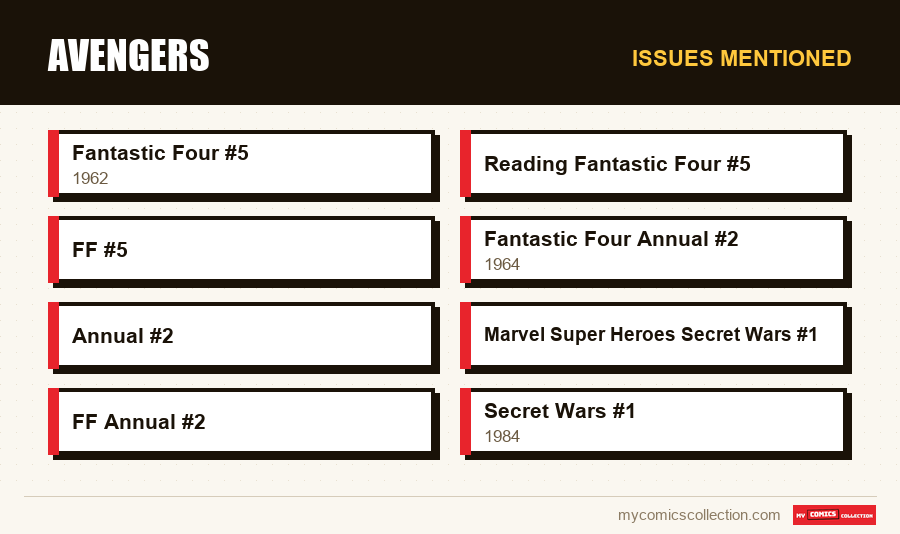
For the collector, the period preceding the release of a major Marvel film is strategic. Experience shows that the rating of numbers linked to the characters highlighted on the screen tends to increase with media enthusiasm. The keys to Doom (first and foremost Fantastic Four #5 (1962), his first appearance) are naturally ones to watch as Avengers: Doomsday approaches. Fantastic Four Annual #2 (1964) and Marvel Super Heroes Secret Wars #1 (1984) complete the list of issues with high potential. Anticipating this interest, before the general public's attention is massively focused on the character, can prove judicious for the informed collector.
That being said, caution remains in order: the value of a number always depends on its condition and its gradation, and reliance on real recent sales is essential before any purchase. Major keys like Fantastic Four #5 peak in good condition, while more modern issues offer accessible entry points. Reading the comics recommended here therefore has a double interest: to better appreciate the film, and to identify the issues that count for a Fatalis collection. As the monarch of Latveria prepares to dominate the Marvel Cinematic Universe, knowing his founding stories is as much a reader's pleasure as a collector's asset. Our dedicated guides in the Fatalis hub detail the rating and potential of each key number.
The connection to Avengers: Doomsday
Avengers: Doomsday marks a turning point for the Marvel Cinematic Universe, placing Doctor Doom as a central threat, played by Robert Downey Jr. under the direction of the Russo brothers. The choice of Fatalis, and the title evoking the “day of destiny” (Doom meaning “destiny” or “fate”), is in line with the great Secret Wars sagas where the character reaches his peak. The comics recommended here shed light on what the film could explore: Doom's cosmic ambition, his mastery of the Battleworld, his eternal rivalry, and his belief that he is the rightful savior of reality.
For both the viewer and the reader, these readings transform the experience of the film by revealing the depth of a character built over more than six decades. Doctor Doom is no ordinary villain: he is a monarch, a genius, a sorcerer and a conqueror, to whom each comic adds a facet. Discovering these stories before Avengers: Doomsday ensures that you fully appreciate the importance of its arrival on the screen. And for the collector, it is the opportunity to target key numbers whose prices often follow cinema news. The Fatalis hub brings together all our guides to go further.
Frequently asked questions
Fantastic Four #5 (1962), its first appearance by Stan Lee and Jack Kirby, is the perfect place to start. It lays all the bases of the character: the mask, the armor, the intelligence and the rivalry with Reed Richards. For detailed origins, continue with Fantastic Four Annual #2 (1964).
Secret Wars (2015) by Jonathan Hickman and Esad Ribić is the most direct source: the Marvel universe is reconstructed by Doom into Battleworld, of which he becomes the "God Emperor Doom". The concept of Battleworld and the centrality of Doom make it the most relevant reading before the film.
The two complement each other. Jim Shooter's Secret Wars (1984) introduced the concept of Battleworld and the cosmic ambition of Doom. Hickman's Secret Wars (2015) is the modern culmination, most closely linked to the film. If you only have to read one, choose the one from 2015.
Robert Downey Jr., who played Iron Man, returns to action in the role of Victor Von Doom, under the direction of the Russo brothers. This landmark choice places Doom at the center of the new Marvel Cinematic Universe, as a major threat.
The major keys: Fantastic Four #5 (1962, first appearance), Fantastic Four Annual #2 (1964, origins) and Marvel Super Heroes Secret Wars #1 (1984). Their rating often follows the character's current events in the cinema. Check out our dedicated guides in the Fatalis hub.
Want to collect Doom's keys? Estimate the value for free of your issues (Fantastic Four #5, Secret Wars #1…) with our tool based on current eBay listings.