Avengers: Doomsday is carried out by the Russo brothers , with Robert Downey Jr. in the role of Doctor Doom. The film places the monarch of Latveria at the center of the "Multiverse Saga" and draws inspiration from the sagas Secret Wars. We take stock of what we know (production, casting, concept) and the comics that feed it.
Announced as one of Marvel Studios' most anticipated event films, Avengers: Doomsday crystallizes expectations around the arrival of Doom. Here are the essentials to know and the comic sources for the project. Decryption.
As always in this guide, only verified information (casting, creators, numbers, dates) is stated; the analysis is ours, without reproduction of plates or protected dialogue.
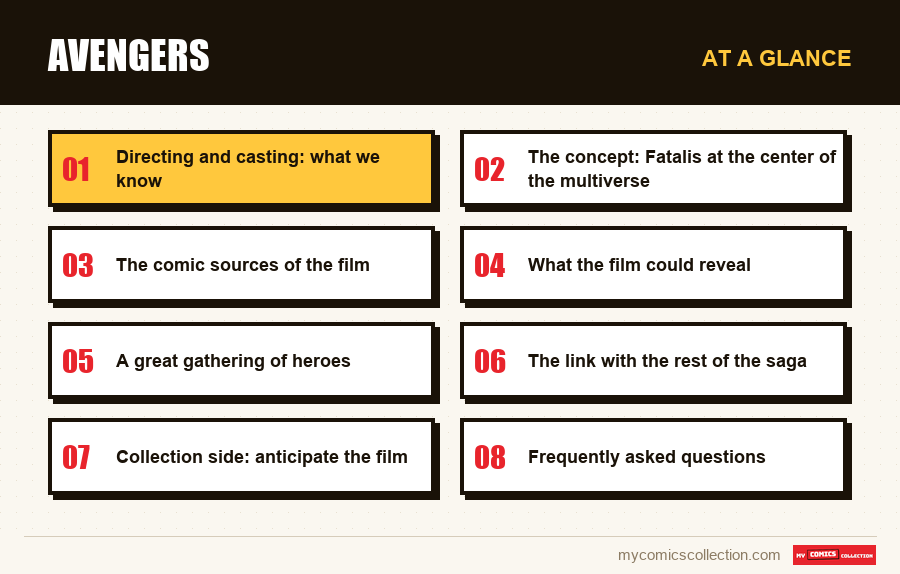
Directing and casting: what we know
Avengers: Doomsday is directed by Anthony and Joe Russo, the Russo Brothers, who helmed many of Marvel Studios' biggest hits, including the previous Avengers films that concluded the "Infinity Saga." Their return to the helm signals the capital importance given to this project. The casting is dominated by the notable announcement of Robert Downey Jr. in the role of Doctor Doom. The actor, inseparable from the role of Iron Man that he played for more than a decade, returns to the Marvel cinematic universe, no longer as a hero but as a great villain. This choice, revealed during a very notable presentation, aroused immense enthusiasm and placed Fatalis at the heart of attention.
It should be remembered that, as with any project under development, certain details remain subject to change, and official information is gradually revealed by the studio. The notable announcements: the production by the Russo brothers, the casting of Robert Downey Jr. in Fatalis: however constitute the solid basis of what we know, and are enough to measure the ambition of the project. The rest, notably the precise plot, is the subject of controlled communication, maintaining the anticipation around the film.
Beyond Robert Downey Jr., the film is presented as a large gathering of characters, bringing together many actors from the Marvel universe. This choral dimension, typical of Avengers films, promises a major confrontation against the monarch of Latveria. The presence of the Russo brothers and the casting of Downey Jr. are enough to make Avengers: Doomsday one of the studio's most anticipated projects. For the viewer, these elements confirm the ambition of the film and the central status of Doom, whose arrival is treated as a major event. The return of emblematic actors and the reunion of multiple heroes against Doom place the film in the tradition of great crossovers, where the entire universe mobilizes against a supreme threat.
The concept: Fatalis at the center of the multiverse
Avengers: Doomsday is part of the "Multiverse Saga", the current phase of Marvel Studios focused on parallel realities and their interactions. The film places Doctor Doom as a unifying threat, reorienting the saga which was initially supposed to culminate around Kang the Conqueror. This choice aligns the project with the concepts of the Secret Wars sagas, where Doom achieves cosmic power by reshaping reality. The very title, evoking the “day of destiny”, Doom meaning “fate” or “fate”, underlines the centrality and menacing aura of the character. The concept promises a clash on the scale of the multiverse, with Doom as the architect of an unprecedented threat.
This orientation towards the multiverse and Fatalis opens up considerable narrative possibilities. The concept of Battleworld, a patchwork world bringing together variants of characters from multiple realities, offers an ideal framework for bringing together figures from different franchises and eras of Marvel cinema. Fatalis, capable in the comics of manipulating time and reshaping reality, can embody the multiversal issues of the saga. For the viewer, this concept promises a film of exceptional scope, where the entire universe is threatened by the genius and ambition of the monarch of Latveria. Understanding these issues, anchored in the Secret Wars sagas, allows us to anticipate the scope of a confrontation that could redefine the Marvel cinematic universe.
The comic sources of the film
Avengers: Doomsday draws primarily from the Secret Wars sagas, where Doctor Doom reaches the peak of his power. The 1984 version, written by Jim Shooter, introduced the concept of Battleworld and the cosmic ambition of Doom. The 2015 version, written by Jonathan Hickman and drawn by Esad Ribić, is the modern culmination: the Marvel universe is reconstructed by Doom into Battleworld, of which he becomes the all-powerful god, the “God Emperor Doom”. These stories, centered on a Doom reshaping reality, constitute the most direct sources of the film. They offer a glimpse of what the monarch of Latveria could become on screen: no longer a simple villain, but a force capable of dominating existence itself.
Beyond the Secret Wars, the film draws on the founding mythology of Doom, born in the pages of the Fantastic Four. His first appearance, in Fantastic Four #5 (1962), and his origins, detailed in Fantastic Four Annual #2 (1964), establish the character that the film adapts. The rivalry with Reed Richards, the links with Iron Man in the comics, and the psychological richness of the monarch of Latveria also nourish the project. For both the reader and the viewer, these sources are the key to understanding the issues of the film. Discovering them before release transforms the experience, revealing the depth of a character built over more than six decades. Our dedicated guides in the Fatalis hub detail these founding stories and the key numbers to know.
What the film could reveal
Several questions remain regarding the precise plot of Avengers: Doomsday. The choice to entrust Fatalis to Robert Downey Jr., the Iron Man actor, fuels hypotheses: is it a multiversal variant, a symbolic link, or an exploitation of the parallels between the two characters in the comics? The concept of Battleworld could justify the presence of multiple versions of heroes and villains, from different realities. The coming together of numerous actors suggests a choral confrontation, where the entire universe gangs up against Doom. These elements suggest an ambitious film, the revelations of which could redefine the trajectory of the Marvel cinematic universe.
For the viewer, the wait around these revelations is part of the event. Avengers: Doomsday promises to answer many questions while paving the way for the continuation of the saga, expected in the vein of Secret Wars. The film marks the culmination of several years of narrative construction, with Fatalis as its crowning achievement. Understanding the comic sources and the concepts at play allows you to better anticipate what the film could deploy. As its release approaches, excitement around Doom continues to grow, making the monarch of Latveria the most anticipated character in the Marvel Universe. The Fatalis hub brings together all our guides to prepare for this event film, from its comic book sources to its key collectible issues.
Collecting this series?
Track what you own, what you are missing and what your collection is worth. 7 day trial.
Start my trial →A great gathering of heroes
Like the previous Avengers films, Avengers: Doomsday presents itself as a large gathering of characters from the Marvel universe. This choral dimension, a trademark of the Avengers films, brings together multiple heroes facing a common threat: here, Doctor Doom. The format promises unprecedented interactions between characters, improbable teams and a major clash worthy of a saga climax. The gathering of numerous actors, including several emblematic figures of the universe, underlines the importance of the event and the need to mobilize all the heroic forces in the face of the genius and ambition of the monarch of Latveria.
This gathering dimension is consistent with Doom's status as a supreme threat. Confronting the monarch of Latveria, capable in the comics of reshaping reality, requires the mobilization of multiple heroes, like major crossovers. The concept of Battleworld, potentially at the heart of the film, also offers an ideal framework for bringing together characters from different realities and franchises. For the viewer, this prospect promises a major spectacle, where the Marvel universe gangs up against its greatest villain. It reminds us that Doom is not an ordinary antagonist, but a threat justifying the assembly of considerable heroic forces, in the tradition of the most memorable clashes of the Marvel Cinematic Universe.
The link with the rest of the saga
Avengers: Doomsday cannot be conceived in isolation: the film is part of a narrative construction that will continue, notably in an expected sequel in the tradition of the Secret Wars sagas. This articulation reflects Marvel Studios' strategy, which builds its phases over several interconnected films, leading to a climax. Doomsday thus appears to be a major step, preparing for future developments while offering a major confrontation. The central role of Doom, and the concepts from the Secret Wars, suggest a saga unfolding over several films, with the monarch of Latveria as a pivotal figure.
This long-term construction illustrates the studio's ambition. By making Doom the heart of several films, Marvel is banking on the richness and potential of the character to carry the saga to its conclusion. For the viewer, understanding this articulation allows them to understand Avengers: Doomsday not as an isolated film, but as a link in a larger story. This dimension reinforces the importance of knowing the comic sources, in particular the Secret Wars, which shed light on the issues of the entire saga. The film thus promises to pave the way for major developments, with Doom as the architect of a threat intended to lastingly mark the Marvel cinematic universe. The Fatalis hub brings together our guides to follow this saga and understand its foundations.
Collection side: anticipate the film
For the collector, the period preceding the release of Avengers: Doomsday is strategic. The hype surrounding Doctor Doom makes its key issues particularly relevant. Fantastic Four #5 (1962), the character's first appearance, is the preferred target, whose rating could increase with media attention. Fantastic Four Annual #2 (1964), which details its origins, and the issues linked to the Secret Wars (1984 and 2015) complete a thematic collection around the film. Anticipating this interest, before the general public's attention is massively focused on Fatalis, can prove wise for the informed collector.
That being said, caution remains in order: the value of a number always depends on its condition and its gradation, and major keys reach heights that reserve them for a substantial budget. More modern or average condition numbers offer more accessible entry points. Following the news of the film also allows you to identify the secondary characters or the concepts put forward, whose key numbers could benefit from the enthusiasm. For the collector, Avengers: Doomsday represents an opportunity to become interested in the keys to Doom and the associated mythology, at a time when their appeal is reinforced by current cinematographic events. Our dedicated guides in the Fatalis hub detail the rating and potential of these numbers, to support you in your acquisitions as the event film approaches.
Frequently asked questions
The Russo brothers, Anthony and Joe Russo, who helmed many of Marvel Studios' biggest hits, including the previous Avengers films. Their return to the helm signals the capital importance given to this event film centered on Doctor Doom.
Robert Downey Jr., the historical interpreter of Iron Man, who returns to the Marvel universe as a great villain. This striking choice, revealed during a very notable presentation, places Fatalis at the center of the “Multiverse Saga” and has aroused immense enthusiasm.
Mainly Secret Wars sagas: that of 1984 (Jim Shooter) which introduced Battleworld, and that of 2015 (Hickman and Ribić) where Doom reconstructs the universe in Battleworld and becomes the God Emperor Doom. It also draws on the founding mythology of the Fantastic Four.
The current phase of Marvel Studios, focused on parallel realities and their interactions. Avengers: Doomsday is a culmination, placing Doctor Doom as a unifying threat, replacing Kang the Conqueror initially planned.
Fantastic Four #5 (1962, premiere of Doom), Fantastic Four Annual #2 (1964, its origins), and both Secret Wars (1984 and 2015). These stories illuminate the character and concepts of the film. Our guides in the Fatalis hub detail them.
Does the film make you want to collect Fatalis? Estimate the value for free of your issues (Fantastic Four #5, Secret Wars, etc.) with our tool based on current eBay listings.