Secret Wars (2015), written by Jonathan Hickman and drawn by Esad Ribic, is the Marvel crossover that inspires the most Avengers: Doomsday. The Marvel universe is destroyed then rebuilt by Doctor Doom in Battleworld, a patchwork world of which he becomes the all-powerful god. We explain this saga and its link with the film.
The culmination of several years of stories, Secret Wars (2015) offers the most grandiose version of Doom: a god reigning over reality. A concept which seems to directly feed the cinematic plot. Decryption.
As always in this guide, only verified information (creators, numbers, dates) is stated; the analysis is ours, without reproduction of plates or protected dialogue.
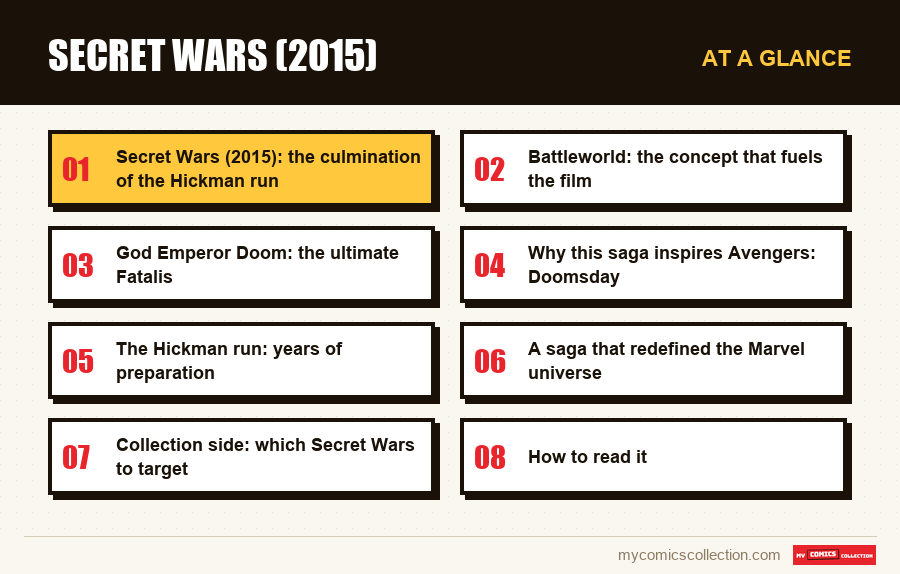
Secret Wars (2015): the culmination of the Hickman run
Secret Wars (2015) is an event miniseries written by Jonathan Hickman and drawn by Esad Ribić, published by Marvel. It is the culmination of several years of stories led by Hickman on the Avengers and New Avengers titles, where he developed the concept of "incursions": the destructive collision of parallel realities threatening to destroy the multiverse. In Secret Wars, this threat reaches its end: the Marvel Universe and the Ultimate Universe are destroyed. From this nothingness, Doctor Doom rebuilds a world from fragments of vanished realities: Battleworld, a patchwork planet bringing together kingdoms from different histories and eras. Fatalis reigns there as an absolute god, the “God Emperor Doom”.
This saga represents a peak in the representation of Doom. After decades of coveting ultimate power, the character finally achieves it, literally becoming the god of his own creation. Hickman offers a fascinating exploration of this all-powerful Doom, confronting the responsibilities and limits of his divinity. The saga questions: what becomes of a man whose ambition no longer has any boundaries? Secret Wars (2015) is thus much more than a simple crossover: it is a meditation on power, pride and identity, carried by the most emblematic character of Marvel's conquest. This dimension explains why it inspires so much the cinematographic ambitions around Fatalis.
Battleworld: the concept that fuels the film
The central concept of Secret Wars (2015), Battleworld, is probably what most directly connects the saga to Avengers: Doomsday. Battleworld is a planet made up of multiple kingdoms, each from a different reality, era, or event in Marvel history. There we find alternative versions of heroes and villains living together in a world shaped by Doom. This concept of a patchwork world, bringing together variants from the multiverse, resonates strongly with the current direction of the Marvel Cinematic Universe, centered on the multiverse and its divergent realities. The very title of the film, evoking the “day of destiny”, and the centrality of Doom suggest a direct inspiration.
Battleworld offers cinema a narrative framework of exceptional richness: the possibility of bringing together characters from different realities and franchises, under the authority of a demiurge Fatalis. This concept would make it possible to explain the presence of many characters, including variations or unexpected returns. For the viewer, understanding Battleworld is essential to anticipating the issues of the film. This is a world where Doom has the power to reshape everyone's reality and identity, which could justify bold narrative choices. We are devoting an article dedicated to this fascinating concept, the cornerstone of Secret Wars and probable inspiration for the film.
God Emperor Doom: the ultimate Fatalis
At the heart of Secret Wars (2015) is the most powerful version of Doom ever depicted: the "God Emperor Doom." Having rebuilt reality after its destruction, Doom becomes its god, endowed with almost unlimited powers. He rules Battleworld with absolute authority, worshiped as a deity by its inhabitants. This version of the character realizes his deepest dream: not to conquer a country or even a universe, but to become the master of reality itself. Esad Ribić renders this deity with striking visual majesty, making God Emperor Doom an imposing and memorable figure.
This divine version of Doom explores deep themes. Despite his omnipotence, God Emperor Doom remains haunted by his rivalry with Reed Richards and by the limits of his control. The saga reveals that even as a god, Doom cannot escape his nature or his obsessions. This exploration of divinity and hubris makes God Emperor Doom one of the richest interpretations of the character. For the viewer of Avengers: Doomsday, this version could foreshadow what Doom will become on screen: no longer a simple villain, but a cosmic force reshaping reality. We are devoting a dedicated article to him as this incarnation is so striking and central in the modern mythology of the character.
Why this saga inspires Avengers: Doomsday
Several elements point to Secret Wars (2015) as the major inspiration for the film. First, the centrality of Doom: the saga makes him the pivotal character, which corresponds to the status of central threat that Doom occupies in Avengers: Doomsday. Then, the concept of Battleworld, perfectly aligned with the theme of the multiverse explored by Marvel cinema. Finally, the very structure of the current phase, which must culminate in a saga inspired by the Secret Wars, makes this work by Hickman a natural reference. The film seems to want to adapt, at least in part, the scale and concepts of this major crossover.
For the reader and viewer, Secret Wars (2015) is therefore the ideal preparatory reading. It offers an overview of the cosmic issues and the demiurgic version of Doom that could define the film. An ambitious, visually sumptuous and thematically rich work, it represents a peak of the Hickman run and the mythology of Doom. Understanding this saga means understanding why Marvel placed the monarch of Latveria at the center of its cinematic universe. It reminds us that Fatalis, in the comics and soon in the cinema, is not an ordinary villain, but a figure capable of reshaping the entire reality. The Fatalis hub brings together all our guides to explore this exceptional character.
Collecting this series?
Track what you own, what you are missing and what your collection is worth. 7 day trial.
Start my trial →The Hickman run: years of preparation
Secret Wars (2015) does not appear out of nowhere: it is the culmination of several years of stories led by Jonathan Hickman on the Avengers and New Avengers titles. From the start of his run, Hickman develops the concept of "incursions": the collision of parallel realities, where two Earths from different universes come into contact, threatening to destroy one of the two worlds, or even the entire multiverse. This narrative thread, woven with remarkable ambition, explores dizzying moral dilemmas: how far are the heroes willing to go to save their world? Should we destroy one Earth to save another? These questions set the stage for the final catastrophe that results in Secret Wars.
This long-term construction makes Secret Wars (2015) the culmination of a saga of exceptional coherence. Hickman is known for his architectural stories, where each element finds its place in a larger design. The reader who discovers Secret Wars without the context of the run can appreciate its magnitude, but the reader who has followed the “incursions” understands the full scope. This dimension illustrates the narrative richness of modern comics, capable of building sagas over several years. To prepare for Avengers: Doomsday, understanding that Secret Wars is an outcome, and not just an isolated event, allows you to understand the scale of the issues. The film could be inspired by this structure, making the arrival of Doom the culmination of a long-term narrative construction.
A saga that redefined the Marvel universe
Beyond its plot, Secret Wars (2015) had a lasting impact on the Marvel Universe. At the end of the saga, reality is reconstructed, allowing the publisher to reshuffle the cards of its continuity and introduce lasting changes. The event was accompanied by numerous tie-ins exploring the different realms of Battleworld, offering a fascinating panorama of alternate versions of familiar characters. This editorial breadth, where a central saga unfolds into a multitude of satellite stories, illustrates the way in which Marvel constructs its major events. Secret Wars (2015) was thus much more than a mini-series: a pivotal moment in the recent history of the publisher.
This structuring dimension makes Secret Wars (2015) a reference for understanding Marvel's narrative strategy, on paper as in the cinema. The idea of a central event capable of uniting, transforming and relaunching an entire universe is exactly what Marvel Cinema seeks to accomplish with its multiverse saga, of which Avengers: Doomsday is a major step. Fatalis, at the heart of this reconstruction in the comics, naturally becomes a central figure on the screen. For the reader, measuring the impact of Secret Wars (2015) on the Marvel universe means understanding why this saga so inspires current cinematographic ambitions. It demonstrates the potential of the character of Doom to carry an event of unequaled magnitude, capable of redefining an entire universe. The Fatalis hub brings together our guides to explore this character and his major sagas.
Collection side: which Secret Wars to target
For the collector, the excitement around Avengers: Doomsday makes the Secret Wars sagas particularly relevant. Secret Wars #1 (2015) by Hickman and Ribić is an accessible modern target, whose interest could grow with current cinematographic news, especially since it is the most direct source of the film. The complete series #1-9 is easily found in a collection, an ideal format for reading. For the historical key, Marvel Super Heroes Secret Wars #1 (1984) remains the sought-after issue, as the origin of the concept of Battleworld and a major milestone in Marvel history. The two versions complement each other, both for reading and for collecting.
As always, the value of an issue depends on its condition and gradation, and reliance on actual recent sales is strongly recommended before any purchase. Cinematographic news tends to increase the odds of numbers linked to the characters highlighted, which makes the Secret Wars sagas and the keys to Doom targets to watch as the film approaches. For the savvy collector, anticipating this craze can be wise. Our dedicated guides in the Doom hub detail the character's key numbers and their potential. Whether you're looking to read the saga that inspired the film or invest in its issues, Secret Wars offers both a major reading experience and exciting collecting opportunities as Doctor Doom prepares to dominate the Marvel Cinematic Universe.
How to read it
- The main series: Secret Wars #1-9 (2015) by Hickman and Ribić, available in collection.
- The context: Hickman's Avengers/New Avengers run (“Incursions”) sheds light on the origins of the saga.
- To learn more about Fatalis: our articles dedicated to Battleworld and God Emperor Doom.
- Collection side: Secret Wars #1 (2015) is an accessible modern target; the 1984 version remains the historical key.
Frequently asked questions
An event mini-series from Jonathan Hickman and Esad Ribić, the culmination of his Avengers run. The Marvel universe is destroyed then rebuilt by Doctor Doom in Battleworld, a patchwork world of which he becomes the all-powerful god, the “God Emperor Doom”.
By the centrality of Doom, by the concept of Battleworld (aligned with the multiverse of Marvel cinema) and because the current phase must culminate in a saga inspired by the Secret Wars. The film appears to adapt the scale and concepts of this major crossover.
The most powerful version of Doom: having rebuilt reality, he becomes its god, ruling Battleworld with almost unlimited powers. It is the fulfillment of his dream of absolute control, a majestic figure drawn by Esad Ribić.
It's not obligatory, but its Avengers/New Avengers run (the concept of "incursions") sheds light on the origin of the saga. Secret Wars (2015) can be read alone, but the context enriches the understanding of the cosmic issues that culminate there.
It is an accessible modern target, whose interest could grow with current cinema news. For the historical key, aim instead for Marvel Super Heroes Secret Wars #1 (1984). Check out our collection guides in the Fatalis hub.
Want to collect Secret Wars? Estimate the value for free of your issues (Secret Wars #1 1984 and 2015…) with our tool based on current eBay listings.