Two sagas Secret Wars , two eras: that of 1984 (Shooter/Zeck), founder of the concept of Battleworld , and that of 2015 (Hickman/Ribić), where Doctor Doom becomes god. Which one to collect? We compare the two to help you choose, according to your budget, your tastes and your objectives: all the more relevant before Avengers: Doomsday.
1984 or 2015? The two Secret Wars are major, but very different. Comparative guide to orient your collection around these sagas where Fatalis shines. Decryption.
As always in this guide, only verified information (creators, numbers, dates) is stated; the analysis is ours. No numerical estimate is put forward: only actual recent sales are taken as proof.
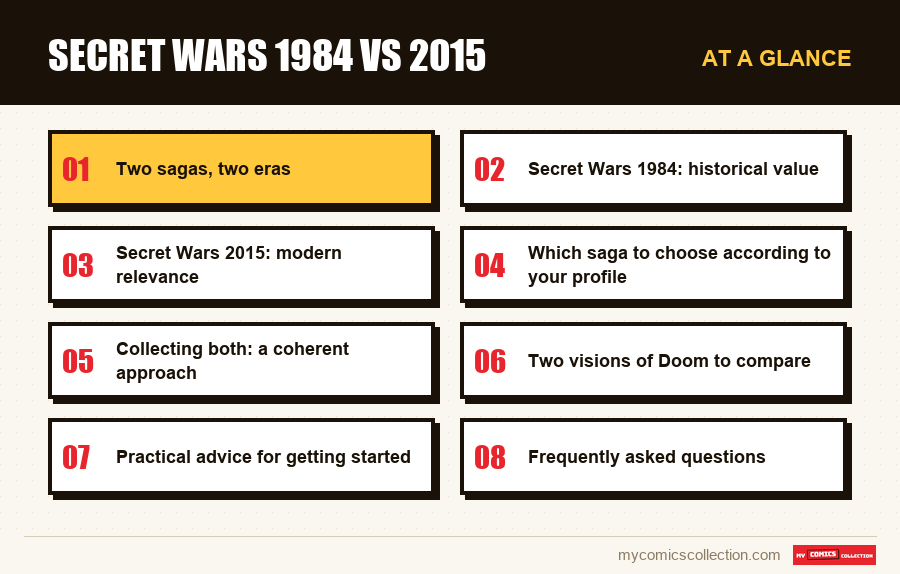
Two sagas, two eras
Marvel has published two major sagas bearing the title Secret Wars, more than thirty years apart, and both feature Doctor Doom. The first, Marvel Super Heroes Secret Wars (1984), written by Jim Shooter and drawn by Mike Zeck, is Marvel's first major crossover: heroes and villains come together on Battleworld to confront each other, under the eye of the Beyonder. The second, Secret Wars (2015), written by Jonathan Hickman and drawn by Esad Ribić, is the culmination of Hickman's run: the Marvel universe is reconstructed by Fatalis into Battleworld, of which he becomes the god, the God Emperor Doom. These two sagas, although sharing a title and the concept of Battleworld, are profoundly different in tone, scale and era.
Understanding these differences is essential to guide your collection. The 1984 saga belongs to the Bronze Age and embodies the spirit of the great emerging crossovers, with a more classic tone and a central place given to action. The 2015 saga is part of modern comics and is distinguished by its cosmic ambition and thematic depth, carried by Hickman's architectural vision. Each offers a different vision of Doom: the ambitious villain aiming for the power of the Beyonder in 1984, the all-powerful god reshaping reality in 2015. For the collector, choosing between the two-or aiming for both-depends on taste, budget, and goals. This comparison aims to shed light on this decision.
Secret Wars 1984: historical value
The 1984 saga presents a major asset for the collector: its historical value. As Marvel's first major crossover, it occupies a founding place in comics history, ushering in the event formula that would become a mainstay of the industry. This pioneering dimension gives the issues of the saga a heritage interest. In addition, the series contains major keys, first and foremost Secret Wars #8, where Spider-Man's black suit makes its appearance: the origin of Venom. This wealth of keys makes the 1984 saga a particularly sought-after set, whose value reflects its historical importance and the presence of emblematic numbers.
For the collector attracted by the history of comics and the keys to the Bronze Age, the 1984 saga is a privileged target. It offers both heritage value, the first crossover, and sought-after key numbers. Its rating, more established due to its seniority, reflects this importance. Collecting this saga means owning a founding milestone in the Marvel universe, as well as keys linked to major characters. This dimension makes it a relevant choice for collectors who prioritize the historical importance and value of old keys. As always, the condition of the copies determines their value, and support from real recent sales remains essential. The Fatalis hub brings together our guides to delve deeper into the collection of this founding saga.
Secret Wars 2015: modern relevance
The 2015 saga has other strengths, geared more towards modern relevance. As a culmination of Hickman's run and an exploration of Doom's version of God, God Emperor Doom, it ties directly into the concepts that inspire the Marvel Cinematic Universe and Avengers: Doomsday. This proximity to current cinematography makes it a particularly relevant saga to discover in the current context. In addition, as recent comics, its issues remain accessible, making it an affordable target for collectors wishing to take an interest in the film's sources. The 2015 saga thus offers a combination of narrative ambition, cinematic relevance and accessibility.
For the collector interested in the link with cinema and in the cosmic version of Doom, the 2015 saga is a natural choice. It allows you to discover the concepts (Battleworld, God Emperor Doom) that the film adapts, while remaining financially accessible. Its rating, more modest due to its recent nature, could however evolve with current cinema news. Collecting this saga means taking a direct interest in the sources of Avengers: Doomsday and the most grandiose representation of Doom. This dimension makes it a relevant choice for collectors who prioritize timeliness and accessibility. As with any comic, condition determines value. The Fatalis hub brings together our guides to delve deeper into the collection of this modern saga and its connection to the film.
Which saga to choose according to your profile
The choice between the two sagas depends above all on your collector profile. If you prioritize historical value, the keys to the Bronze Age and heritage importance, the 1984 saga is for you: it offers the prestige of the first crossover and emblematic numbers like #8 of the black suit. If you are attracted by cinematic news, the cosmic version of Doom and accessibility, the 2015 saga better meets your expectations: it is directly linked to Avengers: Doomsday and remains affordable. These two profiles are not exclusive: many collectors choose to own both sagas, to cover the entire Secret Wars theme.
This decision can also be based on your reading tastes. The 1984 saga offers a classic crossover story, rich in action and clashes, while the 2015 saga offers a more ambitious and thematically dense work, driven by Hickman's vision. Depending on whether you prefer one or the other style, your choice will naturally evolve. For the Doom collector, the two sagas are essential, each offering a striking vision of the character. Owning both allows you to appreciate Doom's evolution through the ages, from ambitious villain to all-powerful god. Whatever your choice, these sagas take center stage in a collection dedicated to the Latverian monarch. The Fatalis hub brings together our guides to support you in this collection.
Collecting this series?
Track what you own, what you are missing and what your collection is worth. 7 day trial.
Start my trial →Collecting both: a coherent approach
For the ambitious collector, owning the two Secret Wars sagas constitutes a coherent and rewarding approach. Bringing together the 1984 saga and that of 2015 covers the entire Battleworld theme and the evolution of Doom over the decades. This comprehensive approach offers a panoramic view of the concept and character, from the first founding crossover to the modern culmination. It also allows us to appreciate the links and differences between the two sagas, two visions of the same concept at distinct times. For the collector of Fatalis, this approach is particularly gratifying, as the character occupies a central place in both works.
This double collection has the advantage of combining historical value and modern relevance. The 1984 saga brings the prestige and the keys to the Bronze Age, while that of 2015 offers the link with cinematographic news and accessibility. Together, they constitute a rich and coherent whole, illustrating the constancy of Doom's ambition throughout the ages. As Avengers: Doomsday approaches, owning the two sagas allows you to fully understand the sources and the evolution of the concept adapted to the cinema. This approach, demanding but rewarding, is ideal for the collector wishing to build a complete collection around Fatalis and Secret Wars. The Fatalis hub brings together our guides to support you in this ambitious collection.
Two visions of Doom to compare
Beyond the collection decision, comparing the two Secret Wars sagas allows us to appreciate the evolution of the representation of Doom. In the 1984 saga, the monarch of Latveria is just another ambitious villain, seeking to seize power from the Beyonder. He is powerful and cunning, but remains an antagonist within a large ensemble. In the 2015 saga, Doom achieves a completely different status: he becomes the god of Battleworld, a demiurgic figure reshaping reality. This progression, three decades apart, illustrates the rise of the character over time, from formidable villain to supreme cosmic threat.
This comparison sheds light on the evolution of Doom in the comics. The character, initially conceived as the enemy of the Fantastic Four, gradually grew in size, until he embodied a threat on the scale of the multiverse. The two Secret Wars sagas bear witness to this progression: the first shows an ambitious Fatalis, the second an all-powerful Fatalis. For the reader, owning and reading both allows them to appreciate this evolution, to measure the path taken by the character. This dimension adds to the interest in collecting the two sagas, beyond their intrinsic value. Heading into Avengers: Doomsday, this comparison illustrates how Doom has become the central figure he is today. The Fatalis Hub brings together our guides to explore this evolution.
Practical advice for getting started
For the collector wishing to start collecting Secret Wars, some practical advice is in order. It is recommended to start by defining your objective (reading, collection, investment) because it guides the choices. For reading, the collections of the two sagas are accessible and ideal. For the collection of original issues, it is advisable to first target the key numbers: #1 and #8 for the 1984 saga, #1 for that of 2015. It is also advisable to favor copies in good condition, whose value will be more stable, and to systematically rely on real recent sales to assess the fair price before any purchase.
A gradual approach is often the most judicious. Rather than trying to acquire everything at once, the collector can build his collection as opportunities arise, prioritizing the most important issues. For the 1984 saga, targeting the keys first (#1 and #8) allows you to build a solid foundation. For that of 2015, #1 is the natural starting point. This approach spread over time allows you to manage your budget and seize the best opportunities. For the Fatalis collector, the Secret Wars constitute an essential set, the collection of which, carried out with method, is particularly gratifying. As Avengers: Doomsday approaches, interest in these sagas is renewed, making it a good time to jump in. The Fatalis hub brings together our guides to support you.
It should be remembered that these two sagas, despite their common title, are independent works which can be read separately, each being sufficient in itself. The collector can therefore approach one or the other in no imposed order, according to his preferences.
Frequently asked questions
Secret Wars (1984), by Shooter and Zeck, is Marvel's first major crossover, where heroes and villains clash on Battleworld. Secret Wars (2015), by Hickman and Ribić, is the culmination of Hickman's run, where Doom rebuilds the universe into Battleworld and becomes the God Emperor Doom.
It depends on your profile: the 1984 saga for historical value and the keys to the Bronze Age (like #8 of the black suit), that of 2015 for cinematographic news, the cosmic version of Doom and accessibility. Many collectors choose both.
That of 2015: it explores the divine version of Doom (God Emperor Doom) and the concept of Battleworld which directly inspire the film. The 1984 saga, however, introduced the concept of Battleworld originally, which also makes it relevant.
Generally that of 2015, as recent comics remain more affordable. The 1984 saga, older and containing sought-after keys like #8, achieves higher values, especially in good condition. Both depend on the condition of the copies.
For a Doom collector, it's a coherent approach: bringing the two together allows you to cover the entire Battleworld theme and the evolution of the character, from the ambitious villain of 1984 to the all-powerful god of 2015. Each offers a striking vision of the monarch.
Do you collect Secret Wars? Estimate the value for free of your numbers (1984 and 2015…) with our tool based on current eBay listings.