Super-Villain Team-Up (1975) is a rare series that highlights Doctor Doom and Namor in the lead: two villains as protagonists, with no heroes to counter them. This Bronze Age curiosity testifies to the singular status of Doom, capable of carrying its own stories. We decipher this little-known series and its interest for collectors.
A series entirely devoted to villains: the idea was audacious for the time. Super-Villain Team-Up illustrates the special place that Fatalis occupies at Marvel. Decryption of a singular series.
As always in this guide, only verified information (creators, numbers, dates) is stated; the analysis is ours, without reproduction of plates or protected dialogue.
A series focused on villains
Super-Villain Team-Up, launched in 1975, is a series with a daring concept: featuring supervillains as protagonists, without a hero to play the leading role. This formula, rare for the time, placed Doctor Doom and Namor the Prince of the Seas at the center of the stories, exploring their alliances, their conflicts and their designs. At a time when series were almost always centered on heroes, giving the leading role to villains was an original approach, which demonstrated the richness and potential of these characters. Super-Villain Team-Up thus illustrates a unique facet of the Marvel universe of the Bronze Age, where the publisher dared to explore unusual formats.
It should be noted that the title itself, “Super-Villain Team-Up”, clearly displayed its ambition: to offer teams of villains as a central argument, a new and catchy concept. This assumed identity testified to Marvel's confidence in the potential of its antagonists, first and foremost Doom, to carry stories without the use of a classic hero.
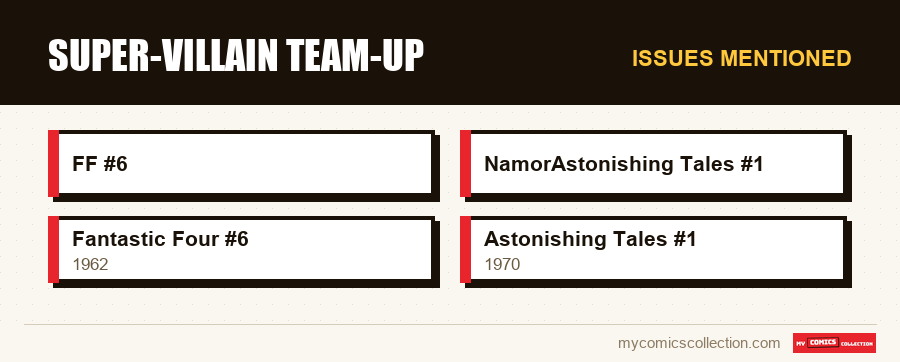
This series takes up the Fatalis-Namor duo, already associated from Fantastic Four #6, to make them the heart of entire stories. The concept of a permanent “team-up of villains” offered an unprecedented area of exploration: the tensions between two proud figures, their reciprocal manipulations, their divergent objectives. Doom, a manipulative strategist, and Namor, a proud and unpredictable ruler, formed an unstable and fascinating duo. For the collector, Super-Villain Team-Up is a curious and endearing series, which documents an editorial experiment by Marvel. It testifies to the special status of Doom, one of the rare villains capable of carrying his own stories, and to his growing popularity throughout the 1970s.
Doom's singular status as protagonist
That Doctor Doom can be the protagonist of an entire series says a lot about his uniqueness. Few villains are rich and charismatic enough to interest readers without the counterpoint of a hero. Fatalis has this stuff: monarch, genius, figure with complex motivations, he can carry stories centered on his own designs. Super-Villain Team-Up confirms this status, alongside other series that have featured it such as Astonishing Tales. This ability to be a protagonist distinguishes Doom from the vast majority of villains, generally confined to the role of antagonists. It illustrates the depth of the character and its enduring appeal.
This dimension illuminates the special place that Fatalis occupies in the Marvel universe. Unlike the villains defined solely by their opposition to the heroes, Fatalis exists fully by himself: his ambitions, his kingdom, his psychology are enough to nourish stories. Super-Villain Team-Up is an illustration of this, exploring the monarch of Latveria in his intrigues and alliances. For the reader, this series offers a glimpse of Doom in a different light, not as an obstacle for the heroes, but as a central figure whose maneuvers we follow. This perspective enriches the understanding of the character and confirms his exceptional status. The Fatalis hub brings together our guides to explore the series that featured the Latverian monarch, testifying to his wealth and popularity.
A key to the Bronze Age sought by enthusiasts
For the collector, Super-Villain Team-Up has the interest of being a series linked to Doctor Doom, in the popular Bronze Age format. The first issues, in particular, are sought after by fans of the character wishing to cover the significant stages of his editorial history. This series, less known than the great keys of the Silver Age, offers a good ratio between historical importance and accessibility, characteristic of Bronze Age issues. It constitutes an interesting target to complete a collection dedicated to Fatalis, by documenting a unique editorial experiment. Its value, generally measured, makes it an affordable acquisition for collectors on a limited budget.
This accessibility makes Super-Villain Team-Up an attractive option for deepening a Doom collection without a major investment. The series illustrates a little-known facet of the character's editorial career, complementing the major keys with a testimony to his ability to carry his own stories. For the collector, bringing together the issues where Doom is featured (Astonishing Tales, Super-Villain Team-Up and the subsequent series) constitutes a coherent and rewarding approach. Each acquisition enriches the understanding of the character and his evolution. As with any old series, the condition of the copies determines their value, and the support of real recent sales remains essential. The Fatalis hub brings together our guides to identify these series and build a collection covering all facets of the Latverian monarch.
The Fatalis-Namor duo, a fascinating dynamic
At the heart of Super-Villain Team-Up is the dynamic between Doom and Namor, two characters who are completely opposed and whose interests occasionally bring them together. Doom, monarch of Latveria and calculating strategist, seeks to exploit Namor for his own purposes. Namor, ruler of Atlantis and proud anti-hero, accepts no submission and pursues his own goals. This relationship, made of distrust, manipulation and alliances of circumstance, offers a rare dramatic richness. The two characters, equally proud and powerful, form an unstable duo where each seeks to dominate the other. This permanent tension is the driving force of the series' stories.
This dynamic illustrates the finesse of writing that villains can be subject to. Far from Manichaeism, Super-Villain Team-Up explores complex characters, with nuanced motivations, whose interactions go beyond simple confrontation. Fatalis and Namor are not simple villains: they are sovereigns, tragic and ambiguous figures, whose relationship reveals as much their faults as their greatness. For the reader, this dynamic offers valuable insight into how Doom interacts with his peers, foreshadowing his many future alliances and betrayals. It also confirms the richness of the character, capable of carrying stories centered on his complex relationships. The Doom Hub brings together our guides to delve deeper into the dynamic between Doom and Namor and its importance in the character's mythology.
Collecting this series?
Track what you own, what you are missing and what your collection is worth. 7 day trial.
Start my trial →The context of the 1970s at Marvel
Super-Villain Team-Up takes place in the particular creative context of the 1970s at Marvel, a period of experimentation and diversification. After the golden age of the Silver Age, the publisher sought to renew its formulas and explore new formats. This decade saw the birth of daring series, darker characters and unusual concepts, of which Super-Villain Team-Up is an example. Entrusting a series to villains demonstrated this desire to innovate, to think outside the box. The Bronze Age, the period during which this series appears, is characterized by this growing maturity and diversity, offering collectors a wide range of original titles to discover.
This contextualization illuminates the interest of Super-Villain Team-Up. The series reflects the spirit of its time, marked by risk-taking and the exploration of new narrative territories. That Marvel dared to devote a title to villains illustrates the editorial audacity of the Bronze Age. For the collector, understanding this context enriches the appreciation of the series, which is not a simple curiosity but the product of a teeming creative period. Super-Villain Team-Up is a testament to how Marvel has experimented with its characters, giving Doom an unusual treatment. This historical dimension adds to the series' appeal for fans of the Latverian monarch and Marvel's editorial history.
Other series featuring Fatalis
Super-Villain Team-Up isn't the only series to feature Doctor Doom. The character has benefited, over the decades, from several titles centered on him, testifying to his enduring popularity. Astonishing Tales in the 1970s marked the beginning of his shared starring role with Ka-Zar. More recently, series like Doctor Doom (2019) by Christopher Cantwell or Infamous Iron Man (2016) by Brian Michael Bendis have devoted solo stories to him. This recurrence of series centered on Doom is revealing: few villains benefit from such treatment, which confirms the exceptional status of the monarch of Latveria.
This collection of dedicated series offers the collector a rich material. Bringing together the titles that have featured Fatalis (from Astonishing Tales to Super-Villain Team-Up, then modern runs) allows us to document the evolution of the character as a protagonist. Each of these series sheds a different light: the classic villain of the 1970s, the modern anti-hero, the character in search of redemption. For the collector, this thematic approach is coherent and rewarding, covering an essential facet of Fatalis' career: his ability to tell his own stories. Super-Villain Team-Up, as a pioneering series in this field, occupies a notable place. The Fatalis hub brings together our guides to identify these series and build a collection covering all eras of the character.
Fatalis and Namor, two current characters
The Super-Villain Team-Up series brings together two characters whose news, on the big screen, rekindles interest. Doctor Doom is set to become the central threat of the Marvel Cinematic Universe in Avengers: Doomsday, played by Robert Downey Jr. Namor, for his part, has experienced a resurgence in popularity thanks to his recent adaptations, which have introduced him to a wide audience. This double topicality gives Super-Villain Team-Up renewed interest: the series features, together, two figures that the cinema is bringing back to light. For the collector, this convergence is an asset, the series affecting both Fatalis and Namor fans.
This relevance linked to current events makes Super-Villain Team-Up a series to consider for collectors interested in one or the other character. Bringing together two figures whose popularity is driven by the big screen, in a series with an original concept, constitutes an attractive proposition. As always, the effects of cinema news on the rating are variable, and the value is based above all on the fundamentals. Nonetheless, the growing exposure of Doom and Namor could support interest in this little-known series. For the collector, Super-Villain Team-Up combines the rarity of the concept, the historical importance and the relevance of its two protagonists, which makes it a unique and interesting acquisition. The Fatalis hub brings together our guides to place this series in a collection dedicated to the monarch of Latveria.
Frequently asked questions
A series launched in 1975, with a daring concept: putting supervillains in the lead, without a hero to occupy the leading role. In particular, it places Doctor Doom and Namor at the center of the stories, exploring their alliances and their conflicts. It is a Bronze Age curiosity.
Because she entrusts the leading role to villains, a rare approach for the time. That Doom can be a protagonist is a testament to his wealth and popularity: few villains are complex enough to carry their own stories without the counterpoint of a hero.
Yes: less known than the great keys of the Silver Age, this Bronze Age series offers a good ratio between historical importance and accessibility. Its value, generally measured, makes it an affordable acquisition to deepen a Fatalis collection without major investment.
A relationship made of distrust, manipulation and alliances of circumstance. Doom seeks to exploit Namor for his purposes, while the latter, proud and unpredictable, accepts no submission. Two proud sovereigns forming an unstable and fascinating duo.
For a Doom collector, it documents a little-known facet of his publishing career: his ability to tell his own stories. It completes the great keys and other series that have featured him, such as Astonishing Tales, in a coherent thematic collection.
Do you own Super-Villain Team-Up or aim for this series? Estimate its value for free with our tool based on current eBay listings.