Astonishing Tales #1 (1970) marks the beginning of the first solo series of Doctor Doom, who shares the bill with Ka-Zar. This Bronze Age issue is an important key: it is the first time that the Latverian monarch carries his own adventures, a sign of his growing popularity. We decipher this often overlooked milestone in the mythology of Doom.
Eight years after her first appearance, Doom finally gets her own stories. Astonishing Tales #1 marks this milestone, testifying to the status acquired by the character. Decryption of a Bronze Age key.
As always in this guide, only verified information (creators, numbers, dates) is stated; the analysis is ours, without reproduction of plates or protected dialogue.
The first solo series of Doctor Doom
Astonishing Tales #1, published in 1970, marks an important milestone in the history of Doctor Doom: the start of his first series featuring the character. In this release, Doom shares the spotlight with Ka-Zar, each getting their own stories within the same issue. For Doom, this is the first time that he carries his own adventures, outside of the role of antagonist of the Fantastic Four. This transition from the status of recurring villain to that of main character testifies to the popularity and interest aroused by the monarch of Latveria, eight years after his first appearance. Astonishing Tales #1 is thus a revealing milestone in the character's rise.
It should be noted that this accession to a featured series, only eight years after a first appearance, demonstrates a remarkable trajectory for a character initially conceived as a simple adversary of the Fantastic Four. Few villains experience such editorial ascension.
This issue is part of the Bronze Age of comics, a period which succeeded the Silver Age and extended from the 1970s to the mid-1980s. Entrusting a villain with his own stories was a daring move for the time, where series were generally centered on heroes. That Doom got this treatment underscores his special status: an antagonist rich and popular enough to carry his own stories. For the collector, Astonishing Tales #1 is a key to the Bronze Age that marks this recognition. Often less known than the great keys to the Silver Age, this issue nonetheless remains an important milestone in the mythology of Doom, testifying to the evolution of its place in the Marvel universe.
A villain who carries his own stories
The fact that Doctor Doom is getting his own series is indicative of the character's uniqueness. Few villains are capable of carrying stories centered on them: this requires sufficient depth, complexity and charisma to interest readers without the counterpoint of a hero. Fatalis has these qualities. Monarch, genius, tragic figure with complex motivations, he can be the protagonist of his own adventures, exploring his rule over Latveria, its schemes and its conflicts. Astonishing Tales thus offers an overview of the character from a different angle, no longer as an obstacle for the heroes, but as a central figure whose plans we follow.
This ability to carry his own narratives distinguishes Doom from most villains. It illustrates what makes him an exceptional character: such richness that he can be both antagonist and protagonist. The Astonishing Tales stories explore the monarch in his kingdom, revealing sides that his clashes with the Fantastic Four did not show. For the reader, this series offers a valuable perspective on Doom, deepening his dimension as a ruler and strategist. It foreshadows the many subsequent stories which will make Fatalis a character in her own right, capable of carrying entire sagas. Astonishing Tales #1 marks the beginning of this recognition, making this issue an important milestone for understanding the evolution of the character.
A sought-after Bronze Age key
For the collector, Astonishing Tales #1 has the interest of being a key to the Bronze Age linked to Doctor Doom. As the start of his first solo series, this issue is sought after by fans of the character wishing to cover the significant stages of his editorial history. Its value, generally more accessible than that of Silver Age keys like Fantastic Four #5, makes it an interesting target to complete a collection without a major investment. Bronze Age issues often offer a good balance between historical importance and accessibility, which is true of Astonishing Tales #1. This issue therefore constitutes a relevant acquisition in a thematic collection approach dedicated to Fatalis.
This relative accessibility makes Astonishing Tales #1 an attractive option for collectors on a budget. It allows you to acquire an authentic key to the character without the sums required by the great keys of the Silver Age. Its presence in a Fatalis collection illustrates the evolution of the character, from recurring villain to protagonist of his own stories. As with any old key, its condition determines its value, and support from real recent sales remains essential. For the collector, this issue combines historical importance, the start of the first Fatalis solo series, and accessibility, making it a wise acquisition. The Fatalis hub brings together our guides to identify these complementary keys and build a collection covering all stages of the character.
Astonishing Tales in the editorial history of Doom
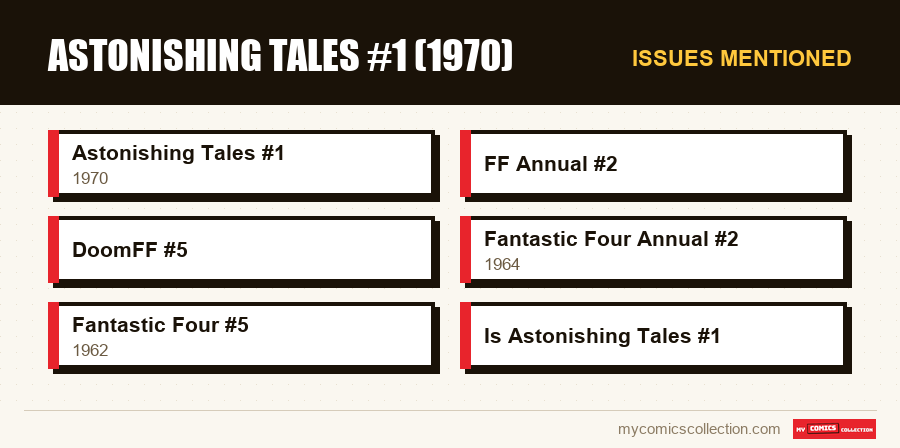
Astonishing Tales #1 is part of a rich editorial history, testifying to the growing place of Doom at Marvel. After its first appearance in 1962, its development through the Fantastic Four stories, and the revelation of its origins in 1964, obtaining its own series in 1970 marked a new milestone. This progression illustrates how a secondary character, initially conceived as an antagonist, gained importance to the point of carrying his own adventures. The stories of Astonishing Tales, although shared with Ka-Zar, allowed Doom to be explored in a new light, helping to enrich his mythology and consolidate his status as a major character in the Marvel Universe.
This editorial dimension makes Astonishing Tales #1 an enlightening issue for understanding the rise of Doom. It testifies to the moment when the character reached a milestone, going from the rank of recurring enemy to that of a figure important enough to carry his own stories. This evolution foreshadows the central place that Fatalis occupies today, until his arrival at the forefront of cinema in Avengers: Doomsday. For the collector and the reader, this issue offers a glimpse of a key stage in this rise. It illustrates how Marvel gradually recognized and exploited the potential of one of its greatest characters. The Fatalis hub brings together our guides to retrace this editorial history and identify the issues that mark its milestones.
Collecting this series?
Track what you own, what you are missing and what your collection is worth. 7 day trial.
Start my trial →Why should we care about it as Avengers: Doomsday approaches?
Doctor Doom's arrival at the forefront of cinema renews interest in its entire publishing history, including lesser-known issues like Astonishing Tales #1. As the character gains notoriety among the general public, collectors are interested in all of his keys, from the most famous to the most confidential. Astonishing Tales #1, as the start of his first solo series, is one of those issues that could benefit from the excitement generated by the film. Its relative accessibility makes it an attractive target for collectors wishing to deepen their collection at a measured cost, in a context of growing interest in the character.
This dynamic makes Astonishing Tales #1 an interesting option to consider. For the collector seeking to cover all stages of Fatalis' publishing career, this issue is an essential milestone, often overlooked in favor of the great keys of the Silver Age. Its acquisition makes it possible to constitute a more complete and coherent collection, tracing the evolution of the character. As always, the effects of cinema news on the rating are variable, and the value is based above all on the fundamentals. For the collector, Astonishing Tales #1 combines historical importance, accessibility and relevance linked to the growing enthusiasm around Doom. Our dedicated guides in the Fatalis hub detail the place of this number and the other character keys to know.
The Bronze Age, a favorable period for the collector
Astonishing Tales #1 belongs to the Bronze Age of comics, a period which presents particular advantages for the collector. Succeeding the Silver Age, the Bronze Age extends from approximately the 1970s to the mid-1980s, and is characterized by often more mature stories and more varied themes. For the collector, this period offers an excellent relationship between historical importance and accessibility: Bronze Age keys, although sought after, generally remain more affordable than those from the Silver Age, while marking significant stages in the history of the characters. Astonishing Tales #1, as a Bronze Age key tied to Doom, illustrates this attractive balance.
This accessibility makes the Bronze Age an ideal gateway for many collectors. Building a collection of Bronze Age keys allows you to acquire important numbers without the considerable investment required for large Silver Age keys. For a Doom collector, Astonishing Tales #1 fits perfectly into this logic: it provides an authentic key to the character at a measured cost. This period contains many interesting issues, and its exploration offers the collector great opportunities. Astonishing Tales #1, with its status as the start of Doom's first solo series, is one of those issues that combines importance and accessibility. The Fatalis hub brings together our guides to explore character-related Bronze Age keys and build a balanced collection.
Fatalis and Ka-Zar: an unexpected association
The coexistence of Doctor Doom and Ka-Zar in Astonishing Tales may seem surprising, as these two characters belong to different universes. Ka-Zar, lord of the Wild Land, is an adventurer living in a hidden prehistoric world, the polar opposite of the scientific and mystical monarch that is Doom. This association within the same title is explained by a common editorial practice at the time: bringing together several characters who do not yet have their own series in a shared publication, each benefiting from their own stories. This formula made it possible to test the popularity of characters by offering them a showcase, without committing to an entirely dedicated series.
This cohabitation illustrates the way Marvel exploited its secondary characters in the Bronze Age. For Fatalis, this sharing of the poster was a step towards wider recognition, a way to develop his solo stories before, possibly, obtaining a series entirely in his name. For the collector, this particularity adds to the interest of Astonishing Tales #1: the issue documents a specific moment in publishing history, where Fatalis reached a milestone while still sharing the poster. This unexpected association with Ka-Zar is a delightful detail in the character's history, testifying to the practices of an era. The Fatalis hub brings together our guides to explore this editorial history and the issues that mark its stages, from Astonishing Tales to later series entirely dedicated to the monarch of Latveria.
Frequently asked questions
Published in 1970, this issue marks the start of the first series featuring Doctor Doom, where he co-stars with Ka-Zar. This is the first time that the character carries his own adventures, outside of his role as the antagonist of the Fantastic Four.
Because it marks Doom's accession to the status of main character, capable of carrying his own stories: a rare recognition for a villain. It is a milestone revealing its popularity and its evolution, eight years after its first appearance.
Its value is generally more accessible than Silver Age keys like Fantastic Four #5. As a key to the Bronze Age, it offers a good ratio of historical importance and accessibility, making it an attractive target to complete a Doom collection.
No: in Astonishing Tales, Doom shares the bill with Ka-Zar, each getting their own stories within the same issue. This was common practice at the time for characters who did not yet have their own dedicated series.
The arrival of Doom at the cinema renews interest in its entire editorial history, including this issue. Its accessibility makes it an attractive target for deepening a collection at a reasonable cost, in a context of growing interest in the character.
Do you own Astonishing Tales #1 or are aiming for this key? Estimate its value for free with our tool based on current eBay listings.