Doom 2099 (1993) transposes Doctor Doom in a dystopian cyberpunk future, where he reappears decades later to regain his Latveria in ruins. A rare title from the 2099 line featuring a protagonist derived from a classic villain, this series offers a futuristic and political vision of the character. We decipher it, to discover an unexpected Fatalis.
A Fatalis in a world of megacorporations and unleashed technologies: Doom 2099 reinvents the character without betraying his essence. Deciphering a singular and little-known series.
As always in this guide, only verified information (creators, numbers, dates) is stated; the analysis is ours, without reproduction of plates or protected dialogue.
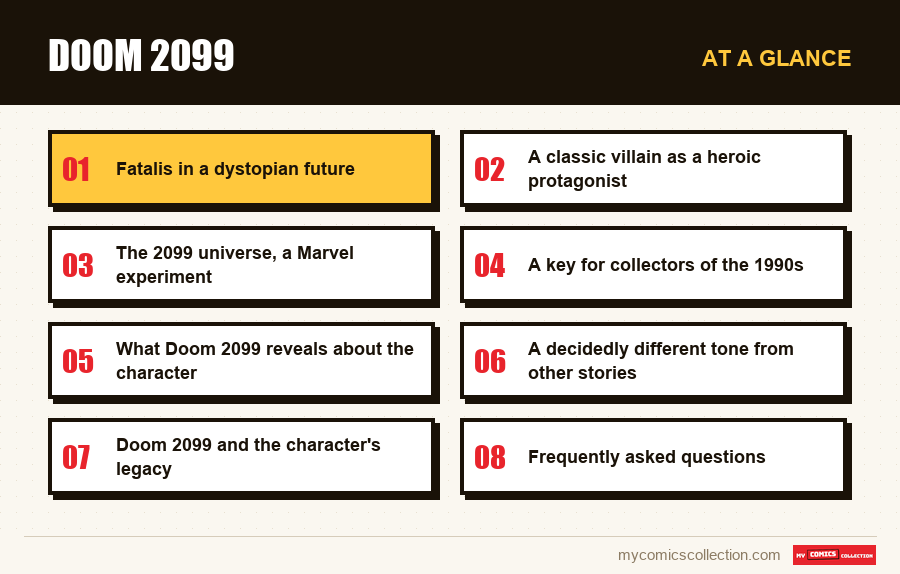
Fatalis in a dystopian future
Doom 2099, a series launched in 1993, transposes Doctor Doom into a dystopian cyberpunk future, within the Marvel 2099 editorial line. This universe imagined the world of Marvel several decades in the future, dominated by sprawling megacorporations, marked by inequalities and governed by omnipresent technology. In this context, Doom reappears, claiming to be the real Victor Von Doom from the past, and discovers Latveria fallen into ruin and under the control of a corrupt regime. His mission: to reconquer his kingdom and restore it. This series offers a new vision of the character, confronted with a world radically different from the one he knew, where he must reaffirm his authority and his identity.
Doom 2099 is distinguished by its resolutely cyberpunk tone, mixing unleashed technology, social dystopia and political intrigue. The character of Fatalis finds there a framework conducive to the expression of his talents: monarch, strategist and genius, he evolves in a universe of power and manipulation. The series explores his quest to reconquer Latveria and assert his rule in an unrecognizable world. This futuristic transposition, far from distorting the character, reveals its versatility: Fatalis works as well in the present as in a dystopian future. For the reader, Doom 2099 offers an original exploration of the monarch of Latveria, in a context that highlights his qualities as a leader and conqueror.
A classic villain as a heroic protagonist
The great singularity of Doom 2099 is to make a classic villain the protagonist of a series, presented in an almost heroic light. Unlike most 2099 titles, which featured new characters, Doom 2099 relies on a version of an established figure, Doctor Doom. In this series, the character, while retaining his pride and ambition, appears as a figure of resistance in the face of a corrupt world, fighting to restore his Latveria and a certain order. This ambiguous position (a classic villain acting as a determined leader, even savior of his people) offers a fascinating exploration of the complexity of the character, capable of taking on varied roles.
This representation of Fatalis as a protagonist illuminates an essential dimension of the character: his ability to be perceived as a legitimate leader, convinced of acting for the good of his kingdom. Doom 2099 exploits this ambiguity, presenting a Doom who, despite his methods, poses as a restorer of order in the face of dystopian chaos. This approach reminds us that the character is never a simple villain: he is a monarch with complex motivations, whose vision of power can make him appear as an antagonist or as a figure of resistance depending on the context. For the reader, Doom 2099 offers a glimpse of this versatility, presenting Doom in an unusual light. The Fatalis Hub brings together our guides to explore the many facets of the Latverian monarch.
The 2099 universe, a Marvel experiment
Doom 2099 is part of the Marvel 2099 universe, an editorial experiment from the 1990s which imagined the future of the characters and the Marvel universe. This line offered a cyberpunk and dystopian vision, reinventing certain classic concepts in a futuristic setting. Marvel 2099 included several titles, exploring future versions of heroes and concepts, in a world marked by technology and megacorporations. Doom 2099, with its protagonist derived from a classic villain, held a special place within this line. This experiment illustrates Marvel's desire, at the time, to explore new narrative territories and reinvent its universe in new contexts.
This experimental dimension gives Doom 2099 a particular interest. The series bears witness to a creative period where Marvel dared to imagine the future of its universe, with cyberpunk aesthetics and themes. For the collector, the 2099 titles constitute a little-known but interesting part of the publisher's history, of which Doom 2099 is one of the most notable because of its protagonist. This series illustrates the flexibility of the character of Doom, capable of functioning in a setting so far removed from his original universe. For the reader, Doom 2099 offers a gateway to this futuristic universe, through a familiar character. The Doom Hub brings together our guides to explore the different incarnations of the Latverian monarch across eras and universes.
A key for collectors of the 1990s
For the collector, Doom 2099 has the interest of being a 1990s series linked to Doctor Doom. The first issue, in particular, marks the launch of this unique series and is sought after by fans of the character wishing to cover his different incarnations. Comics from the 1990s, generally printed in large numbers, remain accessible, which makes Doom 2099 an affordable target. This accessibility makes it an interesting acquisition to complete a collection dedicated to Doom, documenting its futuristic version. The series illustrates the diversity of stories dedicated to the character, from the Silver Age to the cyberpunk future, offering collectors a wide range of issues to discover.
This accessibility makes Doom 2099 an attractive option for deepening a Doom collection without a major investment. The series documents an original side of the character, complementing the great classic keys with a futuristic incarnation. For the collector, bringing together the different versions of Doom (the classic villain, the modern anti-hero, the futuristic protagonist) constitutes a coherent and rewarding approach, illustrating the richness of the character. As with any comic from the 1990s, the condition of the copies determines their value, but their availability remains good. As Avengers: Doomsday approaches, interest in all incarnations of Doom is renewed, which could benefit Doom 2099. The Doom hub brings together our guides to explore these different versions and build a complete collection of the monarch of Latveria.
Collecting this series?
Track what you own, what you are missing and what your collection is worth. 7 day trial.
Start my trial →What Doom 2099 reveals about the character
Beyond its futuristic setting, Doom 2099 reveals an essential truth about Doctor Doom: his ability to adapt and assert his authority in any context. Whether he evolves in the present or in a dystopian future, Doom remains true to himself: a determined monarch, a calculating strategist, a leader convinced of his legitimacy. This constancy, across different eras and universes, illustrates the solidity and coherence of the character. Doom 2099 shows that Doom is defined not by his era, but by his inner nature: his ambition, his hubris, his sense of power. This dimension enriches the understanding of the character, emphasizing his timelessness.
This timelessness makes Fatalis a character of rare richness, capable of functioning in all contexts. Doom 2099 is a demonstration of this, presenting a recognizable Latverian monarch despite the futuristic setting. This versatility explains the longevity and enduring appeal of the character, who has been able to be reinvented from countless angles without losing his essence. For the reader, Doom 2099 offers a glimpse of this adaptability, through an original incarnation of Doom. As Avengers: Doomsday approaches, this timelessness serves as a reminder that the character can be worn in varied contexts while remaining true to himself. The monarch of Latveria, from the Silver Age to the cyberpunk future, remains a figure of exceptional consistency and richness. The Fatalis hub brings together our guides to explore this wealth.
A decidedly different tone from other stories
Doom 2099 stands out from other Doom stories by its resolutely cyberpunk and dystopian tone. Where the character's classic stories take place in the present day of the Marvel Universe, Doom 2099 plunges into a dark future, marked by omnipresent technology, glaring inequality and the power of megacorporations. This setting gives the series a unique atmosphere, mixing the codes of dystopian science fiction with the mythology of Doom. The character evolves in an unrecognizable world, which offers a striking contrast with his usual stories. This originality of yours makes Doom 2099 a series apart in the bibliography of the monarch of Latveria.
This particular tone reflects the spirit of the 1990s, a decade during which cyberpunk science fiction was very successful. Doom 2099 is part of this trend, applying the codes of the genre to an established character. This meeting between cyberpunk and Fatalis produces an original work, which explores the monarch of Latveria from a new angle. For the reader, this dystopian tone offers a different experience, far from the classic stories of the character. It illustrates Doom's ability to operate in varied universes, from the Silver Age to the cyberpunk future, without losing its essence. This diversity of tones and contexts testifies to the richness of the character and his adaptability. The Fatalis hub brings together our guides to explore these different incarnations.
Doom 2099 and the character's legacy
Doom 2099 contributes to the rich and varied legacy of Doctor Doom, adding a futuristic incarnation to the long list of his depictions. The character, who appeared in 1962, has spanned the decades, being reinvented in multiple forms: the classic villain, the tragic monarch, the modern anti-hero, and the futuristic protagonist of Doom 2099. This diversity illustrates the longevity and enduring appeal of the character, capable of inspiring stories in all registers and all eras. Doom 2099, as a cyberpunk version, holds a special place in this legacy, testifying to the flexibility and timelessness of the Latverian monarch.
This wealth of incarnations makes Doom one of the most versatile characters in the Marvel Universe. Each version sheds different light, revealing a facet of the character while retaining his essence. Doom 2099 illustrates this capacity for reinvention, by transposing Fatalis into a dystopian future without distorting it. For the reader, this diversity is a wealth, offering multiple entry points to the character. Heading into Avengers: Doomsday, where Doom is treated as a central threat, this versatility serves as a reminder that the character can be explored from countless angles. Doom 2099, with its futuristic vision, is one such original exploration, contributing to the rich and varied mythology of the Latverian monarch. The Fatalis hub brings together our guides to discover all these facets.
It should be noted that entrusting the leading role to a version of a villain as established as Doom constituted, at the time, a daring editorial choice, testifying to the confidence placed in the character's potential to carry his own adventures, even in a setting so far removed from his original universe. This singularity contributes to the lasting interest of the series.
Frequently asked questions
A series launched in 1993, in the Marvel 2099 line, which transposes Doctor Doom into a dystopian cyberpunk future. The character reappears there decades later to reconquer his Latveria which has fallen into ruin. This is a rare 2099 title featuring a protagonist derived from a classic villain.
He is presented in an almost heroic light: while retaining his pride and ambition, he appears as a figure of resistance in the face of a corrupt world, fighting to restore his Latveria. This ambiguous position illustrates the complexity of the character.
An editorial experiment from the 1990s imagining the future of the Marvel universe, in a cyberpunk and dystopian setting dominated by megacorporations. It included several titles reimagining classic concepts, of which Doom 2099 is one of the most notable.
Yes: comics from the 1990s, generally printed in large numbers, remain accessible. The first issue, marking the launch of the series, is sought after by fans wishing to cover the different incarnations of Doom, at an affordable cost.
His ability to adapt and assert his authority in any context. Whether in the present or a dystopian future, Doom remains true to himself: a determined monarch and strategist. This timelessness illustrates the coherence and richness of the character.
Want to collect incarnations of Doom? Estimate the value for free of your numbers (Doom 2099…) with our tool based on current eBay listings.