The announcement of Avengers: Doomsday illustrates a phenomenon well known to collectors: the “movie bump”, this increase in interest in comics about a character brought to the screen. We explain how this mechanism works to Doctor Doom: what events trigger it, why it is unequal depending on the numbers, and how to approach it lucidly, without giving in to speculation.
Casting, trailer, release: each stage of a film can move the comics market. How does the announcement of Doomsday affect the Doom comics? Decryption of the phenomenon.
As always in this guide, only verified information is stated; the analysis is ours. Nothing here constitutes financial advice: the value of a comic depends on the market and can vary up or down.
The “movie bump”, a well-known phenomenon
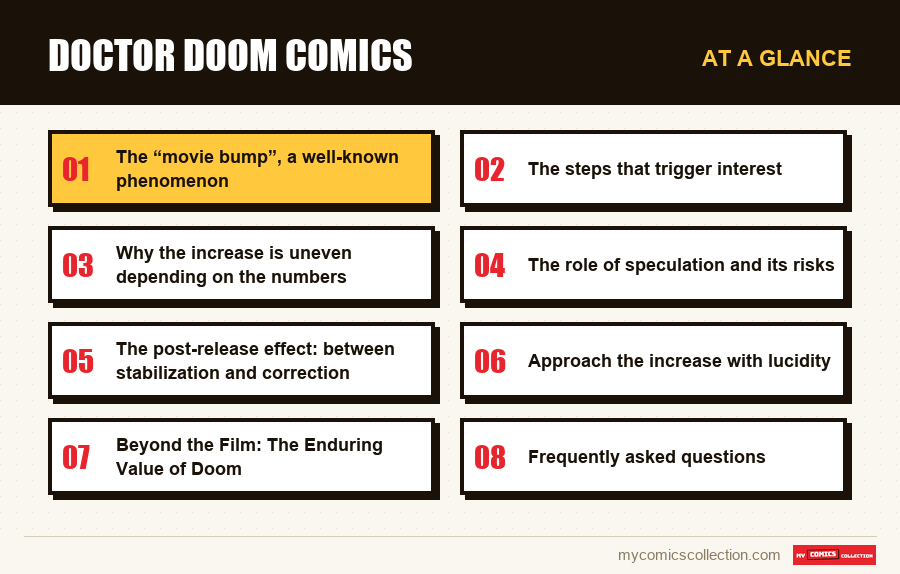
The collectible comics market is sensitive to cinematic news. When a character is announced in the cinema, his comics, in particular his first appearances, often experience a resurgence of interest, a phenomenon that English-speaking collectors call the "movie bump". This dynamic is based on a simple logic: the exposure of a character on screen attracts new buyers, who seek to acquire the significant issues of his story, which increases demand. The announcement of Avengers: Doomsday, with Doctor Doom as the big bad, places the monarch of Latveria in exactly this situation. Understanding this mechanism is essential to approach the news of Doom with lucidity, distinguishing the passing craze from the lasting value of a comic.
This movie bump phenomenon, however, is in no way automatic or guaranteed. Although it reflects a frequently observed trend, it remains subject to numerous factors and may prove ephemeral. The interest generated by an announcement does not always translate into a lasting increase, and market movements can reverse. For the collector, the main thing is to understand that the movie bump is a dynamic of demand, not an economic law: it creates a context, but does not guarantee any result. This lucidity is the best protection against excess enthusiasm, allowing you to approach the news of Fatalis with discernment. The Fatalis hub brings together our guides to explore the character and his collection.
The steps that trigger interest
The movement of interest linked to a film is not triggered all at once, but in stages, at the pace of current events. The first step is the announcement of the project and the casting: when a film and its big villain are confirmed, attention immediately shifts to the character. For Fatalis, the announcement of Avengers: Doomsday and its interpreter constituted this first trigger. The following stages (first trailer, posters, then release of the film) periodically revive interest, each media highlight attracting new eyes to the character's comics. This tiered dynamic explains why interest in Doom could experience several waves between now and the film's release, depending on announcements and revelations.
Understanding these stages allows us to better understand the temporality of the phenomenon. Interest tends to grow closer to release, often peaking around the film itself, before stabilizing. For the collector, this understanding of the calendar is valuable: it illuminates the moments when attention is most intensely focused on the character. However, this temporality remains unpredictable, and no one can anticipate with certainty the magnitude or duration of each wave of interest. The main thing is to understand that the news of Doomsday will punctuate the attention paid to Doom, in successive stages, without any increase being assured. This knowledge helps to approach the phenomenon with perspective and method. The Fatalis hub brings together our guides to follow the latest news about the character.
Why the increase is uneven depending on the numbers
An essential aspect of movie bump is that it does not affect all comics in the same way. Interest traditionally focuses on key issues, particularly the character's first appearance-for Doom, Fantastic Four #5 (1962). These founding comics, rare and emblematic, capture most of the demand, because they represent essential collector's items. Conversely, more current issues or reissues hardly benefit from this enthusiasm, their abundance limiting any effect of scarcity. This inequality is fundamental: the movie bump does not uniformly show all the comics of a character, but focuses on the most significant and rarest pieces.
This concentration of interest on key numbers has practical implications. A collector attentive to the dynamics of Doomsday will logically concentrate on the most striking Doom comics, those which capture demand. Our dedicated guide to the key issues of Doctor Doom details these parts precisely. For the collector, understanding this inequality is essential: it avoids believing that all Doom comics will benefit from the film, and refocuses attention on the pieces that really matter. This understanding allows us to approach the phenomenon with discernment, distinguishing those comics likely to attract attention from those which will remain common. This nuance is at the heart of a lucid approach to movie bump. The Fatalis hub brings together our guides to identifying key character numbers.
The role of speculation and its risks
The movie bump is often accompanied by a phenomenon of speculation. Anticipating an increase, some buyers rush to the comics of a character advertised in the cinema, in the hope of realizing a capital gain. This speculation can temporarily amplify market movements, driving interest beyond what would be justified by collectible value alone. But it carries significant risks: prices inflated by speculation can correct themselves, particularly after the release of the film, when the enthusiasm subsides. For the collector, this speculative dimension is a signal of caution: buying in a hurry, at the height of the craze, exposes one to disappointment if the market turns around.
Understanding speculative risk is essential to approaching movie bump wisely. Speculation can create temporary bubbles, where enthusiasm overrides reason, before a correction. The wise collector is careful not to give in to this haste, preferring to base his choices on knowledge and passion rather than on the hope of a quick gain. This prudence protects against market excesses and the disappointments that can follow a peak of enthusiasm. To approach the news of Fatalis with lucidity, the essential thing is not to get carried away by speculation, but to collect with method and discernment. This measured approach is the best way to ride out the waves of Doomsday-related interest without undue risk. The Fatalis hub brings together our guides to collecting methodically.
Collecting this series?
Track what you own, what you are missing and what your collection is worth. 7 day trial.
Start my trial →The post-release effect: between stabilization and correction
An important feature of the movie bump is what happens after the movie is released. Interest, often at its peak around the release, then tends to stabilize or even fall once the media hype has passed. Comics that have experienced a speculative rise can then see their value correct, while truly rare and significant issues generally retain their interest better in the long term. This post-release phase is revealing: it distinguishes lasting movements from temporary outbursts. For the collector, understanding this effect is essential, because it illuminates the difference between the real value of a comic and the temporary excitement associated with a film.
This post-release dimension invites patience and perspective. A collector who understands this cycle knows that the Doomsday craze will peak, then level off, and that current excitement should not be confused with lasting value. The pieces that stand the test of time are those based on real rarity and historical significance, such as the first appearance of Doom. To approach the phenomenon with lucidity, the essential thing is to think in the long term, favoring the intrinsic value of comics rather than temporary agitation. This perspective allows you to collect with peace of mind, without being destabilized by market fluctuations linked to current cinema events. The Fatalis hub brings together our guides for a thoughtful approach to collecting.
Approach the increase with lucidity
Faced with the phenomenon of movie bump linked to Doomsday, the best attitude is lucidity. Understanding that the craze is real but uncertain, that it focuses on key numbers, that it involves an element of speculation and that it can correct itself after the release, allows us to approach the news of Fatalis with discernment. The wise collector does not rush, does not speculate blindly, and bases his choices on knowledge of the comics and their real value. To evaluate this value rigorously, it is better to rely on real sales data than on intuition or the excitement of the moment. This fact-based approach is the best protection against market excesses.
This lucidity makes all the difference between a thoughtful collection and risky speculation. The Doomsday movie bump is an opportunity to discover or deepen the character of Doom, provided you approach it methodically and with perspective. By understanding the mechanisms of the phenomenon, the collector can benefit from the attention paid to the monarch of Latveria without suffering its excesses. The key is to keep a cool head, prioritize passion and knowledge, and consider value as just one aspect of the collection. This balanced approach allows us to weather the wave of interest linked to Doomsday with serenity, making collecting a lasting pleasure rather than an uncertain gamble. The Fatalis hub brings together our guides to knowingly collect the character.
Beyond the Film: The Enduring Value of Doom
If the Doomsday movie bump focuses attention in the short term, we must not forget that the value of Doom comics rests above all on lasting fundamentals. The first appearance of the monarch of Latveria, his status as one of Marvel's greatest villains, his historical importance in the Fantastic Four universe: so many elements which establish the interest of his comics independently of any film. These fundamentals existed before Avengers: Doomsday was announced and will continue after its release. For the collector, it is this lasting value which must take precedence: a key Doom comic is sought after for its intrinsic importance, which is occasionally reinforced by cinematographic news, but which does not depend on it.
This long-term perspective is essential to approach the phenomenon wisely. Film acts as a spotlight, but the pieces that truly stand the test of time are those based on solid rarity and historical significance. Fatalis, a major and enduring Marvel character, has such fundamentals: his interest will not die out with the end of the craze around Doomsday. For the collector, understanding this distinction between the fleeting effect of the film and the lasting value of the character is the key to a thoughtful approach. It invites us to collect Fatalis for what he is: one of the greatest villains in comics -, considering the movie bump as a simple revealer, not as the basis of his value. The Fatalis hub brings together our guides to explore the character and his importance.
Frequently asked questions
It's the increase in interest in a character's comics when they are brought to the screen. The exhibition attracts new buyers to its landmark issues, which increases demand. The announcement of Avengers: Doomsday places Doctor Doom in exactly this situation.
No. Interest focuses on key issues, especially the first appearance (Fantastic Four #5, 1962). Current issues and reissues hardly benefit from the craze, their abundance limiting any effect of scarcity. The increase is uneven according to the comics.
Interest is triggered in stages: announcement and casting, trailer, then release of the film. It tends to grow closer to release, often peaking around the film, before stabilizing. This temporality, however, remains unpredictable.
Caution is required. Speculation can temporarily inflate prices, which are likely to correct after release. It is better to collect out of passion and knowledge, based on real sales data, than to rush to the height of the craze.
Interest, often at its peak around the release, then tends to stabilize or decline. Comics that have experienced a speculative rise can correct themselves, while truly rare and significant issues maintain their interest better in the long term.
Want to know the real value of your Doom comics? Estimate it for free with our tool based on current eBay listings.