Investing in Doctor Doom comics in 2026: the release of Avengers: Doomsday, with Doom as the big bad, acts as a powerful catalyst for demand. Key numbers (first appearance, origins) and well-graded copies (CGC grades) are the most sought after. We explain the logic of this dynamic and the guidelines for collecting methodically, without promising a return.
Avengers: Doomsday shines the spotlight on Doctor Doom, and with it demand from collectors. How to approach investing in your comics in 2026? Decryption.
As always in this guide, only verified information is stated; the analysis is ours. Nothing here constitutes financial advice: the value of a comic depends on the market, condition and rarity, and may vary.
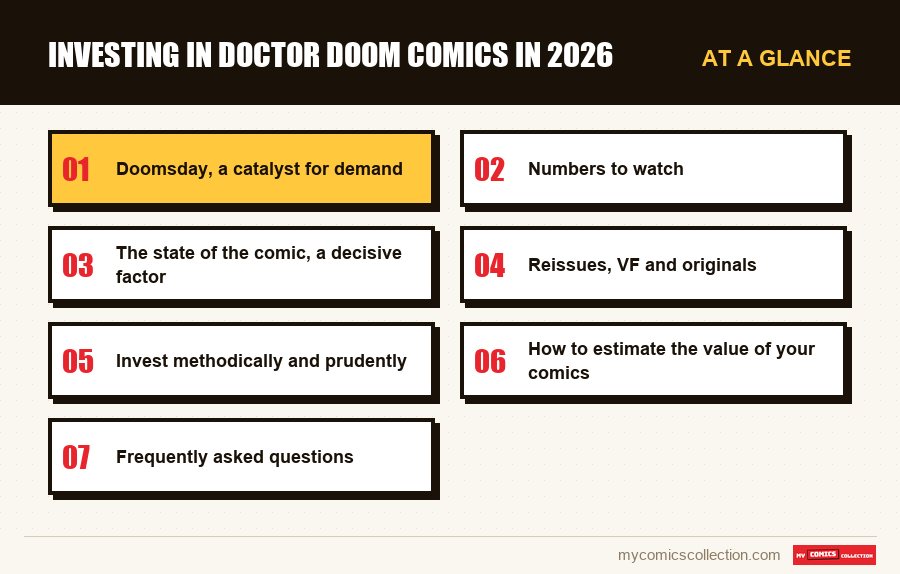
Doomsday, a catalyst for demand
The logic behind the interest in Doom comics in 2026 is clear: the announcement of Avengers: Doomsday, with the monarch of Latveria as the big bad, puts the character in the spotlight. Historically, the exhibition of a character in the cinema is accompanied by a renewed interest on the part of collectors, who seek to acquire the significant issues of his history. This dynamic, observed numerous times for other characters, tends to concentrate demand on key comics, particularly the first appearances. Doom, one of Marvel's most iconic villains, thus benefits from a favorable context, where the film's media attention could support interest in its comics. This exposure constitutes the main catalyst for demand in 2026.
This catalytic dynamic, however, deserves to be understood with nuance. The attention generated by a film does not guarantee any change in value: it creates a context of interest, but the market remains subject to many factors, including the condition of the copies, their rarity and the evolution of demand. For the collector, the main thing is to understand that Doomsday acts as a spotlight on Doom, likely to attract new buyers to his comics. This exhibition is an opportunity to discover or deepen the character, but it calls for caution: investing in comics requires a thoughtful approach, based on knowledge and not on the sole anticipation of an increase. The Fatalis hub brings together our guides to explore the character and his editorial history.
Numbers to watch
At the heart of any interest in Doom comics are its key issues, those that mark major milestones in its history. The character's first appearance, in Fantastic Four #5 (1962), is the most iconic and sought-after comic: it's where Doom makes his debut, making him a centerpiece for any collector. Issues exploring his origins, such as Fantastic Four Annual #2 (1964), are also popular, as they shed light on the character's genesis. These seminal comics traditionally attract most of the attention and demand, due to their historical importance and their rarity, particularly in good states of preservation.
Beyond these founding issues, other significant comics can arouse interest, in particular those linked to major sagas of the character, such as Secret Wars. For a detailed exploration of these numbers and their importance, our dedicated guide to the key issues of Doctor Doom is a comprehensive resource. The main thing for the collector is to understand that the value is concentrated on the significant comics, those which tell the decisive stages of the story of Doom. These issues, especially the first appearance, are the most likely to garner attention in the context of Doomsday. Identifying these key comics is the first step in a thoughtful approach to collecting. The Fatalis hub brings together our guides to delve deeper into each of these issues.
The state of the comic, a decisive factor
An essential factor determines the value of a comic: its state of conservation. The same number can be worth very differently depending on whether it is damaged or in excellent condition. This is why the rating system, or grading, plays a central role in the market. Specialized organizations, like the CGC, rate a comic's condition on a precise scale and seal it in a protective case, guaranteeing its grade. The examples graded in the highest conditions are the most sought after and the most valued, because they offer a guarantee of quality and preservation. For the collector, understanding the importance of condition is fundamental: a key comic in excellent graded condition does not have the same value as a damaged copy.
This importance of the state has concrete implications for investment. A copy of Fantastic Four #5 in good condition, graded by a recognized organization, represents a much more valuable piece than a damaged copy. Grading provides valuable transparency and security, by objectifying the state of the comic. For the collector, favoring examples in good condition, ideally graded, is a prudent approach, which protects the value of the collection. This dimension is even more important for key numbers, where the difference in value between states can be considerable. Understanding the role of grading and condition is therefore essential to approach investing in Doom comics with method and discernment. The Fatalis hub brings together our guides to explore these aspects of the collection.
Reissues, VF and originals
An important point for the collector is the distinction between original editions and reissues. Early American editions of key issues, like Fantastic Four #5 (1962), are the most sought after and valued, due to their rarity and historical authenticity. Reissues, reprints and later editions, although allowing the stories to be read at a lower cost, do not have the same collectible value. Likewise, the French editions (VF) follow their own market logic, distinct from that of the American originals. Understanding these distinctions is essential to avoid confusion and approach the collection with discernment: not all copies of the same story have the same value.
This distinction between editions has direct consequences on an investment approach. A collector looking for value will favor first editions of key issues, knowing that these are rare and demanding. Reissues and completes, on the other hand, are ideal for discovering the stories without aiming for collector's value. For the reader, the main thing is to know what to buy and why: to read or to collect. This clarity allows us to approach the Fatalis comics market methodically, distinguishing between collector's items and reading editions. This understanding is an essential prerequisite for any thoughtful approach to investing, in the context of interest created by Doomsday. The Doom hub brings together our guides to explore the character's editorial history.
Collecting this series?
Track what you own, what you are missing and what your collection is worth. 7 day trial.
Start my trial →Invest methodically and prudently
Approaching investing in comics requires method and prudence. Unlike a traditional financial investment, the value of a comic depends on multiple and uncertain factors: condition, rarity, changes in demand, market fluctuations. No increase is guaranteed, and the exposure of a character to the cinema, although it creates a favorable context, does not automatically translate into a valuation. For the collector, prudence consists of collecting firstly through passion and knowledge, favoring pieces that one understands and appreciates. Diversifying, asking about condition, verifying authenticity and avoiding impulse purchases are all essential principles. Investing in comics must remain a considered approach, never blind speculation.
This cautious approach is all the more important in the context of a catalyst like Doomsday. Excitement about a film can lead to market movements, but also disappointments for those who buy indiscriminately. The wise collector keeps a cool head, bases his choices on knowledge of key numbers and their condition, and considers passion as the primary driving force behind his approach. To calmly approach investing in Doom comics, the main thing is to be informed, to understand the market and to act methodically. This prudence protects the collector and makes collecting a lasting pleasure, regardless of the vagaries of value. The Fatalis hub brings together our guides to knowingly collect the character.
How to estimate the value of your comics
To approach investing methodically, knowing the real value of your comics is essential. Rather than relying on rough estimates, it is better to rely on concrete market data from actual sales. This is precisely what an estimation tool based on actual sales allows: by relying on recent transactions, it offers an evaluation anchored in market reality, much more reliable than a simple intuition. For the collector, this data-driven approach is the best way to approach the value of their Doom comics, avoiding both overestimations and underestimations. Knowing the real value of your collection is an essential prerequisite for any thoughtful investment approach.
This estimation approach based on concrete data is particularly relevant in the context of Doomsday. As interest in Doom grows, having a reliable valuation of its comics allows you to make informed decisions, whether to buy, sell or simply know the value of your collection. For the collector, this tool is a valuable resource, which provides transparency and method. By relying on actual sales, it offers a solid basis for approaching investment in Doom comics in 2026, in a context where the exposure of the character is generating renewed interest. Estimating with rigor means giving yourself the means to collect with discernment and serenity. The Fatalis hub brings together our guides to explore the character's collection.
Ultimately, approaching investment in Doom comics in 2026 requires combining several reflexes: identifying key issues, favoring good condition and grading, distinguishing originals and reissues, remaining cautious in the face of craze, and relying on estimates based on actual sales. The context of Doomsday creates an opportunity for interest, but never dispenses with method. For the collector, the best approach remains to combine passion and rigor: collecting what you like, while informing yourself about the value and the market. This balanced approach is the key to a fulfilling and thoughtful collection, capable of navigating the ups and downs of value without ever losing sight of the pleasure of owning the comics of a character as emblematic as the monarch of Latveria.
Frequently asked questions
The exhibition of the character in cinema creates a favorable context of interest, but nothing guarantees an increase in value: the market depends on condition, rarity and demand. It is better to collect through passion and knowledge, with method and prudence, than to speculate on anticipation.
The character's first appearance, in Fantastic Four #5 (1962), is the most iconic piece. Issues exploring its origins, such as Fantastic Four Annual #2 (1964), are also popular. The value focuses on the significant comics of its history, especially in good condition.
Because the same number can be worth very differently depending on its state. Grading, carried out by organizations like the CGC, evaluates the condition on a precise scale and seals the comic. Copies in the highest states are the most sought after and the most valued.
Much less than the original editions. The first American editions of key issues are the most valued, due to their rarity. Reissues and unabridged versions are ideal for reading the stories, but do not have the same collectible value as the originals.
By relying on concrete market data, derived from actual sales, rather than rough estimates. Our free estimation tool, based on current eBay listings, offers an evaluation anchored in market reality, reliable and transparent.
Want to know the value of your Doom comics? Estimate their value for free with our tool based on current eBay listings.