God Emperor Doom is the most powerful version of Doctor Doom never depicted in comics. In Secret Wars (2015) by Jonathan Hickman and Esad Ribić, Fatalis reconstructs reality after its destruction and becomes the all-powerful god, reigning over Battleworld. We explore this demiurgic incarnation, a probable prefiguration of the Fatalis of Avengers: Doomsday.
After decades of coveting absolute power, Doom finally achieves it: he becomes a god. God Emperor Doom is the character's ultimate achievement, and one of his most fascinating interpretations. Decryption.
As always in this guide, only verified information (creators, numbers, dates) is stated; the analysis is ours, without reproduction of plates or protected dialogue.
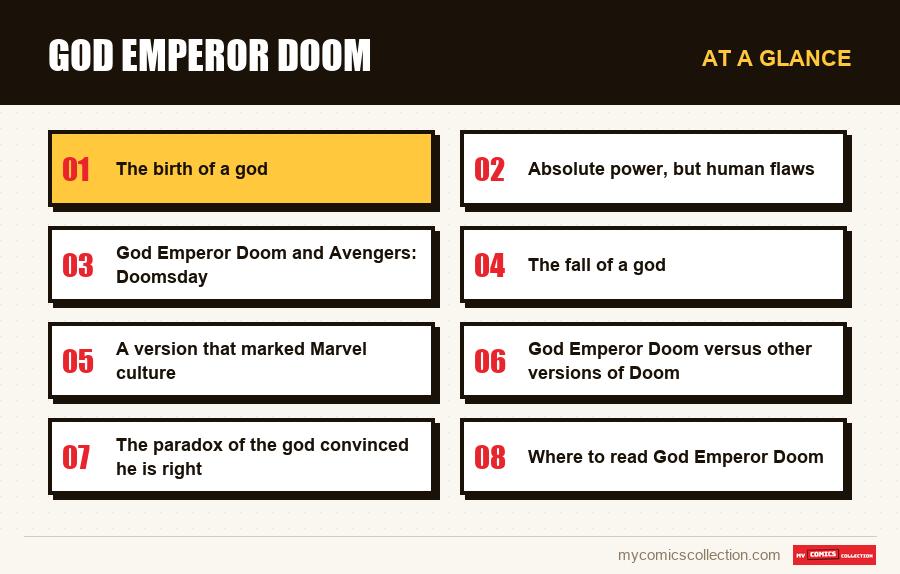
The birth of a god
God Emperor Doom appears in Secret Wars (2015), the event miniseries by Jonathan Hickman and Esad Ribić. In this saga, the Marvel Universe is destroyed following the "Incursions", the destructive collision of parallel realities. From this nothingness, Doctor Doom manages to recover immense cosmic power and rebuild a world from the fragments of vanished realities. He shapes Battleworld, a patchwork planet, and proclaims himself its absolute god: the God Emperor Doom. Dressed in white, revered by the inhabitants of his world, Doom thus realizes his deepest dream: not to conquer a kingdom or a universe, but to become the master of reality itself.
This divine ascension represents the ultimate accomplishment of a character defined by his limitless ambition. Since his first appearance in 1962, Doom has continued to aim ever higher: the throne of Latveria, the power of the Silver Surfer, the power of the Beyonder. God Emperor Doom is the culmination of this quest. Hickman offers a profound exploration of this divine Fatalis, which questions the very nature of absolute power. What happens to a man whose ambition no longer has any boundaries? The saga reveals a Doom who is both triumphant and prisoner of his own creation, a tragic figure despite his omnipotence. This complexity makes God Emperor Doom one of the richest incarnations of the character.
Absolute power, but human flaws
What makes God Emperor Doom fascinating is that his omnipotence does not free him from his flaws. Despite his divine status, Doom remains haunted by his eternal rivalry with Reed Richards, whose shadow hangs over his reign. He remains obsessed with the need to prove his superiority, unable to let go of his pride. The saga reveals that even as a god, Doom cannot escape his deep nature. He has built a world in his image, but this world reflects his own torments: a reign based on control and fear, where the slightest questioning threatens the building. God Emperor Doom is thus a profoundly human god, consumed by the same obsessions that have always defined him.
This exploration of the limits of absolute power gives God Emperor Doom remarkable depth. Hickman does not just show a triumphant Doom: he questions the price of his victory. In realizing his dream, Doom finds himself confronted with the emptiness of his quest: total control does not fill the gap that gnaws at him. This tragic dimension elevates the character well beyond the simple villain. For the reader, God Emperor Doom illustrates what makes Doom so fascinating: a being of prodigious intelligence and will, but trapped in his own hubris, unable to find peace even at the top. This psychological complexity is one of the reasons why the character inspires creators so much, on paper and in cinema.
God Emperor Doom and Avengers: Doomsday
This demiurgic version of Doom is particularly relevant as we approach Avengers: Doomsday. The film places Doom at the center of the story, played by Robert Downey Jr., in a cinematic context marked by the multiverse and its divergent realities. God Emperor Doom, master of a patchwork world bringing together variants from multiple realities, offers an ideal narrative model for such a film. It would explain the presence of characters from different franchises and realities, under the authority of a Fatalis capable of reshaping existence. The concept, ambitious and spectacular, corresponds to the scale of an event film.
For the viewer, understanding God Emperor Doom allows them to anticipate what Fatalis could become on screen: no longer a classic antagonist, but a cosmic force dominating reality. This version of the character, the pinnacle of the modern mythology of Doom, embodies the scope that Marvel seems to want to give to its new great villain. She reminds us that Doom, in the comics, has no equal in terms of ambition and potential power. Discovering God Emperor Doom before the film is to appreciate the importance of the arrival of the monarch of Latveria at the center of the Marvel cinematographic universe. The Fatalis hub brings together all our guides to explore the multiple facets of this exceptional character.
The fall of a god
God Emperor Doom's reign, as absolute as it is, is not eternal. Throughout Secret Wars (2015), survivors of the destroyed universe end up threatening its authority, revealing the flaws in its creation. The final confrontation pits Doom against Reed Richards, his eternal rival, in a clash that goes beyond a simple power struggle to touch on a fundamental question: who, Doom or Reed, was more worthy of wielding such power? This confrontation, the dramatic climax of the saga, highlights the deep nature of Doom. Despite his divinity, he remains defined by his obsessive relationship with Reed, unable to free himself from it even at the height of his power.
The fall of God Emperor Doom is rich in meaning. She reveals that absolute power, far from satisfying Fatalis, has only amplified his obsessions and his limits. In a moment of remarkable depth, the saga suggests that Doom himself recognizes, deep down, Reed's superiority in certain areas: a shocking admission for a character defined by his hubris. This conclusion elevates God Emperor Doom to the rank of tragedy: that of a man who, having obtained everything, discovers that it is not enough to appease his demons. For the reader, this ending gives the character a Shakespearean dimension, that of a being of immense greatness but eaten away by an irreparable flaw. It is this complexity that makes God Emperor Doom one of the most accomplished interpretations of Doom.
Collecting this series?
Track what you own, what you are missing and what your collection is worth. 7 day trial.
Start my trial →A version that marked Marvel culture
God Emperor Doom has had a profound impact on the modern perception of Doctor Doom. By showing him at the absolute peak of his power, finally realizing his dream of total control, the saga offered a definitive picture of the character's ambition. This version has become a reference, cited as the ultimate example of what Doom can become when nothing stops it. She cemented her status as Marvel's supreme villain, capable of rivaling the biggest cosmic threats. The iconography of God Emperor Doom, with his robe and divine aura, has become iconic, illustrating the grandeur and excess of the character.
This cultural imprint explains why God Emperor Doom is so often mentioned in the run-up to Avengers: Doomsday. He represents the character's maximum potential, the scale to which Marvel might want to bring him to the screen. By embodying the culmination of Doom's ambition, this version crystallizes what makes the character so fascinating: a genius whose will knows no limits, capable of becoming a god. For the viewer, God Emperor Doom is a key to understanding the cinematic Fatalis to come. He reminds us that the monarch of Latveria is not an antagonist like the others, but a figure whose ambition can redefine the entire reality. This version, the pinnacle of the modern mythology of the character, embodies everything that makes Doom an exceptional villain. The Fatalis hub brings together our guides to explore its multiple facets.
God Emperor Doom versus other versions of Doom
God Emperor Doom stands out from the many other incarnations of Doctor Doom by its unparalleled scale. The classic Doom, as he appears in Fantastic Four, is an ambitious monarch and genius, but whose power remains, despite everything, on a human or national scale. Doom 2099's Doom is a futuristic ruler fighting in a cyberpunk world. Infamous Iron Man's Doom seeks redemption by donning the armor of a hero. God Emperor Doom transcends all these versions: he is no longer a man seeking power, but a god holding it. This difference in scale makes it the summit of the character's mythology, the point where his ambition reaches its absolute limit.
This comparison illuminates the singularity of God Emperor Doom. Where other versions show Doom on a quest, struggling to achieve his goals, God Emperor Doom shows him having achieved everything, and facing the consequences of that victory. This unique position makes it the most revealing version of the character's psychology: it is by observing Doom at the top that we best understand his obsessions and his flaws. For the reader, measuring the gap between God Emperor Doom and the other incarnations is to grasp the full amplitude of a character capable of being a medieval monarch as well as a cosmic god. This exceptional versatility explains the longevity and richness of Fatalis, and why it inspires creators so much. Heading into Avengers: Doomsday, God Emperor Doom embodies the maximum potential the character could unleash on screen, a threat of unparalleled magnitude in the Marvel Universe.
The paradox of the god convinced he is right
An essential aspect of God Emperor Doom is his unwavering belief in acting for good. Unlike a tyrant who assumes his cruelty, Doom, even having become a god, remains convinced that his reign is legitimate and beneficial. In his eyes, the world he created is better, more ordered, more just than the chaos that preceded it. This sincerity makes the character all the more disturbing: he does not see himself as a despot, but as a savior. This paradox, a being whose tyranny stems from misguided idealism, is at the heart of what makes Doom fascinating, and God Emperor Doom offers its most accomplished expression.
This complex moral dimension distinguishes God Emperor Doom from classic villains. His certainty of being right, even at the height of his power, questions the boundary between savior and tyrant, between order and oppression. For the reader, it offers a profound reflection on power and its justifications. As Avengers: Doomsday approaches, this facet of the character suggests a nuanced cinematic Fatalis, whose actions, as terrible as they are, would come from a sincere conviction. It's this ambiguity that could make him one of the most memorable antagonists in the Marvel Universe on film.
Where to read God Emperor Doom
- The saga: Secret Wars #1-9 (2015) by Jonathan Hickman and Esad Ribić, available as a collection.
- The context: Hickman's Avengers/New Avengers run (the "Incursions").
- To situate the world: our article dedicated to Battleworld.
- Visual side: Esad Ribić's boards make this version one of the most majestic of the character.
Frequently asked questions
The most powerful version of Doctor Doom, appearing in Secret Wars (2015) by Jonathan Hickman and Esad Ribić. After the destruction of the Marvel Universe, Doom rebuilds reality and becomes the all-powerful god, reigning over Battleworld, the "God Emperor Doom".
During the "incursions" which destroy the multiverse, Doom manages to seize immense cosmic power and rebuild a world, Battleworld, from the fragments of vanished realities. He proclaims himself the absolute god, realizing his dream of total control over reality.
Almost: he has almost unlimited powers on Battleworld. But the saga reveals that his omnipotence does not free him from his faults: he remains haunted by his rivalry with Reed Richards and by his pride. God Emperor Doom is a deeply human and tragic god.
The studio hasn't detailed the plot, but this demiurgic version fits the scale of Avengers: Doomsday and the theme of the multiverse. It offers an ideal model for a Doom reshaping reality and bringing together characters from different realities.
In Secret Wars #1-9 (2015) by Jonathan Hickman and Esad Ribić, available in collection. Hickman's Avengers/New Avengers run sheds light on the context of the "incursions" that lead to this saga. Also check out our article on Battleworld.
Want to collect Secret Wars? Estimate the value for free of your numbers with our tool based on current eBay listings.