
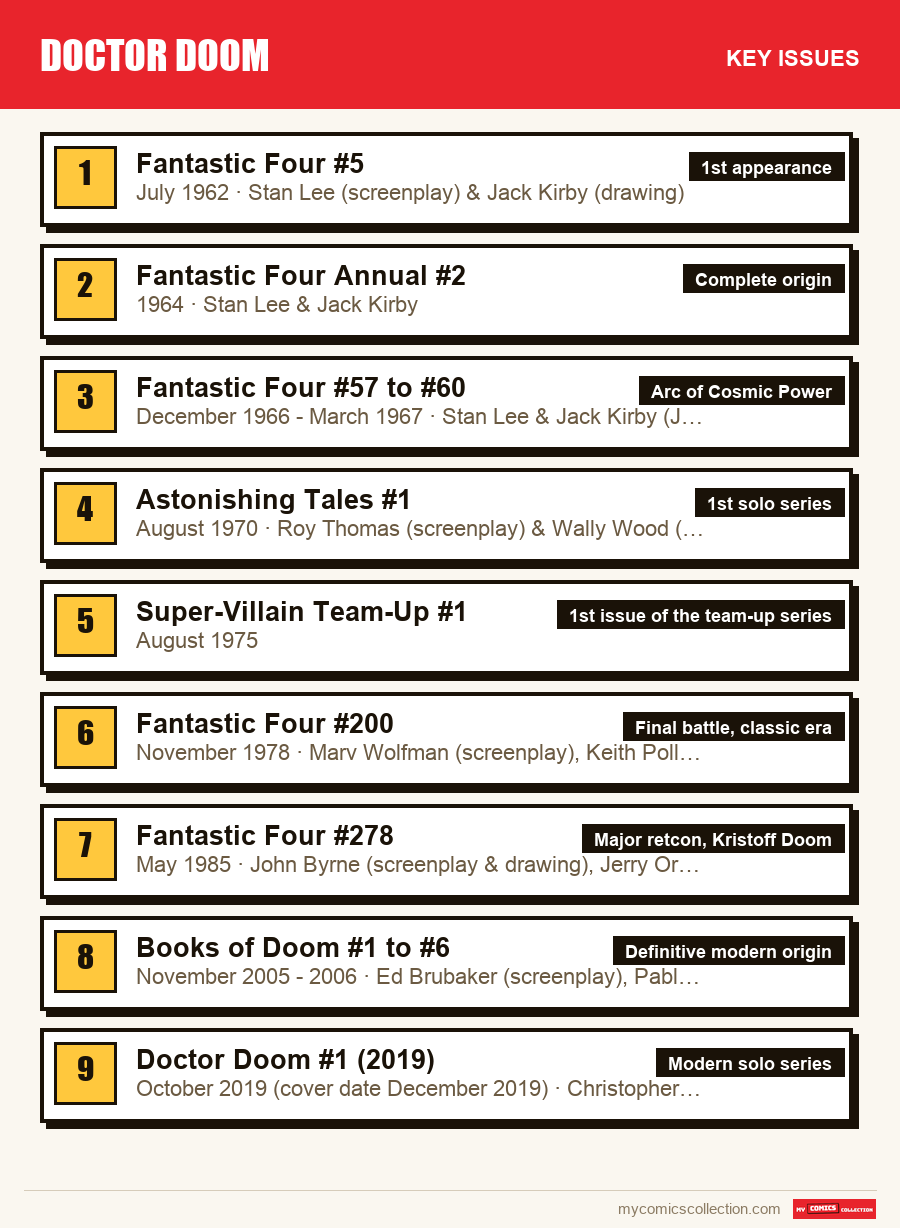
The absolute key number of Doctor Doom is Fantastic Four #5 (July 1962, Stan Lee & Jack Kirby), his very first appearance, which reached $180,000 in NM-9.2 at a September 2022 auction. Fantastic Four Annual #2 (1964, complete origin of the character), Fantastic Four #57-60 (1966-67, theft of the Silver Surfer's cosmic power) and Astonishing Tales #1 (1970, debut of his solo series). With the arrival of Robert Downey Jr. in the role for Avengers: Doomsday (December 2026), demand for first appearances has increased significantly since 2025.
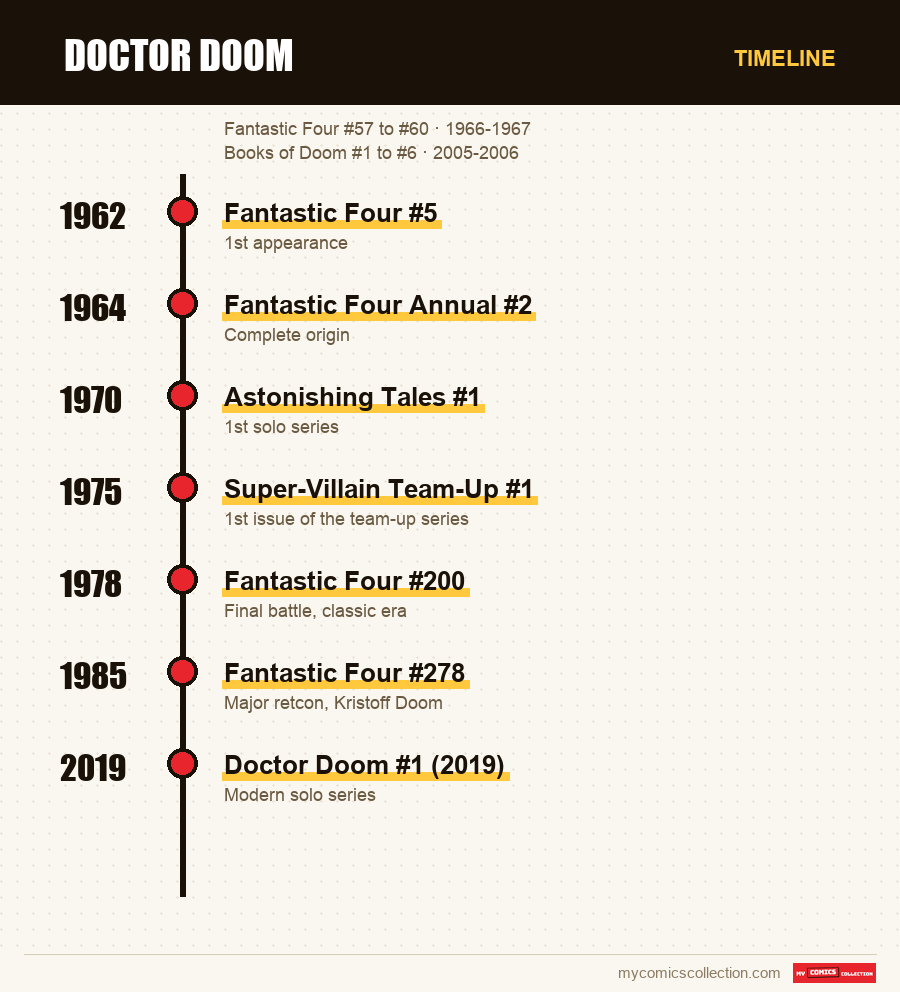
Few Marvel villains have a bibliography as dense and as structured as that of Victor Von Doom. Unlike secondary antagonists who appeared a handful of times before disappearing from the radar, Doctor Doom has benefited from almost continuous editorial treatment since 1962: first notable appearance, origin developed two years later, major cosmic arc in the 1960s, solo series in the 1970s, recurring team-up, spectacular return at the end of the 1970s, controversial retcon by John Byrne in 1985, modern reinterpretation by Ed Brubaker in 2005, then contemporary solo series in 2019. Each of these milestones has a precise editorial value and, for collectors, a well-identified "key" status on the market.
This guide lists the truly determining numbers in the character's history, with verified publication facts (dates, writers, designers) and the truly documented market elements (record sales, known print runs, rarity ratings) without ever inventing a figure. If you are looking for a complete narrative reading of the character, from the Latverian gypsy turned dictator-monarch to the eternal rival of Reed Richards, our article story of Doctor Doom in comics retraces this story in detail; Here, the angle is strictly collection: what numbers to own, why, and in what condition to look for them.
Doctor Doom in Marvel editorial history: a villain built over time
Doctor Doom is born in Fantastic Four #5 (cover date July 1962), barely a year after the creation of the title by Stan Lee and Jack Kirby. From this first story, entitled "Prisoners of Doctor Doom!", Kirby establishes a design that has hardly changed in more than sixty years: metal mask, green hooded cape, armored gauntlets. It is this immediately recognizable silhouette, associated with a scenario that immediately establishes Doom as a former university friend of Reed Richards who became a tyrant gifted with technological genius and occult knowledge, which made this character one of the rare Marvel villains to rival the heroes themselves in popularity.
What sets Doom apart from other Silver Age antagonists is the speed with which the publisher invested in its narrative development. Just two years after its first appearance, Fantastic Four Annual #2 (1964) provides a complete origin: Roma childhood in Latveria, healer father hunted by the local king, exile in the mountains, university studies alongside Reed Richards, failed experience which disfigures him, expulsion, initiation by Tibetan monks, then hasty manufacture of the armor which definitively seals his features. This founding story, popularized over the long term, would only be revisited in depth twenty years later by John Byrne, then revisited in 2005 by Ed Brubaker in Books of Doom.
The decade 1966-1967 marked a second editorial peak with the arc of cosmic power (Fantastic Four #57-60), followed in 1970 by a rare event for a villain of this era: the obtaining of a shared solo series in Astonishing Tales. Few Marvel "big bads" of the 1960s and 70s were entitled to their own regular feature: it's a strong signal of the place that Doom already occupied in the readers' imagination. The end of the 1970s closed a cycle with Fantastic Four #200, presented by critics as the last great Doom/Reed confrontation of the classic era, before John Byrne completely revived the character in the mid-1980s.
Fantastic Four #5
The absolute holy grail of any Doctor Doom collection. Kirby drew for the first time the metal mask and the green cape which have hardly changed since. The story "Prisoners of Doctor Doom!" establishes the Reed Richards / Victor Von Doom / academic rivalry triangle which structures the entire mythology of the character. It's also the very first Marvel cover to feature him.
Fantastic Four Annual #2
Two years after his first appearance, Marvel devoted an entire annual issue to Doom to recount his childhood in Latveria, the death of his mother, the persecution of his father Werner (of whom this is the very first appearance), his university career alongside Reed, the accident which disfigured him and his initiation by Tibetan monks before the manufacture of his armor. It is the story of canonical origin that all subsequent versions (Byrne in 1985, Brubaker in 2005) will complete or recontextualize.
Fantastic Four #57 to #60
Doom lures the Silver Surfer to his Latverian castle under the pretext of studying his powers, then drains him of his Cosmic Power using induction armor. He then seizes the Surfer's board and sows destruction on a global scale before the Fantastic Four manage to defeat him. This is the first time that Doom reaches a level of power capable, according to the narrative, of challenging Galactus himself-a peak of Kirby directorialism widely cited as one of the greatest Doom arcs of the entire Silver Age.
Astonishing Tales #1
Marvel is launching a shared title between Ka-Zar and Doctor Doom, each benefiting from a ten-page story. The Doom featurette, "Unto You Is Born... The Doomsman!", features Prince Rudolfo attempting to reclaim the throne of Latveria while Doom crushes his rebellion. Rare for the time: few Marvel villains of the 1960s and 70s were entitled to a regular series in their name, a sign of the already established popularity of the character.
Super-Villain Team-Up #1
Doom joins forces with Namor the Sub-Mariner in a funeral series dedicated to their duo, taking up intrigues left unanswered in Namor's solo title (notably the fate of the Atlanteans plunged into a coma). This alliance of circumstance, which will not be resolved until issue #13, confirms Doom's ability to carry a title as a main character rather than a simple recurring antagonist of the Fantastic Four.
Fantastic Four #200
Considered the last great Doom/Reed Richards confrontation of the classic era. Reed faces Doom one-on-one in his Adirondack fortress while the rest of the team attempts to foil his plan for world domination before the United Nations. The duel ends with one of the most memorable moments of the character's career: Reed tears off Doom's mask, who finds himself confronted with dozens of reflections of his own disfigured face in a crystal: his own vanity plunges him into a catatonic state. A 48-page special with one of the most famous Kirby covers of the title.
Fantastic Four #278
John Byrne completely revisits the origin of the character through an original narrative device: Doom's ward, Kristoff Vernard, relives the memories of Victor presumed dead and in turn takes on the armor and identity of Doctor Doom. It is also in this rereading that Byrne specifies the true cause of Doom's scar (the mask on while still hot, rather than the explosion itself): a detail which will become reference for all subsequent adaptations, including cinema. The consequences of this manipulation by Kristoff will be felt continuously for almost a decade.
Books of Doom #1 to #6
This six-part mini-series covers the entire journey of Victor Von Doom, from his childhood to his accession to the throne of Latveria, entirely told by Doom himself to a journalist, except that the witnesses to the events deliver a version very different from his. Considered the most successful and most cited rewriting of the character's origin since Fantastic Four Annual #2, it today serves as a reference for most late adaptations, including certain narrative choices taken up in the cinema.
Doctor Doom #1 (2019)
First issue of the last regular solo series dedicated to the character before his elevation to the rank of Sorcerer Supreme in Marvel continuity. Entitled "Pottersville", this launch is part of a period where the publisher has multiplied titles centered on Doom, confirming its status as a character capable of carrying a series alone rather than remaining confined to the role of antagonist of the Fantastic Four.
Collecting this series?
Track what you own, what you are missing and what your collection is worth. 7 day trial.
Start my trial →The impact of adaptations on the rating
Doctor Doom has long been absent from the MCU as a full-fledged villain, appearing only in the Fantastic Four trilogies of 2005, 2007 and in the aborted reboot of 2015. The situation changed radically with the announcement of the casting of Robert Downey Jr. in the role for Avengers: Doomsday, which is scheduled for release on December 18, 2026 by directors Anthony and Joe Russo. The film brings together on the same battlefield the Avengers, the Wakandans and the New Avengers from Earth-616, the Fantastic Four from an alternate Earth (828) and the original X-Men from a separate universe, all facing the existential threat of Doctor Doom.
This announcement had a measurable and documented effect on the collectible market: auction houses reported a significant increase in sales of collectibles. Fantastic Four #5, including on examples in low and medium grades, driven by the rediscovered cultural relevance of the character. The current record remains the $180,000 sale of an NM-9.2 copy in September 2022, but market observers raise the possibility that a CGC 9.8 copy could reach between $250,000 and $300,000 if such a grade were to be offered at auction before or after the release of the film. On the editorial side, Marvel is supporting the movement with releases timed to the cinema calendar, notably the ten-issue event mini-series Doomquest by Ryan North, launched in 2026, in which Doctor Doom travels through the history of the Marvel universe to try to rewrite time to his advantage.
For a collector, this context has two practical consequences. First, first appearance and original issues (FF #5, FF Annual #2) historically constitute the assets most sensitive to this type of cinema ad: their relative rarity and their "first time" status make them natural targets for new buyers attracted by the film. Then, the pivotal issues of the mythology (FF #278 for the retcon of the scar, Books of Doom for the modern origin) benefit from a renewed secondary interest, readers curious to understand the character before his cinema version seeking to read these reference stories. If you already have one or more of these numbers, now is the time to check their state of conservation precisely: the difference between a grade 9.0 and a grade 9.8 can represent a considerable difference in value, a subject that we detail in our comparison CGC grade 9 vs 9.8.
Buying guide
Building a coherent Doctor Doom collection requires prioritizing certain criteria specific to the character rather than randomly purchasing issues bearing his name on the cover. Here are the points to be aware of before any purchase:
- Prioritize the first appearance above everything else. Fantastic Four #5 is the foundation of any serious collection dedicated to the character; the other numbers gain interest once this key piece is acquired, even in a modest grade.
- Distinguish between first appearance and first appearance in final costume. Kirby's design in FF #5 is already almost final, but always check the sales descriptions which sometimes mix "first mention" and "first appearance in panel" for secondary characters linked to Doom (like Werner von Doom in FF Annual #2 or Kristoff in FF #278).
- Systematically check the authenticity of Bronze Age and Copper Age covers. Issues like Astonishing Tales #1 or Super-Villain Team-Up #1 exist in newsstand editions and regional variants (including the Canadian variant for FF #278): the price can vary significantly depending on the exact edition.
- Do not neglect modern collections to complete the reading. Books of Doom and Doctor Doom (2019) are widely available in trade paperback format, an economical option for reading these arcs without investing in the individual periodicals if your goal is reading rather than pure collecting.
- Anticipate the volatility linked to the cinema calendar. As the release of Avengers: Doomsday approaches in December 2026, prices for first appearance issues have already started to move; a thoughtful purchase before the peak of post-release media can make a significant difference to the budget.
- Have your most valuable copies certified. For FF #5 and FF Annual #2 in particular, CGC or CBCS certification secures the transaction and facilitates future resale, especially in a context of growing demand.
- Check the character's history before purchasing complex continuity numbers. Arcs like the Byrne retcon (FF #278-279) or the Kristoff period require a minimum of narrative context to appreciate their collectible value; our article story of Doctor Doom in comics retraces all of these events in chronological order.
To methodically organize a collection as extensive as that of Doctor Doom, more than six decades of publications spread across dozens of titles, the use of a structured tracking tool makes a real difference. OUR comics collection application allows you to catalog each issue, track its rank and estimate its value over time without having to manually recompile spreadsheets. Also find all the stories and notable appearances of the character on his dedicated Doctor Doom page.