Fantastic Four #5 (July 1962), Stan Lee and Jack Kirby , mark it first appearance of Doctor Doom. This founding issue of the Silver Age lays all the foundations of the character (mask, armor, Latveria, rivalry with Reed Richards) and is among the most sought-after Marvel keys, especially as we approach Avengers: Doomsday. We decipher this crucial number.
No issue is more important to a Doctor Doom collector than Fantastic Four #5. Origin of the character, key to the Silver Age, investment target: complete decryption of this founding number.
As always in this guide, only verified information (creators, numbers, dates) is stated; the analysis is ours, without reproduction of plates or protected dialogue.
Fantastic Four #5: the founding issue
Fantastic Four #5, published in July 1962, is the issue that introduced Doctor Doom to the Marvel Universe. Created by Stan Lee and Jack Kirby, this issue is one of the very first in the Fantastic Four series, launched the previous year. The story, titled in its original version after the villain's name, presents Doom as an immediately formidable adversary: a masked genius dressed in armor, he captures the Fantastic Four and sends them to face perils throughout time. From this first appearance, the essential elements of the character are established: the iron mask, the armor, the superior intelligence, the excessive ambition and the hatred towards Reed Richards. Fatalis immediately establishes himself as an enemy worthy of the heroes, which is rare for a first appearance.
This issue occupies a momentous place in Marvel history. It not only introduces the publisher's greatest villain, but also participates in the construction of the emerging Marvel universe, at a time when Stan Lee and Jack Kirby were laying the foundations of an entire mythology. Fantastic Four #5 illustrates the creative genius of this duo, capable of designing in a few pages a character of exceptional richness and longevity. For the collector, this issue is a fundamental key to the Silver Age, marking the debut of a figure destined to dominate the Marvel Universe for more than six decades, until his arrival at the forefront of cinema in Avengers: Doomsday.
What Fantastic Four #5 Establishes About the Character
From his first appearance, Doom appears endowed with all the attributes that will make him legendary. The iron mask and the armor, immediately iconic, hide a face that the character refuses to show, a symbol of his pride and his wounded dignity. His intelligence is presented as exceptional, on par with that of Reed Richards, whose rival he is. His ambition has no limits: he does not only seek to defeat the Fantastic Four, but to assert his absolute superiority. The issue also establishes his taste for elaborate schemes, sending the heroes through time on an adventure that feels like an intellectual challenge. All these elements, present since 1962, will be enriched over the decades without ever being denied.
This consistency from the first appearance explains the longevity of Doom. Unlike many characters who evolve radically after their debut, Doom is essentially complete by Fantastic Four #5: later stories will add his origins, his Latveria, his mastery of magic, but the essence is already there. This founding solidity makes this issue an essential document for understanding the character. For the reader, discovering Fatalis in his first appearance means grasping what, from the beginning, made him an exceptional villain: an adversary equal to the heroes, endowed with a rare aura and depth. Fantastic Four #5 is not just a first appearance: it is the birth certificate of a legend, whose importance only grows with his arrival in cinema.
A major key to the Silver Age
For collectors, Fantastic Four #5 is one of the most sought-after keys to the Silver Age, the boom period of comics that spanned the 1950s to the 1970s. As the first appearance of Doctor Doom, it is among the most coveted issues of the Marvel Universe, alongside other great first appearances of the era. Its relative rarity in good condition, its age and its historical importance make it a prized piece, whose price reaches new heights for the best preserved examples. This major key status reflects the importance of the character it introduces, Marvel's greatest villain.
The value of Fantastic Four #5 varies considerably depending on the condition of the copy, a determining criterion for any old comic. Examples in excellent condition, especially those rated by grading services, fetch high prices, while more damaged examples remain more accessible. As with any Silver Age key, gradation plays a central role in the estimate, and reliance on actual recent sales is essential before any purchase. This issue represents a significant investment for the collector, worthy of its historical importance. Our dedicated guides in the Fatalis hub detail the rating and acquisition strategies for this fundamental key, the appeal of which is reinforced by the character's cinematic news.
Why its rating could climb with Avengers: Doomsday
The arrival of Doctor Doom to the forefront of cinema, in Avengers: Doomsday, has direct implications for the rating of Fantastic Four #5. Experience shows that the value of first appearance numbers tends to increase when the character concerned is highlighted on screen, driven by media enthusiasm and the influx of new collectors. With Doom going from an enemy of the Fantastic Four to the central threat of the Marvel Cinematic Universe, the attention paid to his first appearance can only grow. Fantastic Four #5 thus appears to be a prime target for collectors anticipating this craze.
This dynamic makes the period preceding the film's release a strategic moment. Acquiring Fantastic Four #5 before the general public's attention is massively focused on Doom may prove wise for the savvy collector. That being said, caution remains in order: the value of a number always depends on its condition and its gradation, and major keys reach heights that reserve them for a substantial budget. Examples in average condition offer more accessible entry points. For the collector, Fantastic Four #5 combines historical importance, rarity and potential linked to current cinematographic events, which makes it an exceptional piece. The Fatalis hub brings together our guides to support you in this acquisition and identify the other keys to the character.
Collecting this series?
Track what you own, what you are missing and what your collection is worth. 7 day trial.
Start my trial →Other keys to know after Fantastic Four #5
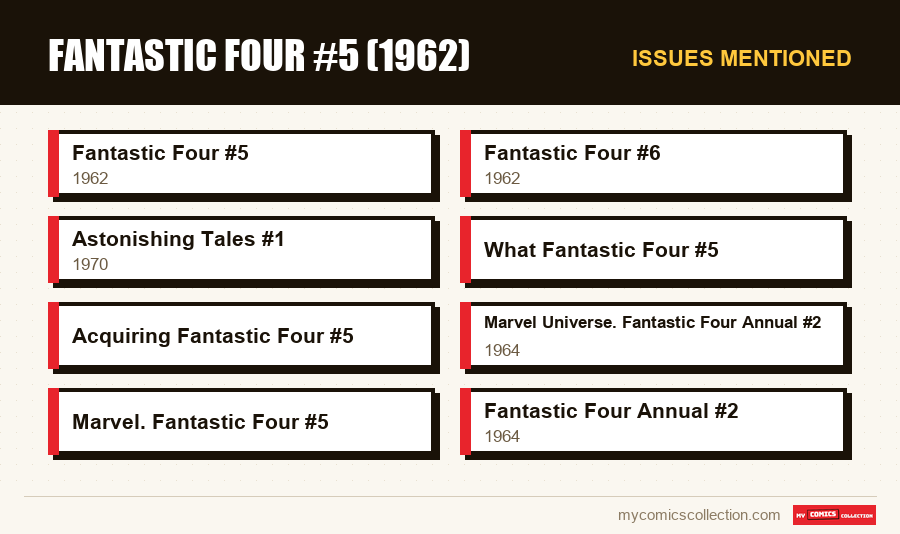
Fantastic Four #5 is the absolute key to Doctor Doom, but other issues complete a collection dedicated to the character. Fantastic Four #6 (1962) features the first team-up between Doom and Namor, marking the first alliance of villains in the Marvel Universe. Fantastic Four Annual #2 (1964) details the origins of Victor Von Doom, revealing his childhood in Latveria and the accident that disfigured him. Astonishing Tales #1 (1970) marks the start of his first solo series. These issues, running from the Silver Age to the Bronze Age, offer complementary targets to deepen a Fatalis collection, each bringing an essential piece to the character's story.
Also note, for more modest budgets, the existence of reissues and completes allowing you to read these founding stories without acquiring the originals: they offer an affordable entry point to the story of Fatalis, while waiting, possibly, to invest in period issues. It's a judicious approach to discovering the character before the film, combining the pleasure of reading and gradually building up a collection.
These secondary keys have the advantage of often being more accessible than Fantastic Four #5, while retaining real historical importance. They make it possible to build a coherent collection around the monarch of Latveria, covering the founding moments of his journey: his first appearance, his first alliance, his origins, his first series. For the collector, aiming for these issues after Fantastic Four #5 is a logical approach, which reflects the evolution of the character in the comics. Each of these keys sees its interest reinforced by the arrival of Fatalis in the cinema. Our dedicated guides in the Fatalis hub detail the rating and potential of each, to help you build a collection worthy of Marvel's greatest villain.
Recognizing an authentic Fantastic Four #5
For the collector, distinguishing an original copy of Fantastic Four #5 from the numerous reissues is essential. The original 1962 issue can be recognized by several elements: its period cover price, its editorial indications, its paper quality characteristic of the Silver Age and the period advertisements which accompany it. Over the decades, this issue has been subject to reissues and reproductions, intended to make the story accessible without the cost of an original. These versions, although they allow you to discover the story, do not have the collector's value of the original edition. Vigilance is therefore required, particularly for copies sold as originals.
This attention to authenticity is even more important the higher the value of Fantastic Four #5. To secure a purchase, the use of professional grading services is strongly recommended: they authenticate the copy, assess its condition and protect it, providing a valuable guarantee for a piece of this importance. A graded example offers peace of mind and a more established resale value. For the collector, investing in such a major key requires surrounding oneself with guarantees and relying on real recent sales to assess the right price. These precautions, essential for any Silver Age key, allow you to calmly acquire one of the most important issues in the Marvel universe. Our guides on gradation, in the Fatalis hub, detail these steps.
Fantastic Four #5 and the Golden Age of Lee-Kirby
Fantastic Four #5 is part of one of the most creative periods in comics history: the collaboration between Stan Lee and Jack Kirby on the Fantastic Four. In the early 1960s, this duo built the foundations of the modern Marvel universe, creating in a few years a gallery of characters and concepts of unparalleled richness. The Fantastic Four series was the laboratory of this revolution, introducing not only Doom, but also many other major figures. Fantastic Four #5, as one of the first issues of this founding series, is part of this creative golden age, where each publication brought its share of innovations.
This historical dimension adds to the importance of the number. To own Fantastic Four #5 is to own a fragment of the birth of the Marvel Universe, a testament to the abundant creativity of Lee and Kirby. The character of Fatalis, conceived in this context of effervescence, illustrates the genius of this duo, capable of creating figures of lasting depth. For the collector, this historical value goes beyond the simple first appearance: it places the issue in the great story of the construction of Marvel. Fantastic Four #5 is thus doubly valuable: as the key to Doctor Doom, and as a milestone in the golden age of Lee-Kirby. This double importance makes it an exceptional piece, whose appeal continues to grow, driven by the character's relevance in the cinema. The Fatalis hub brings together our guides to delve deeper into this story.
Frequently asked questions
Fantastic Four #5, published July 1962, created by Stan Lee and Jack Kirby. This seminal issue of the Silver Age introduces Doctor Doom with all his attributes: iron mask, armor, superior intelligence and rivalry with Reed Richards.
Because this is the first appearance of Doctor Doom, Marvel's greatest villain. As a major Silver Age key, ancient, rare in good condition, and historically significant, it is among the most coveted issues in the Marvel Universe.
Its value varies considerably depending on the condition of the copy. Copies in excellent condition, particularly graded, fetch high prices, while more damaged examples remain more accessible. Supporting real recent sales is essential before any purchase.
It's likely. The value of first appearance numbers tends to increase when the character is highlighted in the cinema. With Doom becoming the central threat in the Marvel Universe, attention to Fantastic Four #5 is expected to grow, making it one to watch.
Fantastic Four #6 (1962, first Fatalis-Namor team-up), Fantastic Four Annual #2 (1964, its origins) and Astonishing Tales #1 (1970, its first solo series). These keys complete a collection dedicated to the character, often more accessible than Fantastic Four #5.
Do you own Fantastic Four #5 or are aiming for this key? Estimate its value for free with our tool based on current eBay listings.