Doctor Doom, Doctor Doom, Doomsday, Avengers: Doomsday: these names are similar but do not designate the same thing. Doctor Doom and Doctor Doom are one and the same character: “Fatalis” is simply the French name for “Doom”, the great Marvel villain. Doomsday is a completely different character: the DC monster who killed Superman. And Avengers: Doomsday is the Marvel movie whose title refers to Doom/Fatalis, not the DC monster. We sort everything out, with a summary table.
Doom, Doom, Doomsday: three similar names, but two distinct characters and a film. Here's how to never confuse them again, once and for all. Decryption.
As always in this guide, only verified information (established elements of characters and publications) is stated; the analysis is ours, without reproduction of plates or protected dialogue.
Doctor Doom and Doctor Doom: one and the same character
Let's start by clearing up the most common confusion: Doctor Doom and Doctor Doom refer to exactly the same character. “Doom” is the original American name (VO), and “Fatalis” is its French translation (VF), long adopted by French-speaking publishers. This is the same monarch of Latveria, Victor Von Doom (Victor Von Doom in original version), the sworn enemy of the Fantastic Four, who first appeared in Fantastic Four #5 (1962). There is therefore no substantive difference between Doctor Doom and Doctor Doom: they are two names, in two languages, for a single Marvel character. This duality of names is the first source of confusion, but it dissipates as soon as we understand that it is a simple question of translation.
This Doom/Fatalis equivalence explains many misunderstandings. A reader accustomed to French comics knows "Doctor Doom", while a viewer of American productions hears "Doctor Doom": both speak of the same masked genius, ruler of Latveria, master of science and magic. The French name, “Fatalis”, evokes the implacable and fatal character of the character, while remaining phonetically close to his VO surname, “Von Doom”. For the French-speaking reader, retaining this equivalence is essential: each time an English-speaking source mentions “Doctor Doom”, it is Doctor Doom, and vice versa. This clarity is the key to calmly approaching the character, whatever the language of the source. The Fatalis hub brings together our guides to explore the Latverian monarch in all its facets.
Doomsday: the DC monster that killed Superman
Let's move on to the character most often confused with Doom, because of the sound proximity of their names: Doomsday. However, Doomsday has absolutely nothing to do with Doctor Doom. He's a character from a completely different universe, that of DC Comics: Marvel's competing publisher. Doomsday is a monstrous creature, a near-indestructible force of destruction, infamous for one major feat: killing Superman. Appearing in 1992, he is the protagonist of the cult saga of “The Death of Superman” (Superman #75, 1993), one of the most resounding events in the history of comics. Doomsday is not a strategic genius like Doom: he is a beast of combat, a Kryptonian monster driven by destructive rage, lacking the cunning and royalty that define the monarch of Latveria.
The difference between Doomsday and Doctor Doom is therefore total, both in substance and in the universe. Doomsday belongs to DC, Doom (Fatalis) to Marvel: two separate publishing houses, two separate mythologies. Doomsday is a monster, Doom a Machiavellian ruler. Doomsday is associated with Superman, Doom with the Fantastic Four. The only thing they share is the sound of their name, which begins with "Doom": an English word meaning "doom" or "perdition", which both publishers used independently. This lexical coincidence is the source of persistent confusion, but it is not based on any real link. For the reader, remembering that Doomsday is a DC monster, killer of Superman, is enough to clearly distinguish him from Doctor Doom. The Doomsday hub brings together our guides to explore this DC creature.
Avengers: Doomsday: the Marvel movie (and the origin of its title)
Third element to unravel: Avengers: Doomsday. Please note, this is not a character, but a film: a feature film from Marvel Cinema (MCU), expected for December 2026, directed by the Russo brothers. And this is where the confusion reaches its peak, because the title “Doomsday” could make one believe in an appearance of the DC monster. This is not the case: Avengers: Doomsday is a Marvel film, and its big bad is Doctor Doom, played by Robert Downey Jr. The word "Doomsday" in the title is a play on words referring to "Doom": that is to say Doom -, and not to the DC creature. The film has nothing to do with Doomsday the Monster: it is a Marvel production centered on the monarch of Latveria.
This choice of title is also clever on the part of Marvel Studios. “Doomsday” literally means “doomsday” in English, an expression evoking an apocalyptic threat: perfect for announcing the arrival of Doctor Doom (Doom) as a unifying big bad. The title plays on the presence of the word “Doom” (the name of the villain) within “Doomsday”, creating a desired resonance. But for the uninformed public, particularly French-speaking, this title may lead to confusion with the DC character of the same name. We must therefore remember a simple rule: Avengers: Doomsday is a Marvel film about Doctor Doom, unrelated to DC's monster Doomsday. This clarification is essential as the film's release approaches. The Fatalis hub brings together our guides to explore the character on screen as well as in the comics.
Summary table
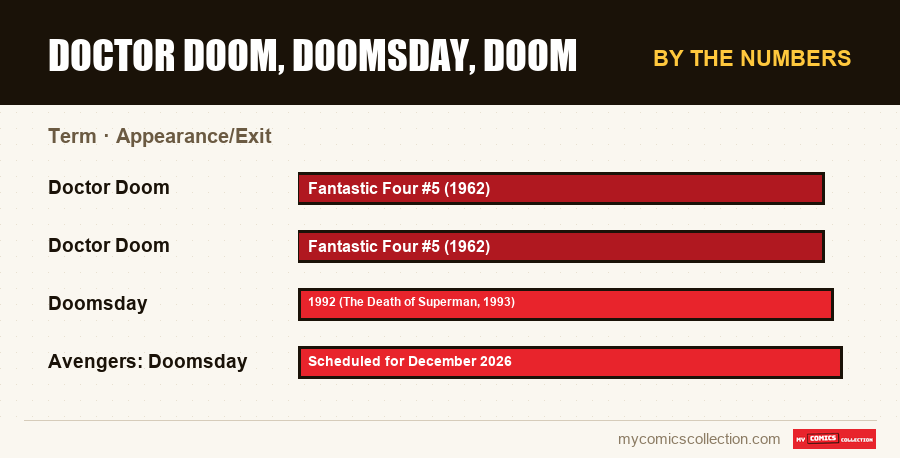
To see clearly at a glance, here is a summary table of the four terms, with what distinguishes them. It summarizes the essentials: two of them (Doom and Doom) refer to the same Marvel character, a third (Doomsday) is an unrelated DC monster, and the last (Avengers: Doomsday) is a Marvel film whose title refers to Doom/Doomsday.
| Term | Universe / Editor | Nature | Appearance/Exit | The key point |
|---|---|---|---|---|
| Doctor Doom | Marvel | Supervillain (character) | Fantastic Four #5 (1962) | Original name of the character:= Doctor Doom |
| Doctor Doom | Marvel | Supervillain (character) | Fantastic Four #5 (1962) | VF (French) name of Doom:same character |
| Doomsday | DC (Marvel competitor) | Kryptonian monster | 1992 (The Death of Superman, 1993) | Superman Killer:no connection with Doom |
| Avengers: Doomsday | Marvel Studios (cinema) | Movie (MCU) | Scheduled for December 2026 | Big Bad = Doom:title referring to Doom, not the DC monster |
This table summarizes the essential: of the four terms, only two distinct characters actually exist: Doctor Doom (Marvel) and Doomsday (DC) -, to which is added a Marvel film dedicated to the first. Retaining these distinctions avoids the most common confusions, especially as the release of Avengers: Doomsday approaches. The Fatalis hub brings together our guides to delve deeper into each of these topics.
Collecting this series?
Track what you own, what you are missing and what your collection is worth. 7 day trial.
Start my trial →Why is this confusion so common?
It's helpful to understand why these names are so often confused. The first reason is sonic proximity: “Doom”, “Doomsday” and even “Fatalis” (by its fatalistic sense) all evoke the idea of fatality and threat. The English word "doom" means "loss", "ruin" or "last judgment", a lexical field that comic book publishers love for their threatening characters. Marvel and DC have independently drawn on this vocabulary: Marvel for “Doctor Doom,” DC for “Doomsday.” This lexical convergence, born by chance, creates a surface resemblance which deceives the non-specialist public. Added to this is the fact that the two characters are major antagonists of their respective universes, which reinforces the erroneous impression that they could be linked.
The second, more recent reason is the title of the film Avengers: Doomsday. By naming a Marvel film whose villain is Doctor Doom (Doom), Marvel Studios has unintentionally revived the confusion with Doomsday, the DC character. A viewer discovering the title might legitimately wonder if the film features Superman's killer monster: which is impossible, since Doomsday belongs to DC. This confusion is further accentuated in French, where "Doctor Doom" (the French name of Doom) does not contain the word "Doom", making the link between the title of the film and the character less obvious for French-speaking audiences. Understanding these confusion mechanisms (sound proximity, common lexical field, ambiguous title) allows us to better distinguish these terms and avoid confusion. The Fatalis hub brings together our guides to explore the character and his news.
How to never confuse them again
To no longer confuse these terms, a few simple guidelines are enough. First, always associate Doom and Doom: they are two names, VO and VF, of the same Marvel character, the monarch of Latveria. Then tie Doomsday to DC and Superman: he's the monster that killed the Man of Steel, with no connection to Marvel. Finally, remember that Avengers: Doomsday is a Marvel movie about Doom, whose title plays on the word "Doom." An effective mnemonic: “Doom = Doom = Marvel; Doomsday = monster = DC; the movie Doomsday = Marvel = Doom”. With these three benchmarks, the confusion is completely dissipated, and we can approach each term with full knowledge of the facts.
These benchmarks are particularly useful in the run-up to Avengers: Doomsday, where the media news will multiply the mentions of these names. Keeping in mind that the film is a Marvel production centered on Doctor Doom, unrelated to the DC monster, the French-speaking public will avoid the most frequent misunderstandings. This clarity also enriches the appreciation of the film and the comics: understanding who Fatalis is, his story and his distinction from Doomsday allows us to better understand the issues of his arrival in the cinema. Far from being a simple detail, this distinction is the basis of a good understanding of these emblematic characters. For the reader as for the spectator, no longer confusing Doom, Doom and Doomsday means giving yourself the means to fully appreciate each of them. The Doom hub brings together our guides to explore the Monarch of Latveria, and the Doomsday hub to discover DC's creature.
Finally, let us note that this confusion, as widespread as it may be, implicitly reveals the richness of comic book universes. That two competing publishers have independently created major antagonists with names evoking inevitability testifies to the power of this imagination of the ultimate threat. Doctor Doom, a masked genius obsessed with power, and Doomsday, a force of pure destruction, each embody a facet of this fascination with great villains. Distinguishing them also means appreciating what each person brings to their universe: cunning and majesty for one, raw and implacable power for the other. Far from being a simple vocabulary exercise, understanding these differences opens the door to two rich mythologies, those of Marvel and DC, and their greatest antagonists.
Frequently asked questions
Yes, exactly the same. “Doom” is the original American name (VO) and “Fatalis” its French translation (VF). It is the same Marvel character: Victor Von Doom, the monarch of Latveria, sworn enemy of the Fantastic Four, appeared in Fantastic Four #5 (1962).
None. Doctor Doom (Fatalis) is a Marvel supervillain, genius and monarch. Doomsday is a monster from DC, the rival publisher, famous for killing Superman in 1992-1993. They belong to two separate universes and only share the sound of their name.
No. Avengers: Doomsday is a Marvel film whose main villain is Doctor Doom, played by Robert Downey Jr. The word "Doomsday" in the title refers to "Doom", not the DC monster Doomsday, which has no connection to Marvel.
Doomsday is a monstrous and almost indestructible creature from DC Comics, appearing in 1992. He is best known for killing Superman in the “Death of Superman” saga (Superman #75, 1993), one of the most significant events in comic book history.
Because of the sound similarity of their names, which both begin with "Doom": an English word evoking doom, which Marvel and DC have used independently. The title of the film Avengers: Doomsday, dedicated to Doom, revives this confusion with the DC character.
Want to collect Doctor Doom or Doomsday comics? Estimate the value for free of your numbers with our tool based on current eBay listings.