Doctor Doom has had several on-screen incarnations before Robert Downey Jr.: from the unreleased 1994 Corman film to the versions of Julian McMahon (2005-2007) and Toby Kebbell (2015), the monarch of Latveria never really convinced. We trace this history of adaptations and why Avengers: Doomsday could finally do it justice.
Few villains have been as poorly served on film as Doctor Doom, despite his status as Marvel's greatest enemy. A look back at his past incarnations and the expectations around the new one. Decryption.
As always in this guide, only verified information (casting, dates, productions) is stated; the analysis is ours, without reproduction of plates or protected dialogue.
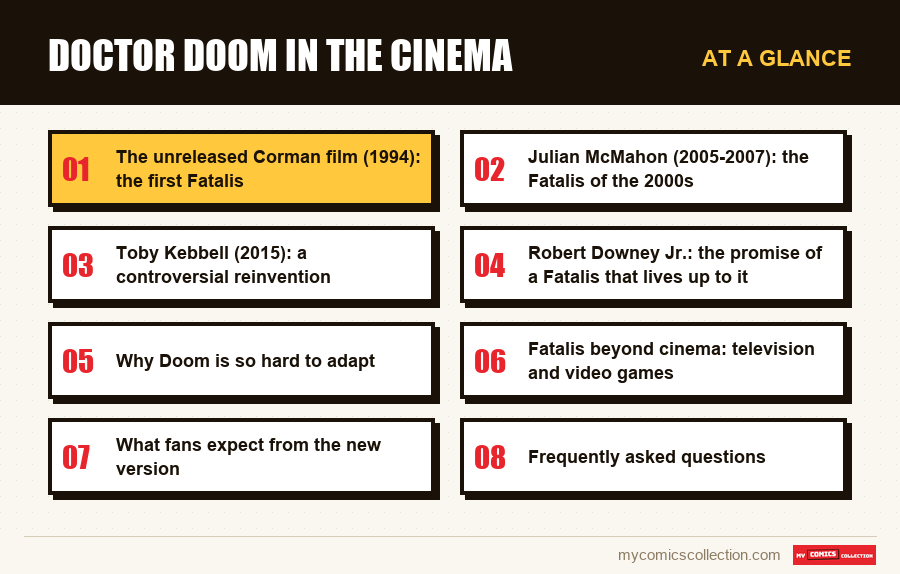
The unreleased Corman film (1994): the first Fatalis
The first appearance of Doctor Doom in the cinema dates back to a film that remained unpublished for a long time: The Fantastic Four, produced by Roger Corman in 1994. Made with a very modest budget, this film was never officially released in theaters, but circulated informally among fans, becoming an object of cult curiosity. Doctor Doom is played by actor Joseph Culp. Despite its limited means and its summary production quality, this film has the merit of being the first to bring the Fantastic Four and their sworn enemy to the screen. It demonstrates the difficulty of adapting this universe with the means of the time, and occupies a unique place in the history of Marvel adaptations.
This Corman film, although never distributed, illustrates the humble beginnings of superhero adaptations in cinema. At a time when the genre had not yet reached its golden age, bringing a character as complex as Doom to the screen was a challenge. The result, tinkered with and mown, is today seen with a certain tenderness by amateurs, as a testimony to another era. It recalls the path traveled since then, up to current productions with colossal means. For the Doom lover, this first essay is a historical curiosity, the very first attempt to bring the monarch of Latveria to life, however imperfect it may be.
Julian McMahon (2005-2007): the Fatalis of the 2000s
The first incarnation of Doctor Doom in a big-budget film was Julian McMahon, in Fantastic Four (2005) and its sequel, Return of the Silver Surfer (2007). In these films, Doom is reinvented as Victor Von Doom, a powerful businessman and rival of Reed Richards, transformed by the same cosmic accident that gives the heroes their powers. This version differs significantly from the comics: Fatalis acquires electrical powers and his armor results from a mutation, far from the scientific and mystical monarch of the comics. This reinterpretation disappointed many readers, attached to the richness of the original character.
This version from the 2000s illustrates the liberties taken by adaptations of the time, which often simplified the characters to make them more accessible. By making Doom a businessman with powers, the films lost the essence of the character: his status as monarch of Latveria, his genius, his mastery of magic, his tragic dignity. Reduced to a more conventional antagonist, McMahon's Doom did not make a lasting impression, despite the presence of the actor. For the reader, this gap illustrates the difficulty of faithfully adapting such a rich character. He reminds us that Doom, in the comics, is much more than a rival with powers: he is a complex figure whose depth had been largely sacrificed in these first big-budget adaptations.
Toby Kebbell (2015): a controversial reinvention
In 2015, a new attempt to adapt the Fantastic Four saw the light of day, with Toby Kebbell in the role of Doctor Doom. This version once again reinvents the character, presented as an antisocial programmer named Victor Domashev, transformed during an expedition into a parallel dimension. The film adopted a darker, more realistic tone, but its tumultuous production and unfavorable reception made it a critical and commercial failure. Kebbell's Fatalis, with his redesigned appearance and motivations, also moves away from the comics version, once again disappointing the expectations of fans of the character.
This 2015 adaptation illustrates the pitfalls of reimagining too far from the original material. By transforming Doom into an unrecognizable character, the film has lost what made the monarch of Latveria rich and attractive. Its failure marked a hiatus in Fantastic Four adaptations, until their recent integration into the Marvel Cinematic Universe. For the reader, this version reinforces the observation that Doom had, until now, been systematically poorly served in the cinema, despite his status as Marvel's greatest villain. Each adaptation seemed to miss the essence of the character, reducing his complexity and greatness. This succession of disappointing attempts explains the immense wait around the new incarnation, which could finally do justice to the character.
Robert Downey Jr.: the promise of a Fatalis that lives up to it
The arrival of Robert Downey Jr. in the role of Doctor Doom, for Avengers: Doomsday under the direction of the Russo brothers, arouses unprecedented anticipation. After disappointing incarnations, the character is finally entrusted to a leading actor, in a production with considerable resources and within the Marvel cinematic universe. This choice signals the studio's desire to treat Fatalis with the seriousness and scope it deserves, placing it as the central threat of the saga. The casting of Downey Jr., the studio's emblematic actor, also plays on the public's memory and on the links between Doom and Iron Man in the comics, adding a strong symbolic dimension.
This new incarnation represents an opportunity to rehabilitate a hitherto ill-adapted character. By relying on a talented performer, an ambitious production and a rich context (the introduction of the Fantastic Four, the challenges of the multiverse) Avengers: Doomsday could finally offer the Fatalis that readers are waiting for: monarch, genius, tragic and complex figure. For the viewer as for the comics lover, this promise is exciting. It marks a turning point in the history of adaptations of the character, after decades of imperfect attempts. Fatalis, long betrayed on screen, could thus achieve the cinematic status that he has always occupied in comics: that of Marvel's greatest villain. The Fatalis hub brings together our guides to rediscover the character as we approach this decisive incarnation.
Collecting this series?
Track what you own, what you are missing and what your collection is worth. 7 day trial.
Start my trial →Why Doom is so hard to adapt
The history of Doom adaptations poses a question: why was this character so difficult to bring to the screen? The answer lies in its very complexity. Fatalis is not a simple villain: he is the monarch of a country, a scientific genius, a master of magic, a tragic figure convinced of acting for a greater good. This richness, which is its strength in comics, is a challenge for adaptations, which attempt to simplify it. To reduce Doom to an antagonist with powers, as previous versions have done, is to betray its essence. The character requires treatment commensurate with his depth, something past adaptations have failed to offer.
This difficulty explains the importance of the new incarnation. Succeeding in Fatalis requires restoring its dignity, its intelligence, its royal dimension and its moral ambiguity: all elements often neglected. Avengers: Doomsday, relying on an ambitious production and a leading actor, finally seems willing to take on this challenge. For the reader, this issue illustrates what makes Fatalis unique: a character of such richness that he resists simplistic adaptations. The monarch of Latveria deserves to be embodied in all his complexity, and the anticipation surrounding the film reflects the hope of finally seeing this wealth honored on screen. Discovering the Fatalis of comics, in our guides, allows you to measure the extent of the challenge and the promise.
Fatalis beyond cinema: television and video games
If the film adaptations of Doom have often disappointed, the character has had other incarnations in various media. On television, particularly in the animated series devoted to the Fantastic Four and other Marvel heroes, Doom has been depicted multiple times, sometimes with more fidelity than in the films. These animated versions made it possible to explore his dimension as a monarch and genius, in formats which left more room for nuance. In video games, Doom regularly appears as an antagonist or playable character, his powers and armor lending themselves well to action. These incarnations, less exposed than the films, helped maintain the character's presence in popular culture.
This multimedia presence illustrates the richness and versatility of Fatalis, capable of operating in very diverse formats. Each medium brings its own interpretation, revealing different facets of the character: his royalty, his genius, his magic, his moral ambiguity. The animated and video game versions, often more faithful to the comics than the films, have sometimes better captured the essence of Fatalis. For the enthusiast, these incarnations offer interesting points of comparison, showing that the character can be adapted well when the format allows it. They also remind us that the potential of Fatalis far exceeds what the cinematographic adaptations had so far offered, reinforcing the wait around a version which would finally do it full justice on the big screen.
What fans expect from the new version
After decades of flawed adaptations, fan expectations surrounding Robert Downey Jr.'s Doom are considerable and specific. Readers hope above all for a version faithful to the essence of the character: a sovereign and respected monarch of Latveria, a genius whose intelligence rivals that of Reed Richards, a master of both science and magic. They also expect his tragic dignity to be preserved, his conviction of acting for a greater good, which distinguishes him from the one-dimensional villain. Finally, the iconography of the character (the mask, the armor, the green cape) is an element that fans want to see respected, as it is inseparable from his identity.
These expectations reflect the importance of Doom for the readership and the disappointment left by previous adaptations. Succeeding in the character requires restoring its complexity and grandeur, without giving in to simplification. The casting of a leading actor, in an ambitious production, gives hope that these expectations will finally be met. For the spectator as for the reader, the stakes are high: to finally offer Marvel's greatest villain a cinematic incarnation worthy of his status. This expectation, nourished by years of disappointing attempts, testifies to the attachment to the character and the hope of finally seeing him triumph on the screen. The Fatalis hub brings together our guides to rediscover the Fatalis of the comics, the one that fans hope to find in Avengers: Doomsday.
Frequently asked questions
Joseph Culp in the unreleased 1994 Corman film, Julian McMahon in Fantastic Four (2005) and its sequel (2007), Toby Kebbell in the 2015 version, and now Robert Downey Jr. in Avengers: Doomsday. Previous incarnations have rarely convinced.
No. The Fantastic Four, produced by Roger Corman in 1994 with Joseph Culp as Doom, was never officially released, but circulated informally, becoming a cult object. This is the first appearance of the Fantastic Four and their sworn enemy in the cinema.
They often simplified the character: Fatalis becomes a businessman or a programmer with powers, far from the scientific and mystical monarch of the comics. This reduction betrays his wealth (his royal status, his genius, his tragic dignity) disappointing fans.
Because he is complex: monarch, genius, master of magic, tragic figure convinced of acting for a greater good. This richness, an asset in comics, is a challenge in cinema, where adaptations are attempted to simplify it, betraying its essence.
It's hope. Entrusted to a leading actor, in an ambitious production within the Marvel universe, with the Fantastic Four introduced, Doom could finally be treated with the seriousness and depth he deserves, as the central threat of the saga.
Does the film make you want to collect Fatalis? Estimate the value for free of your numbers (Fantastic Four #5…) with our tool based on current eBay listings.