Robert Downey Jr., the emblematic interpreter of Iron Man, now embodies Doctor Doom In Avengers: Doomsday, under the direction of the Russo brothers. This dramatic choice, the same actor going from hero to Marvel's greatest villain, upends expectations and builds on the deep connections between Doom and Iron Man in the comics. We decipher what this casting changes.
The announcement electrified fans: the man who launched the Marvel Cinematic Universe in Tony Stark returns under the iron mask of Victor Von Doom. A bold choice which is not without echo in the comics. Decryption.
As always in this guide, only verified information (casting, creators, numbers, dates) is stated; the analysis is ours, without reproduction of plates or protected dialogue.
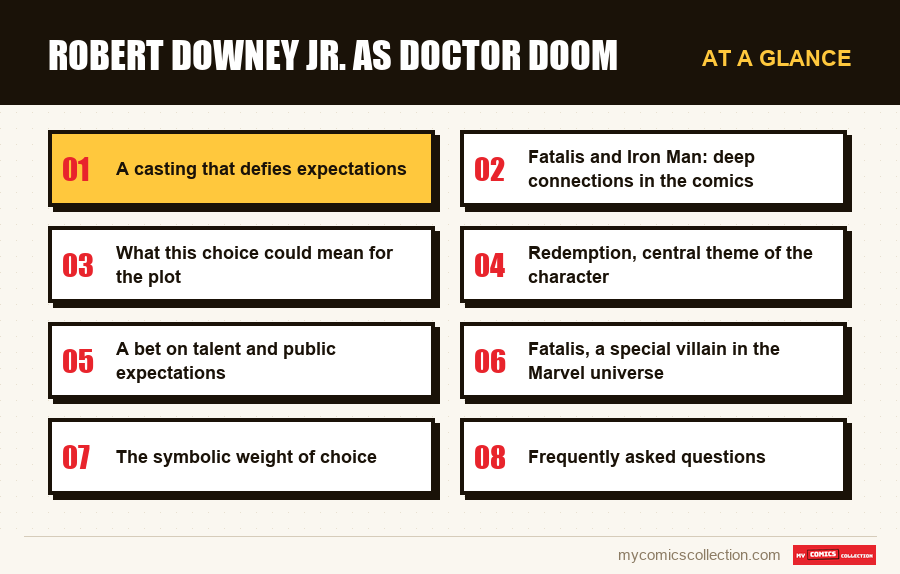
A casting that defies expectations
The return of Robert Downey Jr. to the Marvel Cinematic Universe, not as Iron Man but as Doctor Doom, is one of the boldest casting choices in the studio's history. Downey Jr. is inseparable from the role of Tony Stark, which he played for over a decade, from the first Iron Man to Avengers: Endgame. Seeing him return to service under the iron mask of Victor Von Doom, the sworn enemy of the Fantastic Four, creates an unprecedented narrative vertigo. This choice, unveiled by Marvel Studios with the Russo brothers directing, places Fatalis at the center of the story and signals the capital importance of the character for the future of the franchise.
This casting defies expectations by playing on the spectators' memories. Downey Jr. carries considerable emotional weight with Marvel audiences, as the founding face of the saga. Now associating him with Marvel's greatest villain is a decision that calls into question: a simple communication move or a profound narrative choice? The Russo brothers, who helmed some of the studio's biggest hits, are not accustomed to gratuitous decisions. This choice suggests a strong intention, perhaps linked to the themes of duality, destiny and alternative realities that run through the stories involving Doom. For the viewer, it promises a striking interpretation of an already iconic character.
Fatalis and Iron Man: deep connections in the comics
The choice of Robert Downey Jr. is not devoid of logic with regard to the comics, where Doom and Iron Man maintain close links. Both characters are technological geniuses, each wearing iconic armor: Tony Stark's high-tech armor and Victor Von Doom's iron armor. This symmetry makes them reflections of each other: two genius inventors, one turned toward heroism, the other toward tyranny. In the comics, they have clashed many times, and their intellectual rivalry is one of the richest in Marvel. Doom even, in the story Infamous Iron Man (2016) by Brian Michael Bendis, took on the role of Iron Man after the disappearance of Tony Stark, seeking redemption.
This link between the two armors and the two geniuses sheds light on the casting of Downey Jr. By successively playing Iron Man then Doom, the actor embodies two sides of the same coin: the technological genius in the service of good, then in the service of absolute control. This duality, deeply anchored in the comics, could be exploited on screen, playing on the resemblance and opposition between the two characters. The Infamous Iron Man story also shows that the line between Doom and Iron Man is thinner than it seems. For the reader, this casting is an invitation to rediscover the complex relationship between these two titans of intelligence, whose shared history nourishes a rich mythology that the film could honor.
What this choice could mean for the plot
The casting of Robert Downey Jr. as Doom fuels many hypotheses about the plot of Avengers: Doomsday. Several avenues emerge, anchored in the concepts of the comics. The multiverse, central to the current phase of Marvel, could explain why a character with the face of Tony Stark becomes Doom in an alternate reality: a dark variant of the hero. The concept of Battleworld, from the Secret Wars sagas, brings together divergent versions of characters from multiple realities. Doom, in Secret Wars (2015), rules this patchwork world as a god, reshaping everyone's identity. These elements provide a narrative framework where the choice of Downey Jr. takes on its full meaning.
Beyond the theories, this choice above all signals the studio's ambition to make Fatalis a threat equal to Thanos, or even greater. By entrusting the role to its most emblematic actor, Marvel affirms the central status of the character for the coming years, until the announced sequel in the vein of Secret Wars. For the viewer, this decision promises a charismatic, complex and unmissable Fatalis. It also reminds us that, in the comics, Doom is never a simple villain: he is a monarch, a genius and sometimes an anti-hero, whose depth justifies a leading performer. The film seems to want to honor this richness, by relying on the most ambitious concepts of Marvel mythology.
Redemption, central theme of the character
One aspect of Robert Downey Jr.'s casting deserves particular attention: the theme of redemption, central to both Iron Man and Doom in the comics. Tony Stark's journey in cinema is that of a selfish man who became a selfless hero, until the ultimate sacrifice. Fatalis, for his part, oscillates in the comics between tyranny and quest for redemption: the story Infamous Iron Man (2016) shows him seeking to become a hero after the disappearance of Stark. This thematic proximity (two men haunted by their actions, seeking to atone for their sins in their own way) gives additional depth to Downey Jr.'s choice.
By entrusting Doom to the actor who embodied the redemption of Tony Stark, the film could explore this dimension with particular resonance. Fatalis is never a simple villain in the comics: he is convinced that he is acting for a greater good, convinced that the world would be better under his control. This conviction, this absence of doubt about his own legitimacy, makes him a fascinating and nuanced antagonist. Downey Jr., through his ability to embody complex and ambiguous characters, seems ideally placed to convey this richness. For the viewer, this casting promises a Fatalis far from the cliché of the villain, a character whose motivations and psychology will be explored with the depth that the role deserves. The theme of redemption, common to both characters, could thus be at the heart of the interpretation.
Collecting this series?
Track what you own, what you are missing and what your collection is worth. 7 day trial.
Start my trial →A bet on talent and public expectations
The choice of Robert Downey Jr. is also a calculated bet on his talent and the immense expectations of the public. Few actors are as identified with the Marvel Universe as he is, and his return, in whatever form, guarantees considerable attention. By placing him in the role of the big villain, the studio maximizes media impact while banking on the actor's ability to transcend expectations. The risk exists: the public could have difficulty dissociating Downey Jr. from Tony Stark, but the bet rests on his immense talent and on a direction which will undoubtedly know how to play on this ambiguity rather than suffer from it.
This expectation illustrates the special relationship between iconic actors and superhero franchises. Downey Jr. isn't just a performer: he's a part of Marvel cinema history. His return to Fatalis creates an event, full of nostalgia and curiosity. For the studio, this is the assurance of maximum interest; for the public, it is the promise of a striking interpretation of a major character. This dynamic is a reminder of the importance of casting in the success of an adaptation, and how a bold choice can define a film's identity. Avengers: Doomsday seems to want to make the arrival of Doom, played by a star of this stature, a decisive moment in its cinematic universe. The Fatalis hub brings together our guides to discover the character.
Fatalis, a special villain in the Marvel universe
The choice of an actor of Robert Downey Jr.'s stature reflects Doom's unique status among Marvel villains. Unlike many antagonists, Doom is no mere obstacle to the heroes: he is a recognized sovereign monarch, a head of state, a genius whose intelligence rivals that of Reed Richards, and a master of both science and magic. This unique combination makes him one of the most well-rounded and respected characters in the Marvel Universe. Often cited as the publisher's greatest villain, he inspires enduring fascination precisely because he escapes the clichés of the one-dimensional villain. Entrusting such a character to a leading performer is therefore consistent with its importance.
This singularity explains the extent of the expectations surrounding his arrival on the screen. Doom deserves an interpretation worthy of its richness, and the casting of Robert Downey Jr. signals that Marvel is aware of this. The character offers considerable dramatic potential: his dignity, his pride, his conviction in acting for a greater good, his obsessive rivalry with Reed. So many elements that a great actor can sublimate. For the viewer, this attention to the character bodes well: it suggests a Fatalis treated with the seriousness and depth it requires, far from the caricature villain. By placing one of its most emblematic actors in this role, Marvel affirms that Doom is not an antagonist like the others, but a central figure, called to lastingly mark its cinematographic universe. The Fatalis hub brings together our guides to discover all the richness of this exceptional character.
The symbolic weight of choice
Entrusting Fatalis to Robert Downey Jr. carries a strong symbolic charge. Downey Jr. launched the Marvel Cinematic Universe in 2008 with Iron Man, a role that defined an era of superhero cinema. Seeing him return in Doom completes a sort of cycle: the face that opened the saga becomes the ultimate antagonist. This narrative symmetry, whether assumed by the studio or interpreted by fans, gives the film a particular meta and emotional dimension. It plays on the audience's nostalgia and attachment to the actor, while radically reinventing him in an opposite role.
This symbolic dimension illustrates the way in which superhero cinema dialogues with its own history. By reusing an actor so identified with a heroic role to play evil, Marvel is taking a calculated risk, betting on Downey Jr.'s talent to transcend expectations. For the spectator as for the comic book reader, this choice invites us to think about the tenuous border between hero and villain, a theme dear to the mythology of Fatalis, a character convinced of acting for a greater good. Robert Downey Jr., going from Iron Man to Doom, embodies this ambiguity on screen, promising an interpretation that will be remembered. The Fatalis hub brings together our guides to discover the character he now embodies.
Frequently asked questions
Yes. Marvel Studios has announced that Robert Downey Jr., the historical interpreter of Iron Man, will play Victor Von Doom in Avengers: Doomsday, under the direction of the Russo brothers. This striking choice places Doom at the center of the new Marvel Cinematic Universe.
In the comics, Doom and Iron Man are reflections of each other: two geniuses wearing iconic armor, one heroic, the other tyrannical. Doom even took on the role of Iron Man in Infamous Iron Man (2016). This link, added to the symbolic weight of the choice, sheds light on this decision.
This is the most widespread hypothesis. The multiverse and the concept of Battleworld (from the Secret Wars sagas) allow the existence of variants of characters from different realities. A Fatalis with the face of Tony Stark could thus be explained, even if the studio has not detailed the plot.
The Russo Brothers, who helmed many of Marvel Studios' biggest hits. Their return, associated with the casting of Robert Downey Jr. in Doom, signals the studio's major ambition for this event film centered on the monarch of Latveria.
Start with Fantastic Four #5 (1962, its first appearance) and Fantastic Four Annual #2 (1964, its origins). For the Iron Man connection, read Infamous Iron Man (2016). Our Doctor Doom hub brings together all the guides to explore the character.
Does the film make you want to collect Fatalis? Estimate the value for free of your issues (Fantastic Four #5, Infamous Iron Man…) with our tool based on current eBay listings.