The Fantastic Four: First Steps (2025) finally introduces the Fantastic Four into the Marvel Cinematic Universe, paving the way for their nemesis, Doctor Doom , In Avengers: Doomsday. We explore how this film lays the foundations for the arrival of Doom, the founding rivalry with Reed Richards and what the comics reveal about their confrontation.
Impossible to understand Doom without the Fantastic Four: the character was born as their adversary. The arrival of the family at the cinema directly prepares the ground for the monarch of Latveria. Decryption.
As always in this guide, only verified information (creators, numbers, dates) is stated; the analysis is ours, without reproduction of plates or protected dialogue.
The Fantastic Four enters the Marvel Universe
The Fantastic Four: First Steps (2025) marks the official arrival of the Fantastic Four in the Marvel Cinematic Universe, after several previous adaptations produced outside this framework. The film introduces Marvel's "First Family": Reed Richards (Mr. Fantastic), Sue Storm (the Invisible Woman), Johnny Storm (the Human Torch) and Ben Grimm (the Thing): explorers who became heroes after being exposed to cosmic rays. This introduction is crucial for the future of the saga, because the Fantastic Four are inseparable from Doctor Doom, their sworn enemy since their creation. The film thus lays the narrative foundations on which the arrival of Doom in Avengers: Doomsday will be based.
The integration of the Fantastic Four has been long awaited, as the family occupies a founding place in Marvel history. Their first appearance, in Fantastic Four #1 (1961) by Stan Lee and Jack Kirby, launched the age of modern superheroes at the publisher. Introducing this team to the cinema is opening the door to a whole section of Marvel mythology, of which Doom is the most emblematic figure. First Steps is thus part of a broader strategy, preparing the ground for the great confrontation to come. For the viewer, this film is a gateway to the world of the Fantastic Four and, by extension, to the monarch of Latveria who haunts their stories.
Reed Richards and Doom: a founding rivalry
At the heart of the relationship between the Fantastic Four and Doom is the rivalry between Reed Richards and Victor Von Doom. This opposition, one of the richest in Marvel, dates back to their youth: in the comics, Reed and Victor meet at university, both exceptional geniuses. A catastrophic experience disfigures Victor, who blames Reed for it, fueling a stubborn hatred. This intellectual and personal rivalry opposes two visions of genius: Reed, the altruistic explorer surrounded by his family, and Victor, the loner devoured by pride and the thirst for control. Their confrontation is the mirror of two destinies, two ways of using extraordinary intelligence.
This founding rivalry is essential to understanding Doom, and therefore to appreciating the issues of Avengers: Doomsday. The introduction of Reed Richards and the Fantastic Four in First Steps establishes the context for this opposition, which could culminate in the event film. Doom is not a generic villain: he is intimately linked to Reed, his lifelong rival, whose genius and family happiness he both envies and despises. For the viewer, understanding this relationship allows us to grasp the depth of the antagonism to come. The Reed-Fatalis rivalry, born in the comics more than sixty years ago, promises to be at the heart of the cinematic confrontation, giving it a personal and tragic dimension beyond the simple superhero fight.
Galactus first, Doom next
If Doom is the sworn enemy of the Fantastic Four, he is not the one who takes center stage in First Steps. The film highlights another major cosmic threat from the family's mythology: Galactus, the devourer of worlds, a cosmic entity of colossal power. This choice allows us to introduce the Fantastic Four against an opponent on the scale of their nature as cosmic explorers, while reserving Doom for the big confrontation of Avengers: Doomsday. This narrative progression-Galactus first, then Doom-reflects the importance given to the monarch of Latveria, whose arrival is thus prepared and anticipated.
This choice illustrates the methodical construction of the saga. By first confronting Galactus, the Fantastic Four assert themselves as cosmic heroes, ready to face threats of universal magnitude. Fatalis, reserved for the sequel, becomes all the more anticipated. This gradation reminds us that the monarch of Latveria is not just another adversary, but the great enemy destined for a major confrontation. For the viewer, First Steps is thus an introduction, establishing the heroes and their universe before Fatalis enters the scene. This structure, which increases the tension until the event film, underlines the central status of the character and promises a confrontation worthy of the founding rivalry between the Fantastic Four and their sworn enemy.
Why the Fantastic Four are the key to Doom
Doctor Doom was born in the pages of the Fantastic Four, and his story is inseparable from theirs. His first appearance, in Fantastic Four #5 (1962), presents him as the team's archenemy, and most of his most notable stories fit within this framework. Introducing the Fantastic Four to the cinema was therefore an essential prerequisite for the arrival of Doom. The character draws its substance from his rivalry with Reed Richards and his opposition to this united family, which embodies everything that Doom does not have: solidarity, affection, altruism. To understand the Fantastic Four is to understand what defines and motivates Doom.
It should also be remembered that the Fantastic Four are, historically, at the origin of the entire modern Marvel universe: their first series, launched in 1961, paved the way for all of the publisher's heroes. Fatalis, born in their pages, is inseparable from this founding story. By finally introducing them into the Marvel Cinematic Universe, the studio is not just adding a team: it is integrating the original matrix of its mythology, of which Doom is one of the purest products. This dimension gives their arrival, and that of their sworn enemy, a particular symbolic significance.
This narrative dependency is why First Steps is a crucial step towards Avengers: Doomsday. By establishing the Fantastic Four, their family dynamics and their world, the film sets the stage for the confrontation with Doom. For the comic book reader, this progression respects the logic of mythology: Doom cannot fully exist without the Fantastic Four. For the viewer, it promises a deeply rooted antagonist in a rich context, whose motivations and hatred find their source in his relationship with Reed and his family. First Steps is therefore not just an introductory film: it is the foundation on which the arrival of Marvel's greatest villain is based, whose shadow already hangs over the cinematic universe. The Fatalis hub brings together our guides to explore this mythology.
Collecting this series?
Track what you own, what you are missing and what your collection is worth. 7 day trial.
Start my trial →Collection side: the keys to the Fantastic Four and Doom
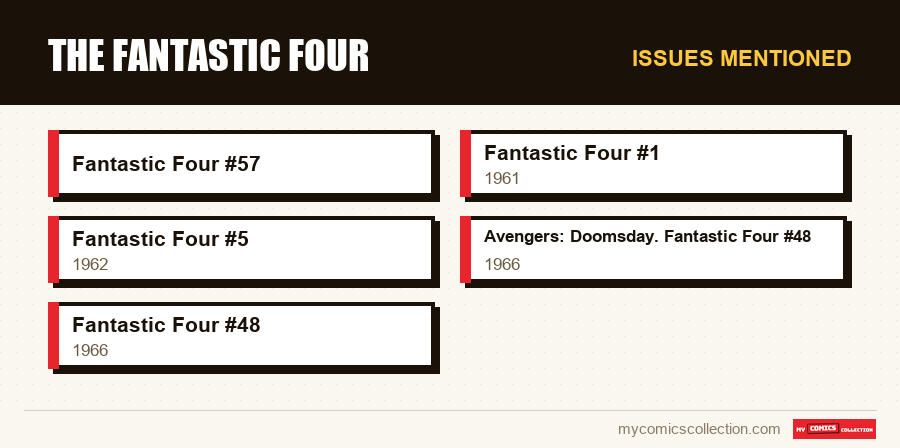
The arrival of Fantastic Four in cinemas, followed by that of Doom, makes their key issues particularly relevant for collectors. Fantastic Four #1 (1961) is the team's founding key, a momentous issue in Marvel history. Fantastic Four #5 (1962), the first appearance of Doctor Doom, is the key directly linked to the central character of Avengers: Doomsday. Fantastic Four #48 (1966), the first appearance of Galactus and the Silver Surfer, is another major key, all the more relevant with Galactus' role in First Steps. These numbers are among the most sought after of the Silver Age.
As always, the value of these issues depends on their condition and grading, and reliance on actual recent sales is strongly advised. Cinematographic news tends to increase the rating of the keys linked to the characters highlighted, which makes Fantastic Four #5 and the big keys of the team targets to watch as the film approaches. For the collector, the introduction of the Fantastic Four and the arrival of Doom constitute a favorable context to take an interest in these founding issues. Our dedicated guides in the Doom hub detail the rating and potential of Fantastic Four #5, key to the first appearance of the monarch of Latveria, whose importance will only grow with his announced domination of the Marvel Cinematic Universe.
A family, not just a team
What sets the Fantastic Four apart from other superhero teams is their family nature. Reed and Sue are a couple, Johnny is Sue's brother, and Ben is Reed's longtime best friend. This family dimension, present from their creation, is at the heart of their identity and differentiates them from more traditional teams bringing together disparate individuals. The Fantastic Four argue, make up, love and protect each other like a real family. This warmth and solidarity are precisely what opposes them to Doctor Doom, a solitary figure without emotional ties, devoured by pride and incapable of such bonds.
This opposition between the united family and the loner is fundamental to understanding the rivalry between the Fantastic Four and Doom. The monarch of Latveria, deep down, envies what Reed possesses: not only his genius, but also his family, his happiness, his ability to love and be loved. This deep jealousy fuels his hatred and gives their confrontation a rich psychological dimension. By establishing the family dynamic of the Fantastic Four, a film like First Steps lays the foundation for this contrast, essential to the antagonism with Doom. For the viewer, understanding that the Fantastic Four are first and foremost a family allows us to understand what makes their opposition to Doom so special and so charged with emotion, beyond the simple superhero fight.
From First Steps to Doomsday: a progressive construction
The connection between The Fantastic Four: First Steps and Avengers: Doomsday illustrates the methodical construction of the Marvel Cinematic Universe. By first introducing the Fantastic Four in their own film, the studio establishes the characters, their universe and their dynamics, before integrating them into the big clash against Doom. This progression allows audiences to become familiar with Marvel's "First Family" before seeing them face their multiverse-wide nemesis. It reflects a proven strategy: building the foundations before the climax, like the construction that led to the confrontation against Thanos.
This progressive approach speaks to the importance given to Doom and the Fantastic Four. Rather than rushing their arrival, the studio takes the time to establish them, ensuring that the audience understands the stakes of their confrontation. For the spectator, this construction promises a confrontation that is all the stronger as it will be anchored in a rich context and well-established characters. She reminds us that Doom is not an interchangeable villain, but a figure whose importance justifies careful preparation. From First Steps to Doomsday, the Marvel Universe is patiently building the conditions for a major confrontation, where the “First Family” will face Marvel's greatest villain. The Fatalis hub brings together our guides to explore this mythology and prepare for the upcoming event film.
Frequently asked questions
The film highlights Galactus as the main threat, reserving Doctor Doom for the big showdown in Avengers: Doomsday. First Steps introduces the Fantastic Four and their universe, laying the narrative foundation for the arrival of their nemesis.
Doom was born in the pages of the Fantastic Four (Fantastic Four #5, 1962) as their archenemy. His story, his rivalry with Reed Richards and his motivations are inseparable from this family. Introducing them to the cinema was an essential prerequisite for the arrival of Doom.
In the comics, Reed and Victor meet at university, both geniuses. An experience disfigures Victor, who holds Reed responsible for it, nourishing a tenacious hatred. Their rivalry pits the altruistic explorer against the control-hungry loner, one of the richest in Marvel.
Galactus, the devourer of worlds, major cosmic entity in the mythology of the Fantastic Four. This choice introduces the team to a threat on a cosmic scale, while reserving Doom for the confrontation in Avengers: Doomsday.
Fantastic Four #1 (1961, founding of the team), Fantastic Four #5 (1962, premiere of Doom) and Fantastic Four #48 (1966, premiere of Galactus and the Silver Surfer). These major keys to the Silver Age see their interest reinforced by current cinematographic events.
Does the film make you want to collect? Estimate the value for free of your numbers (Fantastic Four #1, #5, #48…) with our tool based on current eBay listings.