The run of Jonathan Hickman on Fantastic Four (2009-2012) offers one of the most ambitious explorations of Doctor Doom , foreshadowing the saga Secret Wars (2015). Hickman develops the rivalry with Reed Richards, the role of Valeria and a cosmic vision of the character. We decipher this major run, essential to understanding modern Fatalis and the sources of Avengers: Doomsday.
Architect of stories of remarkable scope, Jonathan Hickman has given Fatalis a cosmic dimension. His run on Fantastic Four laid the foundation for his vision of the character. Decryption.
As always in this guide, only verified information (creators, numbers, dates) is stated; the analysis is ours, without reproduction of plates or protected dialogue.
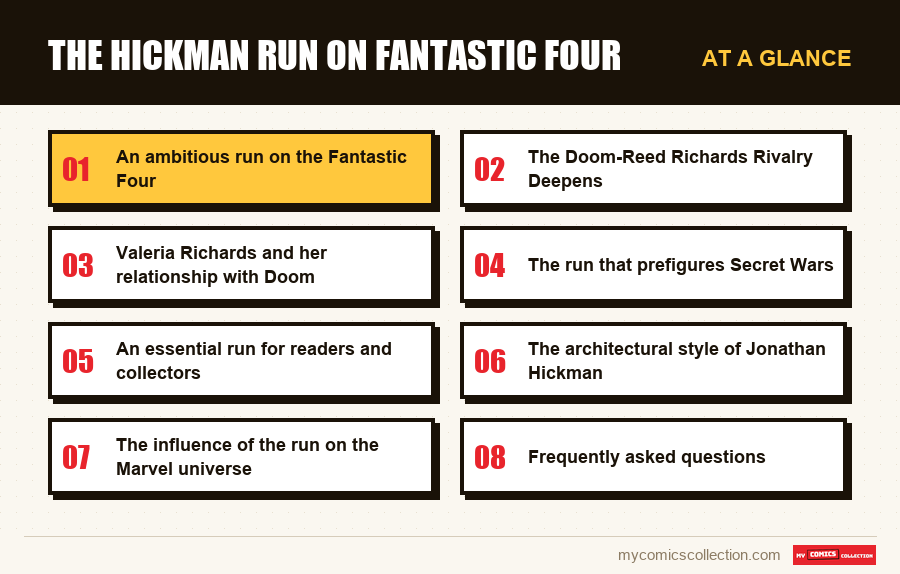
An ambitious run on the Fantastic Four
Jonathan Hickman's run on Fantastic Four, published between 2009 and 2012, is considered one of the most ambitious ever done on the series. Hickman, a screenwriter recognized for his structured stories and his overall vision, has developed a saga of great coherence, exploring the Fantastic Four and their universe with remarkable depth. Doctor Doom occupies a central place, the run deepening his rivalry with Reed Richards and his dimension of genius and conqueror. This run marked readers with its scale and intelligence, laying the foundations for subsequent developments, notably the Secret Wars saga (2015) which constitutes its culmination.
This run stands out for its long-term construction, characteristic of Hickman's style. Each element finds its place in a vast design, each plot preparing the following ones. This structured approach makes the run a coherent and ambitious work, where Fatalis plays a key role. The character is explored from several angles: his rivalry with Reed, his complex relationship with Valeria Richards, and his cosmic dimension. For the reader, this run offers one of the richest explorations of Doom, essential for understanding the modern character and the source material for the cinematic sagas. It illustrates how a great screenwriter can renew and deepen an established character, giving it new depth.
The Doom-Reed Richards Rivalry Deepens
At the heart of Hickman's run is the rivalry between Doctor Doom and Reed Richards, one of the richest in the Marvel Universe. Hickman delves deeper into this opposition, exploring what brings together and separates the two geniuses. The run features the fascinating concept of the "Council of Reeds", a meeting of alternate versions of Reed Richards from different realities, which questions the nature of genius and responsibility. Faced with this exploration of Reed, Doom appears as his dark mirror, the genius turned toward control rather than altruistic exploration. This rivalry, handled with finesse, is one of the common threads of the run.
This in-depth exploration of the rivalry sheds light on both characters. Hickman doesn't just pit them against each other: he questions their similarities, their differences, and what each reveals about the other. Doom and Reed are presented as two sides of the same coin: two exceptional geniuses whose choices lead them on opposite paths. This dimension considerably enriches the understanding of Doom, by situating him in relation to his eternal rival. For the reader, this exploration is fascinating, offering reflection on genius, ambition and morality. It illustrates why the rivalry between Doom and Reed is one of the deepest in Marvel. The Fatalis hub brings together our guides to delve deeper into this founding relationship and the stories that explore it.
Valeria Richards and her relationship with Doom
A surprising aspect of Hickman's run is the relationship between Doctor Doom and Valeria Richards, Reed and Sue's daughter. In this run, Valeria, a gifted child with exceptional intelligence, develops a complex relationship with Doom, whom she considers as a sort of godfather. This unexpected relationship between his family's greatest enemy and young Valeria offers a rich and original dynamic. Fatalis, usually defined by his hatred towards the Richards, finds himself in an ambiguous position vis-à-vis Valeria, which reveals new facets of the character. This relationship, developed with finesse by Hickman, is one of the most striking and original elements of the run.
This relationship between Doom and Valeria enriches the character with an unexpected dimension. It shows a Fatalis capable of a form of respect, even affection, towards a child he considers worthy of his intelligence. This nuance complicates the character, revealing that he is not solely defined by his hatred of Reed. The relationship with Valeria also questions Doom's ability to form bonds, despite her pride and her solitude. For the reader, this dynamic is fascinating, offering an original insight into the psychology of the Latverian monarch. It illustrates the richness of Hickman's run, capable of exploring new facets of a character that has been established for a long time. The Doom hub brings our guides together to explore the character's complex relationships and the narratives that develop them.
The run that prefigures Secret Wars
The importance of Hickman's run on Fantastic Four is also due to its role in foreshadowing Secret Wars (2015). Many elements developed in this run (the cosmic dimension of Doom, alternative realities, the issues on the scale of the multiverse) will find their culmination in the Secret Wars saga, where Doom becomes the God Emperor Doom, god of Battleworld. Hickman has thus built, through his different runs, a vast coherent saga culminating in Secret Wars. The run on Fantastic Four is a founding step, laying the foundations for the cosmic vision of the character that will inspire the Marvel Cinematic Universe. This continuity makes the run an essential link in the modern mythology of Doom.
This foreshadowing dimension gives the run a particular importance in the context of Avengers: Doomsday. The film is inspired by the Secret Wars sagas and the concept of Battleworld, understanding Hickman's run which prefigures them allows us to appreciate the narrative construction which led to this cosmic vision of Doom. The run illustrates how the character has been elevated, in modern comics, to the status of a multiverse-wide threat, capable of reshaping reality. For the reader wishing to understand the sources of cinematic ambitions, Hickman's run is an illuminating read. It shows the evolution of Doom from the villain of the Fantastic Four to the god of Battleworld. The Doom Hub brings together our guides to explore this construct and the stories that shaped modern Doom.
Collecting this series?
Track what you own, what you are missing and what your collection is worth. 7 day trial.
Start my trial →An essential run for readers and collectors
For the reader, Hickman's run on Fantastic Four is a must-read, both for its quality and for its exploration of Doom. Available in collections, this run can be enjoyed as a coherent saga, where each element finds its place in a vast design. Its breadth and intelligence make it one of the most beloved runs in the series, and its exploration of the Latverian monarch is among the richest. For the collector, the relatively recent issues of this run remain accessible, making them an affordable acquisition. Putting this run together makes for one of the great modern explorations of Doom and the Fantastic Four.
This accessibility and richness make Hickman's run an attractive target for fans of the character. As Avengers: Doomsday approaches, this run takes on renewed relevance, as the source of Doom's cosmic vision that inspires the film. Reading it allows you to understand in depth the modern character and the concepts that fuel cinematic ambitions. For both the collector and the reader, Hickman's run is an essential step in the discovery of Doom, completing the great old keys with a major modern saga. It illustrates the richness and ambition of contemporary stories dedicated to the monarch of Latveria. The Fatalis hub brings together our guides to identify these stories and build a collection worthy of the character.
The architectural style of Jonathan Hickman
The run on Fantastic Four perfectly illustrates the style of Jonathan Hickman, often described as the “architect” of stories. Hickman is distinguished by his ability to construct vast and coherent sagas, where each element finds its place in an overall design. His stories, rich in concepts and ideas, unfold over the long term, rewarding the attentive reader. This architectural approach gives his works a rare depth and ambition. On Fantastic Four, this style allows you to explore Fatalis and its universe with remarkable richness, weaving links that will find their conclusion years later. This mastery of narrative construction makes Hickman one of the most respected screenwriters of his generation.
This architectural style explains the coherence and scale of the run. Hickman does not see his stories as isolated stories, but as pieces of a larger whole. This overall vision, applied to Fantastic Four and Fatalis, produces a saga of great richness, where the character gains depth and dimension. For the reader, this approach offers a rewarding experience, provided they immerse themselves in the entire run. It illustrates the way in which a great screenwriter can elevate an established character, by including him in an ambitious construction. Hickman's run on Fantastic Four is thus a demonstration of his talent, and one of the reasons why his exploration of Doom is so beloved. The Fatalis hub brings together our guides to explore the big runs dedicated to the character.
The influence of the run on the Marvel universe
The influence of Hickman's run on Fantastic Four extends far beyond the series itself. The concepts and ideas he developed there (the cosmic dimension of Fatalis, alternative realities, multiversal issues) have irrigated all of his work at Marvel, culminating in the Secret Wars saga (2015). This continuity makes the run an essential link in a vast narrative construction, whose influence is felt in modern comics and, now, in cinematographic ambitions. The run helped elevate Doom to a multiverse-wide threat, a vision that directly inspired the Marvel Cinematic Universe and Avengers: Doomsday.
This lasting influence speaks to the importance of Hickman's run. By laying the foundations for a cosmic vision of Doom, he shaped the modern depiction of the character and paved the way for its later developments. This dimension makes the run essential reading to understand the evolution of Doom in recent comics and the sources of the cinematographic sagas. For the reader wishing to understand the construction that led to the demiurge Fatalis of Secret Wars, the run on Fantastic Four is essential. It illustrates the way in which a great screenwriter can, through his vision, lastingly transform a character and the universe that surrounds him. The Fatalis hub brings together our guides to explore this construction and the stories that shaped the modern Fatalis, at the dawn of its consecration to cinema.
Frequently asked questions
A run published between 2009 and 2012, written by Jonathan Hickman, considered one of the most ambitious in the series. It explores the Fantastic Four and Doctor Doom in great depth, laying the foundations for the Secret Wars saga (2015).
A central role. The run deepens his rivalry with Reed Richards (notably via the “Council of Reeds”), develops his complex relationship with Valeria Richards, and gives him a cosmic dimension which foreshadows his status as God Emperor Doom in Secret Wars.
In the run, Valeria, Reed and Sue's gifted daughter, develops a complex relationship with Doom, whom she considers a sort of godfather. This unexpected dynamic reveals new facets of the character, capable of a form of respect towards the child.
Yes: many elements of the run (cosmic dimension of Doom, alternative realities) find their culmination in Secret Wars (2015), which inspires Avengers: Doomsday. The run foreshadows the character's cosmic vision adapted to the cinema.
Yes: relatively recent (2009-2012), it remains accessible, available in collections as well as in individual issues. It's an affordable purchase to own one of the great modern explorations of Doom and the Fantastic Four.
Want to collect the great stories of Doom? Estimate the value for free of your numbers with our tool based on current eBay listings.