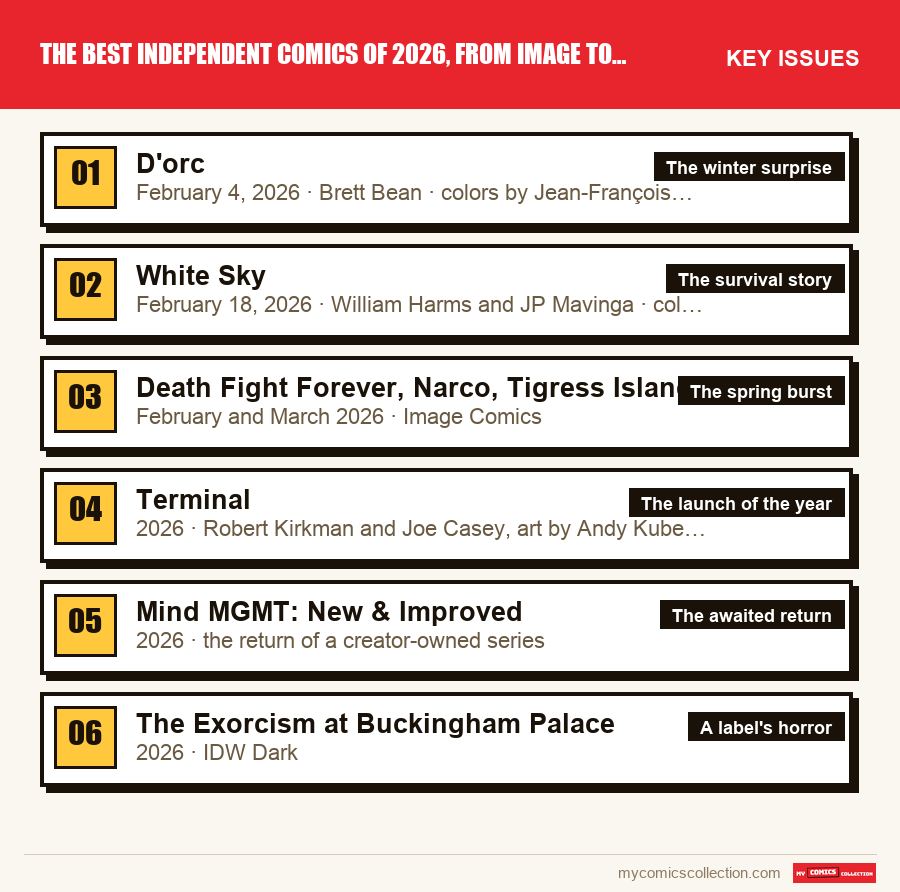
As of early October 2026, the independent creations that have marked the year first came out at Image: D'orc by Brett Bean (February 4), a fantasy comedy, and White Sky by William Harms and JP Mavinga (February 18), a survival story, both sold out on release day; then, in a burst of notable launches, Death Fight Forever, Narco and Tigress Island. At Skybound, Terminal by Robert Kirkman, Joe Casey and Andy Kubert, a crime series printed at 300,000 copies. Outside Image, the return of Mind MGMT and, at IDW Dark, The Exorcism at Buckingham Palace, sold out before release. This review covers January to September: Chainkata by Daniel Warren Johnson and The Snail by Garth Ennis and John McCrea, expected in November, have not come out yet. Our reading advice: the collected edition, not issue #1.
A year of independent comics is not told like a Marvel or DC year. There is no central event, no relaunch of a star character, no editorial line organizing the calendar. There are dozens of original creations, each launched with its own means, most of which vanish in silence and a few of which find their audience. Taking stock means spotting those.
This review is written as of October 3, 2026. The year is not over, and we claim nothing about October, November and December: two highly anticipated November releases are flagged at the end of the article for what they are, announcements. Our angle is that of reading, across several publishers. We do not cover here the speculation on first issues, the subject of our article on speculation on Image's 2026 new releases, nor the question of print runs, analyzed in original creations with big print runs. We ask a simple question: what, in 2026, deserves to be read outside the two big publishers?
The year's landscape, in a few reference points
Let us begin with a caution. There is no public monthly or annual market share for 2026: since 2022, North American direct market distribution reports have no longer been published. What can be cited are one-off register tallies. The one for the week of September 22 to 28, 2026, drawn from more than 600 stores equipped with the same point-of-sale system, puts Image at 19.07%, behind DC and Marvel, then IDW at 2.99%, Titan at 1.98%, Boom at 1.81%, Mad Cave at 1.19%, Dark Horse at 1.09%, Ignition at 1.02% and Oni at 0.95%. It is a snapshot of one week, not an annual trend.
It nonetheless says something useful: the third publisher weighs, over this week, nearly a fifth of register sales, and all the other independents combined remain far behind it. An independent year is therefore first an Image year, and then a constellation of small publishers each putting out a few notable titles. Our history of Image Comics explains how this publisher, founded by artists, became the natural home of creator-owned work.
The second reference point is the wave of sell-outs. In 2026, several original creations were announced sold out at the distributor on release day itself, even before. It is not a sign of quality, it is a sign of under-ordering: stores place firm orders more than two months before release, on the basis of a summary, and cannot keep up when word of mouth starts. Our article on sell-outs on release day details this mechanism. For a reader, the consequence is simple: a title sold out in February was not impossible to find in April.
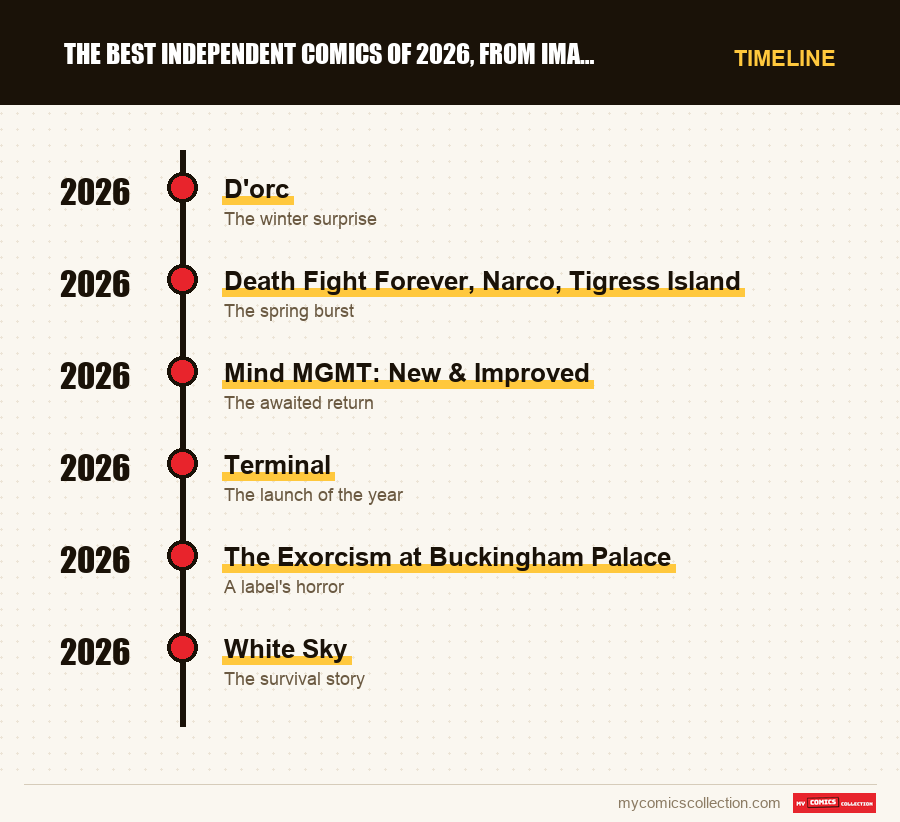
Image Comics: the first quarter of original creations
The start of the year was exceptionally dense at Image. In a few weeks, the publisher put out a series of announcements declaring sold-out issues #1 of series with no known character. Here are those worth reading, and why.
D'orc
A fantasy comedy, written and drawn by Brett Bean, whose hero is a half-dwarf half-orc orphan accompanied by a talkative enchanted shield. Issue #1 sold out at the distributor on release day, and went through a second then a third printing in March. According to the trade press, citing a source inside the publisher, issue #2 had accumulated about 75,000 orders by the end of February.
White Sky
A teenage girl and her father cross a devastated America toward the ruins of San Francisco. Issue #1, sold out on release day, was reprinted a month later, and orders for the second printing exceeded 30,000 copies, beyond those of the first.
Death Fight Forever, Narco, Tigress Island
Three launches in close succession, all announced sold out by the publisher: Death Fight Forever by Andrew MacLean and Alexis Ziritt, Narco by Doug Wagner and Daniel Hillyard, and Tigress Island by Patrick Kindlon and EPHK, the latter sold out at the distributor even before going on sale. For Tigress Island, a collection of issues 1 to 5 is announced in the November catalog.
What stands out in this series of launches is their diversity: a fantasy comedy, a survival story, other titles in very different tones. There is no common recipe, no dominant genre, no unifying character. What brings them together is readers' trust in a creator's name and a favorable first impression in release week. Our calendar of Image and independent releases helps you follow the next issues of these series.
Skybound: Terminal and the weight of a name
Terminal
A crime series, with no shared universe or preexisting character, written by the creator of The Walking Dead and Invincible with Joe Casey, and drawn by Andy Kubert. Issue #1 was printed at 300,000 copies against an initial hope of 100,000, then received a second printing on August 26, 2026.
Terminal raises an interesting question for a reading review: does such a volume say anything about quality? No. It says something about stores' trust in Kirkman, built on two series that each lasted more than ten years. The judgment on the work will come with the following issues and with the first collected edition. But the print run guarantees at least one thing useful to the reader: the series will be easy to find, and so will its first collection.
Beyond Image: three publishers, three signals
The other independent publishers produced less volume, but a few remarkable titles.
Mind MGMT: New & Improved
The return of the Mind MGMT universe, Matt Kindt's psychic espionage series. Issue #1 sold out at the distributor before release, which, for a creator-owned title with a loyal but numerically modest audience, signals an underestimated anticipation.
The Exorcism at Buckingham Palace
An issue #1 from IDW's horror label, announced in October 2024 as a line dedicated to the genre. The issue sold out at the distributor before release.
We should also mention Deniz Camp, one of the writers of the year, honored notably for Assorted Crisis Events, published at Image. His recognition confirms a trend: creators who work for both the big publishers and the independents use the latter for their most personal projects.
What arrives in November, and what we do not judge
Two anticipated creations will come out after the writing of this review. We flag them, without judging them.
Chainkata, by Daniel Warren Johnson, is announced at Image for November 2026, in 40 pages with no ads. Its creator won two Eisner Awards in 2024 for his Transformers series at Skybound, and his personal creations, from Murder Falcon to The Moon Is Following Us, have built a loyal readership. Our portrait of Daniel Warren Johnson details his career.
The Snail, a horror one-shot by Garth Ennis and John McCrea, is also announced at Image for November. The duo has a long shared history, and this release is part of a collaboration that never really stopped.
Neither has been read yet by anyone outside the publisher. They could appear in a December review; they have no place in an October one.
How to read the 2026 independents without getting it wrong
Wait for the collected edition
For an independent creation, the first collected edition generally gathers the first arc, five or six issues. It is the best ratio between cost and reading, and the simplest way to judge a series on a complete arc rather than on one issue.
Ignore the issue #1 fever
An issue #1 sold out on release day resells briefly above its price, then the reprint arrives. Paying that premium to read is paying for nothing: the content is identical in the second printing and in the collection.
Follow the creators
Independents are better followed by name than by title. A creator who pleased you in one series will probably please you in the next, even if the genre changes.
Check the planned length
Some creations are closed miniseries, others open-ended series. Knowing what you are committing to avoids starting a story whose end is not planned.
For a collector who nonetheless prefers single issues, one precaution is in order: note the exact printing. On 2026 series, reprints were numerous and sometimes larger than first printings, which makes identification essential. Our analysis of the direct market's rise explains why the new readers, who buy by genre rather than by continuity, carried these creations.
What this review does not say
We have only retained titles whose publication facts are verifiable: date, team, publisher, distribution events. Many other independent creations came out in 2026, and some are doubtless excellent, but we do not discuss them for lack of being able to document them precisely. This review contains no price guide: no source consulted publishes verifiable recent prices on these titles, and we will not invent any. Nor does it contain any judgment on the November series, which have not come out.
Finally, this review will be completed by a year-end version, once the quarter is over. Until then, a read of two or three of these titles is enough to get an idea of the liveliest thing American independent comics produced in 2026.