Yes, a series with no well-known character can now print as much as a licensed property. Terminal #1, by Robert Kirkman and Joe Casey with Andy Kubert on art, came out at Skybound at 300,000 copies against an initial hope of 100,000, and got a second printing on August 26, 2026. In November 2026, Chainkata by Daniel Warren Johnson arrives at Image in 40 pages with no ads. What carries these numbers is no longer the character, it is the creator's name. For a collector, the conclusion is uncomfortable: a first issue printed at this level starts with an enormous scarcity handicap, and the 1992 precedents demonstrate it conclusively. What makes a key issue is not the launch, it is what the series becomes afterward.
For thirty years, the market's reasoning was fixed: a big print run implied a known character, and an original creation implied a small print run. A creator who wanted to sell six figures had to go through a costume the public recognized, or accept starting at a few tens of thousands of copies while hoping to build a readership issue by issue. The two historical exceptions to this rule are the year 1992 and the mid-2000s, and we will come back to them at length, because they say opposite things.
Fall 2026 breaks this rule in a measurable way. A crime series with no shared universe, no announced film in the works and no preexisting character entered specialty shops at three times the volume its publisher was aiming for, then went back to press. And the following month, a creator whose name was built on a licensed property puts out a personal creation in a format that publishers usually reserve for events: forty pages, without a single ad page.
This article asks three questions in this order. Why this is becoming possible now, when it was not in 2015. What has changed in the ordering mechanism, since that is where the number comes from. And finally the only one that really interests a collector: can a first issue of an original creation, printed at a very high level, become a key issue, or does its very print run prevent it.
What "300,000 copies" means in 2026, and what it does not
Let us start with the limit, because it conditions everything that follows. Since 2022, there is no longer any public tally of actual North American direct market sales: the historic distributor stopped its reports, and its successors publish no sales figures by title. The quantities circulating today are therefore publisher announcements, not independent measurements.
That does not make them suspect, but you need to know what they describe. A publisher announcing 300,000 copies is announcing what it printed and shipped, that is, what retailers ordered. It is not announcing what was sold to the public. The difference is considerable on a launch: part of the volume stays in the bins, comes back secondhand two years later, and ends up in the loss-leader lots. Our guide on how to understand a print run details this mechanism from order to retail, and the one on estimating an issue's real scarcity shows why the printed number is the starting point and not the conclusion.
A second clarification, specific to this quarter's news. The register tally for the week of September 22 to 28, 2026, covering more than 600 equipped stores, puts DC at 41.29%, Marvel at 28.62% and Image at 19.07%. It is a weekly point-of-sale tally, not a monthly or annual market share, and no monthly 2026 data is published. It only indicates that, over the week tallied, the direct market's third publisher weighs nearly a fifth of the registers: that is the frame in which original creations gain their volume.
A third clarification, and the most important one for a buyer: the fact that a title goes back to press is not a measure of scarcity, it is the opposite. A second printing exists because demand exceeded the initial supply, and its very function is to remove that tension. Terminal #1 got its second printing on August 26, 2026. After that date, the issue was no longer hard to find: it was available, in a different edition, which our comparison of first printing versus reprint teaches you to tell apart on the object itself.
Two numbers side by side: 70,000 in 2012, 300,000 in 2026
The best way to measure the shift is to take the most universally successful original creation of the 2010s and set it beside this summer's launch.
Saga #1, by Brian K. Vaughan and Fiona Staples, came out on March 14, 2012 at Image. It sold out before its release date, went through five printings, and had sold more than 70,000 copies across all editions by the following August. The series then won three Eisner Awards in 2013, including best continuing series and best new series, and its first collection reached 120,000 copies sold in summer 2013. We are talking about the absolute peak of the category, the series everyone cited as proof that original creation could win.
Its first issue, over five printings and six months, sits at a fifth of Terminal #1's initial print run in 2026. One printing, one week. The point is not that Terminal would be a better comic: it is that the starting scale of an original creation has changed by an order of magnitude in fourteen years, without the quality or reputation of the object entering into account at the time of the order. Our analysis of Saga as a creator-owned series tells the opposite trajectory, that of a title that grew after its launch.
And Terminal is not an isolated case in its own catalog. The same publisher saw its initial hope of 100,000 copies exceeded by 200%, which means the gap does not come from an overprinting strategy but from underestimation: the orders came in, the publisher followed. It is information about the appetite of the retailer network, not about the publisher's conviction.
Why this is becoming possible now
Three developments add up, and none is enough alone.
The first is the documented arrival of new readers in specialty shops, which the 2025 sales reports make the engine of the channel's growth. These readers do not come looking for the next chapter of sixty years of continuity: they want a story you can pick up midway. An original creation, by construction, has no prerequisites. What was its commercial handicap becomes an argument. Our analysis of the direct market's rise and what it changes details where this demand comes from and what it is worth to a collector.
The second is retailer behavior in the face of risk. A shop owner who orders 300 copies of a title with no known character was, ten years ago, taking a risk they could not cover. Today, the serial sell-outs of 2026 have reversed the incentive: when Absolute Green Arrow sells out a week before release, when Mind MGMT: New & Improved #1 is sold out at the distributor before publication, when The Exorcism at Buckingham Palace #1 is too, the retailer learns that the risk of ordering too little costs more than the risk of ordering too much. So they overorder out of caution, and this reflex first benefits titles carried by a reassuring name.
The third is format. Chainkata comes out in forty pages with no ads, that is, with a higher cover price and an event-object presentation. This choice has become a launch norm: Marvel's Midnight Universe line put out its three October 2026 #1s in forty pages, and Chainkata adopts the same template at a publisher with no superheroes. An event format calls for an event order.
A fourth cause must be added, less flattering and harder to prove: the general inflation of launches. Amazing Spider-Man #1000, released on September 30, 2026, exceeded 400,000 preorders and still sold out on release day, with a second printing planned and unfilled orders announced for November 4, 2026. When the top of the market works at this level, the whole scale shifts, and 300,000 copies for an original creation looks less like an anomaly than a consequence.
The creator's name has replaced the character's name
This is the central point of this feature, and it can be checked on a specific career rather than on a general impression.
Daniel Warren Johnson has been publishing personal creations at Image since Extremity in 2017, then Murder Falcon in 2018 and 2019, then Do a Powerbomb in 2022, which earned him the Eisner Award for best publication for teens in 2023. In between, he moved to DC for Wonder Woman: Dead Earth in 2019 and 2020, and to Marvel for Beta Ray Bill: Argent Star in 2021. Then he wrote Transformers at Skybound from 2023 to 2025, twenty-four issues of which he drew the first six, and won the 2024 Eisner Awards for best continuing series and best writer/artist.
Look at the order of things. His original creations gave him critical reputation. The license gave him a mass audience and two major awards. And it is on the strength of that audience that he returns, in November 2026, with a series he says he has been carrying since 2017. The license did not replace creation: it served as a launch ramp, and the accumulated capital is now attached to his name, not to the character he drew.
This mechanism explains why it does not generalize. Being an original-creation author is not enough to benefit from the effect: you need to have been exposed to a wide audience through a vehicle that is not your own. Robert Kirkman ticks the box differently, through the fame of his own series turned into adaptations. A talented creator without that passage through large scale will start in 2026 roughly where they would have started in 2015.
For a collector, this changes how to file and how to search. Following a creator becomes more predictive than following a publisher or a character, and it is a rather different collecting logic, which our feature on independent creator-owned comics approaches from the angle of buying criteria.
The verifiable precedents, successes and failures
The market has already seen original creations printed at very large scale. The results, thirty years later, do not all point in the same direction, and that is precisely what makes the comparison useful.
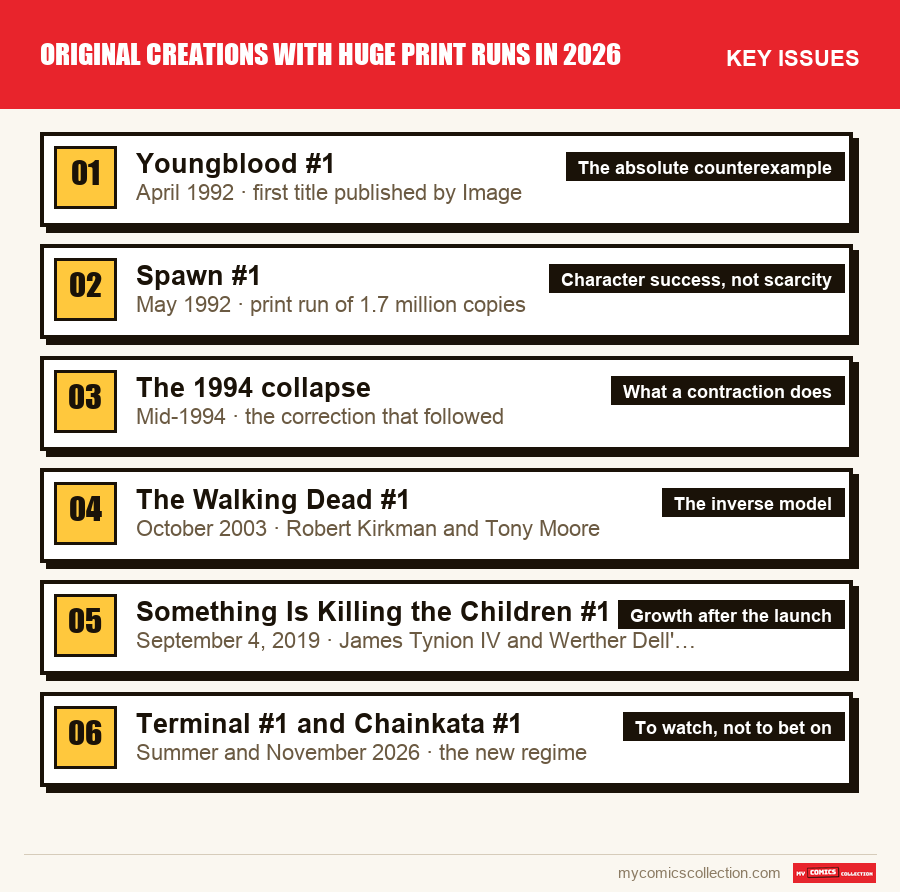
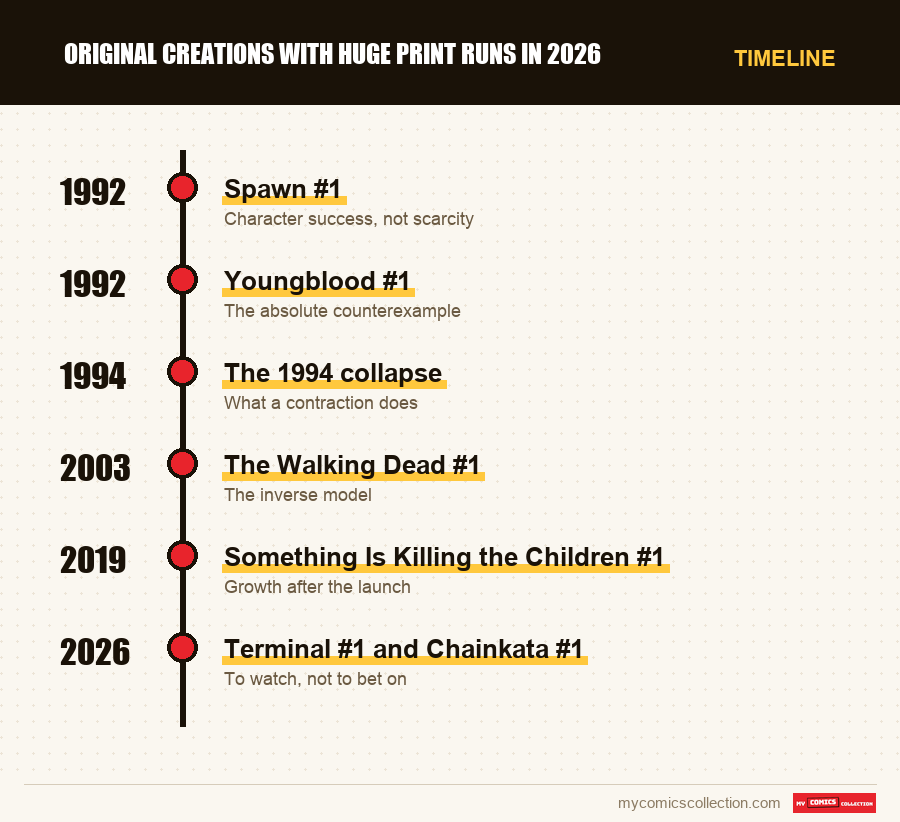
Youngblood #1
Rob Liefeld launches the house with an entirely new creation, with no preexisting character. Preorders reach 930,000 copies, and on release the issue became the best-selling independent comic ever published. Thirty-four years later, it is an issue you find everywhere, in every bin, in every condition. The demonstration is clear: a record order on an original creation produced no scarcity, and the initial success was not enough to durably establish the characters.
Spawn #1
Todd McFarlane writes and draws the first issue, printed at 1.7 million copies. Here the creation held: the series became the longest-running independent series in history and passed its three hundredth issue. But the permanence of the character and the scarcity of its first issue are two distinct things. A title can succeed magnificently over thirty years without its issue #1 becoming hard to find, for the simplest reason in the world: there are 1.7 million of them.
The 1994 collapse
Many Image titles exceeded 500,000 copies per issue in 1992 and 1993. By mid-1994, only the best sellers still reached 250,000. In two years, the scale of high-print-run original creation was halved at the top, and far more below. Publication delays contributed: in April 1993, only 15.3% of the house's titles came out on the scheduled date, against 90.1% at DC.
The Walking Dead #1
The most lucrative series of modern original creation started without any noise, and that is the key to its present value. Nobody ordered many, because nobody knew. Demand came years later, when the number of surviving copies was already fixed and low. That is the very definition of a key issue: late demand meeting a supply that nothing can increase anymore.
Something Is Killing the Children #1
Announced in June 2019 as a five-issue miniseries, the series was turned into an ongoing series by its publisher before the first issue even reached stores. By mid-2024, the publisher announced more than 4.5 million copies sold worldwide across all related titles. The value was therefore built over five years, not over a launch week.
Terminal #1 and Chainkata #1
Terminal #1 was printed at 300,000 copies against a hope of 100,000, with a second printing on August 26, 2026. Chainkata #1 arrives in November 2026 in forty pages with no ads, carried by a creator who just won two Eisner Awards in 2024. Both titles start with an audience that their predecessors took years to build.
Can a first issue with a very big print run become a key issue?
Here is the answer, and it comes in two parts, because the question contains two.
On scarcity, the answer is no, and it is arithmetic. A key issue is an object whose future demand meets a fixed and insufficient supply. A first printing of 300,000 copies, followed by a second printing, puts into circulation a stock that will absorb about any later demand from readers. Supply is not quite fixed either, since the publisher keeps the option to reprint, release a collected edition, then a deluxe edition. On the market for new comics, the response to demand is always supply.
On relative hierarchy, the answer is yes, but not on the base copy. Very big print runs shift value toward what, within the print run, remains rare: a ratio cover whose quantity depends on an order multiple, an authenticated signature, a very high grade on a paper and format that make it difficult. On a massively printed issue, it is not the issue that becomes key, it is a version of the issue. Our guide on investing in limited print runs and our buying strategy for first issues treat this distinction in detail.
There is a third path, rarer and more interesting: the first appearance. If an original creation establishes a character who lasts for decades, and if an adaptation brings it to a wide audience, its first issue can matter despite its abundance, simply because demand becomes massive in turn. That is Spawn's trajectory. But note the condition: it took a series of three hundred issues to get there. It is not a bet on a launch, it is a bet on thirty years.
One last methodological remark, valid for any new release after 2022. Since no distribution report by title is published anymore, the variable that determines future scarcity has become unobservable on recent series, except when the publisher itself communicates a figure. In the present case, it did, and the figure is high: we therefore know with rare certainty that Terminal #1 is not scarce. On most other new releases, we know nothing, which should make anyone who claims a 2026 issue would be low print run very cautious.
The three conditions of lasting success, and why they are rarely met together
If the goal is to spot, among high-print-run original creations, those that will matter in ten years, three conditions emerge from the precedents above. They are demanding.
The first is publication regularity. The 1993 episode is explicit on this point: a house that only released 15.3% of its titles on the announced date lost its readership in two years, despite print runs that nobody has seen since. An original creation depends entirely on the buying habit, since no continuity holds the reader. A two-month delay on a title with no known character costs infinitely more than a delay on an established series.
The second is duration. Spawn mattered because it held for three hundred issues. The Walking Dead mattered because it lasted long enough to meet its adaptation. Something Is Killing the Children reached its cumulative volumes over five years. None of these three series owes its place to its launch, and two of them made it despite a modest or quiet launch.
The third is ownership. An original creation stays in its creators' hands, which is its editorial strength and its industrial fragility. Nothing obliges a creator to continue, and nothing allows the publisher to hand the series to someone else. A superhero universe survives the departure of its creators; a personal creation stops when its creator stops. It is a risk that no print run figure measures.
What to do in practice, from now on
Buy these titles as a reader, and own it
On a first issue printed at three hundred thousand copies, the expectation of scarcity is close to zero by construction. What remains guaranteed is the reading. Take the main cover, at cover price, and do not overpay for a variant whose quantity is not documented.
Note which printing you hold, on the day of purchase
On a title that goes back to press a few weeks after release, the only thing that will distinguish your copy in fifteen years is its printing and its cover. This information is readable on the object at the time of purchase and becomes tedious to reconstruct afterward. Enter it in your collection right away.
Follow the creator, not the issue
Since it is the name that carries the volume, it is the name to follow. Build your watch list by creator, and observe what happens with their next project rather than the launch week. Documented careers show that recognition precedes the series, sometimes by five years.
Wait for issue 6 before judging
First-issue orders measure retailers' confidence, not readers'. The first figure that says something about the real audience is the level at which the series stabilizes after the usual dip of the first months. On an original creation, it is the only launch statistic that has predictive value.
Look for scarcity where it still exists
If your goal is the scarce object rather than the reading, the very big print run original creations of 2026 are not the terrain. Original creations launched quietly still are, exactly as in 2003. They are simply impossible to identify in advance, which is the definition of the problem.
What we do not know, and must refuse to fill in
A few blind spots deserve to be named, because they are the ones market discussions fill most willingly.
We do not know the sales to the public of Terminal #1, only its announced print run. We do not know the print run of Chainkata #1, which had not come out at the time of writing. We have no price guide and no quantified price movement on these issues, and we will not invent any. We also do not know whether the retailers' overordering reflex will hold: it was born of a series of sell-outs in 2026 and could reverse as quickly as it appeared, as in 1994.
Finally, a major convention runs from October 8 to 11, 2026, with scheduled panels. Nothing has been said there yet as these lines are written, and it is likely that announcements of original creations will be made there. They therefore do not appear here, and any statement of the "announced at this convention" kind circulating before mid-October would be, by construction, made up.
What we know fits in one sentence, and it is enough to decide: the starting scale of original creations has changed, the creator's name is the cause, and a high print run remains bad news for the object's scarcity, whatever the quality of the series. The two pieces of good news are elsewhere: more creators can make a living from their own universes, and more ambitious series reach a wide audience. For a reader, it is an excellent period. For a key-issue hunter, it is a period when you need to look elsewhere, toward already established key issues and the history of the house that invented this model.