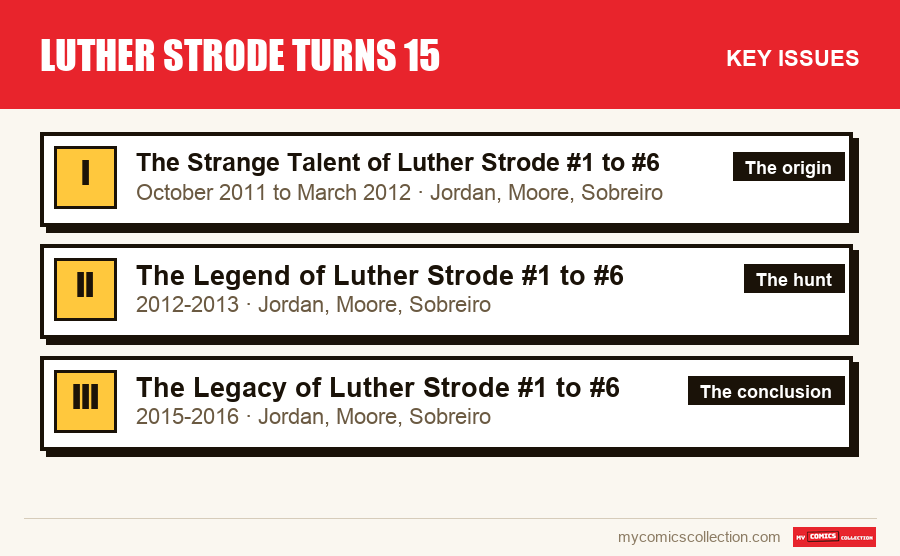
Luther Strode is an action and horror trilogy published by Image Comics, written by Justin Jordan, drawn and inked by Tradd Moore, colored by Felipe Sobreiro. It has three six-issue miniseries: The Strange Talent of Luther Strode (October 2011 to March 2012), The Legend of Luther Strode (2012-2013) and The Legacy of Luther Strode (2015-2016), that is 18 issues. For the series' 15th anniversary, Image publishes a Luther Strode #1 Anniversary Edition on October 7, 2026. What to keep: the 2011 #1 in first printing, the duo's first published work and the reference piece, then the complete trilogy in single issues or collected editions. The anniversary edition is first of all an invitation to read: it does not replace the original in a collection.
In 2011, two unknowns publish at Image a miniseries that looks like a B-movie: a scrawny teenager orders a bodybuilding method by mail, and discovers that it gives him a strength and reflexes that turn him into a killing machine. The pitch fits on one line. What made the series' reputation is the art of Tradd Moore, then a young graduate, whose almost rubbery suppleness and choreographed violence looked like nothing that was coming out at the time.
Fifteen years later, Moore has become one of the most admired artists of his generation, and Image celebrates the series' anniversary with a special edition of its first issue. It is the right moment to take stock: what the trilogy contains, how to read it, and which issues to keep if you collect.
The creators: a meeting online
Justin Jordan, an American writer born in 1978, spots Tradd Moore on an illustration-sharing platform while he is still a student at the Savannah College of Art and Design, from which he graduates in 2010. He offers him the script for a new series. The Strange Talent of Luther Strode is their first collaboration, and the first published series for each of them. Felipe Sobreiro handles the colors, bright and saturated, which give the pages their character of a bloodied cartoon.
The creators described their intention in simple terms: crossing a masked-killer movie with the principle of Spider-Man. In other words, asking what a Peter Parker would become who received powers without having an Uncle Ben to teach him responsibility. The series is a creator-owned work, which is the rule at Image: Jordan and Moore hold the rights.
The trilogy, miniseries by miniseries
The Strange Talent of Luther Strode #1 to #6
Luther Strode, a skinny teenager who lives alone with his mother, receives a training manual by mail, the Hercules method, a pastiche of the bodybuilding ads that once adorned the last pages of comics. The results exceed anything he imagined. He gains superhuman reflexes, sees bodies as maps of muscles, and begins to have visions of massacre. A mysterious character, the Librarian, takes an interest in him. The series reveals that the method goes back to Cain, and that others mastered it before Luther, including Jack the Ripper.
The Legend of Luther Strode #1 to #6
The story picks up five years after the end of the first installment. Luther now goes after the forces that sent the Librarian, and the series widens its universe by showing the organization hiding behind the method. Moore's art gains even more scale, with multi-page action sequences.
The Legacy of Luther Strode #1 to #6
Last installment of the trilogy, published after a two-year pause during which Moore worked at Marvel. Luther this time takes the fight to the source of what put him on his road. Moore left All-New Ghost Rider to come back to this conclusion, a sign of the importance the duo gave to closing its story.
The October 7, 2026 anniversary edition
Image publishes on October 7, 2026 a Luther Strode #1 Anniversary Edition, for the series' 15th anniversary, whose first issue came out in October 2011. This type of edition in principle takes up a series' first issue on the occasion of an anniversary, with its own packaging. The detail of its contents, any bonuses and its covers is not developed here, for lack of confirmed information at the time of writing: check the publisher's page before buying if an extra interests you.
For the reader, it is the ideal occasion to discover the series at the price of a new issue, without hunting for a 2011 copy. For the collector, the question is different, and it deserves to be asked clearly.
Anniversary edition or original: what to keep?
An anniversary reissue is not an ordinary reprint, nor a variant of the original issue. It is a new object, dated 2026, that reproduces content from 2011. In a collection, it never takes the place of the original: the first printing of the 2011 #1 remains the reference issue, the one that census records associate with the start of the series and with Tradd Moore's first published work.
That does not mean the anniversary edition has no interest. It has three. First, it lets you read the first issue in a new copy. Next, it may carry a new cover, which will interest Moore fans. Finally, it marks a moment in the series' life, which always has sentimental value. But these arguments are about pleasure, not investment. Our article on the difference between first printing and reprint explains why the gap almost always holds in favor of the original.
You are discovering the series
Take the anniversary edition to read the first issue, then the trilogy in collected editions. It is the most economical and most comfortable option.
You collect Tradd Moore
Look for the 2011 #1 in first printing, then complete with the anniversary edition if its cover pleases you. The two objects complement each other; they do not replace each other.
You want the complete trilogy
Aim for the 18 original issues. Start with the three #1s, then complete each miniseries. The third, later one is the one that demands the most patience.
How to recognize a 2011 first printing
Like many successful Image series, the first issue of The Strange Talent of Luther Strode may have had reprints after its release. To check that a copy is indeed a first printing, read the legal notices inside the issue: Image usually indicates the printing there when it is not the first. A cover different from the original, or a printing notice, should alert you. On an online listing, ask for a photo of this page. The guide on the value of second printings gives the general method.
No price guide value is given in this article: for lack of a reliable, dated public source on recent sales of these issues, any numeric indication would be made up. The general trend is simple to state: the 2011 #1 is the most in-demand issue, the other issues remain markedly more accessible, and condition makes most of the difference. For a specific copy, the free estimate starts from its real condition.
What the series says about independent publishing
Luther Strode is a good example of what Image has allowed since its creation: a first work by unknown creators, published as creator-owned, that finds its audience with no known character or license. The series also served as a springboard. Justin Jordan went on to write 22 issues of Green Lantern: New Guardians at DC. Tradd Moore drew All-New Ghost Rider, which launches Robbie Reyes in 2014, then Silver Surfer: Black and Doctor Strange: Fall Sunrise at Marvel, works that confirmed his place among the most singular artists of the moment.
It is, moreover, this trajectory that explains collectors' interest in the 2011 #1: you are looking for not only the start of a series, but the first issue of an artist who became major. The articles on the value of independent comics and on original creations with big print runs in 2026 place this phenomenon in the current market, and our guide to collecting Image Comics gives other leads at the same publisher.
An adaptation project also exists: in late October 2020, a production studio took an option on the rights to a film, with Justin Jordan's agreement. No release has been announced since. An option is not a film, and it is not a reason to buy.
Who is this series for?
Luther Strode is reserved for an adult audience. The violence is extreme, graphic, owned as a spectacle. Those who like action drawn as choreography, revenge stories and over-the-top horror will find a complete and coherent work, wrapped up in 18 issues. Those put off by gratuitous violence can pass without regret. For fans of the genre, our guide to collectible horror comics offers other series to explore.