When we talk about valuable comics, the names that come to mind are invariably Marvel and DC: Amazing Fantasy #15, Action Comics #1, Incredible Hulk #181. The general public has internalized the idea that value is in the mainstream. That's false, and savvy collectors have long known it.
When we talk about valuable comics, the names that come to mind are invariably Marvel and DC: Amazing Fantasy #15, Action Comics #1, Incredible Hulk #181. The general public has internalized the idea that value is in the mainstream. That's false, and savvy collectors have long known it.
The independent comics market holds gems that often surpass, in value-for-money ratio and appreciation potential, the equivalent Marvel and DC key issues. A Saga #1 or Walking Dead #1 bought for $3 at release and kept in perfect condition now trades for hundreds, even thousands, of dollars. This article tours the independents that are really worth gold in 2026, publisher by publisher.
Image Comics, the 1992 revolution
Image Comics was born in 1992 from a historic rupture: seven of Marvel's star artists (McFarlane, Lee, Liefeld, Silvestri, Portacio, Larsen, Valentino) slammed the door to create their own publishing house. The idea was revolutionary for the era: authors keep intellectual property of their characters. The shock is enormous in the industry.
Thirty years later, Image Comics has produced some of the most important runs in independent comics history. Here are the key issues that count:
Spawn #1 (1992), Todd McFarlane
First issue of Image Comics' flagship series. Massive print run (~1.7 million copies), which limits value in average condition. But in CGC 9.8, unopened polybagged copies (with poster) remain symbolic collection pieces of Image's launch.
CGC 9.8: $150-300 · Standard condition: $10-30Walking Dead #1 (2003), Robert Kirkman
The most influential zombie series of the 2000s, adapted as an AMC TV show from 2010. The show's popularity exploded the value. Black-and-white first issue, relatively small initial print run. One of the most sought-after 21st-century independent key issues.
CGC 9.8: $1,500-3,000 · Raw VF/NM: $440-990Saga #1 (2012), Brian K. Vaughan & Fiona Staples
The space opera series that redefined independent comics' narrative ambitions. Critically acclaimed, Eisner Award-winning, and expected for adaptation for years. Saga #1 hasn't yet known the "boost" of an adaptation, meaning its upside potential is intact.
CGC 9.8: $300-600 · Raw NM: $90-220Invincible #1 (2003), Robert Kirkman & Cory Walker
Kirkman's Image superhero series, whose Amazon Prime Video animated adaptation caused significant price rises. The #1 remains accessible for reasonable budgets, but trend is clearly upward since 2021.
CGC 9.8: $600-1,200 · Raw VF/NM: $165-385East of West #1 (2013), Jonathan Hickman & Nick Dragotta
One of Hickman's most ambitious works: an American uchronic dystopia with Dantean plotting. Less mediatized than Saga or Walking Dead, East of West #1 remains undervalued relative to its narrative quality, potentially interesting before a possible adaptation.
CGC 9.8: $80-150 · Raw NM: $17-45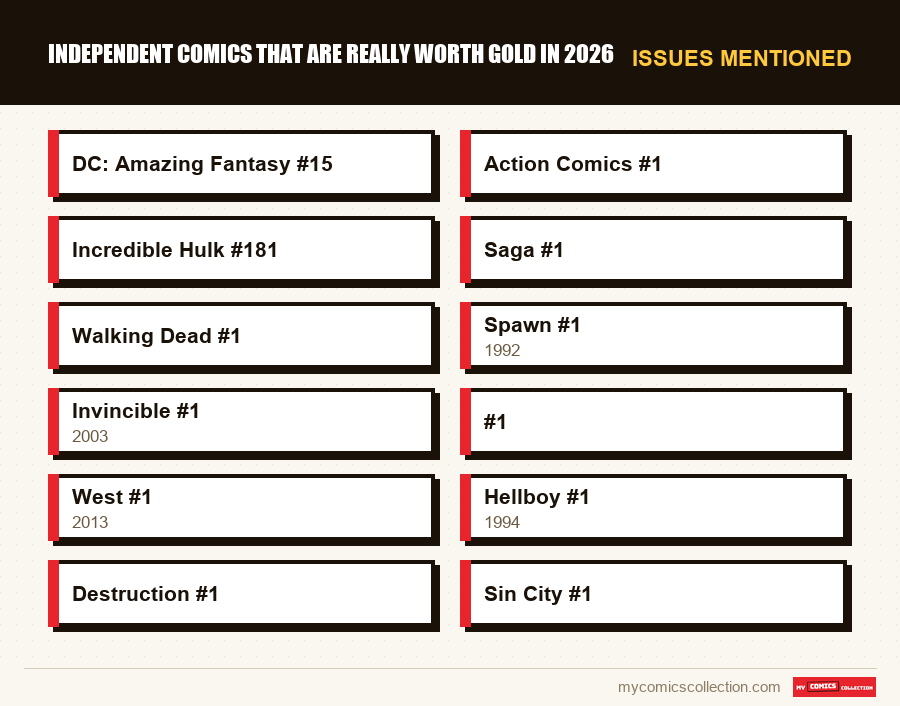
Dark Horse Comics: the other major independent house
Founded 1986 in Milwaukie (Oregon), Dark Horse Comics built its reputation on solid licenses (Star Wars, Indiana Jones, Aliens) but also original creations that became classics.
Hellboy #1 (1994), Mike Mignola
Seed of Destruction #1, first issue of Hellboy's main series: the stone-armed paranormal detective. Mignola created a unique, immediately recognizable graphic universe. The two films (Ron Perlman) and 2019 reboot maintained visibility. Solid Dark Horse key issue.
CGC 9.8: $300-600 · Raw VF/NM: $65-165Sin City #1, The Hard Goodbye (1991), Frank Miller
First appearance of Marv and Sin City's world, initially published in Dark Horse Presents #51-62 before compilation. The original Sin City #1 album (1993) remains a top collection piece, carried by Frank Miller's prestige and Robert Rodriguez's 2005 film adaptation.
CGC 9.8: $200-450 · Raw VF/NM: $45-110The Mask #0 (1991), John Arcudi & Doug Mahnke
The series that inspired the Jim Carrey film (1994). The main series' #0 is the collection's official starting point. The film's cultural popularity maintains regular demand, though value stays moderate.
CGC 9.8: $150-280 · Raw VF/NM: $28-65IDW Publishing and TMNT: a safe bet
Teenage Mutant Ninja Turtles (TMNT) is a case study in independent comics history. Created in 1984 by Kevin Eastman and Peter Laird for Mirage Studios from practically nothing, a self-published bet at a few thousand copies, the Ninja Turtles became a multi-billion-dollar global franchise.
TMNT #1, Mirage Studios (1984), Eastman & Laird
The Holy Grail of independent comics. First printing estimated at about 3,000 copies, black and white. Absolute scarcity makes it one of the most sought-after pieces outside Marvel/DC. Multiple printings exist (1st, 2nd, 3rd...): only the first printing commands stratospheric prices.
CGC 9.8: $5,000-8,000 · CGC 9.0: $1,500-3,000Locke & Key #1 (2008), Joe Hill & Gabriel Rodriguez, IDW
Joe Hill's horror/fantasy series (Stephen King's son), successfully adapted by Netflix since 2020. The main series' first issue is a solid modern-period key issue, still relatively affordable relative to its potential.
CGC 9.8: $200-500 · Raw VF/NM: $55-130Fantagraphics & Drawn and Quarterly: alternative value
These two publishers occupy a different market space: American author comics, often closer to graphic literature than traditional comics. Their collection value follows different rules: critical prestige and first-edition scarcity count, not film adaptations.
Ghost World #1 (1998) by Daniel Clowes (Fantagraphics), Jimmy Corrigan #1 by Chris Ware, or first editions of Adrian Tomine's collections (Optic Nerve) are collection pieces for serious comic art lovers. Ghost World's 2001 adaptation by Terry Zwigoff considerably reinforced Clowes's visibility and his first editions' value.
Collecting this series?
Track what you own, what you are missing and what your collection is worth. 7 day trial.
Start my trial →Criteria that make an independent's value
Low print run
An independent published at 3,000 copies will always be rarer and potentially more valuable than a Marvel printed at 500,000 units, even if the character is less famous.
Film or series adaptation
Adaptation announcements are the most powerful and predictable rise drivers. Monitoring optioned rights sometimes lets you anticipate peaks.
Author popularity
A comic signed by an author whose reputation is rising (Hickman, Vaughan, Fraction) will see its value increase with its creator's career, even without adaptation.
First edition vs. reprint
For independents, the distinction between first and second printing is critical. Only the first printing counts for collection. Always check the cover bottom or rights page.
Key issues to watch in 2025-2026
A few recent series deserve particular attention for their appreciation potential:
- Kaya #1 (2022, Image): W. Maxwell Prince. Fantasy series starting to get critical attention.
- Something is Killing the Children #1 (2019, BOOM! Studios): James Tynion IV & Werther Dell'Edera. Most acclaimed horror series of the last decade, already in strong rise.
- House of Slaughter #1 (2021, BOOM! Studios): Something is Killing the Children spin-off, first issue still affordable.
- Department of Truth #1 (2020, Image): James Tynion IV & Martin Simmonds. Timely conspiracy thriller.
The independents rule: Initial print runs are almost always lower than equivalent Marvel/DC series. If an independent series takes off in popularity afterward (adaptation, critical buzz), the first issue is structurally rare, and the value rise can be brutal. Buy first printings of promising series at launch, not after.
Why independents offer better value for money
An Amazing Spider-Man #300 (first Venom) in CGC 9.8 exceeds $2,200. A Walking Dead #1 in CGC 9.8 is at $2,200. Price levels are comparable, but the probability that a good-condition Walking Dead #1 was preserved since 2003 is lower than for a Spider-Man kept in a shop since 1988: because in 2003 nobody yet thought to encapsulate modern Image comics.
Recent independents (2000-2015) benefit from a market blind spot: few collectors treated them as "key issues" at release. Perfect-condition copies are therefore structurally rarer than for same-era Marvel/DC, whose savvy fans bought multiple copies from publication.
That's the real opportunity of independents: pieces of great narrative quality, carried by talented creators, with objective scarcity and a market sometimes still undervalued relative to mainstream.
FAQ, Valuable Independent Comics
Manage your independent collection with My Comics Collection
Track your Image, Dark Horse and IDW key issues, check their estimated value, and never miss a missing issue in your favorite runs.
🚀 7-day free trial, no commitment