Is a comic signed by Stan Lee, Todd McFarlane, or Jim Lee automatically more valuable? The answer is subtler than it looks. In collecting, an artist's signature can multiply an issue's value, or send it crashing, depending on how it was obtained and certified.
Is a comic signed by Stan Lee, Todd McFarlane, or Jim Lee automatically more valuable? The answer is subtler than it looks. In collecting, an artist's signature can multiply an issue's value, or send it crashing, depending on how it was obtained and certified. Understanding this distinction is essential before buying or selling a signed comic.
This complete guide covers everything you need to know about signed comics: the fundamental difference between a raw signature and CGC Signature Series, which artists actually move prices, how to get a legitimate autograph, and the traps that can turn a beautiful comic into a bad investment.
Financial disclaimer: The values and examples in this article are provided for informational and educational purposes only. Signed comic values fluctuate with the market, signature authenticity, and many other factors. This article does not constitute investment advice. Consult experts and specialized platforms before any buy or sell decision.
Raw signature vs. CGC Signature Series: a crucial difference
The first thing to understand is that not all signatures are equal in the eyes of buyers and certification bodies. There are two radically different scenarios when it comes to signed comics.
Raw signature: uncertified, risky
A "raw" signed comic is a copy carrying an artist's signature with no third-party authentication. It might be an autograph obtained at a convention, a purchase from a dealer, or a comic passed down through family with a personal signature. The problem is simple: no one can guarantee the signature is authentic. The market for forged comic celebrity autographs is very active, especially around Stan Lee signatures.
If you submit a raw signed comic to CGC for grading, they will not authenticate the signature. They'll simply note "Signature on cover" on the green label: a neutral mention often perceived negatively by buyers. Under CGC policies, this annotation can result in a grade reduction (if the signature is considered surface alteration) or a "Qualified" label that meaningfully reduces market value compared to an unsigned copy.
CGC Signature Series: the yellow label, authenticity guarantee
The CGC Signature Series (identifiable by its distinctive yellow label) is an entirely different program. Here, a CGC representative, called a "witness", is physically present during the signing. They certify in real time that the designated artist has signed the comic. The comic is then encapsulated with a yellow label bearing the signer's name, the date, and sometimes the event.
The result is radically different: a CGC Signature Series on a key issue with a major artist commands a significant premium over an unsigned raw copy of the same grade. That premium can range from 20% to more than 100% depending on the signer's notoriety and the importance of the comic.
There's also CBCS Verified Signature (blue label), an alternative offered by CGC's competitor, working on the same witness-authentication principle.
Which artists actually move value?
Not all signatures carry the same weight. The artist's notoriety, the link to the comic in question, and the scarcity of the signature are the three determining factors.
Stan Lee (1922-2018): the most sought-after signature
Stan Lee is arguably the comic artist whose signature is the most valuable and most sought after in the world. Co-creator of Spider-Man, Iron Man, the X-Men, the Fantastic Four, and dozens of other Marvel characters, Stan Lee signed millions of comics over his long career. Since his death in November 2018, supply has obviously frozen, which supports upward pricing pressure.
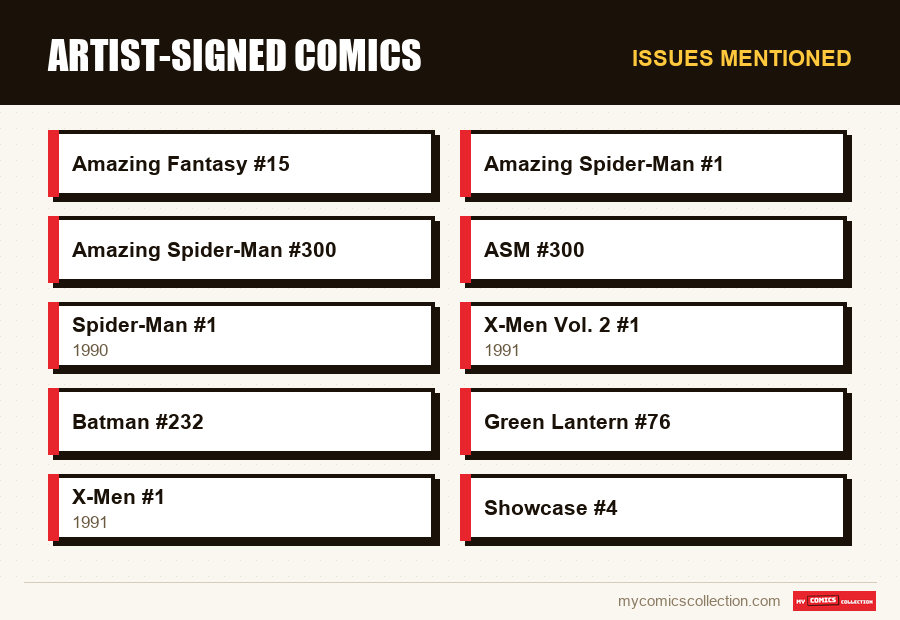
A CGC Signature Series Stan Lee signature on Amazing Fantasy #15 or Amazing Spider-Man #1 represents staggering sums today. Even on less iconic issues, a certified Lee signature adds systematic value. Warning though: the enormous volume of existing signatures makes authentication especially critical: forgeries are legion on the secondary market.
Todd McFarlane: the most-signed artist of the '90s
Todd McFarlane is the star artist who revolutionized Amazing Spider-Man with his organic, swirling style between 1988 and 1990. His signature on Amazing Spider-Man #300 (first full Venom) or his solo Spider-Man run (1990) is in extremely high demand. McFarlane remains very active at conventions and continues to sign regularly, making his signature more accessible than Stan Lee's.
The premium from a certified McFarlane signature on ASM #300 can reach 40% to 60% over a raw unsigned copy of equivalent grade. On his solo Spider-Man #1 (1990), the premium is also substantial for high-grade copies.
Jim Lee: the definitive X-Men artist
Jim Lee is the artist who brought X-Men to heights of popularity in the early '90s. His run on X-Men Vol. 2 #1 (1991), the best-selling comic of all time with over 8 million copies, remains an emblematic piece. His signature on X-Men key issues or on Batman: Hush (DC Comics) is highly sought after. Jim Lee is now DC Comics's co-publisher and signs regularly at conventions.
Neal Adams (1941-2022): a now-rare signature
Neal Adams is the artist who revolutionized superhero art in the '70s with his runs on Batman and Green Lantern/Green Arrow. His death in April 2022 naturally froze signature supply and boosted market value. A Neal Adams CGC Signature Series comic on his emblematic runs (Batman #232, Green Lantern #76-89) commands an increasingly marked premium today.
Jack Kirby and Steve Ditko: the legend market
Signatures by Jack Kirby (died 1994) and Steve Ditko (died 2018) are extremely rare on the market. Both signed little in their final years. A CGC Signature Series with their signature is a museum piece, with prices reflecting their historical importance in creating the Marvel characters.
Concrete examples: value with and without signature
To illustrate the real impact of a certified signature, here are some examples based on market trends. These numbers are indicative and can vary based on actual sales:
Value comparison (indicative only)
- Amazing Spider-Man #300 CGC 9.8 raw: about $880-$1,320
- ASM #300 CGC 9.8 Signature Series Todd McFarlane: about $1,540-$2,200
- X-Men #1 (1991) CGC 9.8 raw: about $66-$110
- X-Men #1 CGC 9.8 Signature Series Jim Lee: about $220-$385
- Amazing Fantasy #15 CGC 3.0 raw: about $44,000-$66,000
- Amazing Fantasy #15 CGC 3.0 Signature Series Stan Lee: value noticeably up since 2018
These numbers show that the signature premium varies widely by comic and artist. It's particularly strong on major key issues with artists historically tied to the book in question.
Catalog your signed comics with their value
My Comics Collection lets you record every detail of your autographed copies: signing artist, certification type, CGC grade, and daily-updated value tracking.
Free 7-day trial, no commitmentCollecting this series?
Track what you own, what you are missing and what your collection is worth. 7 day trial.
Start my trial →How to get an artist autograph
There are several ways to get an artist's signature on your copy. Each has its advantages and constraints.
Conventions: the most direct method
Major American conventions (San Diego Comic-Con (SDCC), New York Comic Con (NYCC), C2E2 in Chicago) regularly host major artists who agree to sign comics for a signing fee. These fees range from $20 to over $200 depending on the artist's notoriety.
If you're aiming for a CGC Signature Series, verify upfront whether a CGC representative will be present: CGC dispatches "witnesses" to major American conventions. You need to hand your comic over to the CGC representative before the signing, and it will be graded and encapsulated afterward.
Mail-in signing: the remote method
Some artists or their agents organize mail-in signing sessions. You send your comic (with proper protections and required fees), the artist signs it, and you get it back. Warning: without a CGC witness present, an ordinary mail-in signature cannot benefit from the Signature Series program. Third-party organizers, like Heroes & Fantasies in the US, offer authenticated mail-in sessions, but always verify the service's reputation.
Private sessions and certified dealers
Some comics art galleries and specialty shops organize private signing sessions with artists, sometimes with CGC representatives present. It's often pricier than a convention, but the more exclusive setting guarantees better queue management and optimal conditions for the comic.
What invalidates a signature for CGC
Understanding CGC rules is essential if you're aiming for Signature Series certification. Here are the situations that prevent or complicate the process:
No CGC witness during the signing
This is the most critical point. If no CGC-mandated witness was present during the signing, the comic cannot receive the yellow Signature Series label, regardless of signature quality.
Comic already encapsulated before signing
A comic already in its CGC slab cannot be signed without breaking the encapsulation. If you want a Signature Series, the comic must be submitted to CGC before or during the signing event, per the prescribed procedure.
Signing on a comic with hidden defects
If the comic has defects that would make it ungradable (significant tears, missing pages, mold traces), CGC will refuse to encapsulate it even with a certified signature. Comic condition always takes precedence.
Signer not recognized by CGC
CGC maintains a list of artists and personalities whose signatures they certify. If the artist isn't on that list, CGC cannot issue a Signature Series label. Check the official CGC list before any event.
Traps to avoid with signed comics
The signed comics market is unfortunately riddled with traps for uninformed collectors. Here are the most frequent risk scenarios:
- Fake Stan Lee signatures: given the volume of comics signed by Stan Lee during his life and the value of his signature since his death, forgeries have multiplied. Never buy a Stan Lee signature without CGC Signature Series certification or perfectly traceable provenance.
- Worthless "Certificates of Authenticity": many unscrupulous sellers provide COAs issued by unknown or invented organizations. A COA without a CGC, CBCS, or JSA (James Spence Authentication) imprint is generally worthless.
- Overvaluation of obscure signatures: a comic signed by an author or artist with limited notoriety carries virtually no market premium. The signature must come from a recognized name tied to the comic in question to have a real impact.
- Signatures on damaged comics: some sellers use a famous signature to mask a comic's poor condition. Always look at the comic's overall condition independent of the signature.
Golden rule: For any significant-value signed comic purchase, always demand either CGC Signature Series encapsulation (yellow label) or perfectly documented provenance with photos and proof of the signing event. Never pay a signature premium you can't verify.
Signature Series vs. raw: which is better to own?
The question often comes up for collectors who receive or buy uncertified signed comics: is it better to submit them to CGC for grading (with the "Qualified" label) or keep them raw?
The answer depends on the comic's intrinsic value and the signer's notoriety. If you have a raw comic with a signature you can prove authentic (photo with the artist, video of the event), CGC submission with the "Qualified" grade at least gives you an official grade, even though the value will be below a non-annotated copy.
Conversely, if you have a comic you plan to get signed soon at a convention, research in advance whether a CGC representative will be present. If a witness is there, submit the comic on-site to benefit from the Signature Series program: you'll get the best of both worlds: an official grade AND a certified signature with the associated premium.
FAQ: Signed comics and value
Track the value of your autographed pieces
My Comics Collection helps you track the valuation of each signed copy in your collection, with daily-updated market data.
Free 7-day trial, no commitment