This series launched in 2012 does not belong to a publisher: its rights remain in the hands of its authors. This status is not a legal detail, it outlines the very shape of the collection. No crossover with other titles, no derivative series, no renumbering, no alternative order cover: the series of issues advances in a straight line, without branching. As a result, a single object concentrates attention, the very first issue, and the statement of August 29, 2026 confirms this in a brutal manner: among the copies offered without external verification, there are 124 advertisements, asking from $3.00 to $454.98, with a median of $22.48; among the copies passed by a verification agency, 28 advertisements asking for $35.00 to $1,999.99, median $274.97. About twelve times more in the middle of the pile. On such a recent title, this discrepancy says a simple thing: in the absence of variants, special editions or competing entry points, all that remains is the condition of the paper to sort the copies between them.
We must first accept an idea that clashes with the habit of the comic book collector: most of the series that we put in boxes are not works, they are production lines. They belong to a house which exploits them, extends them, grafts them onto other titles, interrupts them and relaunches them according to a schedule which has nothing to do with the story. A series owned by its creators escapes this mechanism. No one above the authors can decide that a supporting character deserves its own monthly, that a cross-cutting event should cross twelve titles at once, or that a new number one would boost sales. The consequence for those who collect is immediate and rarely formulated: the set to be assembled is known in advance, with no gray area, no annexes and no pitfalls.
This clarity comes at a price. A publisher's title produces relief: issues that we search for years, confidential prints, decisive appearances hidden in a neighboring series, regional editions, covers signed by a guest artist. So many reasons to keep looking once the main series is complete. Nothing like that here. Hunting is reduced to a single truly difficult catch, and everything else can be purchased in batches without any particular effort. It's an entirely different collection scheme, more readable, quicker to complete, and much flatter.
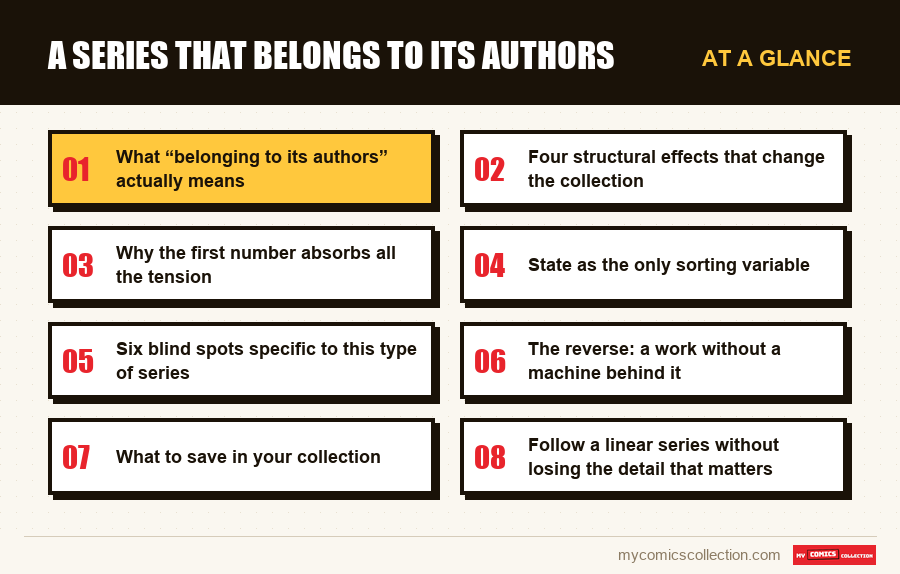
What “belonging to its authors” actually means
The term covers a contractual reality: the rights to exploit the story and its characters remain the property of the people who designed them, the publisher only ensuring the manufacture and distribution of the booklets. The decision-making power then changes sides. A proprietary publisher arbitrates between the health of a catalog and the coherence of a story, and this arbitration almost always leans on the side of the catalog: this is how derivative series, special out-of-continuity issues and relaunches are born. Proprietary authors do not have this dilemma, because they do not have a catalog to support. They only have one story, and it ends when they think it should end.
It is difficult to measure the extent to which this difference extends to the shelf. Take the most banal question asked by a reader who discovers a title: “where to start?” ". On a series of editors, the answer rarely fits in one line, because several entry points coexist, each legitimate, each resulting from a reboot. On a creator-owner series launched as a whole, the answer is unique and will remain so. Only one first issue has ever existed, there will be no more, and no renumbered anniversary edition will blur the line. This uniqueness is exactly what explains the concentration observed in the market: the desire of tens of thousands of readers flows into a single bottleneck.
Four structural effects that change the collection
Aucun croisement à traquer
On a title integrated into a shared universe, part of the work consists of locating the issues of other series where the plot continues. Here, this part disappears. The story is entirely contained in its own numbering, which eliminates a whole category of collection errors: invisible holes, those that we only discover when reading, months after having believed the whole thing to be complete.
No spin-off series
No monthly magazine dedicated to a supporting role, no original mini-series, no annual. The list of booklets to have never grows longer. What simplifies the inventory also removes the ramifications from the journey: it is impossible to extend the collection by moving away from the trunk, since there are no branches.
No raise to number one
The numbering runs without being reset. A publisher's series can have several first issues separated by a few years, which fragments demand and makes the benchmarks confusing for buyers. Here, only one truly begins the story, and nothing will ever share that status with him.
No alternative order coverage
The system of variants proportional to orders from booksellers is an editorial instrument intended to support implementations. A series owned by its authors does without it. Without this family of rare objects manufactured on purpose, rarity can only come from an accident: wear, conservation, chance of surviving examples.
These four absences do not compensate for each other. They add up, and their sum produces a linear collection: a series of objects identical in nature, different only by their rank and their condition. It is the very definition of a featureless ensemble. You can find it relaxing (the list is short, it doesn't hold any unpleasant surprises) or frustrating, depending on what you expect from a collection. But we cannot ignore it when estimating what a set represents.
The amounts quoted here are sums réclamées by sellers on August 29, 2026, not completed transactions. An ad displays an intention, it does not prove that a buyer has accepted. Copies passed by a verification body are counted separately from others, because a sealed case and a raw booklet cannot be compared.
This reading was taken on a single date. It therefore shows no evolution, no increase, no decline: it describes a state of supply at a moment, nothing more. And the $1,999.99 at the top of the verified range reflects a seller's hope, not an observed level: isolated extremes are worth discarding before any reading.
Why the first number absorbs all the tension
In this type of series, the first issue is not simply the oldest: it is the only object whose available quantity was fixed before the title met its audience. An inaugural booklet is printed on the basis of orders placed blindly, by booksellers who know nothing about what they are selling. The next draw is already adjusted by what the first revealed. On a 2012 launch without a powerful editor behind it, this adjustment comes into play: the initial order was cautious, the following ones were raised, and the gap between the two will never be made up again.
Add to this that the first number has no substitute. On a publisher's title, a reader who renounces an overpriced inaugural issue can fall back on a later edition, an identified reprint, a relaunch number one or a collection which carries the same initial prestige. Here, none of these loopholes exist within the logic of the creator-owner regime. Demand has no place to disperse. This is the real reason why a single object concentrates interest throughout, and not a so-called premium that the market would pay at the beginning.
This concentration has a practical consequence for the collector: the budget for a complete set is not distributed, it is stacked on a single line. Everything else in the series is obtained at levels that do not require calculation. This is an unusual spending profile, and it's better to know it before you start rather than discovering it in the last missing booklet.
State as the only sorting variable
The most telling figure in the statement is neither the minimum nor the maximum, it is the ratio between the two medians. $274.97 versus $22.48: about twelve times. On a title published around ten years ago, this gap cannot be explained by age: the copies are largely contemporary with each other, come from the same boxes, handled under the same conditions. It is explained by what remains when we have removed all the other criteria of distinction.
On a publisher's series of the same age, a buyer has several options to decide between two copies: the cover, the edition, the edition, the marking. Each of these axes absorbs a part of the value. On a creator-owner series, they don't exist. There remains only one question, that of the freshness of the paper: the corners, the holding of the staples, the whiteness of the edges, the absence of creases on the back. When a single criterion carries the entire differentiation, it also carries the entire price gap. Twelve times is not an anomaly, it is the arithmetic translation of a one-dimensional market.
This report must be read for what it is, without making it say more. He does not say that having a copy verified makes a difference: verification has a cost, a time limit, and above all it can only note a state, never improve it. A tired booklet remains a tired booklet in a box. Nor does he say that one of the two groups would be easier to resell than the other. It only says that the two populations of advertisements do not describe the same object, and that we cannot combine them into a single average without producing a figure that corresponds to nothing.
A word on staffing, finally. 124 listings on the unverified side is enough of a basis for a median to make sense. The 28 advertisements verified are a more modest number; their median remains usable, but it is sensitive to some withdrawals or additions, and it would be imprudent to treat it as a stable benchmark. As soon as we go down to just a few announcements, which happens quickly if we segment by specific state, it is better to give up on concluding anything on a price level.
Collecting this series?
Track what you own, what you are missing and what your collection is worth. 7 day trial.
Start my trial →Six blind spots specific to this type of series
Confusing absence of variants with absence of pitfalls
A series without official alternative covers is not a series without special copies. Prints associated with trade fairs, covers produced for a single dealer and signed copies still circulate. They do not fall under the editorial program, so there is no official list of them: they must be identified on a case-by-case basis.
Take a photograph for a trend
A statement dated August 29, 2026 describes the supply visible that day. It contains no information about what was happening a month earlier or what will follow. Any phrase like “it goes up” or “it goes down” based on a single measurement is an invention, regardless of the quality of the reading.
Trust the top of the range
Between $35.00 and $1,999.99, the gap in verified listings is considerable. The top belongs to a seller testing his luck, not to a trade. The middle of the ranking remains the only defensible reading, and even then, on a limited number.
Mix Verified and Unverified
Adding the 124 raw listings and the 28 verified listings to come up with an average figure produces an irrelevant number. These are two distinct markets, with different buyers and different expectations. They are read side by side, never blended together.
Underestimate the cost of the end of the journey
Common issues in such a series accumulate quickly and cheaply, giving the illusion of a cheap set. Almost the entire expense is spent on a single piece, generally saved for last. The real budget is only revealed at the last moment.
Count on recommendations to find it
Without an editorial structure to maintain it, a series stops being pushed as soon as its authors stop. It disappears from the new features tables, selections and automatic suggestions. It continues to exist, but you have to go look for it: no one will put it back in front of you.
The reverse: a work without a machine behind it
The creator-owner regime is generally presented by its advantages, and they are real: freedom of tone, absence of obligation to extend, ability to conclude. The reverse deserves to be stated with the same clarity. A publishing house is not only a constraint, it is also a memory infrastructure. She re-edits, she recomposes, she brings out a title during an adaptation, she slips it into selections, she reinjects it into the conversation every two or three years. A series that is owned by its authors has none of this once publication ceases.
Concretely, the visibility of such a series rests on the authors themselves and on its readership. As long as publication continues, each issue acts as a reminder. As soon as it stops, announced break or definitive stop, the recall stops, and the title slips out of the recommendations in a few months. This is not a judgment on its quality, it is a distribution mechanism: suggestion algorithms and bookseller tables work on what is moving, not on what exists.
For a collector, this results in a less predictable supply window. The copies do not disappear, but they cease to be put back into circulation through the usual circuit, and the discovery of the title by new readers slows down. The consequence is not mechanically a drop or an increase, a single reading does not allow us to confirm either, but a more irregular supply, with slack periods where nothing correct can be found.
There is a counterpart that this regime offers to the reader, and it is significant: a story whose length is decided by those who write it, without extension intended to support sales, without filler episodes imposed by a transversal calendar, without death or return dictated by an event external to the story. This is rare, and this is precisely what a readership is looking for in this type of title. See the way this world was built to understand what end-to-end consistency allows.
What to save in your collection
Separate the first number from the rest in your follow-up. On this type of series, an inventory that treats all the issues equally gives a false image of what you hold. One line concentrates almost all of the value and difficulty of acquisition; the others form a homogeneous block. Write it down separately, with its detailed condition, its visible defects and how you obtained it.
Record status with unusual precision. Since the condition is the only criterion that differentiates two copies, it becomes the main information of your file, not a secondary mention. Corners, staples, edge, spine, flatness: describe each point rather than giving an overall rating. A note summarizes, a description allows you to go back and compare.
Date each amount you note. The figures for August 29, 2026 apply to this day. If you copy them into your follow-up without the date, in six months they will become a timeless and false reference. An amount without a date cannot be corrected, it silently misleads.
Explicitly mark the verification status. A verified copy and a raw copy belong to two populations which are not comparable: the ratio of one to twelve between the two medians is enough to show this. Your sheet must say to which population each piece belongs, otherwise any overall estimate mixes objects of different nature.
Save special copies outside the program. Salon print, cover intended for a reseller, signed copy: these objects exist on the sidelines of a series without official variants, and no editorial list will list them for you. Describe precisely the origin of each at the time you acquire it; piecing together this information later is almost always impossible.
The power of decision over the story and what surrounds it. The author-owners decide on the pace, duration and ending, without arbitration for the benefit of a catalog. The publisher ensures manufacturing and distribution, but cannot launch a derivative series, impose a crossover or order a relaunch. For the collector, this means a list of issues to collect that never grows sideways.
Because state is the only available criterion of distinction. In this series, there are no order variants, no competing editions, no official markings to separate two examples. All the differentiation therefore relates to the conservation of the paper, and the price difference follows. On a title offering more axes of comparison, this gap would be distributed between several criteria instead of being carried by a single one.
No, and that's important. The data was taken on August 29, 2026, a single date. A single metric describes a state of supply at a point in time; it contains no previous point of comparison, therefore no direction. It would take at least two spaced readings, constructed in the same way, to speak of movement. Any claim of evolution based on these figures alone would be fabricated.
The question can only be answered on a case-by-case basis, and it depends first of all on the actual state of the fascicle. The verification finds, it does not improve anything: a damaged copy leaves the process with a damaged copy report. It also has a cost and a time limit. It makes sense for a piece whose condition is clearly above average and which we wish to describe in an opposable manner; it hardly has any for a current reading copy.
It is gradually leaving the recommendation circuits, due to the lack of an editorial structure to keep it there. No opportunity reissue, no in-house selection, no promotion linked to another title in the catalog. The fund remains accessible, but you must seek it out voluntarily. For supply, this translates into a more irregular supply, with periods where nothing correct is offered.
Follow a linear series without losing the detail that matters
When a collection fits into a single line of value and everything else looks the same, the inventory must be finer, not lighter: detailed condition, verification status, dated amounts, non-program items. My Comics Collection maintains this level of detail for each copy and shows you what is still missing.