Saga #1 appears in March 2012 at Image Comics, created by the screenwriter Brian K. Vaughan (Y: The Last Man, Ex Machina) and the artist Fiona Staples. The series chronicles the escape of two soldiers from enemy camps, Alana and Marko, across a galaxy at war, with their daughter Hazel as narrator. After 54 issues, the series goes into hiatus from July 2018 to January 2022. Publication resumes with #55 and continues today, with more than 70 issues published. Saga has won multiple Eisner Awards and remains one of the most collected independent comics of the 21st century. A first print of #1 in CGC 9.8 sells for between €800 and €1,500 on the secondary market.
There are series that redefine a medium. Saga is one of those. When Brian K. Vaughan and Fiona Staples published the first issue in March 2012, the landscape of independent comics was already rich, driven by Walking Dead, Invincible and the creations of Jason Aaron and Jonathan Hickman. However, Saga manages to immediately establish itself as a separate phenomenon, mixing space opera, fantasy, family chronicle and political satire in a story that is unlike anything that existed before.
The commercial success is dazzling. #1 was reprinted six times in a few weeks. Monthly sales exceeded 50,000 copies from the first arc, an exceptional figure for a creator-owned title without a pre-existing license. Ten years later, the trade paperback collections have sold several million cumulative copies, and the series systematically appears in the lists of the best comics of the decade.
This guide traces the complete history of Saga: its genesis, its narrative arcs, its legendary hiatus, its rewards, and above all what collectors need to know to build a coherent collection of this series that has become essential.
The genesis of Saga: Vaughan after Y: The Last Man
To understand Saga, you have to understand its creator. Brian K. Vaughan finished Y: The Last Man in 2008 after 60 issues at Vertigo, a unanimously acclaimed series which earned him several Eisner Awards. At the same time, he concluded Ex Machina at Wildstorm in 2010. At that time, Vaughan was considered one of the best comic book writers of his generation, but he made an unexpected choice: he left comics to work as a writer on the television series Lost (seasons 3 to 5) and develop other projects for the small screen.
This passage through television profoundly influences his narrative vision. Vaughan discovers the mechanics of the serialized cliffhanger, the management of long arcs over several seasons, and above all the art of making the intimate and the epic coexist. When he returned to comics in 2012, he carried out a project that he described as his most personal work: a family story in a universe at war, inspired by the birth of his own children.
Fiona Staples' choice
Fiona Staples, a Canadian artist born in Alberta, was a surprising choice at the time. She is known for her work on North 40 at WildStorm and some covers for DC, but has never carried a prominent monthly series. Vaughan chose it for precisely this reason: he wanted a fresh look, not a style associated with Marvel or DC. The result is a rare creative alchemy. Staples' drawing, entirely digital, combines the expressiveness of the faces, the richness of the alien decorations and a chromatic palette which gives each arc a distinct atmosphere.
The duo signs a creator-owned contract with Image Comics, the only publisher that guarantees authors total ownership of their work. At Image, creators retain 100% of the rights to their characters, their universe and their stories. The publisher only takes a percentage of sales in exchange for distribution and production. This model, radically different from the work-for-hire practiced by Marvel and DC, means that Vaughan and Staples control absolutely everything: the pace of publication, the editorial content, the adaptation decisions. This choice will have major consequences on the future of the series, in particular on the systematic refusal of any audiovisual adaptation.
The first issue was ordered for around 37,000 copies by comic shops, a decent figure but not exceptional for an Image launch in 2012. No one, not even Vaughan, anticipated what would follow.
Publication and story arcs: the complete timeline
Saga is structured in arcs of six issues, each corresponding to a trade paperback. This regularity makes tracking easier for collectors, whether you buy single issues or collections. Here is the detailed timeline:
Phase 1: the escape (issues 1 to 18, 2012-2014)
Arc 1 (#1-6, March-August 2012): Alana, winged soldier of Landfall, and Marko, horned Wreath, each desert their camps after falling in love in prison. Their daughter Hazel is born on the first page of #1. Hunted by the two armies who cannot tolerate their union, they flee with the help of an organic tree-shaped ship, the Rocketship. This first arc also introduces The Will, a bounty hunter hired to find them, and Lying Cat, his lie detector feline who has become the series' mascot.
Arc 2 (#7-12, November 2012 - April 2013): The couple takes refuge on the planet Quietus to find the author D. Oswald Heist, whose novel inspired their meeting. Prince Robot IV, sent by the nobility of Landfall in #1 to eliminate the fugitives, continues his hunt. #12 ends on a cliffhanger that has become famous in the history of the series.
Arc 3 (#13-18, August 2013 - January 2014): The assault on the Heist lighthouse. Direct confrontation between Prince Robot IV and the couple. The consequences of this arc permanently change the dynamic of the series, with significant losses and a flight into the unknown.
Phase 2: the galaxy expands (issues 19 to 36, 2014-2016)
Arc 4 (#19-24, May-October 2014): Time jump. Hazel has grown up, and the series explores the consequences of life on the run on a child. New characters appear, notably the journalist Upsher and her companion Doff, who investigate the existence of the forbidden couple. The universe is considerably enriched.
Arc 5 (#25-30, February-July 2015): One of the darkest arcs of the series. The family is separated. Marko sinks into addiction. Alana works undercover on a TV fight circuit. Vaughan uses narrative structure to explore precarity, addiction and loss of identity.
Arc 6 (#31-36, November 2015 - April 2016): Family reunification and introduction of Petrichor, a transgender character from Wreath. The arc concludes with the capture of part of the group and sets the stage for the next phase.
Phase 3: escalation (issues 37 to 54, 2016-2018)
Arc 7 (#37-42, August 2016 - January 2017): Hazel is a prisoner in a Landfall detention camp, separated from her parents. The arc explores themes of education in hostile environments and institutional racism through the eyes of a mixed-race child in a world that refuses mixed race.
Arc 8 (#43-48, May-October 2017): Escape and its costs. New antagonists appear, including The March, a paramilitary organization. Vaughan confirms that Saga is a series where no one is safe, eliminating characters that readers thought were untouchable.
Arc 9 (#49-54, February-July 2018): The most emotionally devastating arc. #54, published on July 25, 2018, ends with a shocking event that leaves readers stunned. The last page announces an indefinite hiatus. Vaughan and Staples disappear from the radar.
Phase 4: the return (issues 55+, 2022-present)
Arc 10 (#55-60, January-July 2022): Three and a half years of waiting are over. #55 sold more than 300,000 copies, a record for an independent comic. The series picks up exactly where it left off, with no flashbacks or recaps. Hazel is now a preteen, and the aftermath of #54 structures this entire arc.
Arc 11 (#61-66, January-September 2023): The war between Landfall and Wreath reaches a new level. New alliances are formed. #66 introduces a major narrative twist linked to the narration of Hazel herself.
Arc 12 (#67-72, July 2024 - March 2025): The exploration of new territories, both geographical and narrative. Vaughan has confirmed in several interviews that the series is past its halfway point, without specifying a final number.
After #72 was released in March 2025, the series went on hiatus again. Vaughan has stated that it will run 108 issues in total.
Collector tip: To keep up with issues and never miss a first print, subscribe at your local comic shop or use an online pull list service. First prints of Saga often sell out within the week of release; Waiting a month means risking only finding second prints.
The 2018-2022 hiatus: three years of silence
The Saga hiatus is an unprecedented event in the history of modern independent comics. After #54, published in July 2018, no official communication filtered through for months. Vaughan vaguely mentions a need for a break in scattered interviews, but neither he nor Staples give a timetable for resuming.
Several factors explain this interruption. Vaughan mentioned a creative exhaustion after nine consecutive arcs without significant interruption, six years of almost uninterrupted monthly publication. Fiona Staples, for her part, expressed the need to recharge her batteries artistically. The pace of a monthly comic entirely drawn and colored by a single person is a marathon that wears out even the most disciplined artists.
For collectors, this hiatus has had a paradoxical effect. Initially, the prices of the first issues fell slightly, the market fearing a permanent abandonment. Then, as the silence continued, a perceived scarcity set in. First prints of early arcs became harder to find, and when the resumption was announced at the end of 2021, prices jumped 30 to 50% in a few weeks.
Collector's lesson: A hiatus is not an end. Quality creator-owned series almost always resume, and the hiatus period is often the best time to acquire key issues at a reasonable price. The market panics before the informed collector.
Awards and critical recognition
Saga is one of the most awarded series in comics history. The list of his distinctions is eloquent:
- Eisner Award for Best New Title (Best New Series) in 2013, from the first year of publication
- Eisner Award for Best Current Series (Best Continuing Series) in 2015 and 2016
- Eisner Award for Best Artist for Fiona Staples, on several occasions, rewarding her exceptional work of drawing and color
- Hugo Award for Best Graphic Story in 2013, for the first collected volume, a distinction from the world of literary science fiction which confirms the influence of the series beyond the circle of comic book readers
- Harvey Awards multiple, in the categories best series and best artist
- Regular presence in New York Times bestsellers for trade paperback collections, a rarity for an independent comic
Beyond prices, Saga helped bring independent comics into general bookstores. Bound volumes can be found in the literature sections of many stores, not just in specialized comic shops. It's a phenomenon comparable to what Art Spiegelman's Maus or Marjane Satrapi's Persepolis experienced: a comic strip that transcends its usual readership to reach the general literate public.
Censorship, controversies and editorial freedom
Saga did not go through its publication smoothly. The series has been the subject of several controversies linked to its explicit content, which paradoxically reinforced its notoriety and the conviction of its creators to never censor themselves.
In April 2013, a controversy broke out when Apple seemed to ban the #12 of its digital sales platform Comixology. Brian K. Vaughan publishes a press release denouncing the censorship, the affair makes the rounds of the specialized and general media. It ultimately turns out that the decision came from Comixology itself, out of an abundance of caution, and not Apple. The episode highlights the tensions between the creative freedom of independent comics and the content policies of digital platforms.
Le #28 caused a new incident in 2015, with some retailers refusing to put the issue on shelves because of a scene deemed too graphic. Vaughan and Staples refuse any modification. Image Comics publicly supports them, recalling that the creator-owned model implies that the publisher has no right to censor the content. This firm positioning has become a selling point for Image and a symbol of the editorial independence that the Big Two cannot offer.
For the collector, these episodes of controversy have a direct effect: the numbers concerned become sought-after curiosities. #12 and #28 trade at a slight premium to adjacent issues, their prominence adding a layer of historical value beyond simple narrative content.
The themes of Saga: why the series resonates
If Saga has reached such a wide audience, it is because behind the flamboyant space opera, Vaughan addresses deeply current themes with a sincerity rare in the medium:
- Parenting in a war zone: The driving force of the series is the question: how to raise a child in a world that wants him dead? Alana and Marko aren't heroes saving the world, they're parents trying to survive.
- Racism and tribalism: The war between Landfall and Wreath is a transparent metaphor for identity conflicts. The very existence of Hazel, a mixed-race child, is considered an abomination by both camps.
- LGBTQ+ representation: Saga integrates queer characters organically and without sensationalism. Petrichor, Wreath's transgender woman, is a fully developed character whose gender identity is one aspect among many, never the sole subject of her arcs.
- The media industry and propaganda: Reporters Upsher and Doff, combat television, the Open Circuit: Vaughan dissects the mechanisms of information control with an acuity that becomes more relevant with each passing year.
- Grief and loss: Saga does not protect its characters. The losses are brutal, definitive, and the series explores how survivors continue to live, not to “get over,” but to carry the weight of absence.
This thematic richness explains why Saga attracts readers who do not usually read comics. It also explains the extraordinary loyalty of its readership: during the three and a half year hiatus, the fan community remained active, convinced that Vaughan and Staples would return to finish their story.
The “no adaptation” policy: a unique case
Brian K. Vaughan has stated on multiple occasions that Saga would never be adapted into a film or television series. This position, extremely rare in an industry where each comic hopes to land a Netflix or Amazon contract, is based on a simple conviction: certain stories are designed for a specific medium and lose their essence by changing format.
Vaughan argues that Saga's visual and narrative content, the hybrid creatures, the explicit sexuality, the graphic violence coupled with constant familial tenderness, would either be watered down or sensationalized by a live-action or animated adaptation. He also believes that the budget necessary to do justice to the Staples universe would be astronomical and would impose unacceptable compromises.
For the collector, this policy has a direct consequence: unlike Walking Dead, Invincible or The Boys, Saga will never experience the “adaptation spike”, this sudden increase in prices caused by the announcement of a TV series. Saga prices therefore evolve more organically, driven by the intrinsic quality of the work and reader demand, not by speculation linked to Hollywood. This is an advantage for those who collect for the long term.
Key issues and market values
Saga presents an interesting collecting profile: the initial print runs of the first issues were modest (Image Comics does not overprint), which makes the first prints of the first 18 issues particularly sought after. Here are the key numbers to know, with their approximate values in the 2025-2026 market:
The essential numbers
- Saga #1 (March 2012): First issue, first appearance of all the main characters (Alana, Marko, Hazel, Izabel). First print recognizable by the absence of “second printing” and the cover price of $2.99. CGC 9.8: €800-1,500. CGC 9.6: €400-700. Raw NM: €150-300. It is the holy grail of the series, and examples in high condition are becoming rarer.
- Saga #1 (second printing): Different cover, limited edition. CGC 9.8: €150-250. An interesting alternative for tight budgets.
- Saga #2 (April 2012): First appearance of The Stalk. Very low initial print run because Image had not anticipated the success of #1. CGC 9.8: €200-400.
- Saga #4 (June 2012): The Will's stopover on Sextillion. The Will and Lying Cat, both present from #1, have become icons of the series. CGC 9.8: €100-200.
- Saga #7 (November 2012): Opening of the second arc, after a two-month break (Prince Robot IV himself appears as early as #1). CGC 9.8: €80-150.
- Saga #12 (April 2013): End of the second arc, major cliffhanger. Limited edition, number difficult to find in first print.
Key numbers for the rest of the series
- Saga #19 (May 2014): First time jump, start of the fourth arc. Marks a narrative turning point.
- Saga #28 (May 2015): Controversial number for its graphic content, briefly withdrawn from sale on certain digital platforms.
- Saga #54 (July 2018): Last issue before hiatus. The shocking event of this issue makes it an emotional collectible, often kept as a marker of the end of an era.
- Saga #55 (January 2022): Return number. First massive print run (300,000+ copies), but demand remains strong. The first prints of this issue could become significant if the series gains further historical stature.
For a detailed analysis of key numbers and their rating evolution, see our guide to keys from Saga.
Pay attention to the variations: Saga has produced relatively few variant covers compared to Marvel or DC series, making those that exist all the more collectible. Exclusive SDCC covers and ratio variants (1:25, 1:50) command significant premiums.
Collecting this series?
Track what you own, what you are missing and what your collection is worth. 7 day trial.
Start my trial →Collection strategy: single issues or trade paperbacks?
The question of format is central for any collector approaching Saga. Both approaches have their merits, and the optimal strategy depends on your goals.
Collect single issues
Single issues (individual issues) are the original format of the series, published monthly at a price of $2.99 then $3.99. Collecting floppies offers several advantages:
- Resale value: First prints of single issues are the only formats that really increase in value. No Saga trade paperback has ever exceeded €50 on the secondary market, where a #1 single can be worth twenty times more.
- Original reading experience: Vaughan writes for the monthly format. Each issue is calibrated for a final page cliffhanger that loses its impact when read together.
- CGC gradability: Only single issues can be submitted to CGC/CBCS grading, which gives a certified value to your collection.
On the other hand, building a complete collection of single issues first prints of the 72 issues represents a significant investment, particularly for the first 18 issues whose first prints have become rare.
Collect trade paperbacks (TPB)
Image Comics publishes the collections in TPB (soft volumes) grouping each arc of 6 issues, as well as hardcovers (bound hardcover volumes) grouping two arcs per volume, or 12 issues. There are also compendiums (flexible omnibuses) grouping together larger blocks of numbers.
- Trade Paperbacks (Vols. 1-12+): Most accessible format, between €10 and €15 per new volume. Great for reading, but without significant collectible value.
- Hardcovers Deluxe (Book 1-5+): Oversized hardcover format, 12 issues per volume. Superior printing, exclusive extras. New between €30 and €50, they constitute a good compromise between quality reading and library presentation.
- Compendium One (#1-54): Published to accompany the series' return in 2022, it collects the first 54 issues into one massive volume. Economical format but not very practical for reading.
The recommended hybrid strategy
For the serious collector, the best approach combines both formats. Acquire them key issues in single issues first prints (#1, #2, #4, #7, #54, #55) and submit them for CGC grading if their condition warrants it. Complete with the Deluxe hardcovers for reading and library presentation. This strategy optimizes both heritage value and reading pleasure.
OUR complete Saga collection guide details this strategy with precise budget recommendations according to your collector profile.
Estimated budget for a complete collection
The total cost depends radically on the format and condition sought. Here are realistic ranges for 2025-2026:
- Complete collection in TPB (Vol. 1-12+): Between €120 and €180 new, often less second-hand. The most economical entry door.
- Complete collection in Deluxe Hardcovers: Between €200 and €350 depending on editions and availability. Some old volumes are starting to become rarer in new ones.
- Complete collection in single issues (mix first/later prints): Between €500 and €1,200 depending on conditions and draws. #1 in first print alone represents a significant part of the budget.
- Complete collection in first prints, raw NM: Between €1,500 and €3,000. A serious commitment, but a coherent heritage ensemble whose value should be maintained, or even increased.
Why Saga is a solid investment
Several factors make Saga a resilient collection choice over the long term:
- Definitive creator-owned: No reboot, no relaunch, no numbering restarted at #1. The series will have an ending defined by its original creators, which guarantees complete narrative coherence.
- Limited edition of first issues: Image Comics does not overprint, and the first issues of 2012 were printed before success was established. The supply of first prints in high condition can only decrease.
- Lack of adaptation: No artificial spike followed by a crash. The value reflects organic demand from collectors and readers.
- Unanimous critical recognition: The Eisner Awards, Hugo Awards and presence on the New York Times lists anchor Saga in the literary canon of comics, not just in ephemeral pop culture.
- Scheduled end: Vaughan confirmed that the series has a planned ending. Complete series completed by their original creators systematically become sought-after collector's items (see Y: The Last Man, Preacher, Sandman).
Organize and track your Saga collection
With more than 70 published issues, several collection formats and scattered variant covers, tracking your Saga collection requires a dedicated tool. An Excel sheet can be enough for 20 numbers, but it quickly becomes unmanageable when you have to cross-reference owned numbers, variants, CGC grades, market values and missing numbers.
A collection management application allows you to catalog each issue with its condition, grade and estimated value. The functionality of missing number detection automatically identifies holes in your run, which avoids duplicates in conventions and allows you to target your purchases. THE tracking number by number transforms your collection into a living database, with price alerts and valuation history.
Preservation and storage of Saga issues
Saga singles are printed on good quality modern coated paper, but this does not exempt from rigorous storage. Fiona Staples' covers, with their bright solid colors and saturated tones, are particularly sensitive to direct light and friction.
- Bags and boards: Each number must be protected in a Mylar pouch (or polypropylene at a minimum) with acid-free cardboard. Standard Current Size sleeves are suitable for most Saga issues.
- Short boxes: Store your numbers vertically in acid-free cardboard short boxes. Avoid packing: lateral pressure creates stress marks visible when grading.
- Temperature and humidity: Ideally between 18 and 22°C with a relative humidity of 40-50%. Cellars and attics should absolutely be avoided.
- Handling: Always handle your numbers by the edges or with cotton gloves. Fingerprints on Staples glossy covers are visible to the naked eye and cause the CGC grade to drop.
If you are considering having your key numbers graded by CGC, submit them as soon as possible. Each additional manipulation is a risk. A Saga #1 in Near Mint condition easily loses half a grade point through poor storage or careless handling, and the difference between a 9.6 and a 9.8 can be several hundred dollars.
Saga in the landscape of independent comics
Saga occupies a unique place in the independent comics ecosystem. Alongside Walking Dead (completed in 2019 after 193 issues), Invincible (completed in 2018 after 144 issues) and Spawn (in progress since 1992), it is part of the pantheon of series that built Image Comics' reputation as the leading American independent publisher. But where Walking Dead and Invincible found a second life thanks to their television adaptations, Saga draws its value exclusively from the paper medium.
This singularity makes it a fascinating case study for the collector. The series proves that a comic can maintain and increase its market value by the sole force of its narrative and artistic quality, without the help of Hollywood. It's a rare model, and collectors who invested early in Saga are reaping the rewards.
Saga is a series that rewards the patient and methodical collector. The first prints of the first arcs are already beyond the reach of modest budgets, but the recent issues remain accessible, and the collections offer an affordable entry point to discover the work before embarking on the single issues collection.
Whatever your approach, single format or collections, exhaustive collection or selection of key issues, Saga deserves a place in any serious independent comics collection. The story of Vaughan and Staples is not yet over, and that is precisely what makes now such an interesting time to start or complete your collection: the series is far enough along to have proven its lasting value, but not yet finished, which gives the discerning collector time to position themselves before the market revalues the set upwards, as it systematically does with major creator-owned series once the last issue is published.
Biography of Marko (Saga)
Saga is created by Brian K. Vaughan and Fiona Staples and published by Image Comics. His first appearance is in Saga #1 in March 2012.
Identity sheet
- Full name: Marko (Landfall) + Alana (Wreath) + their daughter Hazel
- Date of birth: March 2012 (creation)
- Place of birth: Landfall / Wreath (enemy moons at war)
- First appearance : Saga #1 (March 2012)
- Creators: Brian K. Vaughan (writer) and Fiona Staples (artist)
- Editor: Image Comics
- Memberships: Family at the heart of the intergalactic war Landfall vs Wreath
Origins
Saga tells the story of an interstellar family caught in an eternal galactic war between Landfall (giant planet of wings) and its moon Wreath (people of horned magicians). Marko (from Wreath) and Alana (from Landfall) fall in love and run away with their daughter Hazel. The series, narrated by Hazel as an adult in retrospect, is hailed as one of the most innovative comics of the 2010s, winning multiple awards (Eisner, Harvey, Hugo).
Powers and Abilities
- Marko (Wreath): magician, samurai, converted pacifist
- Alana (Landfall): soldier with wings, protective mother
- Hazel: hybrid child between two enemy species (narrator of the future)
- Space opera universe mixing fantasy and SF
- Iconic secondary characters: Ghüs, Lying Cat, The Will, Prince Robot IV
- Interstellar travel via rocketship trees
Costume and visual identity
No traditional heroic costume. Aesthetic inspired by Star Wars, Princess Bride, European fantasy. Marko wears simple clothes (shirt, pants). Alana wears a soldier's suit. Characters with very varied designs (robots, humanoid animals).
Key issues to know
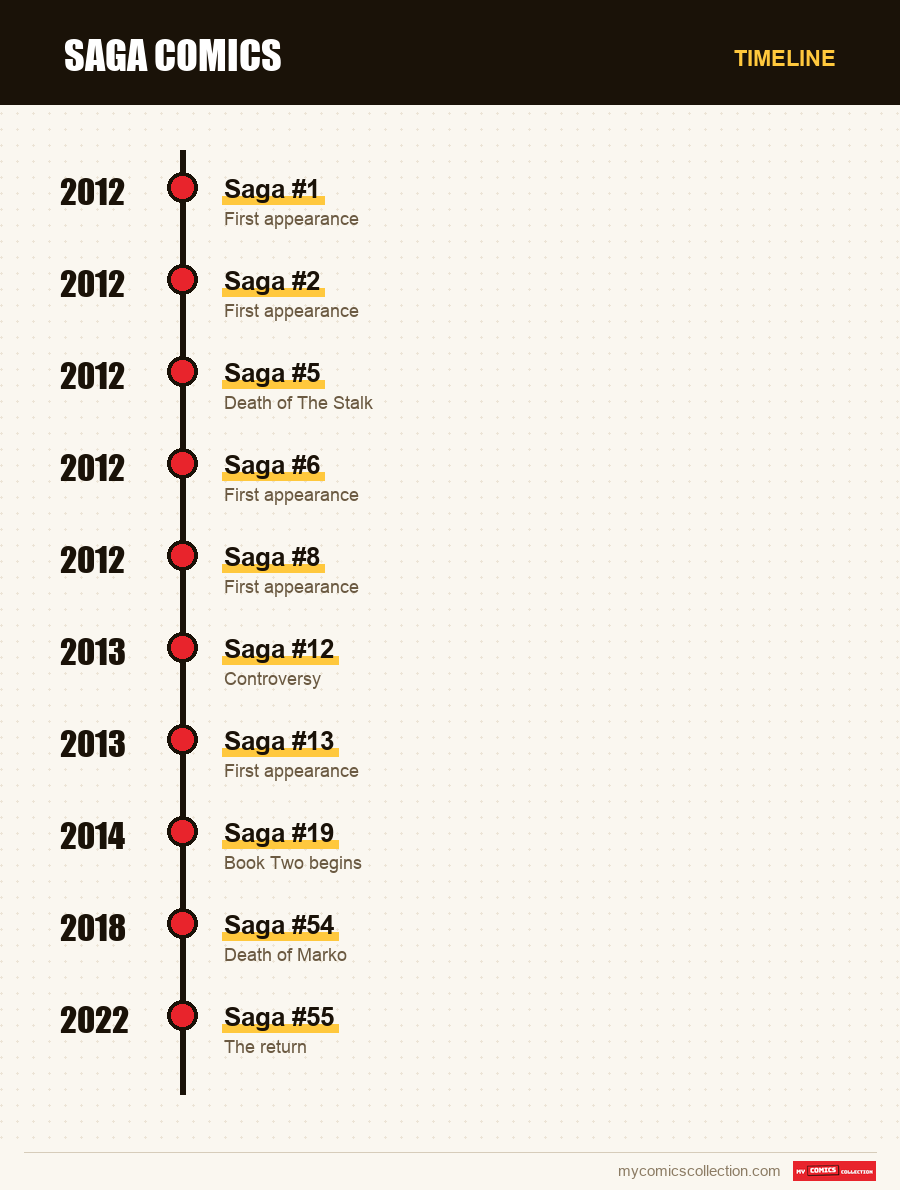
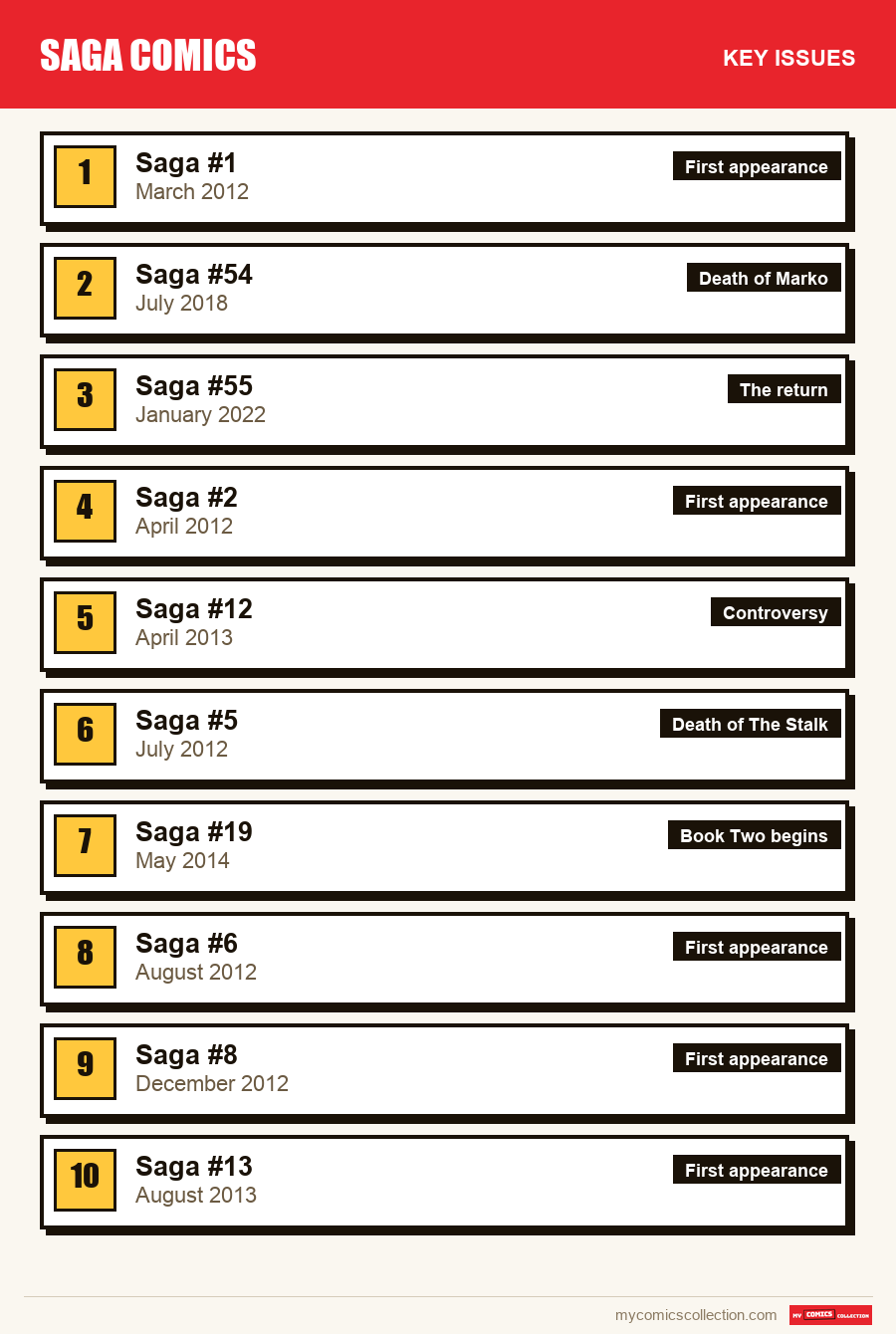
Saga #1
A double-sized, ad-free 44-page first chapter released by Image Comics on March 14, 2012, whose first printing sold out. It introduces Alana, Marko and their daughter Hazel, the story's narrator, along with Prince Robot IV. The Will and Lying Cat, hired to hunt down the couple, already show up here.
Saga #54
Released on July 25, 2018, this chapter closes the first half of the series with the death of Marko. A long hiatus follows, and the book only resumes in January 2022. The first 54 chapters were later gathered in Saga: Compendium One.
Saga #55
The comeback chapter, released on January 26, 2022 after more than three years away. Double-sized like the first issue, at 44 pages, it opens the second half of the series, which Vaughan says will also run 54 chapters. The story jumps ahead in time: Alana is now raising Hazel and Squire on her own.
Saga #2
The first appearance of The Stalk, a rival bounty hunter to The Will, and of Izabel, the young ghost from the planet Cleave who becomes Hazel's babysitter. Two major players of the first arc, introduced as early as the second chapter.
Saga #12
The first appearance of Ghüs and of cult novelist D. Oswald Heist, whom the family heads to Quietus to find. In April 2013, digital sales of the chapter on mobile devices were briefly blocked over two small panels depicting sex between men, then restored after an outcry.
Saga #5
The Stalk, the bounty hunter introduced in issue 2, dies in this chapter, just three issues after her debut. The issue also marks the first appearance of Mama Sun.
Saga #19
This chapter opens the second book of the series: the family is hiding on the planet Gardenia, Alana works for the Open Circuit and Marko looks after a Hazel who is starting to talk. It marks the first appearance of Dengo and of Prince Robot IV's son.
Saga #6
The last chapter of the first arc, featuring the first appearance of Barr and Klara, Marko's parents. A two-month break followed while the first collection came out in October 2012, a rhythm repeated after every arc.
Saga #8
The first appearance of Gwendolyn, Marko's former fiancée, as well as The March. Gwendolyn later teams up with The Will to track down the couple.
Saga #13
The start of the third arc, pitched by Image as a jumping-on point after the first two collections. It marks the first appearance of Upsher and Doff, two journalists investigating the trail of Alana and Marko.
Go further
- Saga Reading Guide: Where to Start, How to Follow the Series
- Best Saga Story Arcs to Collect: Top 7 Ranked by BKV & Staples
- Saga Comics: the best story arcs for collectors
- Top 10 essential Saga key issues
- Saga #1 First Appearance: CGC Value, Variants & Collector's Guide
- Saga Comic Collection Guide: Brian K. Vaughan Key Issues