Essential Saga characters: The Will (freelance assassin), Lying Cat (feline lie detector), Prince Robot IV (TV aristocrat), The Brand (bounty hunter), Ghüs (miniature warrior with a heart of gold). Two main factions: Wreath (lunar magic) and Landfall (winged technology).
Saga by Brian K. Vaughan and Fiona Staples, published by Image Comics since 2012, has redefined space opera in comics. This abundant universe combines intergalactic war, forbidden romance and a gallery of secondary characters as striking as the protagonists Alana and Marko.
For the collector, Saga represents a particular challenge: independent series with limited edition during the first issues, the first prints of key issues exploded in value. Understanding the universe and its characters allows you to target the most sought-after numbers.
Warring factions: Wreath and Landfall
The central conflict pits Wreath, the moon whose inhabitants master magic, against Landfall, the home planet with winged inhabitants equipped with advanced technology. This proxy war extends across the galaxy via mercenaries and satellite armies.
The Will and The Brand: bounty hunters
The Will, introduced in the first arc, is one of the most formidable Freelancers in the galaxy. Accompanied by Lying Cat, a giant feline capable of detecting any lie, he embodies the moral anti-hero. Her sister, The Brand, later appears as an equally competent hunter. Issues featuring their first appearances are highly prized by collectors.
Prince Robot IV and mechanical royalty
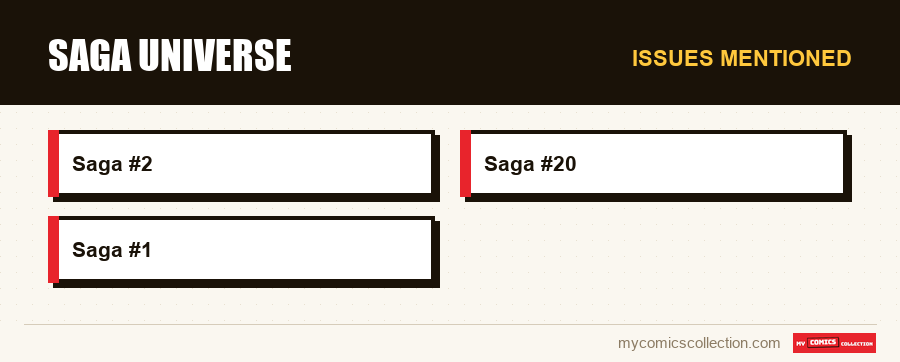
Representative of the Robot Kingdom, ally of Landfall, Prince Robot IV tracks Alana and Marko across the galaxy. His unique design, humanoid body topped with a television screen, makes him one of the most visually iconic characters. His first appearance in Saga #2 contributes to the value of this issue.
Ghüs: readers' favorite
This little resident of Gardenia, half-seal, half-human armed with an axe, has become an icon of the series. Introduced in Saga #20, his popularity with fans caused this issue's rating to rise well beyond expectations for a supporting character.
Spin-offs and related titles
Unlike many comic book universes, Saga has not generated any official spin-off: Vaughan and Staples maintain complete control over their creation. This makes the main series all the more valuable: the entire universe is contained in one continuous run.
Variants and special editions
In the absence of spin-offs, collectors are focusing on variant covers (notably SDCC exclusives), deluxe hardcover editions, and compendiums. The Saga #1 variants are among the most sought-after modern indies.
Collection strategy for the Saga universe
Prioritize first prints of the first 20 issues: initial print runs were modest before popularity exploded. Saga #1 first print in high condition is the absolute holy grail of modern independent comics. The issues introducing major new characters (The Brand in #21, Ghüs in #20) offer excellent value for money.
For a complete collection, aim for the entire run in first print. As the series had a three-year hiatus (2018-2022), post-hiatus issues (#55+) are easier to find in mint condition. Check out our guide to independent comics and their value to deepen your strategy.
Manage your Saga collection number by issue with our dedicated application: track your first prints, identify your missing items and estimate the value of your complete run.
Organize my Saga collectionReading Saga: volumes, pacing and collecting pitfalls
Saga can be read straight through, since the whole story fits in a single continuous series. That simplifies the reading order, but it raises a few practical questions for readers and collectors alike: which format to choose, what to do about the hiatus, and how to find your way among the printings.
A rhythm of six issues
The paperback collections (TPBs) gather six issues each, which cuts the story into volumes of comparable breath. Compendium One gathers the first nine volumes, that is issues #1 to 54, in a single massive book. The Deluxe Hardcovers bring three volumes together per "Book" in a large hardcover format, more pleasant to display than to carry around.
The 2018 to 2022 hiatus
The series went through an interruption of several years, between 2018 and 2022. The issues published after the return, from #55, are easier to find in new condition: the pitfall is therefore not there, but with the very first issues. If you read in collections, the hiatus changes nothing: the volumes follow one another as before.
An adult audience
Saga is explicitly an adult work, which matters if you lend it or give it as a gift. Its critical recognition is considerable, with twelve Eisner Awards since its debut. No adaptation is planned: Brian K. Vaughan considers the comic the final form of the work.
Collecting pitfalls
- The first issues were reprinted. A first printing carries no printing note on the back, whereas reprints say "2nd printing", "3rd printing" and so on.
- The Diamond Retailer Summit variant of Saga #1, estimated at about 500 copies, can be recognized by its alternate cover and the RRP logo: be wary of listings that seem too good to be true.
- Exclusive convention variants, such as those from San Diego Comic-Con, are sought after but need to be verified before purchase.
- Not every later issue is equal: only the issues that introduce a major character deserve special effort.
Organizing your reading and your collection
To lose nothing, split your catalog into blocks of six issues, matching the volumes, and note for each issue the printing you own. You will then know exactly what you are missing: a whole volume, a single issue or simply the first printing of a chapter you have already read.
Read the first volume first: if you enjoy it, you will know the rest is within reach, with no spin-off to hunt for, and that every purchase adds directly to the main story.
Frequently asked questions
Wreath, the moon whose inhabitants master magic, and Landfall, the mother planet whose winged inhabitants wield advanced technology. Their proxy war spreads across the whole galaxy through mercenaries and satellite armies.
The Will, introduced in the first arc, is one of the most formidable Freelancers in the galaxy, a moral antihero. Lying Cat is his giant feline, able to detect any lie, and The Brand, his sister, appears later as an equally skilled hunter.
A representative of the Robot Kingdom, allied with Landfall, he tracks Alana and Marko across the galaxy. His humanoid body topped with a television screen makes him a visually iconic character, whose first appearance in Saga #2 contributes to the value of that issue.
This small inhabitant of Gardenia, half seal and half human and armed with an axe, is introduced in Saga #20. His popularity with fans has pushed that issue's value well beyond expectations for a supporting character.
No: Vaughan and Staples keep total control of their creation, and the whole universe is contained in a single continuous run. Collectors therefore focus on variants, notably SDCC exclusives, deluxe editions and compendiums.