Let's be straight: there is no "Silver Age" Saga key issue. Brian K. Vaughan and Fiona Staples' series launched at Image Comics in March 2012: more than 40 years after the Silver Age ended (around 1970). The series' only true grail is Saga #1, whose "all editions combined" eBay median is just €6 across 46 listings (June 2026), but whose 1st printing in high grade is scarce and far more valuable.
If you're hunting for a "Silver Age Saga," it's almost certainly an era mix-up: the Silver Age runs roughly 1956 to 1970, and the Bronze Age through the mid-1980s. Saga is a Modern Age series, born in 2012. Its issues that matter are therefore all recent, and concentrated on the very first issue.
Rather than invent a historical value that doesn't exist, this guide sticks to the verifiable: real-time eBay medians via our estimator, documented sale records, and publishing facts. When a figure isn't reliable, we state it qualitatively.
Saga has no Silver Age: the timeline
For a "Silver Age Saga" to exist, the series would need to date back to 1956-1970. But the first issue came out in March 2012. Saga belongs squarely to the Modern Age of independent comics: the same wave Image has carried since 1992. No "Silver Age" value, no "Bronze Age" key: those eras ended decades before Alana and Marko were ever drawn.
Good news for the collector: Saga's real modern keys are easy to identify, and far cheaper than a genuine Silver Age grail. Here's where to focus.
The only true grail: Saga #1 (March 2012)
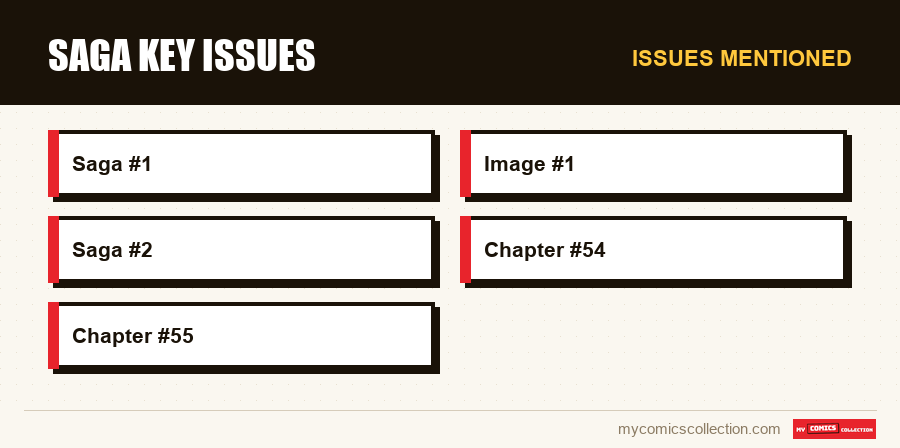
Saga #1 contains the first appearance of Alana, Marko, Hazel, The Will, Lying Cat and Prince Robot IV: in other words the entire core cast. It's the only issue in the series for which our estimator has a solid sample:
| Issue | Significance | eBay median (all editions) |
|---|---|---|
| Saga #1 (March 2012) | First appearance of Alana, Marko, Hazel, The Will, Lying Cat, Prince Robot IV | €6 · 46 listings |
Source: our estimator (eBay.fr + eBay.com), June 24, 2026. This €6 median is misleading taken alone: it blends every later printing and every cheap raw copy, which drags the price down.
The 1st-printing trap: under-printed, therefore scarce
Unlike most Image #1s, Saga #1 was under-printed at launch: Image didn't expect such a hit, the issue sold out fast, and it had to be reprinted up to five times . The result: the 1st printing in high grade is genuinely hard to find, while 2nd, 3rd and later printings are everywhere.
- How to spot the 1st printing. The "Saga" title is printed in orange lettering on the first-printing cover. It's the simplest marker to avoid overpaying for a reprint.
- The real value is in high grade. In CGC 9.8, the 1st printing hit a documented record of $4,000 (August 2021), after $2,400 in 2020. That's where, and nowhere in a raw €6 median, #1's serious value hides.
- The median blends everything. The 46 listings are mostly reprints and raw copies: at €6, you're usually buying a late printing, not the 1st printing in high grade.
What about the other issues (#2, #3, #5…)?
The following issues carry narrative weight but little market depth: on our estimator, Saga #2 through #9 each show only a handful of listings (often 3 to 8). With so little data, quoting a "precise value" would be dishonest: those figures aren't stable. Qualitatively, these issues generally trade above cover price on the collector market, without approaching the grail status of a 1st-printing #1.
Saga's real modern milestones
- 2012: launch. Image Comics publishes Saga #1 (Brian K. Vaughan writing, Fiona Staples on art).
- 2013-2017: acclaim. The series wins twelve Eisner Awards and seventeen Harvey Awards, cementing its reputation and supporting demand for #1.
- July 2018: hiatus. The series stops after Chapter #54 for a long break.
- January 2022: return. Saga comes back with Chapter #55, a double-length 44-page issue, as part of a story envisioned across 108 issues total.
Collector strategy (grounded in real data)
- Forget the "Silver Age": it doesn't exist. Focus on Saga #1, the series' only grail.
- Target the 1st printing in high grade. Orange lettering + CGC 9.8: that's the only version that creates scarcity and appreciation, far from the raw €6 median.
- Check live value. The medians above are from June 2026 and move; on thinly-traded issues, always check the market before buying.
Own a Saga #1 or another comic? Get a free valuation with our tool based on real eBay sales to find its low, median and high value.
Frequently asked questions
No. The series by Brian K. Vaughan and Fiona Staples was launched by Image Comics in March 2012, more than 40 years after the end of the Silver Age (around 1970). It is a modern-era series: any idea of a Silver Age or Bronze Age valuation comes from a confusion of eras.
Saga #1 (March 2012), which contains the first appearance of Alana, Marko, Hazel, The Will, Lying Cat and Prince Robot IV, the whole heart of the cast. It is the only issue of the series that concentrates real collector demand.
The issue was underprinted at launch, because the publisher did not expect such success, and was reprinted up to five times. The title "Saga" is printed in orange lettering on the first printing's cover, which keeps you from paying top price for a reprint.
They have narrative importance but little market depth: each shows only a handful of listings, too few to quote a precise valuation. Qualitatively, they generally trade above cover price, without approaching the grail status of #1 in first printing.
The launch dates from 2012. Between 2013 and 2017, the series won twelve Eisner Awards and seventeen Harvey Awards. It stopped in July 2018 after chapter #54, then returned in January 2022 with chapter #55, a double 44-page issue, in a story planned for 108 issues in total.