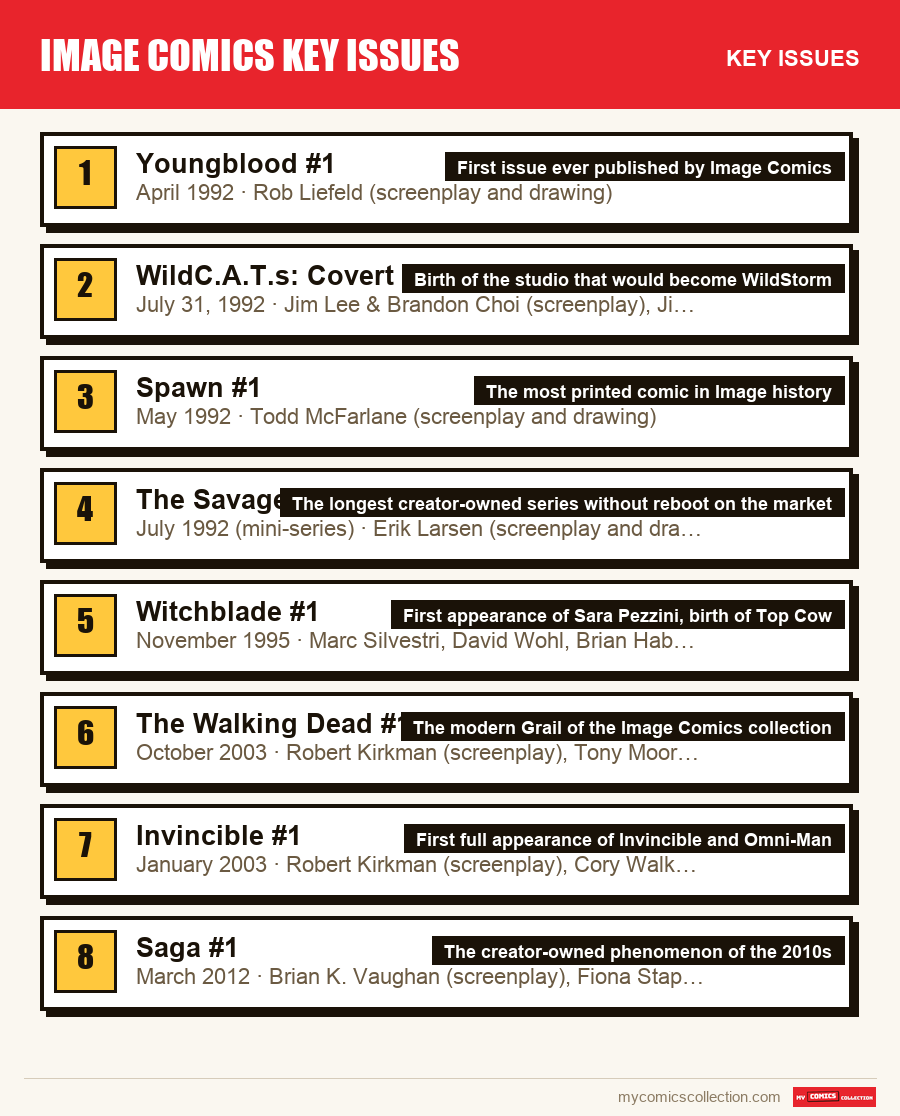
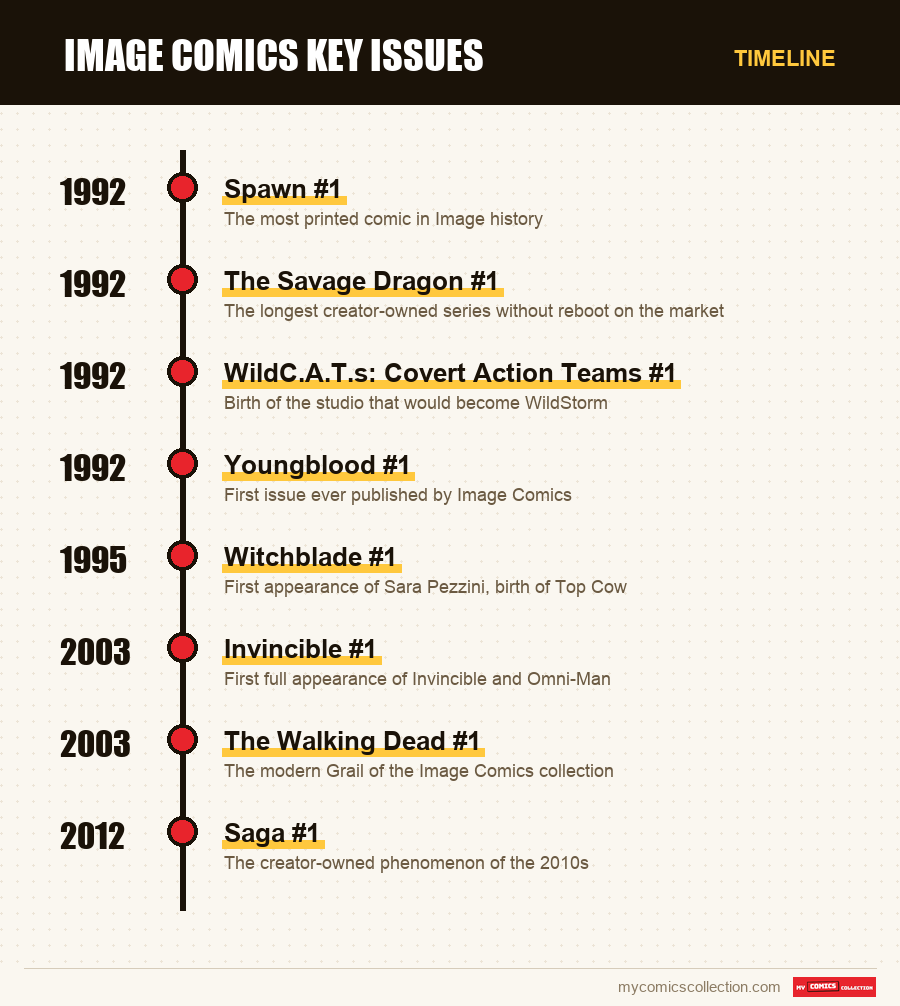
Image Comics' key issues span three distinct decades: the seminal 1992 launch (Youngblood #1, WildC.A.T.s #1, Spawn #1, Savage Dragon #1), the Top Cow expansion of the mid-1990s (Witchblade #1), and then the modern creator-owned series that redefined the genre (The Walking Dead #1, Invincible #1, Saga #1). Their rating depends less on their age than on their actual circulation: the founding titles from 1992, printed in hundreds of thousands or even more than a million copies, remain accessible even in CGC 9.8, while The Walking Dead #1 (estimated circulation of around 7,500 copies) exceeded $32,000 at public sale in 2024.
Image Comics occupies a special place in the history of American comics. Unlike Marvel or DC, where the characters belong to the publisher, each Image series remains the property of its creator. This model, born from a break with Marvel in 1992, produced a catalog of "number 1s" of rare heterogeneity: some became objects of extreme speculation in the months following their release before collapsing, others remained confidential for years before exploding thanks to a television adaptation.
Understanding the key issues of Image Comics therefore requires moving away from the classic “old comic = expensive comic” reflex. A 1992 copy can be worth less than $100 in near-perfect condition because more than a million copies were printed, while an issue released in 2003 to relative indifference can trade for five figures today. This guide details eight founding issues of the publisher: their creation context, their actual print runs when documented, and the elements of rarity which explain (or not) their current rating.
1992: the founding of Image Comics and the birth of its first key issues
The story begins in December 1991, at a Sotheby's auction in New York dedicated to comic book art. Todd McFarlane, then undisputed star of Spider-Man of Marvel, recruits Jim Lee, himself a rising figure on X-Men . Marc Silvestri ( Uncanny X-Men , Wolverine), also present, joins the movement; Lee in turn convinces Whilce Portacio. Rob Liefeld, Erik Larsen and Jim Valentino complete what will become "the seven founders" of Image Comics. Their demand was simple but radical for the time: that the creators retain the intellectual property of their characters, a principle that neither of the two major publishers granted them at the time.
Image's founding charter is unambiguous on this point: the company does not own any of the works published under its banner, only its name and logo. Each founder launched his own studio and his own series in 1992 - an operation still in force today, which explains why the Image catalog resembles more a federation of studios (Todd McFarlane Productions, Top Cow, Skybound, WildStorm originally) than a centralized publishing house. This structure has a direct consequence on the key numbers: their value is not based on a “shared universe” as at Marvel or DC, but on the trajectory specific to each creator and each title. For a complete dive into the publisher's three decades, our article history of Image Comics in 30 years retraces the complete story of this adventure; This guide focuses on the collecting angle: which issues to buy, why, and at what level of real rarity they are.
The 1992 launch was an unprecedented commercial phenomenon for an independent house. Youngblood Liefeld #1 became, at the time of its release, the best-selling independent comic ever published, despite harsh criticism of the readability of the story. McFarlane's Spawn #1 had an estimated 1.7 million copies printed: a figure that alone explains why this cult title remains accessible to small budgets even at the highest grades today. It is precisely this period of speculative boom in the early 1990s, followed by a collapse of the comic book market in 1993-1996, that makes reading the key Image issues so counterintuitive: the notoriety of a title and its actual rarity are two totally different things.
Youngblood #1
Youngblood #1 holds a unique status: it is literally the very first comic published under the Image banner, even before Spawn or WildC.A.T.s. Sold for $2.50 on newsstands for 36 pages, it came in "flip book" format with two covers and marked the first appearance of Shaft, Badrock and Chapel, members of this team of superheroes sponsored by the American government. Upon its release, it became the best-selling independent comic in history at that time, driven by Liefeld's notoriety on X-Force at Marvel: despite a very mixed critical reception on the storytelling.
WildC.A.T.s: Covert Action Teams #1
After having made the commercial success of X-Men at Marvel, Jim Lee launches his own team of paramilitary superheroes with this issue sold for $1.95. WildC.A.T.s laid the foundations for the studio that would become WildStorm, one of Image's creative pillars in the 1990s, before being bought by DC Comics at the very end of the decade: a buyout that brought WildStorm and its characters out of Image's creator-owner fold and into the DC stable. Number 1 therefore illustrates a special case: a title born from the Image model but whose ownership ended up changing hands, unlike Spawn or The Walking Dead which remained with their original creators.
Spawn #1
Spawn #1 introduces Al Simmons, a mercenary murdered and resurrected as a hellspawn in the service of a bureaucratic hell: a pitch that made McFarlane the best-selling artist of his generation. The estimated circulation of 1.7 million copies makes it one of the most widely printed comics in the history of the medium, independent or not. This massive distribution directly shaped the character's career: Spawn inspired a film in 1997, an animated series on HBO broadcast from 1997 to 1999, and the comic series itself continues to be published without interruption more than thirty years after this first issue, making it one of the longest creator-owned series ever published by a single publisher.
The Savage Dragon #1
First published as a three-issue $1.95 miniseries, Savage Dragon was successful enough to warrant the launch of an ongoing monthly series in June 1993: a series that Erik Larsen still writes and draws himself today, without ever having renumbered the title from the beginning. This is an extremely rare case in the American industry: one and the same creative team, on one and the same continuous numbering, for more than thirty years. This first issue lays the foundations for an amnesiac alien character who becomes a police officer in Chicago, in a much more referenced and satirical tone than the average superhero of the time.
Witchblade #1
Published under the imprint Top Cow Productions founded by Marc Silvestri, one of the seven creators of Image, Witchblade #1 marks the first appearance of Sara Pezzini, a New York police officer injured in intervention who inherits the mystical artifact giving its name to the series. The issue ranked as the 79th best-selling comic in the American market in the month of its release, a score which set sales records for Top Cow and launched the career of Michael Turner, whose style would become an aesthetic reference for the studio throughout the second half of the 1990s. Witchblade was then adapted into a television series broadcast on TNT in 2001-2002, with Yancy Butler in the role of Sara Pezzini.
The Walking Dead #1
Released in relative confidentiality in October 2003, with an estimated circulation of only 7,500 copies distributed to comic shops via Diamond, The Walking Dead #1 marks the first appearance of Rick Grimes, Shane Walsh, Morgan Jones and Duane Jones. Nothing upon its release suggested the cultural phenomenon that the series would become. It was the launch of the AMC television series in 2010 that completely reshuffled the cards: the demand for this seminal issue, until then unknown to the general public, exploded to the point of making it one of the most sought-after modern comics on the market, and one of the rare post-2000 Image issues whose confidential circulation was never able to absorb the demand created by the adaptation.
Invincible #1
Released the same year as The Walking Dead from the pen of Robert Kirkman, Invincible #1 introduces Mark Grayson and his father Nolan, aka Omni-Man, in what will become one of the most acclaimed retellings of the superhero genre, with an estimated circulation of around 9,000 copies. Long remaining a cult title reserved for informed readers, the character has enjoyed a spectacular second life thanks to the animated series launched on Amazon Prime Video in 2021, whose graphic violence and twists have far exceeded the original readership of the comic and revived demand for this first issue.
Saga #1
Romantic space opera built around a couple from two opposing sides in a galactic war, Saga #1 immediately met with exceptional critical reception, multiplying Eisner awards over the years and becoming one of the most commented creator-owned series of the decade. Unlike most of the titles in this guide, Saga has never been adapted for the screen: Brian K. Vaughan has publicly expressed his preference for the work to remain a purely literary object, which distinguishes its commercial trajectory from that of The Walking Dead or Invincible - its rating increases solely on the reputation of the comic, without the effect of a TV series or film.
Collecting this series?
Track what you own, what you are missing and what your collection is worth. 7 day trial.
Start my trial →The impact of adaptations on the rating of key issues Image Comics
Few publishers offer a field of observation as clear as that of the Image catalog to measure the real effect of an adaptation on the value of a comic. Unlike Marvel or DC, where almost every major character ended up being entitled to their film or series, only a minority of Image creations were brought to the screen: which makes it possible to directly compare adapted and non-adapted titles, released at the same time, from the same publisher.
Spawn was the first example: the film released in 1997 then the animated series broadcast on HBO from 1997 to 1999 maintained the notoriety of the character for years, but without ever transforming the rating to number 1 due to the colossal circulation mentioned above: the demand created by the adaptation was never able to compete with the offer available on the secondary market. Witchblade experienced a comparable pattern with its TNT series from 2001-2002: a real spotlight on the character, without lasting upheaval in the value of the first issue, whose circulation also remained substantial for the time.
The Walking Dead offers the perfect counterexample. The confidential print run of around 7,500 copies of number 1, coupled with the massive and lasting success of the AMC series between 2010 and 2022, created an extreme supply-demand imbalance: it is this mechanism, and not the sole notoriety of the franchise, which explains why this issue is trading today at five figures while Spawn #1, much better known to the general public at the time of its release, remains accessible for a few tens of dollars. Invincible follows a similar trajectory on a smaller scale: the Amazon Prime Video animated series launched in 2021 gave a second lease of life to a circulation that was already significantly smaller than that of the 1992 titles, which supported the number 1 rating without, however, reaching the heights of The Walking Dead.
The case of Saga, finally, shows that an adaptation is not a necessary condition for the recognition of a key issue: its rating rests entirely on the critical reputation of the series and the relative rarity of its first printing, without the slightest cinema or television announcement effect to date. For buyers looking to anticipate the development of a title, the question to ask is never "will this character have a film?" but "how many copies actually exist, and how many new buyers could an adaptation bring to this fixed number?".
Image Comics Key Issue Buyer's Guide
The Image catalog has a particularity that regularly traps novice buyers: the age and notoriety of a title guarantee nothing about its real value. Here are the points to be aware of before investing in a key issue from the publisher.
- Check the draw before paying a premium: titles from the 1992 release (Youngblood, WildC.A.T.s, Spawn, the Savage Dragon miniseries) were printed in very large quantities; their high-grade value remains modest despite their founding status, unlike titles with low circulations like The Walking Dead or Invincible.
- Systematically distinguish the first print from the reprints: The Walking Dead #1 had a second printing with an identical black cover, significantly less rated than the first original printing; Chew #1 was also withdrawn after a surprise success in bookstores. The displayed price varies from single to twentyfold depending on the exact draw.
- Choose CGC or CBCS certified copies for titles in high demand: The more an issue like Invincible #1 or The Walking Dead #1 increases in value, the more the market attracts high-grade counterfeits or undeclared restoration manipulations.
- Understand the nuance between very high ranks: the difference in value between a CGC 9.8 and a 9.9 or 10.0 can be considerable on low census titles, as shown by the example of Spawn #1; our guide CGC 9 vs 9.8: what difference in rating details the precise criteria which separate these grades.
- Beware of variants advertised as "rare" without mintage data: an alternative cover is not automatically a good investment if its actual print run has never been communicated by the publisher or distributor.
- Watch for adaptation announcements before they become official: the rating of a low-circulation issue can change quickly as soon as a series or film project is confirmed for an Image title, as Invincible showed in 2021.
- Track your collection with a dedicated tool: to precisely catalog your key Image numbers (run, condition, certification) and monitor the evolution of their rating over time, our collection management application centralizes this information in one place.
- Always compare with actual sales before buying or selling: the list prices published in paper guides are often several years out of date on titles as volatile as The Walking Dead or Invincible; an estimate based on recent actual eBay sales gives a much more reliable picture of the current market.