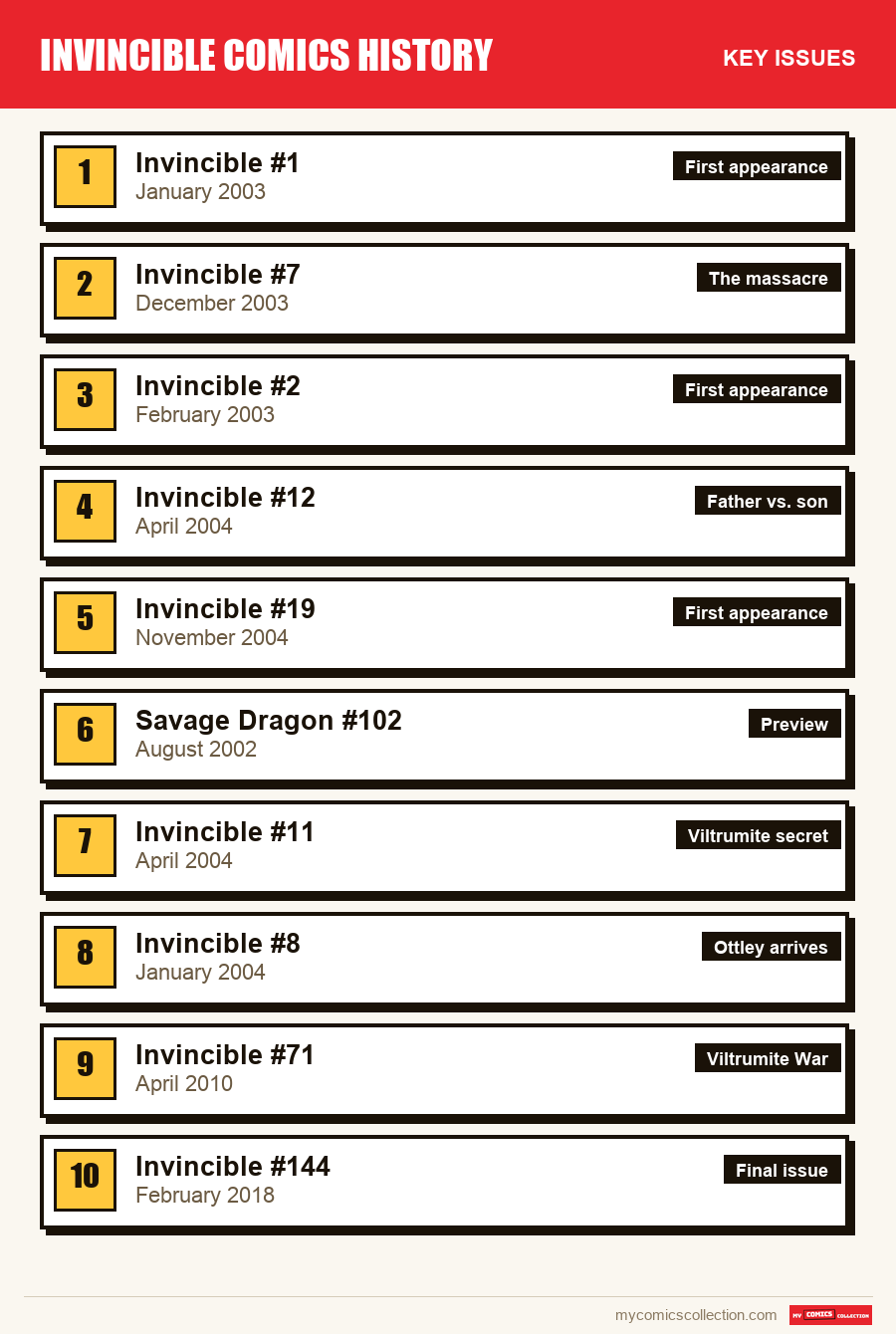
Invincible was born on January 22, 2003 at the house of Image Comics, created by the screenwriter Robert Kirkman and the designer Cory Walker (Bill Crabtree in colors), before Ryan Ottley does not pick up the pencil again from number 8 for most of the following 136 episodes. The series recounts the heroic apprenticeship of Mark Grayson, son of the all-powerful Omni-Man, and switches from Invincible #7 in a twist that left a lasting mark on superhero comics. It ended on 144 numbers on February 14, 2018, before experiencing a spectacular second life thanks to the animated series Amazon Prime Video launched in 2021, now renewed for a sixth season. Invincible #1 remains the most sought-after issue, with a CGC 9.8 copy sold $8,235 at auction.
There are few comic series where the first appearance of the main hero shares the poster, from the seventh issue, with the most brutal revelation of his young editorial existence. Invincible belongs to this rare category: a title launched almost anonymously in January 2003, carried by a screenwriter who had then only published a few confidential series, and which ended up establishing itself as one of the most influential works of the Image Comics label of the last twenty years. Between its launch and its conclusion in 2018, the series went through fifteen years of graphic mutations, permanent deaths, intergalactic wars and narrative twists that redefined what an independent superhero story could be.
This file traces the complete genesis of Invincible, from Robert Kirkman's studio to the animation sets of Amazon Studios, including the editorial decisions that almost derailed the series from its beginnings. We detail the precise publication chronology, the pivotal issues to know to build a coherent collection, the evolution of the creative duo Kirkman-Walker-Ottley, as well as the measurable impact of the television adaptation on secondary market ratings. The objective: to give collectors and curious readers a complete and sourced vision of the editorial history of one of the rare modern comics to have built its own mythology from A to Z, without reboot or creative relaunch for fifteen years.
The genesis at Image Comics: Kirkman, Walker and the bet of an adolescent antihero (2003)
In 2003, Robert Kirkman was not yet the author of The Walking Dead: this series would only see the light of day a few months later, in October of the same year, from the same publisher. Kirkman is then a screenwriter who multiplies collaborations with Image and Marvel without having yet found the title which will define him. It's with the designer Cory Walker, encountered in the small circle of American independent creators, whom he imagines Invincible: the story of a seventeen-year-old high school student, Mark Grayson, who develops superpowers identical to those of his father Nolan, aka Omni-Man, Earth's most famous and respected defender.
Invincible #1 appeared on January 22, 2003 under the Image Comics label, with Cory Walker drawing and Bill Crabtree in colors: a collaboration which will also earn Crabtree notable professional recognition for his work on the very saturated chromatic palette of the series. The initial print run remains modest, in line with most Image launches of the early 2000s: orders from comic shops via Diamond amounted to just under 11,000 copies according to distribution data cross-checked by specialists in the key issues market, a figure to be compared to the much more generous print runs of the Marvel and DC series at the time. This relative rarity of origin partly explains why very high grade copies are actively sought after today: fewer copies have survived over time in near-mint condition than for a mass-print title.
The initial pitch seems, in the first three issues, to follow a relatively classic framework of a superheroic coming-of-age story: Mark discovers his powers, learns to fly, dons a costume designed by his mother Debbie, joins high school under a dual identity and meets a gallery of characters who will become central -Invincible #2 (February 2003) alone introduced the first full appearance of Atom Eve , as well as those of Robot , Rex-Splode , Dupli-Kate and Mauler Twins, when Invincible #1 only featured a simple cameo from Atom Eve in the background. This density of character creations from the first two issues is one of the reasons why “first appearances” oriented collectors follow the series from its launch rather than from a later arc.
Invincible #7: the twist that saved the series from cancellation
The editorial history of Invincible changes with Invincible #7, cover-dated December 2003. In this issue, Omni-Man summons the Guardians of the Globe: the most prestigious superhero team in the Invincible universe, a thinly veiled pastiche of the Justice League: in their Utah lair, and massacres them one by one. The scene, drawn with unusual brutality for the time, reveals to the reader what Mark still does not know: his father is not the benevolent defender of the Earth that he believed, but the vanguard of a project of planetary conquest led by the Viltrumite Empire.
However, this turnaround was not anticipated so early in the editorial timeline. Robert Kirkman has explained several times that his original plan placed the revelation of Omni-Man's true nature much later in the series, around issue 25. This is Jim Valentino, one of the co-founders of Image Comics and historic publisher of the label, who convinced Kirkman to drastically advance the twist: with fragile sales over the first six issues, the series risked outright cancellation before even being able to deploy its long arc. By compressing the reveal over seven issues, Kirkman transformed Invincible into a story with real stakes in its first year of publication: an editorial choice which would become the signature of the entire series: no character is ever completely safe, and the consequences of the fights reverberate over several arcs rather than closing neatly at the end of the episode.
This narrative shift also has a direct impact on the collectible market: issues #1 to #7, which cover the entire arc from setup to the massacre of the Guardians, today form the essential basis of any serious Invincible collection, well before the popularity of the animated series came, fifteen to twenty years later, to multiply the demand for these same issues.
From Cory Walker to Ryan Ottley: the graphic transformation of a series that lasted fifteen years
Cory Walker gradually left the regular drawing after issue 7, while retaining a role as co-creator and occasionally returning to certain issues and covers over the years. It is Ryan Ottley who takes over from Invincible #8 and who will draw the vast majority of the remaining 136 issues, until the end of the series in 2018. This choice of graphic continuity over such a long period is rare in the American comics industry, where artist rotations are the norm on long-term monthly series. Ottley developed an increasingly dynamic and muscular style over the years, with increasingly choreographed fight scenes and increasing graphic violence which would become one of the series' trademarks: particularly during the confrontations of the viltrumite war.
On the screenplay, Robert Kirkman remains the sole author of the entire run, Invincible #1 à Invincible #144, almost unique editorial consistency for a series of this length from an independent publisher. The lettering is provided by Rus Wooton on almost the entire run, and the coloring evolves from Bill Crabtree to other colorists over the years while retaining the saturated visual identity characteristic of the title. This creative stability allows the series to build an internal continuity of remarkable coherence: the consequences of a confrontation in issue 20 can resurface, literally, in an issue published ten years later.
The editorial structure of the series is based on a division into narrative arcs grouped a posteriori into 25 volumes of trade paperbacks, several of which bear titles borrowed from American television sitcoms: a recurring nod by Kirkman to the popular culture of the 1980s and 1990s. These arcs are then taken up in more prestigious collection formats: twelve volumes of Ultimate Collection in hard cover, a Complete Invincible Library in six volumes, and three Compendiums which each group together several dozen numbers in a single block. A complementary Omnibus format has also been announced for 2026, a sign that editorial interest in the series remains active almost a decade after its conclusion.
The Viltrumite War and the major arcs that shaped the series' mythology
Between 2003 and 2018, Invincible built an increasingly ambitious cosmic science fiction mythology around the Viltrumite Empire, this extraterrestrial civilization to which Omni-Man belongs and whose genocidal history Mark gradually discovers. The most emblematic arc of this rise in narrative power is the viltrumite war, which unfolds over issues 71 to 78 and sees the Coalition of Planets, an alliance of extraterrestrial civilizations seeking to put an end to Viltrumite expansionism, head-on against the Empire. This arc marks a turning point: Invincible definitively ceases to be a simple adolescent coming-of-age story to become a science fiction epic on a galactic scale, with definitive losses among the historical characters of the series.
Other major arcs punctuate the run: the attempted coup d'état of the Robot, a character introduced in issue 2, who orchestrates behind the scenes a progressive takeover of the Earth through genetic manipulation and cloning; the tumultuous relationship between Mark and Atom Eve, which runs through almost the entire series until a long-running epilogue; or the in-depth exploration of Omni-Man's past and the deeper reasons for his betrayal, which considerably nuances the initial portrait of the character presented in 2003. Kirkman has always claimed to want to subvert the codes of classic superhero comics, in particular by refusing the eternal status quo: the characters really die, age, and physical and psychological injuries leave lasting traces from one arc to the next.
The series concludes on February 14, 2018 with a Invincible #144 in double format, drawn by Ryan Ottley and Cory Walker, with Nathan Fairbairn in colors. Kirkman explained that he wanted to end the series on its own terms rather than seeing it continue indefinitely under other creative teams, going against the dominant trend of American superhero series which regularly change writers without ever concluding. This deliberate choice to put an end point gives the entire run a novel-like narrative coherence, rather than a simple accumulation of arcs without a planned end: an argument that complete reading-oriented collectors regularly put forward to justify the acquisition of the series in its entirety rather than in isolated issues.
The impact of adaptations on the rating
The event that most profoundly transformed the perception of Invincible on the collectible market was undoubtedly the launch of the animated series Amazon Prime Video , available from March 25, 2021. Produced by Skybound and Amazon Studios, the adaptation faithfully repeats the plot of the first issues from its first season, with Steven Yeun in the role of Mark Grayson, Simmons in that of Nolan Grayson / Omni-Man and Sandra Oh in that of Debbie Grayson. The rest of the voice cast includes Zazie Beetz, Gray DeLisle, Chris Diamantopoulos, Walton Goggins, Gillian Jacobs, Jason Mantzoukas, Ross Marquand, Khary Payton, Zachary Quinto, Andrew Rannells, Kevin Michael Richardson and Seth Rogen.
The series has since experienced sustained and continuous development: season 2 was broadcast in two stages, from November 3 to November 24, 2023 then from March 14 to April 4, 2024; season 3 followed from February 6 to March 13, 2025, with the arrival of Aaron Paul, Simu Liu and Kate Mara to the cast; and season 4, which notably adapts the Viltrumite War arc, was broadcast from March 18 to April 22, 2026. Amazon has also officially renewed the series for a fifth season, then for a sixth season confirmed on June 24, 2026: a rare rate of renewal which testifies to the place acquired by Invincible in the landscape of adult animation, alongside titles like The Boys.
This television exposure has a direct and documented effect on the ratings of the original comics. According to published auction results, a copy of Invincible #1 graded CGC 9.8 with white pages sold $8,235, a result that several specialist commentators explicitly attribute to the popularity of the Amazon series rather than to the age of the issue: Invincible #1 only being around twenty years old, compared to almost a century for the major key issues of the Golden Age which reached comparable heights. The Overstreet guide has also revised upwards its Near Mint reference value for Invincible #1, from $1,100 to $1,800, an increase of 63% noted by pricing editor Yolanda Ramirez on the grounds that “the title has been a popular success since its launch in 2003”. The graded market also records regular transactions on blue label CGC 9.8 copies, with a market value observed around $3,500 on specialized sales sites during the most active sales cycles.
The halo effect isn't limited to number 1. Invincible #19 (November 2004), which contains the first full appearance of Battle Beast: the lion-headed alien warrior who became one of the series' most popular supporting characters and a recurring regular in the animated seasons: saw his Near Mint benchmark value climb to 500 dollars, a spectacular progression for an issue initially published at a circulation much higher than that of #1. Numbers 4 and 5 saw an increase of 450% to reach $110 in Near Mint according to the same Overstreet update. Invincible #1 also regularly appears in the Overstreet ranking of the twenty most sought-after Modern Age comics, where it traditionally occupies a position among the very first places at the top of the table.
The success of the animated series has also relaunched editorial activity around the license on a strictly paper level. In April 2025, in the midst of season 3 broadcast, Kirkman and Ottley launched Invincible Universe: Battle Beast, a miniseries that explores a previously unpublished period in the character's life between issues 19 and 55 of the original series: a choice of editorial schedule that is no coincidence and illustrates how Skybound now synchronizes its print releases with the broadcast schedule of the television adaptation to maximize cross-exposure between the two formats.
Collecting this series?
Track what you own, what you are missing and what your collection is worth. 7 day trial.
Start my trial →Buying Guide: How to Approach an Invincible Collection Today
Building a cohesive Invincible collection requires a different approach than a Silver Age or Bronze Age run, due to the recent age of the series and the still significant availability of many issues on the secondary market. Here are the points to know before buying:
- Prioritize the first seven numbers. Invincible #1 through #7 cover the entire set-up of the series and the entire Guardians of the Globe massacre arc; these are, by far, the most requested numbers and those whose rating has increased the most since 2021.
- Systematically check the grade and whiteness of the pages. The $8,235 sales result for a CGC 9.8 of Invincible #1 was specifically for a blank page copy; Comics from the early 2000s printed on thinner paper can yellow faster than expected if stored improperly, which directly affects the gradation rating.
- Distinguish first printing and reprints. Invincible #1 has been the subject of multiple reprints and a more recent facsimile edition published by Image Comics; only the very first print run from January 2003 carries the collector's value associated with the founding number.
- Do not neglect the “character” key issue numbers. Invincible #2 (first appearances of Atom Eve, Robot, Rex-Splode, Dupli-Kate) and Invincible #19 (first appearance of Battle Beast) constitute consistent purchase targets for those who want to represent the most popular characters from the animated series without being limited to just number 1.
- Consider hardback collection formats for complete reading. With 144 issues spread over 25 volumes of trade paperback, the acquisition of the series in Compendium or Ultimate Collection format often remains more economical and more practical than the accumulation of individual issues for those who prefer reading to speculation.
- Consider the release schedule of the animated series. Ratings historically tend to react as each new season approaches and during the broadcast; the confirmation of seasons 5 and 6 suggests prolonged media exposure in the coming years.
- Check for rare variants before purchasing. Some issues were the subject of very limited exclusive print runs, such as the Larry's Wonderful World of Comics variant of Invincible #1, initially planned for 1,000 copies but ultimately printed for 1,600, making it a collector's item in its own right distinct from the standard print run.
To accurately catalog your run-whether key early issues or bound volumes spanning the entire fifteen years of publication-our collection management application allows you to track each issue, its circulation, its grade and its origin in one place.
The key issues to know
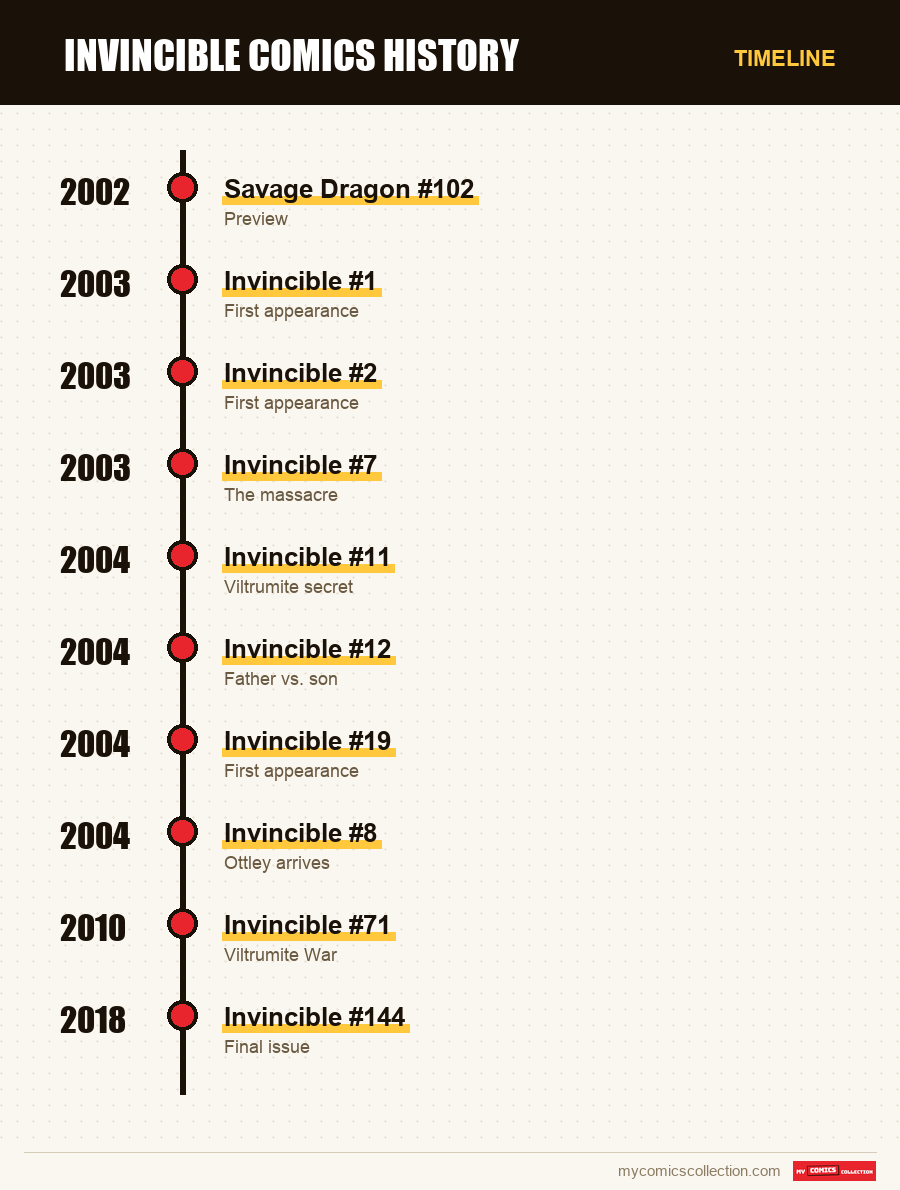
Invincible #1
Robert Kirkman and Cory Walker launch the series at Image: Mark Grayson, son of the superhero Omni-Man, sees his powers manifest. The issue also introduces Debbie Grayson and Omni-Man himself. It is the centerpiece of any Invincible collection.
Invincible #7
The Guardians of the Globe make their first appearance and are immediately slaughtered by Omni-Man: Darkwing, Red Rush, War Woman, Aquarus, Martian Man and Green Ghost die here. The last issue drawn by Cory Walker before Ryan Ottley's arrival. The turning point that gave the series its identity.
Invincible #2
First appearance of the Teen Team: Robot, Atom Eve, Rex Splode and Dupli-Kate, along with the Mauler Twins. The issue also mentions the Viltrumites and the planet Viltrum for the first time, in flashback. A character key in high demand since the animated series.
Invincible #12
The conclusion of "Perfect Strangers": Omni-Man fights his son in the middle of the city, leaves him badly injured and tells him Earth is just a planet to conquer. Shaken by Mark's answer, he ends up leaving the planet. The most memorable fight of the series' early days.
Invincible #19
Ryan Ottley draws the first appearance of Battle Beast, the lion-headed alien warrior who became one of the series' most popular characters. The issue also introduces several villains, including Magmaniac. A secondary key whose demand has clearly grown with the adaptation.
Savage Dragon #102
Several months before his series launched, Invincible appears in a five-page preview published in Erik Larsen's series. It is Mark Grayson's very first printed appearance. A complementary piece for collectors aiming for completeness.
Invincible #11
Omni-Man reveals to Mark the truth about his origins and the Viltrumite Empire, a society that culled its weak before conquering other worlds. The issue also shows a Viltrumite warrior in flashback, the first appearance of the man who would become Thragg. It leads straight into the clash of #12.
Invincible #8
Ryan Ottley's first issue as regular penciler and inker, after Cory Walker's departure. He would draw the vast majority of the series through to its conclusion. The issue also introduces Damien Darkblood.
Invincible #71
The first chapter of "The Viltrumite War": the Coalition of Planets goes on the offensive against the Viltrumite Empire, with Mark caught in the middle. The arc turns the series into a galactic epic. It is also the basis of the fourth animated season.
Invincible #144
The conclusion of "The End of All Things" and of the whole series, written like everything else by Robert Kirkman, with Ryan Ottley and Cory Walker on art. The issue jumps far into the future and shows new bearers of the Invincible name. Kirkman chose to end the series himself rather than hand it to others.